

Who Was the Richest Person In History?
When you think of countries with vast wealth and power, there’s a good chance Mali is not on that list. The United Nations ranks Mali 121st out of 213 on its list of countries by GDP. Even so, there was a time when Mali’s wealth and prestige were fabled and known throughout the world. Even more impressive was the wealth of its ruler, who may have been the wealthiest person to have ever lived.
Mansa Musa, also known as Musa I of Mali, (1280-1337) reigned over the Kingdom of Mali from 1312 to 1337. During his reign, Mali’s borders encompassed much of modern-day Mali, Senegal, The Gambia, Niger, Nigeria, Chad, Mauritania, and Burkina Faso.

It was Mansa Musa who turned Timbuktu into an important center of commerce and a center of culture and education. He acquired the best architects he could find to design and improve the cities in his kingdom.
It was for his wealth, however, that Mansa Musa is best remembered. He cornered the market in the salt trade at a time when salt was the petroleum of the world’s economy.
With approximately $191 billion, Jeff Bezos is the wealthiest person currently living, according to Forbes Real-Time Billionaires List. As impressive as that is, it is less than half of the bankroll of Mansa Musa. Conservative estimates place the 14th-century monarch’s wealth at $400-450 billion dollars. Some analysts have thrown up their hands, however, and declared that there is no way to accurately quantify the amount of his wealth.
One way to appreciate the significance of the resources at Mansa Musa’s disposal is to look at what happened when he started throwing them around. In 1324, Mansa Musa went on a pilgrimage (hajj) to Mecca. As wealthy people are wont to do, he took a few assistants along with him. By “few,” we mean that his entourage consisted of tens of thousands of people and eighty camels. Each of the camels carried 300 pounds (136 kg) of gold.
The king stopped over in Cairo to meet with the Sultan of Egypt. Musa was feeling quite magnanimous and handed out gold left and right. It was said that the streets of Cairo glistened as the sunlight reflected off the gold that was scattered in the streets.
Rather than bless the residents of Cairo, however, Mansa Musa’s generosity had some serious unintended consequences. The sudden onslaught of gold into the Egyptian economy sent the value of the precious metal downward. It would take 12 years before the economy recovered from the over-abundance of the money supply.
US-based technology company SmartAsset.com calculated that Mansa Musa’s lavish distribution of gold led to nearly $1.5 billion of economic losses across the Middle East.
Recognizing that his generosity did not have the intended effect, Mansa Musa tried to rectify things on his return trip. As he passed through Egypt, he tried to remove gold from circulation by borrowing it back at extravagant interest rates.

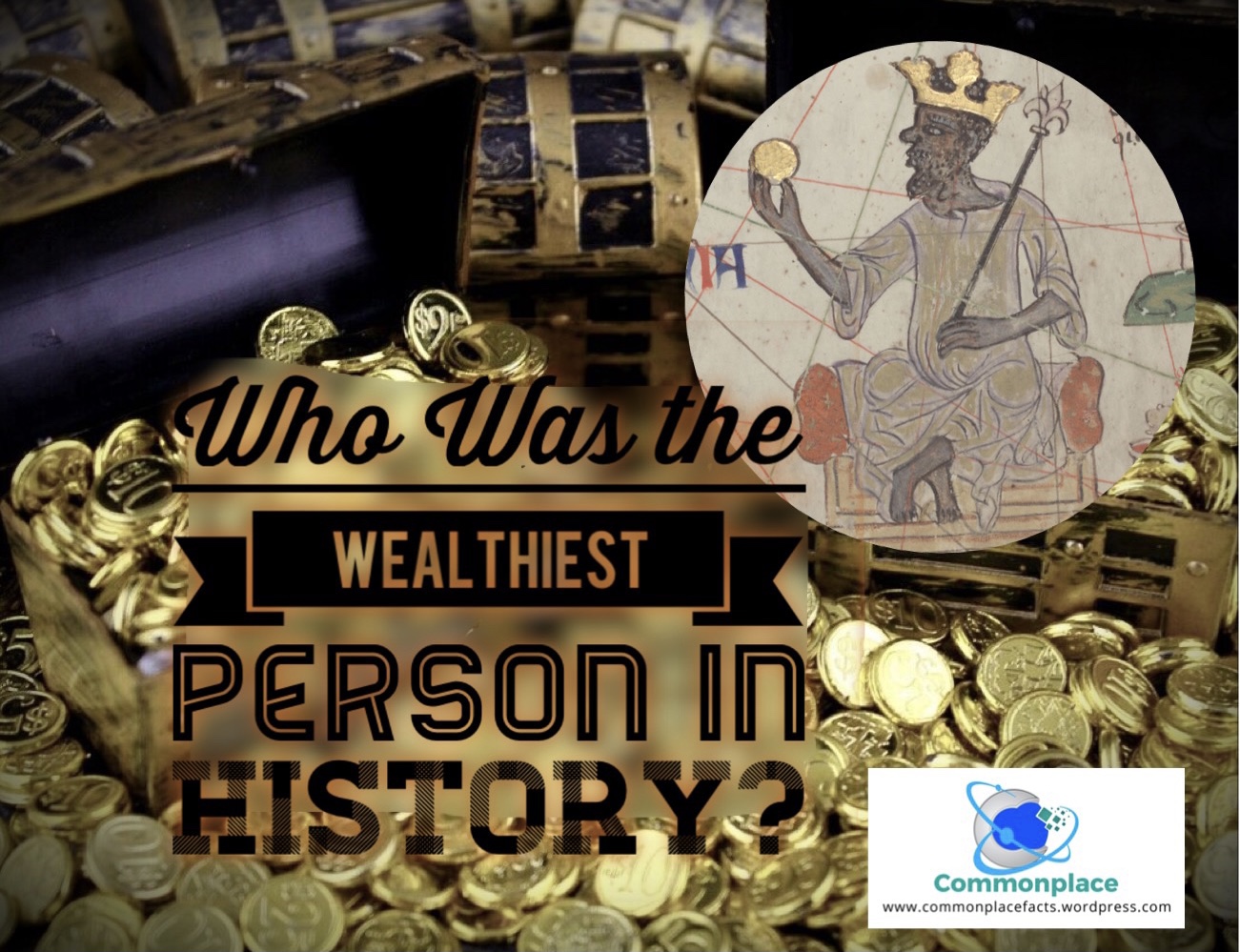
In 1375, nearly forty years after Mansa Musa’s death, Spanish cartographers produced the Catalan Atlas. Mansa Musa’s reputation still towered throughout the land, so that the Atlas shows West Africa dominated by a depiction of Mansa Musa sitting on a throne, holding a nugget of gold in one hand and a golden staff in the other.
While many point to Mansa Musa’s ill-advised largesse as evidence of his incalculable wealth, others suggest just the opposite. This article on Jetpunk.com points out that gold is not particularly valuable if there is nothing that can be bought with it. A basic tenet of economics is that an item’s value is determined by what others will give in exchange for it. In a world where the economy could be thrown for such a loop by one man’s journey through a city, one could make a good argument for the Mansa Musa’s gold not being nearly as valuable as we would consider it today.
Regardless of the bottom line of Mansa Musa’s bank account, the African ruler’s wealth and influence were unquestionably impressive. His generosity also teaches the sobering lesson that simply throwing money at someone can often have the exact opposite of a charitable effect.
You may also enjoy…

Why is Whale Poop So Stinking Valuable?
What is yellowish-gray, comes after a whale, and is worth more than $1,000 per ounce? No, this isn’t the start of a corny joke; it is a legitimate question. The answer is whale poop. To find out why people are so eager to find and pay for something whales are so eager to get rid…

The Curious Case of Alfred Loewenstein: The World’s Third-Richest Man Who Fell From an Airplane
Alfred Loewenstein, the third richest person in 1928, met a mysterious end when he fell from his private plane into the English Channel. The circumstances surrounding his death, including theories of murder, suicide, or faking his death, remain unsolved. Despite his fortune and power, the truth behind his fatal plunge remains elusive.

The Forbes Fictional 15: Exploring the Wealthiest Characters in Fiction
Who’s the richest fictional character? Dive into the lucrative world of the Forbes Fictional 15, where billionaire tycoons like Scrooge McDuck and Tony Stark battle for the top spot. Fictional wealth has never been this fun! #ForbesFictional15 #BillionaireBattle




Leave a Reply