
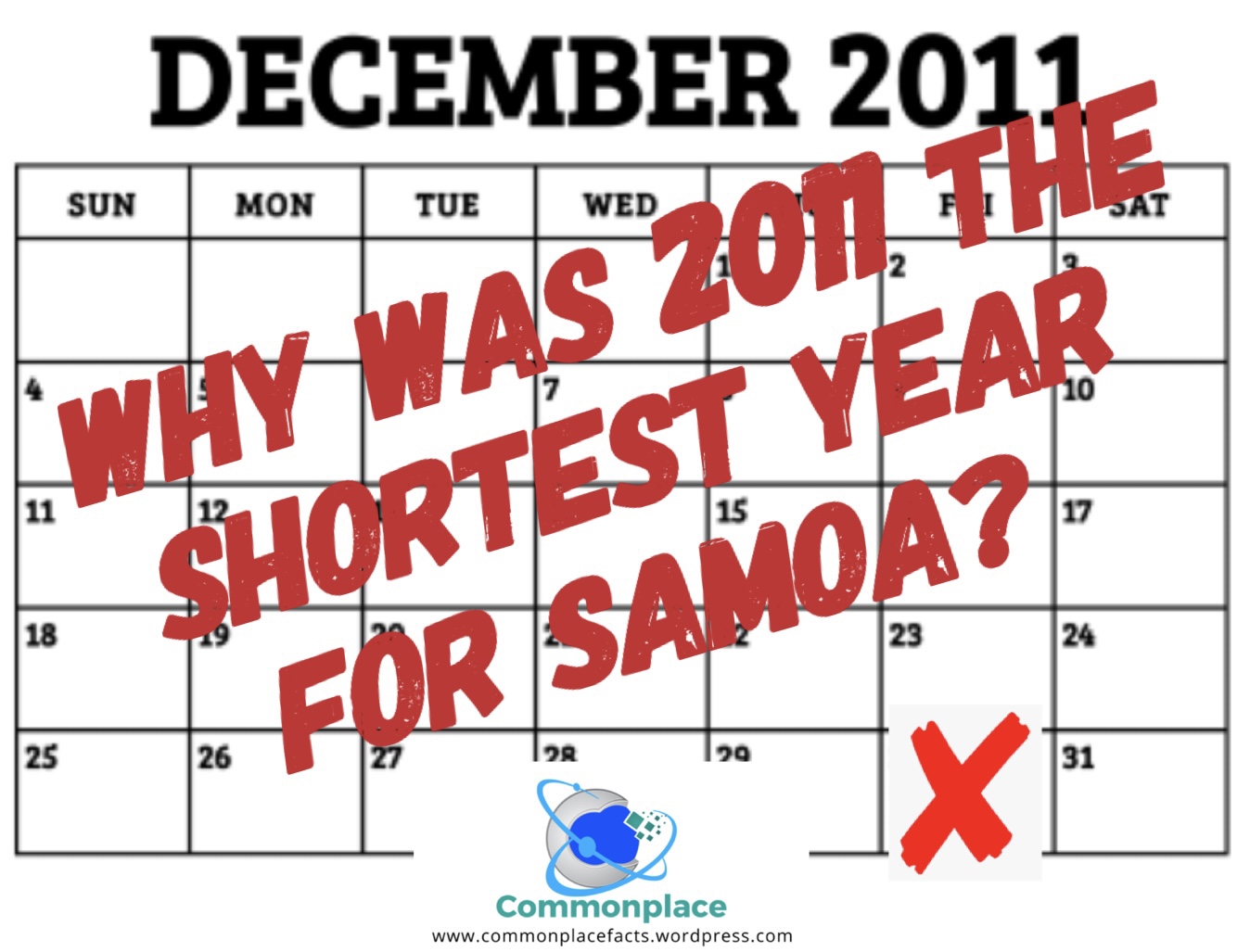

2011: The Year Samoa Skipped December 30
The year 2011 will be remembered by most of the world for its political and geological upheaval. Osama bin Laden and Muammar Gaddafi were killed, the Arab Spring saw protests in Libya, Egypt, and Tunisia, and a series of massive earthquakes triggered a massive tsunami in Japan.
As memorable as those events were, the people of Samoa will also be able to reflect on the fact that 2011, for their nation, consisted of only 364 days.
For most of the relatively-short time since Samoa’s first contact with the rest of the world, it owed most of its influence to western nations. Located 3,263 km (2,028 miles) from New Zealand in the South Pacific, it became an important base for whaling and trading vessels.
The Tripartite Convention of 1899 placed the western islands under German control and the eastern ones with the United States. Things remained that way until World War I when New Zealand seized control of the German territory. It remained under New Zealand’s control until 1962 when Samoa was given its independence.
Samoa’s proximity to the International Date Line placed it in the position of essentially getting to choose which side it wanted to claim. Although the nation’s geographic and cultural ties were closer to New Zealand, Samoa’s biggest trading partner was the United States. For that reason, it made sense to be in the time zone UTC -11 — 3 hours behind California.
Increasingly, however, Samoa has grown aligned to New Zealand, culturally and commercially. Remaining on the other side of the International Date Line made it difficult to do business with New Zealand. When it was Monday in New Zealand, it was Sunday in Samoa, while on Friday in Samoa, it was Saturday in New Zealand. In other words, the two nations only had three days each week that overlapped as days both countries could do business.
Samoa had already been moving itself to be more aligned with New Zealand. In 2009, for example, Samoans changed the rule of the road to drive on the left side, instead of the right, conforming with the New Zealand and Australian custom. (Read about why countries drive on a particular side of the road here.)
In 2011, the Samoan government decided to change its time zone to assist with the burgeoning New Zealand trade. For 119 years, Samoans had the distinction of being able to see the planet’s last sunset each day. At 11:59 pm on December 29, the country switched from UTC-11 to UTC +13. This meant that they entirely skipped over December 30.
The principal events of December 30, 2011, included the marriage of Doctor Who actor David Tennant to Georgia Moffett and the death of Italian nationalist politician Mirko Tremaglia, leaving some question about the legitimacy of the marriage and the status of the probate estate if there are any Samoan connections to either family. Otherwise, the biggest concern is that everyone in Samoa missed out on celebrating the United States’ National Bacon Day.
You may also enjoy…

Some Timely Facts About Time Zones
Time zones are relatively new phenomena in world history. Prior to the late 19th century, the authoritative source for the official time of day was the town clock. At noon each day, when the sun reached the highest point in the sky, clocks could be set and checked. This system worked well in a world…

The History of the Country That Existed for Six Hours
There is some debate about which country has the honor of being the oldest nation in the world. When it comes to the other extreme, it is hard to beat the Russian Democratic Federative Republic, which has the distinction of having been a country for a whopping whole six hours. With the abdication of Czar Nicholas…

Bad Weather Really Does Make the Days Longer
The post discusses the perception that bad weather makes days feel longer, a sentiment backed by scientific observations on Earth’s rotational changes due to various factors, including weather and geological events. It mentions historical perspectives on time and emphasizes a desire to eliminate Daylight Saving Time while humorously suggesting compensation for longer rainy days.





Leave a Reply