
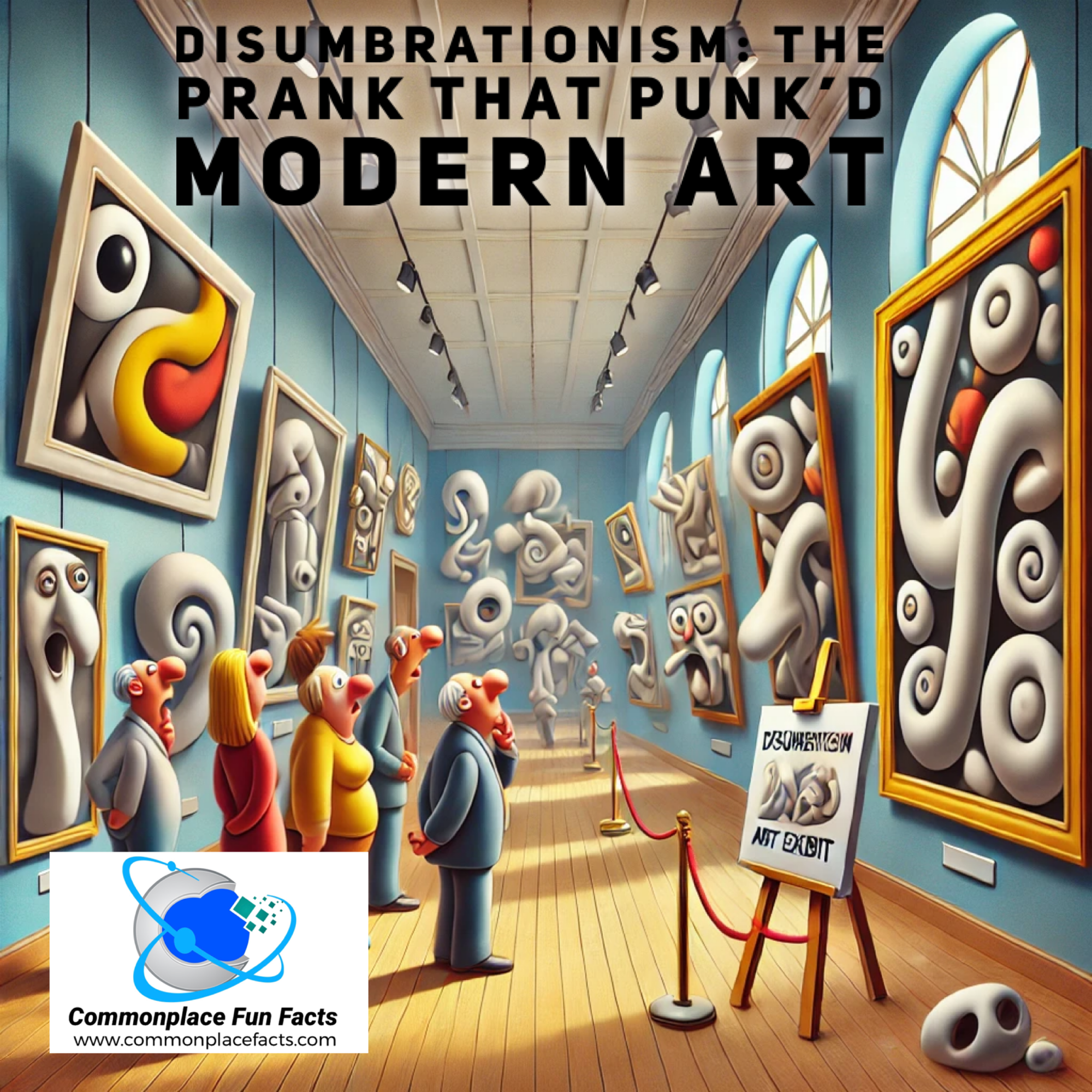

Ever had one of those moments where you think, “Hey, I could throw paint at a wall and call it art”? Well, welcome to the writing department of Commonplace Fun Facts! The other day, we were gathered around, half paying attention to reruns of The Twilight Zone, when inspiration struck: what if we created our very own art movement? We’ll call it Neo-Commonplacism. Throw a few scribbles on a canvas, maybe draw a stick figure looking confused, and we’ll call it a day. It’s practically foolproof—right?
Before you dismiss us as the latest batch of wannabe Warhols, we have historical precedent on our side. Let us introduce you to Paul Jordan-Smith and his utterly bonkers but wildly successful Disumbrationist movement. If you haven’t heard of Disumbrationism, don’t worry. It wasn’t real. But that didn’t stop it from fooling some of the biggest names in art.
The Birth of a (Fake) Russian Art Genius
Back in 1924, Paul Jordan-Smith—a perfectly respectable American literary scholar—woke up one day and decided to make the art world his personal playground. Because, why not? Armed with a fancy new alter ego, Pavel Jerdanowitch, Jordan-Smith transformed himself into a brooding Russian painter, a la every comic book villain who’s ever twirled a mustache and monologued about world domination. Jerdanowitch wasn’t just any painter, though—he was the tortured genius behind an entirely new art movement: Disumbrationism. Don’t bother looking it up. We assure you, it’s as real as the Batcave.
For three glorious years, Jordan-Smith paraded his abstract masterpieces under the Disumbrationist banner, selling his work to a world that simply could not get enough. Spoiler alert: the art critics ate it up.
Shadows and Shade: A Quick Guide to Making Up an Art Movement

Now, if you’re wondering what “Disumbrationism” even means, let us break it down. The word umbrage means shadows or shade. The “dis” part? That was Jordan-Smith’s cheeky admission that he had no idea how to paint shadows. But, as anyone who’s ever attended a modern art exhibit knows, if you can make it sound intellectual, you’re halfway to selling out your first gallery.
Armed with this bit of linguistic wizardry, a completely fabricated Russian identity, and a painting titled Yes, We Have No Bananas (because nothing says avant-garde like starfish that look like half-peeled bananas), Jerdanowitch made his grand debut at the 1925 Waldorf Astoria exhibition. This wasn’t just any show, mind you—it was staged by the Society of Independent Artists, the same group founded by Marcel Duchamp, that guy who once put a urinal on display and called it art. So, you know, Jordan-Smith was running with the big dogs.
When the Art World Fell for the Banana
Here’s where things get deliciously ironic. Much like they would go nuts over a chimpanzee’s art in the years to come, the art world was thrilled with Disumbrationism. Critics, armed with flowery prose and an unshakable fear of admitting they didn’t understand anything, praised Jerdanowitch’s work. Parisian critic Le Comte Chabrier, writing for Revue du Vrai et du Beau (that’s “Review of the True and the Beautiful,” because apparently truth and beauty can be found in banana-starfish hybrids), reached out to Jerdanowitch and begged to know more about his “vision.”
Jordan-Smith, being the sort of prankster we aspire to be, didn’t just stop at the paintings. He spun a backstory for Jerdanowitch that reads like a comic book origin story. Born in Moscow, raised in Chicago, nearly struck down by tuberculosis, and forced to recover in Hawaii, Samoa, Tahiti, and Southern California. All in pursuit of art, of course. And to top it off, Jerdanowitch’s portrait was styled in imitation of Leon Trotsky “as he might have looked before a firing squad.” Yeah, it was that kind of prank.
More Bananas, Please: The Art World Eats It Up

Jerdanowitch’s next masterpiece was called Aspiration—though Jordan-Smith originally named it Perspiration because — well, who knows? Artists are tortured souls, after all, unfathomable to the great unwashed. The painting, a technicolor dream of a woman washing clothes, was hailed by the Chicago Evening Post as a “delightful jumble of Gauguin, Pop Hart, and Negro minstrelsy.” In other words: “We don’t know what we’re looking at, but we like it because it sounds smart.”
The Western art world ate it up. Jerdanowitch’s absurdist paintings even made their way into the French art book L’Art Contemporain: Livre D’Or, because if you’re going to pull a prank, might as well take it global.
The Joke Comes to an End—Sort Of
By 1927, Jordan-Smith had had enough fun. He came clean, confessing to the world that Disumbrationism was, in fact, a joke. A very successful joke, mind you. He’d spent less than an hour a year maintaining the charade, yet the prank earned him more fame than all of his serious work combined. In fact, when his confession hit the front page of the Los Angeles Times, it probably caused more existential consternation among critics than when St. Elsewhere’s final scene created a whole new universe.
Even after the big reveal, Jerdanowitch wasn’t quite done. He made one final appearance in 1928 at Vose Galleries in Boston, showcasing seven paintings that Jordan-Smith dubbed “The Seven Deadly Sins” (not to be confused with the Seven Deadly Sins that are represented in Gilligan’s Island). If you’re going to end a prank, you might as well go biblical with it. Five of those paintings still live on in the UCLA Library of Special Collections, and the other two? Well, they’re probably hanging in some unsuspecting collector’s living room.
Neo-Commonplacism: The Next Great Art Movement?
So, what’s the moral of this absurd tale? If Paul Jordan-Smith could pull off Disumbrationism and fool the art world, surely we can make Neo-Commonplacism a reality. All we need is a dash of shadowy nonsense, a few bold lines, and a backstory involving an obscure spacefaring philosopher from Mars. If the critics ask, we’ll just tell them, “It’s not about aesthetics—it’s about existential profundity.”
Stay tuned for the debut of our soon-to-be-popular product: Yes, We Have No Coffee Mugs.
You may also enjoy…

Jonathan Swift’s Dead Astrologer Hoax: The Joke That Killed John Partridge While He Was Still Alive
Jonathan Swift’s infamous hoax convinced England that astrologer John Partridge was dead—even while he was still alive. Discover the bizarre true story behind Isaac Bickerstaff.

The Origin of April Fools’ Day: Centuries of Pranks, Confusion, and Questionable Judgment
Discover the origin of April Fools’ Day, from calendar confusion to classic pranks, and explore the surprising history behind this playful holiday.

The Tichborne Claimant: How a Victorian Butcher Convinced a Nation He Was An Aristocrat
The true story of the Tichborne Claimant—how a Victorian butcher convinced Britain he was a missing aristocrat, igniting one of history’s strangest trials.





Leave a Reply