
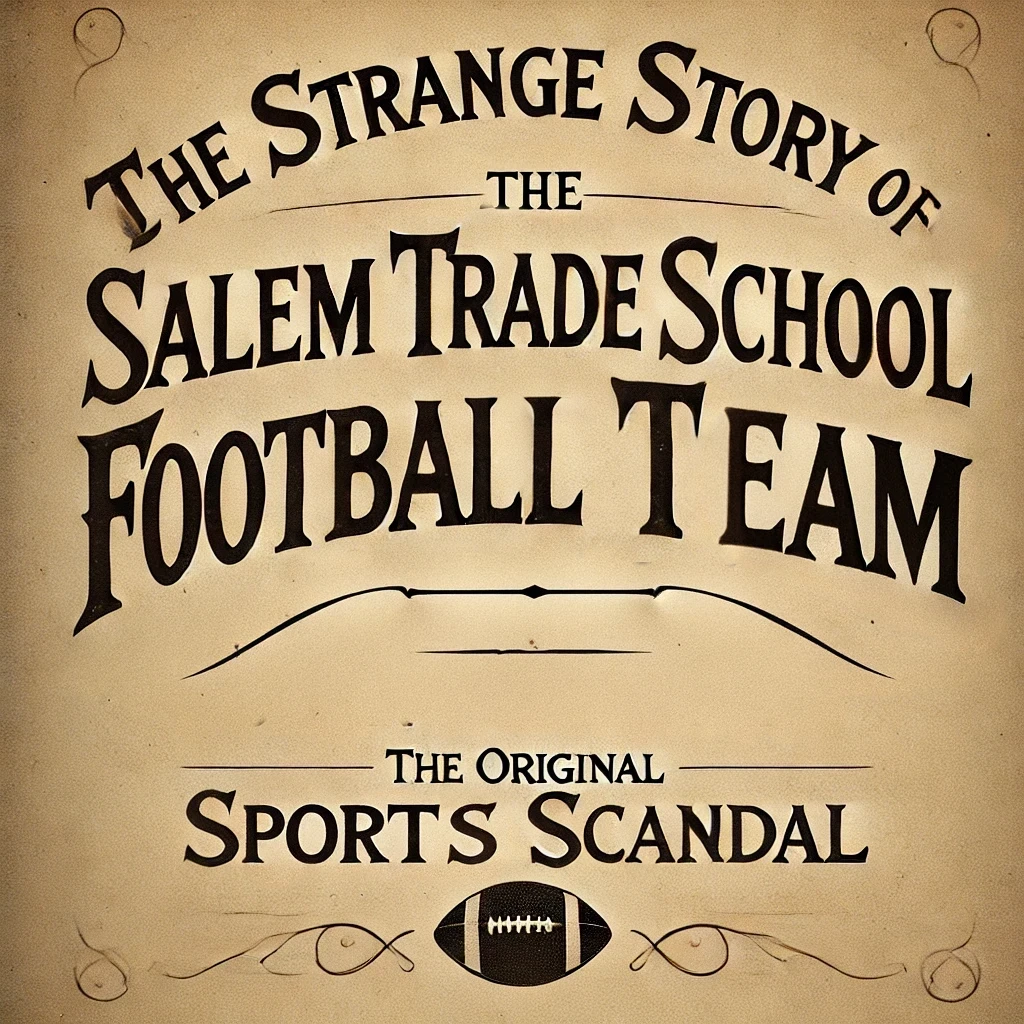

We, the staff Commonplace Fun Facts, are led to believe that most people have hobbies that include incomprehensible things such as sports and friendship. Those topics remain a mystery to us, but that doesn’t mean we don’t occasionally find an interesting story that ventures into the world of athletics. Take, for example, the strange tale of the Salem Trade School Football Team.
At first glance, the Salem Trade School football team doesn’t seem to be particularly interesting — particularly since it was a team that had a lot of experience with losing seasons. What the team members pulled off, however, was something that put the Salem Trade School on the map. That’s particularly impressive, since there was no such thing as the Salem Trade School.
If you are looking for life and death sports scandals, few can compete with that of the Wyoming State Penitentiary baseball team, the Death Row All-Stars, who had to keep winning in order to stay alive. You can read about that chapter in sports scandal history here. The scandal of the Salem Trade School Football team didn’t have the specter of the death penalty hanging over its players, but it is in a league of its own in terms of sheer audacity. It managed to play for six whole years without anyone realizing the school was about as real as Bigfoot in a tutu.
The Birth of the Salem Trade School Football Team
Our story kicks off in 1924, with a teenage high school dropout named Harold Burgess. What he lacked in high school diplomas, he made up for with his love for football and penchant for innovative thinking. He missed playing football, but it’s a little hard to play high school football when you aren’t in high school. Burgess realized it would be easier to create a fake school than to become a student again. He rounded up a few friends, most of whom had also aged out of high school eligibility, and put together a team. He called it the Salem Trade School football team.
The problem was, Salem Trade School didn’t exist. There was no campus, no teachers, no students. Just a team of guys — most of whom were definitely not teenagers but still wanted to play ball. Burgess, showing a flair for multi-tasking that would make even the most determined micromanager proud, wasn’t just the team’s quarterback. Under the alias “Ritchie Ray King,” he also acted as the team manager, coach, and, most importantly, the guy who sweet-talked local high schools into scheduling games.
Over-Age Players and a “Losing” Strategy
Burgess’s team was, to put it mildly, seasoned. While high school rules at the time allowed players up to the age of 20, Salem Trade’s roster included players in their mid-20s. There was a leatherworker, a chauffeur, even a professional boxer. No one seemed to be checking birth certificates, so the team just kept showing up to games.

The real secret to Salem Trade’s longevity was their strategy: they were terrible. More to the point, they were terrible on purpose. Burgess had a rule: always lose. The reasoning was simple—if they kept losing, no one would look too closely at who they were and discover that they represented a fake school. His strategy worked. Schools around the Boston area lined up to play them, figuring it was an easy win. In their first game, Beverly Junior High pummeled them 117-0. And just like that, they were in business.
The Scheme Unravels: A Shocking Win
Of course, no plan is foolproof. In November 1927, Salem Trade accidentally won a game against St. Mary’s of Brookline, and they followed that up with a shocking 6-0 victory over Taunton High in 1929. That win was thanks to star player Mike Iwanicki, who scored the game’s only touchdown. For the Salem Trade School, known primarily for always having a losing season, winning was bad news—it brought attention, and attention was the last thing they wanted.

After scoring the winning touchdown, Salem Trade’s halfback, Mike Iwanicki, decided he deserved a little more for his efforts—say, $10 per game, which would be about $140 today. Not exactly a king’s ransom, but a guy’s got to pay his bills. Soon, the other players jumped on the bandwagon, asking for anywhere between $2.50 to $10 each.
Harold Burgess, wasn’t having it. He flat-out refused, and that pushed the players over the tipping point. They decided to blow the whistle on Burgess’s whole operation.
The Boston Globe broke the story of the fake school on October 16, 1929, with a front-page headline: “Schools Hoaxed by Salem Trade.” The story revealed that Burgess had been pocketing advances ranging from $25 to $160 per game. While it may sound a bit outrageous, it was actually pretty common back then. In the 1920s, high school teams often relied on sponsors or a cut of ticket sales to cover expenses like uniforms, equipment, food, lodging, and transportation to away games. It was a decent setup, assuming, of course, that the manager actually shared the funds.
In exchange for their “services,” Burgess had promised the players sweaters and varsity letters at the season’s end, a grand trip to New York City, and even a post-season game somewhere in Michigan. According to the whistleblowers, they’d seen none of this. In fact, it appeared Burgess had pocketed just about all the money, despite coaches for other teams suggesting there wasn’t much to pocket in the first place—Salem Trade wasn’t exactly raking it in from their games.
Their grand victory against Taunton High? That brought in only $90, or about $1,250 in today’s dollars. And even though it was a tidy sum for a high school game back then, not a single player ever saw a penny.
The scandal spread quickly. Principals across the region were stunned to learn they’d been duped by a team that wasn’t even a real school. Teams started canceling games against Salem Trade faster than you can say “illegal forward pass.” But one school, Maynard High, decided to keep their scheduled match, figuring that playing against the now-infamous team would draw a crowd. On November 22, 1929, the two teams met, with Salem Trade sporting a cobbled-together lineup of players who’d never met before game day. They somehow managed to tie the game 19-19, proving that even when they weren’t trying to lose, they couldn’t quite win.
The Legacy of Salem Trade
Incredibly, Salem Trade didn’t disappear immediately. The Boston Globe, in a tongue-in-cheek editorial, praised Burgess’s scheme as a “contribution to the athletic ideas of the United States, this recipe for turning defeat into victory.” They weren’t wrong—Burgess’s plan had been bizarrely brilliant, at least until it wasn’t.
Salem Trade faded out after a few attempts at other sports, including basketball and baseball, where they also got trounced. Burgess, undeterred, tried to run similar scams in other states, only to get caught each time. He eventually moved to Texas, where he became a huge fan of high school football, presumably because it was safer to cheer from the sidelines than to field another fake team.
The Salem Trade story might have faded away entirely, but in 2018, Paul Carlin and John Murphy, sons of two original team members, revived the tale. They gathered memorabilia and shared the infamous team’s story, leading to a display at The Sports Museum in Boston’s TD Garden. So, in the end, Salem Trade got a home after all—just not the kind they’d originally imagined.
Fast-Forward Almost a Century: The Bishop Sycamore Debacle
Now, let’s jump forward almost 100 years to August 2021, when history decided to repeat itself, only this time on national television. Bishop Sycamore, the Ohio “online” charter school managed to get itself a high-profile matchup against national powerhouse IMG Academy. The game, broadcast on ESPN, was supposed to showcase top high school talent. Instead, it turned into a 58-0 blowout that had everyone scratching their heads, not least because the players seemed suspiciously… experienced.
It didn’t take long for reporters and social media sleuths to uncover the truth: Bishop Sycamore was essentially a name, a P.O. box, and a bunch of grown men running around pretending to be high school athletes. Sound familiar? They didn’t have a real campus, and no one could quite figure out who was in charge. The only thing missing was Harold Burgess wandering the sidelines.
Comparing the Playbooks: Salem Trade vs. Bishop Sycamore
It’s hard not to draw parallels between these two scandals, separated by nearly a century. Both teams had over-age players, nonexistent campuses, and managers who knew how to bend the rules (or ignore them entirely). Both teams also relied on the one thing that often allows scams to thrive: nobody was looking too closely.
But there’s one big difference. While Salem Trade’s scheme was largely played out on the dusty fields of New England, Bishop Sycamore brought the con into the 21st century. It wasn’t just about fooling a few high schools anymore; it was about fooling everyone—including ESPN and the football world at large. And in a world of instant news and social media, their downfall was swift and spectacular.
A Lesson in History (and Hilarity)
What makes the Salem Trade saga so fascinating, even after all these years, is how it managed to stay afloat for so long. Six seasons of sneaky calls, fake rosters, and real games. It was audacious, absurd, and, in a strange way, kind of genius. Sure, it wasn’t exactly fair play, but you’ve got to admire the creativity.
Bishop Sycamore’s brief stint in the spotlight was like a modern reboot—only this time, they got caught a lot faster, and in full view of the entire country. If there’s a lesson to be learned here (besides, you know, don’t fake a school), it’s that history really does have a way of repeating itself.
If you find yourself upset about your team’s performance on the field, you might find comfort in this one little detail: at least your team is actually real. We think.
You may also enjoy…

The Christmas Truce of 1914: When War Paused for Peace and Football
In December 1914, World War I briefly paused when British and German soldiers left their trenches, exchanged gifts, sang carols, and played football. The true story of the Christmas Truce of 1914—and what it reveals about war, humanity, and a different age.

The Football War of 1969: When Honduras and El Salvador Took Rivalry Too Far
Discover the true story behind the 1969 Football War, when World Cup tensions between Honduras and El Salvador erupted into a real shooting war. Explore the causes, battles, and lasting impact of this extraordinary 100-hour conflict.

The Treadmill Origin: How a Torture Device Became the World’s Favorite Workout Machine
Discover the strange history of the treadmill origin—from Victorian prison punishment to modern fitness favorite—and how it became today’s workout essential.



Leave a Reply