
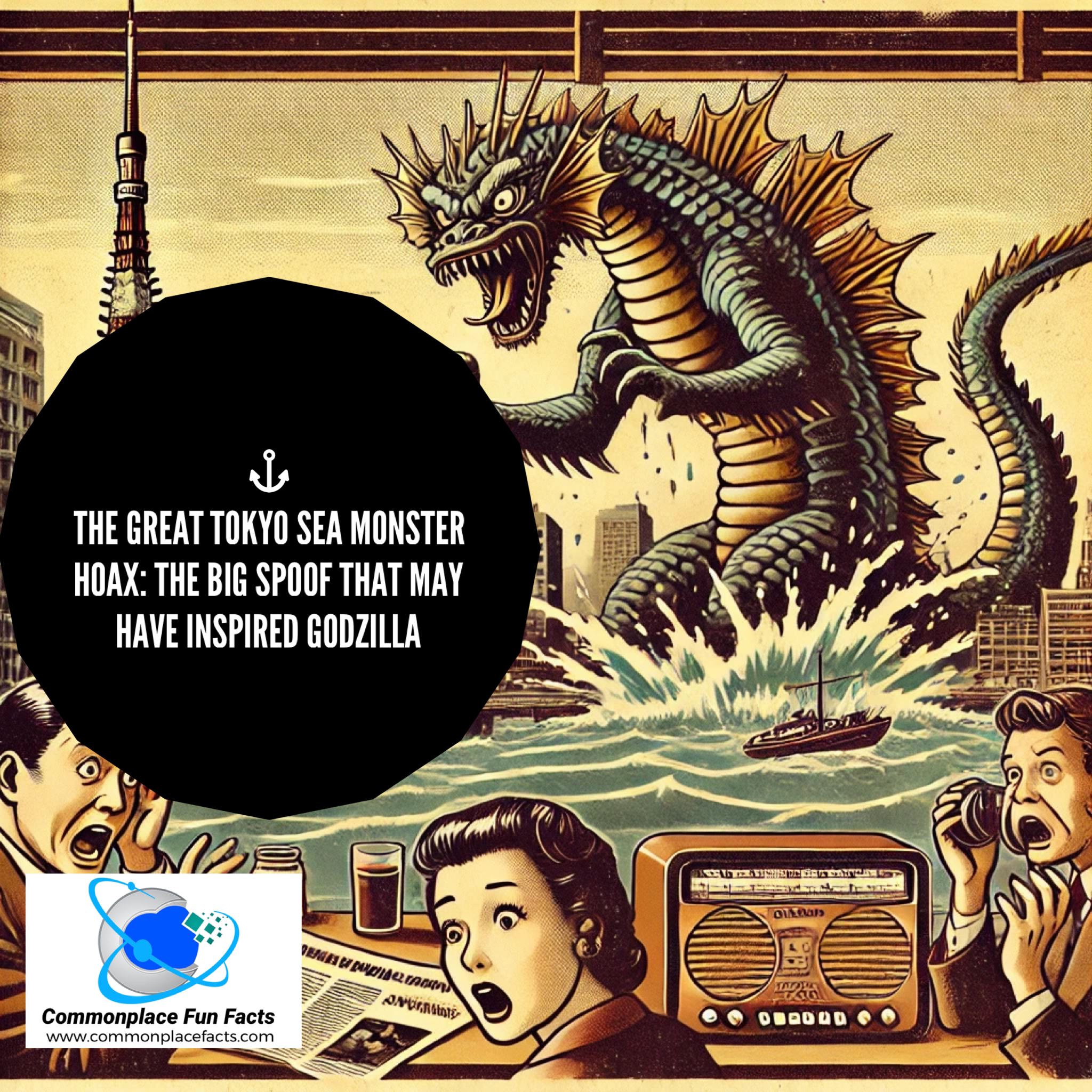

Before Godzilla There Was the Great Tokyo Sea Monster Hoax
The breathless reports come over the airwaves: Tokyo is under attack by a giant sea monster! The creature is squashing anyone and anything that gets in its way! Buildings are crumbling! The authorities are powerless to stop its violent escapade!
Yeah, we know it sounds like the beginning of every Godzilla movie ever. What if we told you this wasn’t the plot of a movie? It was the horrifying report by broadcasters of the Armed Forces Radio Service. And it happened a full seven years before anyone ever heard of Godzilla.
Join us as we go back in time to the day a 20-foot giant sea monster sent panic throughout Japan.
Table of Contents
Setting the Stage for Godzilla
1954 was quite the year. The world was still dusting itself off from World War II, trying to figure out how to live in this brave new world (with or without Aldous Huxley’s help). The Cold War was just in its early, frosty stages. Elvis was still flipping burgers somewhere, and Japan was about to give the world a monster that would stomp its way into pop culture history: Gojira—or as the rest of the world calls him, Godzilla.

We’ve all seen the giant, radioactive lizard wreak havoc on Tokyo, symbolizing Japan’s post-Hiroshima/Nagasaki nuclear anxiety. There have been endless deep dives into how Godzilla represents the trauma of atomic warfare and the lurking fear of mankind’s new, shiny doomsday toys. Japanese fiction—from The Tale of Genji to Dragon Ball Z—has always danced on the edge of the apocalyptic, but nothing quite captured the sheer, pants-wetting terror like a skyscraper-sized, fire-breathing reptile stomping on commuter trains.
But what if we told you Godzilla’s first Tokyo rampage didn’t happen in a movie theater in 1954? What if the real first monster attack was broadcast live on the radio… in 1947?
The 1947 Sea Monster Attack That (Almost) Was
Picture this: it’s May 29, 1947. The war’s been over for two years, and Tokyo is in that weird, post-apocalyptic reconstruction phase where everyone’s trying to pretend things are normal while still side-eyeing the rubble. The evening airwaves are filled with the smooth sounds of big band dance music, courtesy of Tokyo’s Armed Forces Radio Station, WVTR.
Then, without warning, the music cuts out. A stern, serious voice crackles through the static.
A sea monster has emerged from Tokyo Bay and is advancing inland.
Cue chaos.
WVTR then dropped a series of increasingly frantic updates. The creature—a 20-foot-tall, dragon-like nightmare—is smashing buildings, derailing trains, and heading straight for downtown Tokyo. Soldiers are reportedly engaging the beast with everything they’ve got: bullets (useless), grenades (meh), flamethrowers (moderately toasty), and even tear gas (because apparently, sea monsters are known for their sensitive mucus membranes).
Listeners are advised to barricade themselves indoors, keep the phone lines clear for emergency calls, and kiss their loved ones goodbye.
The broadcast features live sounds of the chaos: gunfire, screaming civilians, the unholy roars of the monster itself. You can practically hear the city’s collective blood pressure skyrocketing.
And just when it seems like all hope is lost, the monster reaches downtown Tokyo. The announcer, Cpl. Jim Carnahan from Chicago, draws listeners in closer, his voice tense, breathless.
And then… the punchline.
Cpl. Carnahan congratulates the Armed Forces Radio Station on its fifth anniversary. Taking a page from The War of the Worlds radio broadcast 9 years earlier, the attack of the sea monster was nothing more than a hoax.
Cue the sound of thousands of jaws hitting the floor.
When Hoaxes Go Nuclear
You’d think people would’ve laughed, right? A good old-fashioned prank? Nope. Turns out, Tokyo wasn’t in the mood for a kaiju comedy.
Listeners had taken the broadcast deadly seriously. The phone lines at the radio station were jammed for hours, as people called in to get updates—or, in some cases, to confirm that they hadn’t lost their minds. Japanese police were put on high alert. Military police were gearing up for what they thought was an actual monster hunt. One British officer reportedly called in, saying his men were demanding grenades and rifles to battle the beast.
And let’s not forget the poor sap who phoned in, swearing up and down that he’d seen the monster with his own eyes. Described it in loving detail: thick-skinned, horrifying, grinning in a slimy, oily way. (We’re going to go out on a limb and guess he’d had a drop or two of sake before the broadcast.)
As the New York Times reported the next day:
‘MONSTER’ IN TOKYO
ARMY’S JOKE BROADCAST SCARES AMERICANS AND BRITONS
TOKYO, May 28 (UPI) An Army radio station described for a gag today a ‘battle’ between American soldiers and a ‘twenty-foot sea monster’ in the streets of Tokyo. The description was so vivid that Gen. Douglas MacArthur was reported to have been fooled, as well as thousands of Americans and Britons.
For more than three hours the telephones of Station WVTR [Far East Network] and of Army agencies were clogged with telephone calls from Americans and Britons, some of whom were frankly frightened. According to a member of the station’s staff, one caller was General MacArthur.
It took a while for the hysteria to die down. People were still phoning the station a full twelve hours after the broadcast ended, some asking what to do, others just wanting someone to explain what the heck had just happened.
The Real Monsters: Radio Scriptwriters
So, who was behind this monstrous mess? A group of mischievous scriptwriters from Los Angeles, of course. Pfc. Arthur Thompson, Cpl. Arthur Bartick, Pfc. Pierre Meyers, and their boss, AFRS Japan Director Dr. Wilson W. Cook, cooked up the whole scheme to celebrate WVTR’s fifth anniversary.

The plan? Simple: invent a sea monster, unleash it on Tokyo via radio waves, and sit back to enjoy the chaos. What could possibly go wrong?
As it turned out—everything.
The five members of the creative team lost their jobs as a result of the ill-advised practical joke. They may have thought it was hilarious, but their superiors were far from amused.
The prank was so convincing, so immersive, that it sent an entire city into a full-blown panic. Thompson later mused that the whole thing wasn’t just a joke—it was practically a script begging to be turned into something bigger.
So, Did This Inspire Godzilla?
It’s tempting to point to this 1947 hoax and say, “Aha! This is where Godzilla was born!” But, like any good monster origin story, it’s a little more complicated than that.
Godzilla’s roots are tangled in Japan’s post-war nuclear trauma, the lingering fears of radiation, and the horrors witnessed in Hiroshima and Nagasaki. The monster is a symbol of unchecked technological power, environmental destruction, and humanity’s hubris.
But can we say that the WVTR hoax had nothing to do with it? Not entirely. The timing, the imagery, the sheer panic it caused—it’s hard to believe there wasn’t at least a little bit of inspiration drawn from that bizarre radio stunt.
So, the next time you watch Godzilla stomp through Tokyo, just remember: before he was the King of the Monsters, there was a 20-foot sea monster that was the King of Radio Hoaxes.
You may also enjoy…

If I’m Lying May I Be Afflicted By Beasts, Leprosy, Wretchedness, and Sea Monsters
If you have attended court proceedings or watched a televised legal drama, you are familiar with the process of swearing in a witness. Before testimony can be accepted, the individual must “solemnly swear to tell the truth, the whole truth, and nothing but the truth.” It wasn’t always quite that simple. Those who testified in…

The Fearsome Giant Foot of Japanese Folklore
Learn about the weird and fearsome giant foot from Japanese folklore that terrifies the homes of the unwary.

Space Cadets: TV’s Most Expensive Hoax
Discover the jaw-dropping story behind ‘Space Cadets,’ the most expensive TV hoax ever, where contestants believed they were trained for space travel. Learn how a reality TV show fooled its participants with Hollywood magic.





Leave a Reply