
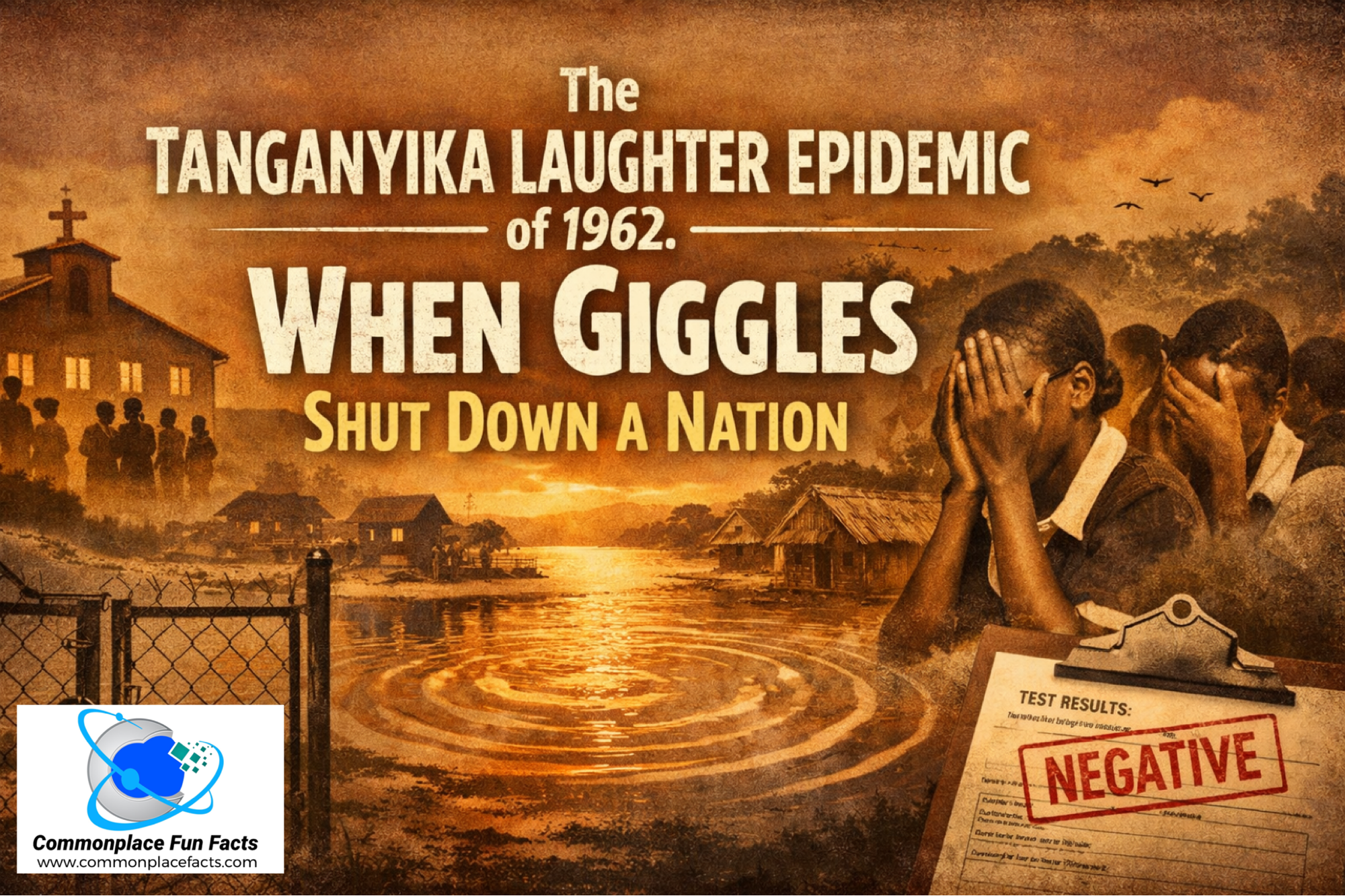

The Tanganyika Laughter Epidemic: When Laughing is No Laughing Matter
Laughter is supposed to be a welcome condition. You laugh because something is funny, or awkward, or because your brain has momentarily shut down under social pressure. Laughter is how humans signal, “Everything is fine, do not call a doctor.” It is not generally how epidemics begin.
And yet, in 1962, laughter shut down schools, disrupted villages, baffled doctors, and ricocheted across an entire region of East Africa. No jokes were told. No comedians were booked. There was no punchline. Just groups of people who could not stop laughing, crying, or panicking—and no one involved was enjoying themselves.
This is the Tanganyika Laughter Epidemic, one of history’s most misleadingly named events. It was not particularly funny. It did not behave like an infection. And the more officials tried to contain it, the more it politely relocated and continued elsewhere, like a bureaucratic nightmare with a nervous system.
This is not a story about humor. It is a story about pressure, authority, expectation, and what happens when the human brain, denied reasonable outlets, finds a deeply unreasonable one.
Contents
Tanganyika, 1962: A New Country with Old Expectations
At the time of the outbreak, Tanganyika (modern day Tanzania) was brand new. Independence from British colonial rule had arrived in December 1961, barely a month before everything went sideways. The nation was trying to reinvent itself while still operating inside institutions designed for a very different social order.

Education was one of those institutions. Mission-run boarding schools remained strict, hierarchical, and intensely disciplined. They were places of opportunity and upward mobility, but also of constant pressure—especially for students expected to embody both academic success and moral perfection.
The laughter epidemic began at one such school, a mission-run girls’ boarding school near the village of Kashasha, on the western edge of Lake Victoria in the Bukoba District. The students were adolescents, living away from home, subject to rigid expectations, and navigating a society in transition. This was not a carefree environment accidentally infected by joy. This was a pressure cooker.
And pressure cookers, when they fail, rarely do so politely.
It Starts Small. It Always Does.
On January 30, 1962, three students at the school began laughing. Not laughing-at-something laughter—more like laughing-as-a-thing-that-happens-to-you laughter. The episodes came in waves and could last hours. Sometimes laughter blurred into crying. Often, fear crept in. Concentration evaporated.

Within days, dozens of students were affected. Classes became impossible. Discipline—which depends heavily on people being able to stop doing things—collapsed. Teachers could not teach. Students could not learn. Nobody could explain the cause of the giggles.
Eventually, the school did the logical thing, meaning the thing institutions always do when faced with something they don’t understand: it closed.
This would have been very helpful if the laughter epidemic had politely respected administrative boundaries. It did not.
Students were sent home to their villages. The laughter went with them.
What “Laughter” Actually Looked Like
This is where the name of the event causes problems. When people hear “laughter epidemic,” they tend to picture something whimsical. Group giggles. Uncontrollable chuckles. A Monty Python sketch that escaped containment.
What was experienced was very different.
Those affected experienced episodes of laughter, yes, but also crying, agitation, anxiety, restlessness, and an inability to focus. Some complained of physical symptoms like pain, faintness, or general malaise. Episodes could last minutes or hours and recur over days or weeks.
There is an important distinction here: these people were not pretending, exaggerating, or participating in a prank. The symptoms were real, disruptive, and extremely distressing. Laughter, in this context, functioned less like comedy and more like a malfunctioning reflex.
Laughter Is Contagious—And So Was The Problem
Closing the school in Kashasha may have felt decisive, but it turned out to be the epidemiological equivalent of picking up a beehive and shaking it somewhere else. When students were sent home, the laughter didn’t politely stop at the school gates. It traveled with them.
Within weeks, similar episodes appeared in nearby villages, most notably Nshamba, where the situation escalated enough that another school was forced to close. From there, reports followed predictable social pathways rather than geographical logic—affecting neighboring communities like Ramashenye and Kanyangereka, then flaring up again when conditions lined up just right.
This wasn’t a single, rolling wave that swept steadily across the countryside. It behaved more like a series of aftershocks. One group would experience weeks of symptoms. Things would calm down. Then, elsewhere, the pattern would repeat. Some communities dealt with episodes lasting days; others struggled for months. In total, the phenomenon dragged on well into 1963, long after any reasonable person would have expected the “laughing thing” to sort itself out.
What connected these outbreaks wasn’t proximity so much as context. The groups affected were socially linked, often through family or school networks. The stressors were similar. The authority structures were familiar. The symptoms followed the same rough script. Laughter didn’t so much spread as it reappeared wherever the conditions that triggered it had been successfully reassembled.
This is the part of the story that makes “contagious” a deeply misleading word. Nothing was being transmitted in the medical sense. No pathogen was hopping from village to village. What traveled was expectation, observation, and the knowledge—unspoken but powerful—that something strange was already happening. In the right environment, that knowledge was enough.
By the time the outbreaks subsided, hundreds of people across multiple communities had been affected. No one died. No permanent physical damage was recorded. What took the hit instead was daily life: schools closing and reopening, routines breaking apart, and confidence in institutional control quietly eroding. The laughter didn’t grow louder as it spread. It just proved stubbornly resistant to being contained.
Doctors, Tests, and the Sound of Nothing Being Wrong
Medical examinations followed. Doctors looked for infections, toxins, and neurological causes. Tests were conducted. Nothing turned up.

This was not reassuring.
In medicine, “nothing found” often translates into “nothing real,” a conclusion history has repeatedly demonstrated to be spectacularly incorrect. The absence of a pathogen does not mean the absence of illness. It simply means the problem is being generated somewhere less microscope-friendly.
Eventually, researchers categorized the laughter epidemic as mass psychogenic illness—a term that sounds dismissive until you understand it. MPI does not mean “imaginary.” It refers to real symptoms arising from psychological and social stressors, spread through observation, expectation, and shared environments.
In simpler terms: humans are social animals, and sometimes the nervous system takes cues from the room instead of reason. When enough people are under strain, the body may express that strain in synchronized, inconvenient ways.
One frequently noted feature of mass psychogenic illness is that it tends to express distress in ways a given culture does not readily permit—or know how to manage. In highly structured environments built around obedience and conformity, overt resistance, anger, or fear may carry social or disciplinary penalties, especially for adolescents. The body, however, is not bound by rulebooks. When acceptable channels for expressing stress are blocked, involuntary behaviors sometimes fill the gap. In this context, uncontrollable laughter makes a grim sort of sense: it is disruptive without being openly defiant, emotionally expressive without articulating a complaint that can be corrected or punished. What appears, from the outside, to be bizarre behavior is often the nervous system finding a form of release that slips past the cultural guardrails designed to keep emotions in line.
Uncontrolled, laughter can stop being funny very quickly. A number of people have actually laughed themselves to death, as we detailed in “Death By Laughter: A Humorous And Dangerous Exploration of History’s Most Lethal Laughs.”
The Tanganyika Laughter Epidemic was not caused by a virus. It was caused by pressure seeking expression—an internal alarm system misfiring in chorus.
And the chorus had not yet finished its song.
The Big Misunderstanding: Contagious Laughter Is Not the Same Thing as Something Being Funny
This is the point in the story where modern retellings often skid off the road. The phrase “laughter epidemic” practically begs for a lazy explanation. Surely someone told a joke. Surely this was joy run amok. Surely it was just teenage silliness that got out of hand.
None of that fits the evidence.
The laughter epidemic did not involve social bonding laughter or humor response. It was not triggered by wit, surprise, or timing. It behaved more like a reflex—closer to a hiccup or a panic response than anything related to amusement. People were not laughing with one another. They were laughing at the wrong time, often alone, often frightened by the fact that they could not stop.
All of us know (or are) the person who laughs at inappropriate times, such as in the middle of a funeral or in the middle of a corporate meeting when the boss is announcing that a “slight downsizing” of 75% of the workforce. It isn’t that the person has a sick sense or humor or finds anything at all amusing about the situation; he or she (or you) simply can’t help it.
The human brain has a limited number of ways to discharge stress. Crying is one. Laughter, inconveniently, is also on the list. When conditions are right—or wrong—the mechanism can misfire. Once that behavior appears in a tightly knit group, especially one composed of young people under authority, it can spread through imitation, expectation, and social feedback loops.
This does not make it fake. It makes it human.
Why This Group, in This Place, at This Moment
No single cause explains the Tanganyika Laughter Epidemic, which is unfortunate for anyone hoping for a clean moral lesson and excellent for anyone interested in how societies actually work.
Christian Hempelmann of Texas A&M University has examined the outbreak and argues that the laughter epidemic fits the pattern of a mass psychogenic (or sociogenic) illness—real symptoms sparked not by a virus but by sustained stress in tightly controlled environments. Because the episodes were concentrated among adolescent girls in boarding schools, he points to a particular combination of pressures: rigid expectations imported from British-run education systems layered onto the broader uncertainty of a country that had gained its independence barely a month earlier. In that setting, the laughter was less a reaction to humor than a release valve for stress that had nowhere else to go.
None of this requires exotic explanations. It does not hinge on local superstition or cultural peculiarity. Similar episodes have occurred across time and geography under remarkably familiar conditions. When pressure builds and expression is constrained, the body occasionally files a complaint without asking permission.
The laughter was not the problem. It was the symptom.
A Brief Tour of History’s Other “What On Earth Was That?” Episodes
If the Tanganyika episode feels uniquely strange, it is mostly because it wears an unusual label. History is full of comparable events that go by less cheerful names.
Medieval Europe produced repeated outbreaks of choreomania—dancing plagues in which groups of people danced until collapse. Early modern factories recorded waves of fainting and paralysis among workers. Schools around the world, including in the United States, have experienced sudden clusters of mysterious symptoms during periods of academic stress. There was even a period during the middle ages when a bunch of nuns suddenly started uncontrollably meowing and biting people.
Strip away the cultural dressing, and the pattern remains recognizable: tightly bonded groups, shared anxiety, unclear authority, and bodies that respond collectively when words or actions are constrained.
The Tanganyika Laughter Epidemic does not stand apart from these events. It sits comfortably among them, insisting—quietly but firmly—that human psychology has always been a group sport.
How the Story Keeps Getting Retold (and Slightly Mangled)
The laughter epidemic refuses to stay buried. It resurfaces every few years in podcasts, documentaries, and articles that tend to open with the same hook: “What if laughter were contagious?”

This framing is understandable. It is clickable. It is weird in a friendly way. It is also misleading.
By focusing on laughter as novelty, these retellings often drain the story of its actual significance. The event becomes an amusing anecdote rather than a case study in how stress, authority, and social structure interact. The people involved become curiosities rather than participants in a very real national moment.
The truth is less whimsical and far more interesting. This was not comedy. It was communication—just not in a form anyone expected.
What We’re Supposed to Learn from All This (Whether We Like It or Not)
What the Tanganyika Laughter Epidemic really tells us is not that stress exists—that part was never in doubt—but that how stress is allowed to show itself matters a great deal. Cultures don’t just decide which behaviors are proper; they also decide which emotional reactions are acceptable. In places where open disagreement, visible anxiety, or “I’m not okay with this” are quietly discouraged, pressure doesn’t go away. It just looks for a loophole. In Tanganyika, laughter turned out to be the perfect one: disruptive without being openly rebellious, involuntary enough to resist punishment, and strange enough that authority couldn’t simply scold it back into compliance. The outbreak wasn’t random chaos. It was a message delivered in the only format that slipped past the rules.
That framing makes the modern world slightly uncomfortable to look at for too long. We like to believe we’re far more open now, emotionally and politically, but many of our systems still reward conformity and punish deviation—just with different tools. Your boss may not cane you for speaking out of turn, but the performance review has replaced the ruler. Online spaces promise free expression, right up until you say the wrong thing in the wrong tone to the wrong crowd. We have more outlets than ever, yet somehow manage to look just as tightly wound as people in 1962 boarding schools.
It also casts today’s extreme politicization and social media behavior in a different light. The endless outrage cycles, public denunciations, and ritualized venting often present themselves as principled stands, and sometimes they are. But they also behave suspiciously like stress responses traveling through networks at high speed. That doesn’t mean political conflict is fake any more than the Tanganyika laughter was fake. It means some of what we experience may not be best understood purely as ideology, but as pressure echoing around a system that amplifies emotion faster than it resolves it.
The Tanganyika Laughter Epidemic doesn’t give us a tidy moral or a clear villain. What it offers instead is a reminder that societies run on unspoken psychological agreements as much as written rules. When those agreements break down—or leave people no safe way to say “this is too much”—the response doesn’t disappear. It shows up somewhere else.
Sometimes it looks like mass laughter. Sometimes it looks like mass outrage. And sometimes it just makes you look around the modern world and think, with no small amount of exhaustion, that people seem to be acting a little unhinged lately. History suggests that reaction may not be entirely figurative.
When the Laughter Finally Stopped
Eventually, the laughter epidemic subsided. Schools reopened. Villages resumed daily life. The laughter, having made its point, withdrew without a formal announcement.
No single intervention ended the epidemic. Time passed. Tension eased. Social equilibrium reasserted itself. As with many such events, resolution came quietly, without a ceremonial “all clear.”
What remained was a story that resists simple interpretation. A reminder that humans are not machines, that stress has a half-life, and that even the most familiar behaviors can become deeply unsettling when they stop obeying context.
Laughter is usually a sign that things are fine.
In 1962, the Tanganyika laughter epidemic produced the sound of a society letting off steam the only way it could.
That may not be funny, but it is oddly clarifying.
You may also enjoy…

Death By Laughter: A Humorous And Dangerous Exploration of History’s Most Lethal Laughs
Is death by laughter really a thing? Discover the bizarre true stories of people who reportedly died from laughing too hard—from ancient philosophers to British TV fans—in this hilarious yet deadly dive into history’s strangest fatalities.

The Tanganyika Groundnut Scheme: Britain’s Billion-Pound Peanut Disaster
Discover how Britain’s Tanganyika Groundnut Scheme turned into a billion-pound disaster, revealing the dangers of colonial arrogance and poor planning.

Mass Hysteria in the Middle Ages: The True Tale of the Meowing Nuns With Biting Issues
The Middle Ages saw a peculiar outbreak of meowing nuns who started biting everyone. Find out about this weird case of mass hysteria in this fascinating article.




Leave a Reply