
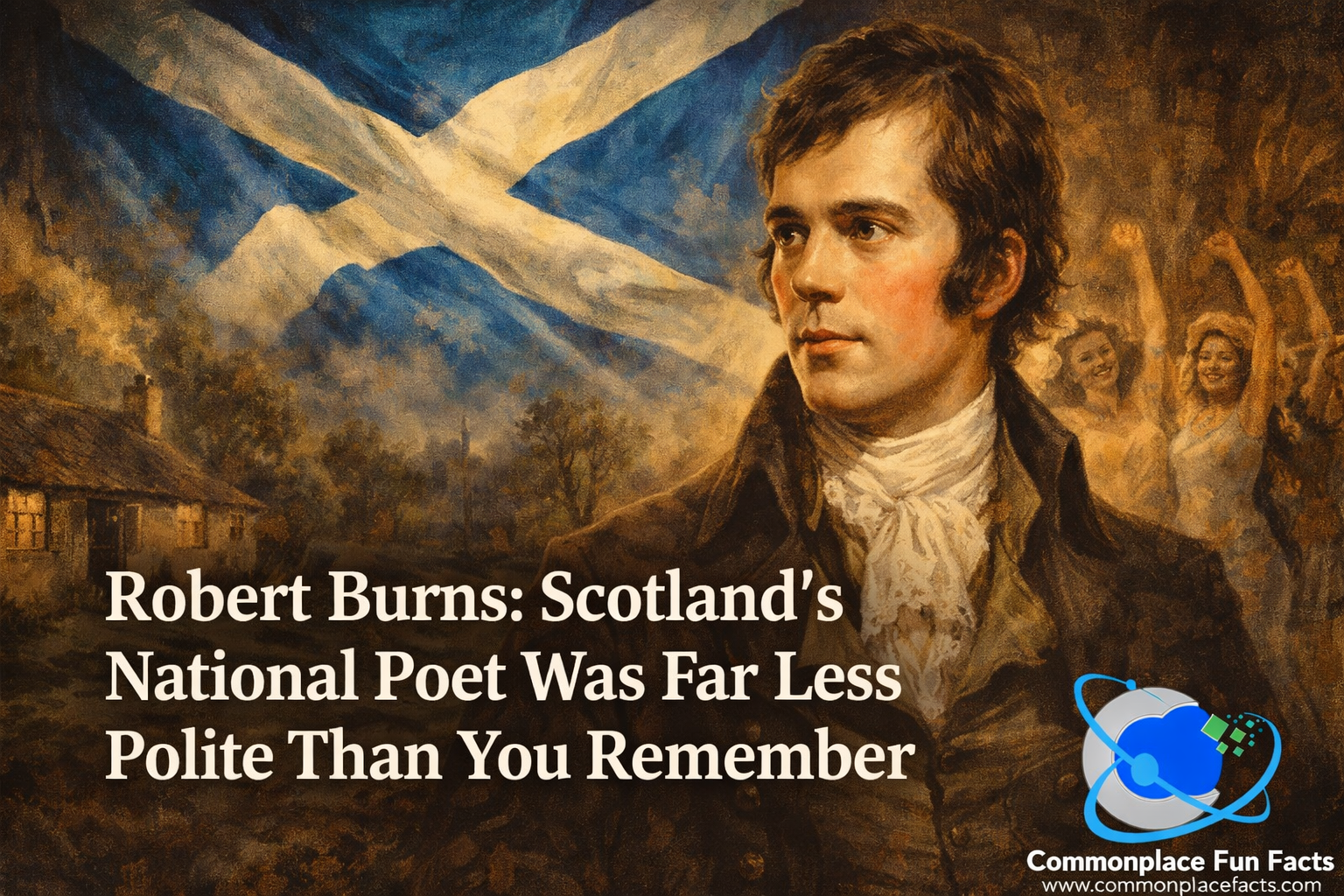

Robert Burns is one of the most aggressively safe historical figures on earth.
He is the national poet of Scotland. His face appears on banknotes. His name is printed on tea towels. His words turn up on greeting cards handed to aunts who enjoy lavender. Entire nations pause once a year to solemnly recite his verses, preferably while wearing tartan and holding something steamed.
All of which is impressive, given that Burns spent a good portion of his short life writing love poems, drinking songs, political barbs, and assorted literary mischief that would not survive a modern streaming platform’s content moderation meeting.
This is the paradox that makes Burns interesting. He is celebrated precisely because history has spent more than two centuries tidying him up, sanding off splinters, and translating just enough of his work to make him sound earnest rather than alarming. Burns works as a national poet because he has been very carefully defanged.
Read selectively, he is the poet of friendship and memory.
He is also the poet who gave us “A Man’s a Man for a’ That,” a piece often presented as a gentle affirmation of human dignity but which is, in fact, a blunt rejection of aristocracy, hierarchy, and inherited superiority—written with very little concern for whether the people in charge would enjoy hearing it.
Burns, in other words, is dangerous—but in the safest possible packaging.
Contents
Robert Burns: A Product of Place, Poverty, and Unfortunate Timing
Robert Burns was born on January 25, 1759, in Alloway, Ayrshire, on the western coast of Scotland. The date is important, because a lot of annual celebrations now depend on it.

He entered the world not as a destined literary icon but as the eldest son of a tenant farmer, William Burnes, and his wife Agnes Broun. The Burnes family lived close to the margins, leasing poor land, building their own house by hand, and enduring the sort of economic precarity that makes later romanticization feel slightly impolite. Burns’ childhood was shaped by hard physical labor, irregular schooling, and the constant awareness that effort did not reliably produce security.
This was late 18th-century Scotland, a country in transition. The Scottish Enlightenment was in full intellectual bloom, but its benefits were unevenly distributed. Philosophers debated reason and equality in Edinburgh drawing rooms while rural families like the Burneses worried about crop yields and rent. Burns grew up caught between these worlds: educated enough to read widely, poor enough to understand exactly how limited opportunity could be.
His father, though struggling financially, placed an unusual emphasis on education. Burns received instruction not only in basic literacy but in literature, moral philosophy, and theology. This combination—intellectual seriousness paired with rural hardship—left a lasting mark. Burns absorbed Enlightenment ideals while watching social hierarchy operate with cold efficiency around him.
The Scotland of Burns’ youth was still deeply shaped by class distinctions, rigid religious expectations, and the aftershocks of failed rebellions and economic change. It was a place where a person’s birth largely dictated their future, where ambition was permitted but mobility was not guaranteed.
Burns did not emerge from this environment eager to overthrow society outright. Instead, he grew into someone keenly aware of its injustices, suspicious of its pretensions, and emotionally invested in the inner lives of ordinary people. His poetry would later give voice to that perspective—not as a polished outsider looking in, but as someone who had come up through the mud and never entirely shook it off.
In short, Burns didn’t write about common folk because it was fashionable. He wrote about them because he was one—and because he knew exactly how rarely their lives were treated as worthy of serious attention.
The Ploughman Poet (Or: How Branding Worked Before Marketing Departments)
Burns’ reputation as a “natural genius” did not happen by accident. It was cultivated, encouraged, and occasionally leaned on a bit too hard.
The publication of Poems, Chiefly in the Scottish Dialect, commonly known as the Kilmarnock Edition, in 1786 introduced Burns to a wider audience as a rustic marvel: a farmer who simply happened to write poetry of startling quality between plowing fields. Edinburgh society embraced this framing enthusiastically. Here was talent, yes—but talent that arrived with mud on its boots. Respectable, but not threatening.

The book opens with a four-page preface in which Burns downplays his formal education, insisting that he lacks the advantages of “learned art,” that none of the poems were written “with a view to the press,” and that they were composed “amid the toils and fatigues of a laborious life.” It concludes with a five-page glossary explaining Scottish words common in Burns’s Ayrshire that might have been unfamiliar to readers elsewhere in Scotland.
As a result of the Kilmarnock Edition, the world was introduced to such classics as “To a Mouse.” According to popular lore, Burns wrote the poem after accidentally destroying a mouse’s home while plowing a field. With his hands still on the destructive plow, Burns conceived the words:
“Wee, sleekit, cow’rin, tim’rous beastie,
O, what a panic’s in thy breastie!
Thou need na start awa sae hasty,
Wi’ bickering brattle!
I wad be laith to rin an’ chase thee,
Wi’ murd’ring pattle!”
For those who don’t understand the native language of Heaven Scots dialect, here is the translation:
“Little, sleek, cowering, timorous beast,
Oh, what a panic is in your breast!
You need not start away so hasty
With bickering prattle!
I would be loath to run and chase you,
With murdering ploughstaff!”
It was when he was in this role of “peasant poet” that Burns was safest. He could be viewed as a curiosity from the countryside whose brilliance could be celebrated without requiring too much reflection on class, power, or who usually gets published.
He couldn’t stay in that lane, however. In the same volume that gave us “To a Mouse,” we also got “The Twa Dogs.” There, Burns takes on class inequality by doing something both disarming and strategic: he lets two dogs do the talking. One belongs to a wealthy landowner and lives in comfort; the other is attached to a poor farmer and knows hunger, exhaustion, and hard work firsthand. By framing the poem as a conversation between animals rather than an outright lecture, Burns creates enough distance to say things that would sound inflammatory if stated directly. The privileged dog does nothing to earn his ease, while the working dog labors constantly for little reward—a contrast Burns presents not as fate or divine order, but as an arbitrary social arrangement. The hierarchy exists because everyone agrees to pretend it makes sense.
What makes the poem effective is that Burns never turns it into a simple rant. The tone is reflective rather than furious, observational rather than bombastic. He allows the injustice to reveal itself through comparison: comfort versus strain, leisure versus toil, inherited status versus lived experience. The poem quietly dismantles the idea that wealth correlates with virtue or effort, suggesting instead that class determines circumstance long before character gets a vote. For a piece published in 1786, this was a remarkably clear-eyed critique—one that slips its argument past polite defenses by disguising social analysis as pastoral conversation. Burns isn’t shouting at the system here. He’s letting it incriminate itself.
Burns was keenly aware of this tension. He enjoyed the attention. He resented the condescension. Both feelings show up in his writing, sometimes in the same stanza.
The branding worked. Burns became famous in his own lifetime, which was rare for poets and inconvenient for Burns himself. He wanted to be taken seriously as an intellectual equal, not exhibited as a novelty act who just happened to rhyme.
History, naturally, leaned into the novelty.
The Revolutionary Who Clocked In for the Crown
One of the neatest tricks in the Burns story is that the poet of equality, sincerity, and suspicion toward entrenched power made his living as an excise officer.
This meant Burns spent his days collecting taxes and preventing smuggling on behalf of the British government. The same Burns who wrote lines like:
“The rank is but the guinea’s stamp,
The man’s the gowd for a’ that.”
It is difficult to imagine a modern equivalent that doesn’t sound like parody: an outspoken cultural critic of hierarchy whose paycheck depends on enforcing it.
Burns did not see this as hypocrisy so much as necessity. Radical ideas have always had rent to pay. He believed deeply in human equality and social sympathy while also believing, quite reasonably, that employment mattered. His résumé makes sense once you accept that historical figures, like modern ones, rarely enjoy the luxury of ideological purity.
Burns wasn’t trying to overthrow the system. He was trying to live in it, criticize it, and occasionally mock it, all at the same time.
Auld Lang Syne and Other Songs You Know—but Don’t Really Know
Burns’ most famous song, “Auld Lang Syne,” is now welded permanently to New Year’s Eve, group singing, and a vague sense of emotional obligation. It feels timeless, inevitable, and deeply respectable, all while allowing us to sing lyrics we haven’t the foggiest idea what they mean.
“Auld Lang Syne” is often treated as emotional wallpaper—something you sing because the clock told you to—but the words themselves are far more specific and grounded than the vague nostalgia they now trigger. The title phrase literally means “old long since,” or more smoothly, “times gone by,” and the song is structured as a series of questions and affirmations about whether shared experiences should ever be forgotten. The answer, emphatically, is no.
When Burns asks whether old friendships should be neglected, he immediately answers by proposing a drink shared in remembrance, not abstraction. The song is not really about the passage of time so much as about loyalty across it—holding fast to bonds formed through work, trouble, joy, and endurance. Lines that modern singers half-mumble while linking arms actually describe people who have “run about the slopes” together, shared labor, crossed hardships, and earned familiarity the long way. Stripped of ceremony, the song is less a misty-eyed farewell and more a declaration that shared history matters, and that relationships forged through lived experience deserve to be actively remembered, toasted, and reaffirmed—even if it’s inconvenient, emotional, or happens at midnight when everyone is a little unsteady.
Burns did not so much invent “Auld Lang Syne” as collect it, revise it, and improve it—part of a larger project of preserving and refining Scottish folk songs. He acted as editor, fixer, and occasional lyrical smuggler, slipping in new lines when the old ones could use sharpening.
History prefers to imagine this process as purely sentimental. Burns, gently rescuing tradition from oblivion. What gets glossed over is that he was also making editorial decisions about tone, meaning, and emphasis—sometimes nudging songs in directions their earlier versions had only implied.
The result is that we inherit the polished versions and forget the mess underneath. Burns becomes a vessel for collective nostalgia, even when he was actively reshaping what that nostalgia sounded like.
Which is exactly how national treasures prefer their past: improved, simplified, and warmly lit.
The Scots Language: History’s Most Effective Censorship Tool
Burns enjoys an additional advantage that few poets can claim: a significant portion of his work is written in Scots, a language that many modern readers experience as charming but opaque.
This turns out to be extraordinarily helpful.
When lines are only partially understood, they are more easily romanticized. Sentiment floats to the surface. Meaning sinks quietly out of sight. If some of Burns’ more enthusiastic expressions of appetite, desire, or misbehavior were rendered into plain contemporary English, they would acquire an elevated parental advisory rating almost immediately.

Instead, they are treated as folkloric mood pieces. Pleasant sounds. Cozy vowels. No further questions.
Consider this charming passage from his immortal poem “Tam O’Shanter”:
The dancers quick and quicker flew;
They reel’d, they set, they cross’d, they cleekit,
Till ilka carlin swat and reekit,
And coost her duddies to the wark,
And linket at it in her sark!
To the non-Scots eye, this reads as cheerful linguistic choreography—a blur of reels and frolicsome movement, all very spirited and harmless. To anyone fluent in Scots, however, it describes hot, exhausted dancers sweating profusely, throwing off their dresses, and continuing with impressive enthusiasm while dressed down to their undergarments.
The scene grows more awkward when we remember that Tam himself, whose wife is waiting at home with entirely reasonable expectations, would be sorely tempted to join the revel—if only the dancers were young and attractive. His restraint has nothing to do with moral reflection and everything to do with the unfortunate detail that these figures are old witches rather than appealing companions.
This linguistic buffer allows Burns to occupy a rare cultural position: a poet who can be quoted liberally without being read too closely. It is not that the danger has vanished. It is that it has been wrapped in consonants most readers politely decline to investigate.
Language and history alike have been very helpful to Robert Burns.
The Parallel Burns: Polite Genius vs. Private Menace
We cannot overlook the fact that the same Burns who writes tender reflections on friendship and human dignity was also satirical, bawdy, occasionally gleeful in his irreverence, and absolutely uninterested in future school anthologies.

This version of Burns wrote verses for friends, for private circulation, and for contexts that did not include educators, monuments, or tasteful embroidered cushions. He enjoyed poking authority, puncturing pretension, and occasionally detonating social norms for sport.
Unsurprisingly, this side of Burns is not the part that is depicted on banknotes. Burns’ statue self survives. The private menace self was politely left out of the tour.
Romantic Entanglements, Enthusiastically Achieved
Burns’ personal life followed the same pattern as his writing: emotionally sincere, energetically pursued, and largely unconcerned with long-term logistical consequences.
He formed intense attachments. He fell in love easily. He wrote beautifully about devotion and feeling. He then tended to sprint headlong into every feeling available, sometimes in parallel.
The result was a famously complicated romantic history involving multiple relationships, pregnancies, delayed marriages, and more emotional turbulence than the tidy version of Burns usually acknowledges.
This is often treated as scandal or footnote material, but it makes more sense as part of the larger picture. Burns did not simply write about passion from a safe distance. He treated it as an immersive experience, preferably without guardrails.
The same impulse that produced heartfelt poetry also produced interpersonal chaos. These were not separate compartments. They were the same engine running at full speed.
Burns Night: A Ritual He Would Absolutely Have Mocked

After Burns’ death, Scotland did something both touching and deeply ironic: it invented a formal dinner in his honor. Scotland may not have officially recognized Christmas until 1958, but it has celebrated Burns Night since 1802.
Burns Night, celebrated each year on January 25, comes complete with ritualized speeches, ceremonial readings, solemn toasts, and—most notably—the public recitation of “Address to a Haggis.” This is not a metaphor. A poem is formally delivered to an actual haggis, which is then carried into the room with theatrical seriousness and cut open at a precisely designated line, as though centuries of cultural meaning hinge on proper timing with a sharp knife. The occasion is earnest. It is structured. It involves rules.
Fair fa’ your honest, sonsie face,
Great chieftain o’ the puddin-race!
Aboon them a’ ye tak your place,
Painch, tripe, or thairm;
Weel are ye worthy o’ a grace
As lang’s my arm.
Blessings on your honest, good-natured face,
Great chief of the pudding clan!
Above them all you take your place—
Paunch, tripe, or sausage casing;
You are well worthy of a prayer
As long as my arm.
The spectacle is sincere, affectionate, and faintly absurd—an entire dinner party pausing in respectful silence while a national poet praises a boiled organ dish as the rightful ruler of its kind. It is difficult to imagine a ritual more perfectly suited to honor a man who delighted in puncturing pomposity, even as future generations wrapped him in it with great care.
All of which is fascinating, given that Burns spent a great deal of his life mocking pomposity, puncturing solemn moralism, and generally resisting being told how things should be done.
There is a strong case to be made that he would have loved Burns Night. There is an equally strong case that he would have ridiculed it mercilessly, preferably over several drinks, probably in rhyme.
The contradiction is fitting. Burns has become the centerpiece of a tradition he would both enjoy and immediately undermine.
Dying Young, Becoming Immortal, Missing the Awkward Part
Burns died young, financially strained, and not entirely satisfied with how his life had unfolded. This, it turns out, is an excellent career move for a poet.

Early death freezes the narrative. There are no late-career embarrassments. No ideological reversals. No inconvenient aging into someone with opinions everyone wishes would stop talking.
Once Burns was gone, his rough edges softened quickly. He became a symbol, a shorthand, a national emblem. The messy parts did not disappear, but they became easier to ignore.
Burns did not change. His reputation did.
Why Robert Burns Endures (Despite Himself)
Robert Burns survives as the national poet of Scotland and a global cultural figure not because he was perfect, but because he was inconveniently human.
He was brilliant and reckless, sincere and self-sabotaging, deeply committed to dignity and spectacularly prone to making a mess of his own affairs. He wrote lines that invite collective reflection and others that history politely files away.
Burns endures because he was complicated, and because generations have worked hard to make that complication feel comfortable.
Pull the curtain back just a little, and he becomes more interesting, not less. The danger returns. The humor sharpens. The poetry feels alive again.
Which is exactly where Robert Burns belongs.
You may also enjoy…

Scotland’s Problem With Christmas
If you are looking for a traditional Christmas, Scotland has just about everything you could want. A deep reverence and emphasis on faith provide the religious elements. The pristine, snowy Highlands offer the perfect backdrop for an ideal white Christmas. A strong emphasis on family makes for festive and memorable holiday gatherings. Add Scottish pride…

The Poetic Passage of Plakkopytrixophylisperambulantiobatrix
G.K. Chesterton’s poem “Plakkopytrixophylisperambulantiobatrix,” found in The Coloured Lands, features a perplexing title whose origin remains unclear. The poem explores intriguing themes combining fear with fantastical elements like dragons and wisdom. The whimsical title serves as an amusing contrast to other lengthy names in literature, leaving its meaning open to speculation.

The Senator Who Poeticized a President
One of President Theodore Roosevelt’s favorite poems was written by Senator John James Ingalls of Kansas. He kept a copy of the poem, “Opportunity,” in his office at the White House, and it seems to perfectly capture the life of the Rough Rider who became President of the United States. Opportunity by Senator John James…





Leave a Reply