
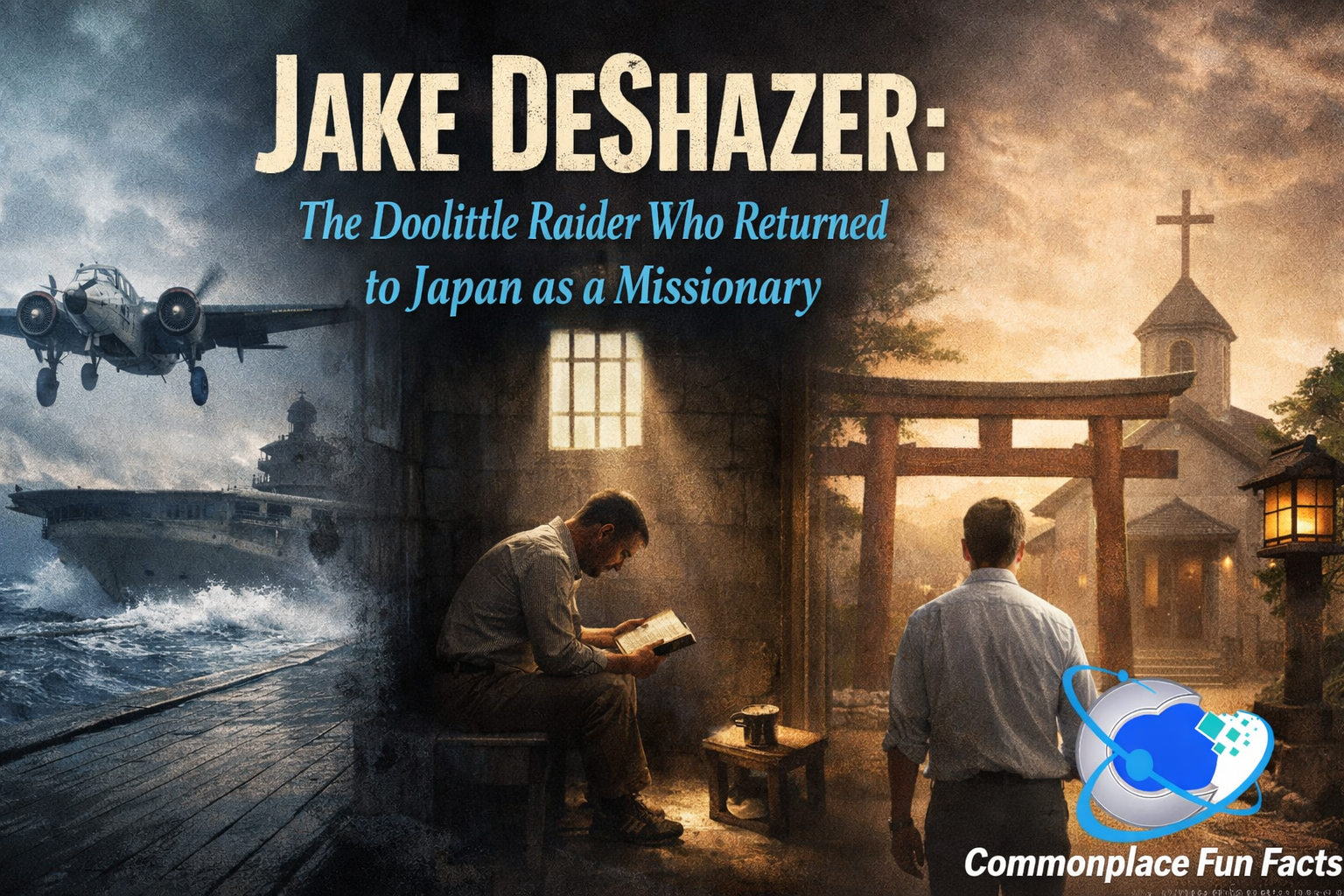

Some spiritual transformations begin in a church, accompanied by gentle piano music and a gentle nudge from a pastor.
Jake DeShazer’s begins with Pearl Harbor, rage, a propelled potato, and a promise of vengeance.
On December 7, 1941, Jacob “Jake” DeShazer—a young member of the Army Air Corps from Oregon—was in the kitchen of a mess hall doing something gloriously un-heroic. He was peeling potatoes when he heard the news that Japan had attacked Pearl Harbor. His response was anything but subtle. He was enraged and threw a potato against the wall. He vowed, “Japan is going to pay for this!”
Which, in fairness, was not an uncommon mood in the United States that day. If you’re looking for a moment when a nation collectively clenched its jaw, that was one.
Jake had grown up in a Christian home, but by adulthood he’d drifted away and—by his own later description—had become an unbeliever. The faith of his childhood was there somewhere in the attic, packed in a box marked “Old Stuff,” underneath a stack of worldly certainties and wartime anger.
Then history offered him a job opening: Do you hate what just happened and would you like to do something about it?
Contents
The Doolittle Raid: When America Struck Back
Jake didn’t have to wait long for history to present him with an outlet for that anger.

After Pearl Harbor, the United States did not simply need a military response. It needed a visible one. Not because sixteen bombers could topple an empire, but because morale is a strategic resource—and ours had just been introduced to the canvas.
So in the early months of 1942, barely four months after the shock of December 7, a plan emerged that felt half military strategy, half controlled audacity.
Lieutenant Colonel James “Jimmy” Doolittle—aviator, engineer, and the sort of man who looked at impossible and asked for a runway—assembled a volunteer force from the Army Air Forces’ 17th Bomb Group. The group flew B-25 Mitchell medium bombers, twin-engine aircraft not designed for aircraft carrier decks. The objective was simple to say and complicated to survive: launch sixteen of these bombers from a Navy carrier, strike targets in Japan itself, and then continue westward to China.
No one had flown a medium bomber off a carrier before.
Naturally, that meant they would try.
Jake was serving as a bombardier with the 34th Bomb Squadron of the 17th Bombardment Group. At the time, his B-25B was stationed at Pendleton Field in eastern Oregon. One day the commanding officer gathered the men and presented the proposal in terms that were far from sugar-coated.
“Any volunteers for an extremely dangerous mission?” he asked. “Step forward if you do. Chances are most of you won’t come back.”
It was exactly the sort of invitation most people pray they will never receive.
Jake later admitted that he briefly considered letting this “wonderful opportunity” pass. But then he noticed that everyone else had stepped forward. So he did too.
He was selected and assigned to Crew 16 aboard B-25B serial number 40-2268, nicknamed Bat Out of Hell. Which is either an expression of confidence or a warning label, depending on your perspective.
In mid-April 1942, the sixteen bombers were loaded aboard the USS Hornet and carried west across the Pacific. The plan was to launch closer to Japan, maximizing fuel for the escape into China. Instead, Japanese patrol boats sighted the task force earlier than expected. Surprise was compromised. The decision was made to launch immediately—roughly 170 miles farther from Japan than planned.
The margin for error had just evaporated.
One by one, the B-25s roared down the pitching deck of the carrier. Each aircraft had been stripped of unnecessary weight and most defensive armament to preserve fuel. Fully loaded with bombs, medium bombers lifted off a Navy deck in a maneuver that blended skill, nerve, and a refusal to think about the water directly ahead.
All sixteen made it airborne.
The Raiders hit targets in cities including Tokyo and Nagoya. The physical damage was limited. This was not the decisive blow that ended a war. It was something arguably more important at that moment: proof that the Japanese home islands were not untouchable.
Back home, Americans who had been absorbing bad news by the bucketful suddenly had something else to feel. Relief. Pride. A reminder that shock was not paralysis.

For Japan, the psychological effect cut in the opposite direction. The raid sparked anger, tightened defenses, and led to brutal reprisals against Chinese civilians accused of assisting downed airmen. The strategic ripples would extend into planning decisions that shaped later battles, including Midway.
Then came the part that the headline rarely includes.
After completing their bombing runs, the crews were supposed to continue to friendly airfields in China. But the early launch had devoured their fuel cushion. Night fell. Weather worsened. Gauges drifted toward empty.
One by one, the crews bailed out or crash-landed over eastern China. Fifteen of the sixteen aircraft were lost. One landed intact in the Soviet Union and was interned there for the duration of the war.
Most of the eighty airmen eventually reached safety with help from Chinese civilians and resistance fighters.
Eight did not. They were captured by Japanese forces. Jake was among them.
The Doolittle Raid was modest in military damage and immense in psychological force. It gave America a jolt of hope. It forced Japan to reconsider its defenses. It entered history books as an audacious strike.
For Jake, however, the raid was not an entry in a textbook. It was the door that closed behind him.
A mission meant to restore morale became the opening chapter of forty months as a prisoner of war—months that would dismantle his assumptions, confront his hatred, and ultimately redirect the entire course of his life.
From Heroic Raider to POW
Jake and the other seven captured Raiders were held briefly in occupied China before being transported to Japan. Within weeks of the raid, they found themselves in Tokyo—not in a regulated prisoner-of-war camp, but in the hands of military police determined to extract information and secure confessions.
Their first taste of captivity was not orderly detention. It was interrogation.
And by “interrogation,” we mean a systematic effort to dismantle a human being: days without sleep, relentless questioning, threats, and physical torture. Robert L. Hite later described being held down while water was poured into his nose.
This was not random brutality. It was policy.
Part of what made Japanese captivity so brutal in the Pacific War was cultural doctrine. Japanese military ideology treated surrender as dishonor. The logic—warped but internally consistent—was that if surrender is shameful, then a surrendered enemy is contemptible. Prisoners were not merely defeated opponents. They were failures of the warrior code.
That worldview had consequences.
The eight were starved. They were beaten. They were isolated. They were treated not as captured soldiers, but as criminals.
After weeks of deprivation, they were pressured into signing “personal history” statements written in Japanese—documents later presented as confessions of war crimes. Eventually, they were transferred to a military prison in Shanghai and placed together in a common cell.
They were exhausted. Malnourished. Sick.
One image lingers: rice crawling with worms. When some of the men refused to eat it, Chase Nielsen swallowed it down and announced that the worms contained protein and he intended to survive long enough to tell the world what was being done to them.
That is more than optimism. It is spite with a purpose.
In August 1942, the eight Americans were brought before a Japanese military court. The proceedings were conducted entirely in Japanese. They were accused of intentionally targeting civilians during the raid.
They were convicted.
Classified as war criminals.
Sentenced to death.
Two months later, three of the captured Raiders—Lt. Dean Hallmark, Lt. William Farrow, and Sgt. Harold Spatz—were executed. Jake was forced to watch as the three were forced to bend over a cross to which they had been tied. Executioners ended their lives with shots from behind.
Oddly, Jake, the crewman who actually released the bombs, was spared execution. He would never learn why this occurred.
The remaining five, including Jake, had their sentences commuted to life imprisonment. They later learned that if Japan won the war, they would likely be used as forced labor; if Japan lost, execution still hovered as a possibility.
Why some were spared and others were not was never clearly explained.
They disappeared into prison cells. Their families back home did not know whether they were alive. They did not know where they were held. They did not know whether the next telegram would deliver finality.
Jake’s father would sometimes bow his head before meals and wonder aloud whether his son had anything to eat. On occasion, the thought stopped the family from eating at all.
Prison life hardened into routine.
The men would ultimately spend roughly forty months in captivity. Much of that time—about three years—was solitary confinement. Cells with high windows. Walls. Silence. A narrow stool. No meaningful sense of whether the day outside was bright or gray.
Solitary confinement is often described in clinical terms: sensory deprivation, cognitive strain, social isolation.
The lived version sounds different: boredom, rats, insects, beatings, silence, memory, and the question that gnaws at the edge of the mind—what happens to you when you are alone with yourself long enough?
Unfortunately, Jake wasn’t completely alone. The guards assigned to him made his life miserable. One in particular seemed to take a special delight in being cruel. He forced Jake to spend hours each day seated on a narrow bench, staring straight ahead at a wall. If he so much as glanced in either direction, the guard beat him mercilessly.
Jake was permitted to go out to exercise for a few minutes each day. In the winter months, he did this barefoot in the snow. On one of those days, his guard was in a hurry and pushed Jake into his cell. Jake’s feet, numb with cold, stumbled, and he got one of his feet stuck on the door jamb. The guard repeatedly slammed the heavy metal door against Jake’s foot, sneering at him with undisguised hatred as he did so.
When you remove the world, the mind begins rummaging through storage. Jake had brought hatred into his cell, and his time in solitary confinement gave it uninterrupted time to multiply.
The Book That Shouldn’t Have Mattered — But Did
On December 1, 1943, one of the remaining prisoners, Lt. Robert Meder, died from beri-beri and malnutrition.
His death alarmed the prison authorities—not necessarily out of compassion, but out of concern. Dead prisoners are inconvenient. Dead prisoners raise questions. Dead prisoners turn into paperwork. So the treatment of the remaining men improved slightly: an extra blanket, better food, and something they had longed for—books.
One of those books was a Bible.

The arrangement was not generous. The Bible was shared among the remaining four men, and each man had only a brief window—about three weeks—to read it before it had to be passed along.
Under normal circumstances, three weeks with a Bible might produce a few underlined verses and some guilt about not finishing Leviticus.
Under these circumstances, it became an intellectual and spiritual lifeline.
The four men began reading it seriously—Psalm 23 as a starting point, then the Gospels as the center.
When it was Jake’s turn, he devoured the Bible, reading it cover-to-cover. Passages that had previously been completely unknown to him suddenly became captivating. He memorized the Sermon on the Mount. For Jake, the turning point was not merely “religion” in the abstract. It was the words of Jesus—especially the words spoken from the cross, words that sound like lunacy if you’ve never been harmed: forgive them.
Jake’s life had become a factory for bitterness. Friends executed. A slow grind of humiliation and pain. A system built to convince him he was less than human.
And then, in that environment, he encountered a set of teachings that asked him to do the opposite of what his instincts screamed: to forgive.
On June 8, 1944, in his cell, Jake bowed his head and prayed. The gist of his words:
“Lord, You know all things. You know I do repent of my sins. Even though I am far from home and though I am in prison, I must have forgiveness.”
That is not a prayer written for public relations. It’s not polished. It’s not theatrical. It’s the kind of sentence you say when you’ve reached the end of yourself and all that remains are guilt, despair, and a desire for mercy.
From that point, Jake’s inner posture began to change. Not his circumstances. Not the walls. Not the guards. But something inside him pivoted—from vengeance and hatred to forgiveness and a strange, unsettling compassion.

One of the other men later described how Jake’s thinking changed after reading the Bible, how his faith became real rather than inherited, and how the change was obvious to the others.
For Jake, it was as if a massive weight had been lifted from him. For the first time since being taken prisoner—in fact, for the first time he could ever remember—he felt safe.
It’s worth noticing what did not happen here. Jake was still a prisoner and was living under horrible conditions with no real expectation that he was going to get out of there alive. He did not become delusional about captivity. He did not decide the beatings were good. He did not pretend the Japanese prison system was secretly a wellness retreat with bad branding.
In other words, nothing changed about his circumstances. What changed was his knowledge of how ultimately unimportant those circumstances were for him.
Forgiveness in an Unforgiving Cell
If only something could happen to change his guards. Despite Jake’s internal transformation, the conditions in his prison continued to be beyond horrible. If anything, they were getting worse. His guards continued their cruel and sadistic treatment, refusing to let up for even a moment.
After one particularly difficult encounter with his least-favorite guard, Jake found himself having a pity party. A lot had changed in his life, but that hatred he carried into Japan was still there. Every encounter with his guards reminded him why that hatred was justified. Even so, he knew in his heart that this wasn’t acceptable.

Finally, in desperation, he spoke to the only one who could hear him. He said, in effect, “Jesus, You said I’m supposed to love my neighbors. But the only neighbors I have here are my guards, and I don’t love them. In fact, I hate them. But You said I’m supposed to love them. I want to be obedient to You, but the only way that’s going to happen is if You put that love in my heart. Can You make me love my guards?”
He said the transformation was instantaneous. One moment he was consumed with hatred and self-pity about his horrible circumstances, and the next moment he found himself praying, “Lord, please don’t be hard on my guards. The only reason they act the way they do is because they don’t know You. What a tragedy that no one has ever told them about You! Would you please send someone to tell my guards about You?”
He said in that moment he heard a response to his prayer: “Well, Jake… What about you? Will you tell your guards about Me? And while we’re on the subject, if I get you out of here, do you think you’d be willing to come back and tell this nation about Me?”
There was no hesitation on Jake’s part. He later testified, “I found my bitter hatred changed to loving pity! … With His love controlling my heart, the 13th chapter of First Corinthians took on a living meaning.”
In that moment, his life changed. Little did he realize how much that moment would change the lives of so many others.
The War Ends and a New Chapter Begins
Jake was committed to telling his guards about Jesus, but he had a bit of a problem: he didn’t know how to speak Japanese. He decided the best way to start the conversation would be to start treating them with respect. The surprised guards noticed the difference and slowly began responding in similar fashion. He started to learn a few words of Japanese and used those words to express respect and forgiveness. The guards were surprised, confused, and intrigued.
The summer of 1944 was reportedly the hottest on record in Nanking, and the following winter was the coldest. The prison environment was still brutal, still monotonous, still designed to erase personality.
There were small moments that reminded the men the war was still happening. On Christmas Day, the remaining Raiders were jubilant when American planes bombed a nearby oil refinery. For a moment, it sounded like rescue. It sounded like justice. It sounded like an ending.
The planes did not come back for them.
So life returned to what it did best: months of repetition.
In June 1945, the prisoners were abruptly moved to Peking. They were blindfolded, handcuffed, and shackled—transported like dangerous cargo. In the new prison, each man was forced to sit on a narrow stool facing the wall. Alone. Again.
And yet, this is where the transformation becomes startlingly practical.
When guards were occupied, Jake and Bobby Hite could communicate briefly—through a shared toilet between their adjoining cells. It’s an image that feels too undignified to be symbolic, which is probably why it’s perfect: faith passed through the least glamorous pipeline available.
Jake told Hite that he’d been praying that morning and believed the war would be over that day—something had been “revealed” to him. Hite later recalled strange behavior from the guards in early to mid-August: odd questions, unusual routines, haircuts and shaves, a sense that the machine was wobbling.
Then, on August 17, 1945, an OSS team parachuted into an airfield near Peking with orders to accept surrender and ensure prisoners were released.
The captors finally opened the cell doors. Their explanation for releasing them was self-serving: they claimed they were doing it because their hearts were kind. The prisoners, wisely, did not argue theology with people who had spent the last forty months kicking them around.
They were taken to a hotel and learned, with a disbelief that must have felt like vertigo, that Japan had surrendered and they were actually free.
Food appeared. Irish stew. Cake. Milk. The kind of meal that makes you wonder if your dreams developed tastebuds.
A Letter from Walter Reed
The most important evidence that Jake’s conversion was not a prison-born mood swing is what happened next.
After returning to the United States and receiving care at Walter Reed Hospital, Jake wrote a letter to his parents. It was not a letter about revenge. It was not a letter about how he planned to spend the rest of his life hunting down former captors like a one-man sequel nobody asked for.
It was a letter about God.
He told them that God had spoken to him in solitary confinement, and that he wanted to go to missionary school and return to help the people of the East. He wrote that he had learned to pray and obey God in solitary cells. He thanked his parents for their prayers, their care, and their forgiveness.
It is difficult to overstate how unexpected this was.
People come out of war with all kinds of scars—physical, psychological, moral. Many carry hatred for the rest of their lives and consider it justified. Jake DeShazer walked out of a Japanese prison and announced that he wanted to go back, not as an avenger, but as a missionary.
That decision did not erase what happened to him. It didn’t resurrect the executed. It didn’t rewrite the abuse into something palatable.
But it did mean that the final chapter of his story would not be authored by the worst people he ever met.
Returning to Nagoya — This Time Without Bombs
It is one thing to forgive your enemies from the safe distance of a victory parade.
It is quite another to buy a one-way ticket and go live among them.
Six weeks after returning to the United States, Jake was out of the Army and enrolled at Seattle Pacific College. Going from solitary confinement to a college classroom is not a transition anyone prepares you for in basic training. He was thin. His speech was monotone from prolonged isolation. His diction still bore the marks of someone who had spent years without normal conversation.
And yet he was focused.
He spoke in churches nearly every weekend. Crowds came to hear the former prisoner of war describe torture, faith, and forgiveness. People expected anger. They often found something else entirely.
Somewhere in those classrooms he also met Florence Matheny, a former teacher from Iowa who wanted to be a missionary. Florence was described as cheerful, talkative, quick with a smile. Jake had just endured years of staring at walls. This was, perhaps, a welcome contrast.

They married. He continued his education, including theological training. And then he did what, on paper, looked mildly insane.
In December 1948, Jake and Florence landed in Yokohama, Japan as missionaries.
He did not settle in a remote village where anonymity would cushion history. He went to Nagoya — the very city he had bombed during the Doolittle Raid.
Imagine being one of his neighbors and learning that the friendly American missionary once flew over your city in a bomber.
History does provide this level of symmetry.
Jake’s ministry in Japan was not a short-term tour designed to satisfy a good intention and then retreat. He and Florence would serve there for decades, planting churches and building relationships in a nation that, only a few years earlier, had imprisoned him.
And then came one of the most unsettling details in his story.
The Japanese judge who had presided over the trial of the Doolittle Raiders—the proceedings that condemned three of his friends to execution and sent the others into years of brutal captivity—was himself later sentenced to death as a war criminal.
Jake did not celebrate.
He campaigned for the judge’s pardon.
There are moments when forgiveness can still be dismissed as emotional vocabulary. This is not one of those moments. This is forgiveness as a measurable act. A public one. A controversial one.
He argued for mercy for the very man who had shown none to his closest friends.
If his earlier prayer in a prison cell was private repentance, this was applied theology.
Later, he would also form an unexpected friendship with Mitsuo Fuchida, the Japanese officer who had led the attack on Pearl Harbor. Two men whose lives had been set on collision by war eventually stood side by side sharing a message of reconciliation.
If you are tempted to call that poetic, go ahead. History sometimes earns the adjective.
What Solitary Confinement Really Did
Solitary confinement is designed to collapse a person inward.
Modern psychological research tells us that long-term isolation can distort perception, impair cognition, and unravel identity. Time blurs. Memory becomes louder than reality. Anger can crystallize into permanent architecture.
For Jake, solitary confinement did something paradoxical.
It stripped away distraction.
There were no headlines. No debates. No cultural reinforcement of his anger. No companions to help him rehearse grievances. There was a wall, a stool, and memory.
And eventually, a Bible.
Left alone long enough, he revisited the faith of his childhood—not because someone pressured him at a revival meeting, but because in isolation he had nowhere else to turn his thinking. The prison forced him to confront questions that ordinary life allows us to postpone indefinitely.
Who am I when everything is taken?
What survives when comfort disappears?
What do I do with hatred that has no outlet?
His conversion did not remove trauma. It reframed it. The beatings did not become blessings. The executions did not become footnotes. But forgiveness deprived them of ultimate control.
This distinction matters. Forgiveness is often misunderstood as moral amnesia. It is not forgetting. It is refusing to let harm dictate your future.
Jake emerged from prison with the same biography everyone else could see: tortured POW, survivor, victim of injustice. Internally, he carried something different: he no longer saw himself as defined by what had been done to him.
That shift redirected his life.
The Hard Question
A skeptical reader might reasonably ask whether forgiveness in such circumstances is naïve.
What if the war had ended differently?
What if his captors had executed him in August 1945 instead of opening the cell door?
Would forgiveness still have been worth it?
We cannot run the alternate timeline. History permits only one recording.
But we can observe this: forgiveness did not change Japanese military policy. It did not shorten the war. It did not rescue his friends from execution.
What it did change was Jake.
It altered the trajectory of his mind, then his choices, then his vocation, then the communities he influenced. It led him back to the nation he once bombed, not with ordnance but with conviction.
Forgiveness did not rewrite the past. It prevented the past from writing him.
That is not sentimental. It is strategic at the level of the soul.
From Rage to Return
On December 7, 1941, Jake DeShazer responded to Pearl Harbor with anger and a desire for retribution. That response was understandable, ordinary, and almost universal.
On June 8, 1944, alone in a cell, he bowed his head and asked for forgiveness.
On December 28, 1948, he stepped back into Japan—not as a combatant, but as a missionary.
Same man. Different interior world.
History books tend to measure wars in tonnage dropped and territory gained. They chart troop movements and casualty counts. They record who surrendered and who signed what document.
But sometimes the more consequential battles are invisible.
Just as Father Damien let his life live out his faith by living among lepers and ultimately becoming one himself, Jake DeShazer allowed the rest of his life to be spent in service.
Forty months in prison reshaped Jake DeShazer more thoroughly than basic training ever could. Solitary confinement, intended to break him, became the setting in which his thinking was dismantled and rebuilt.
He began the war determined that Japan would pay.
He ended it determined that he would give.
And that may be the most powerful victory of all.
You may also enjoy…

Father Damien: The Priest Who Lived—and Died—Among Lepers
Explore the inspiring true story of Father Damien, the Belgian priest who voluntarily served a Hawaiian leper colony, ultimately contracting the disease himself and becoming a global symbol of compassion, sacrifice, and unwavering faith.

Did William Shakespeare Help Translate the Bible? Psalm 46 Mystery Explored
Explore the fascinating theory that William Shakespeare left clues in the 46th Psalm that he helped translate the King James Bible.

How the Baby Ruth Candy Bar Influenced the Bombing of Hiroshima
The Baby Ruth candy bar, initially the Kandy Kake, emerged in 1921 after Chicago’s Curtis Candy Company revamped its recipe and branding. Named ambiguously after Ruth Cleveland, its success soared amidst intense competition. Its marketing stunts, including aerial candy drops, contributed to its rise, eventually leading to significant legal disputes with Babe Ruth.




Leave a Reply