

When people think about the causes of the French Revolution, they tend to picture dramatic scenes: mobs storming the Bastille, aristocrats fleeing in carriages piled high with luggage, and a sudden influx of income for anyone who happened to have stock in a guillotine manufacturing business.
But revolutions rarely begin with dramatic moments. They begin with smaller things. Things that seem mundane. Things like bread.
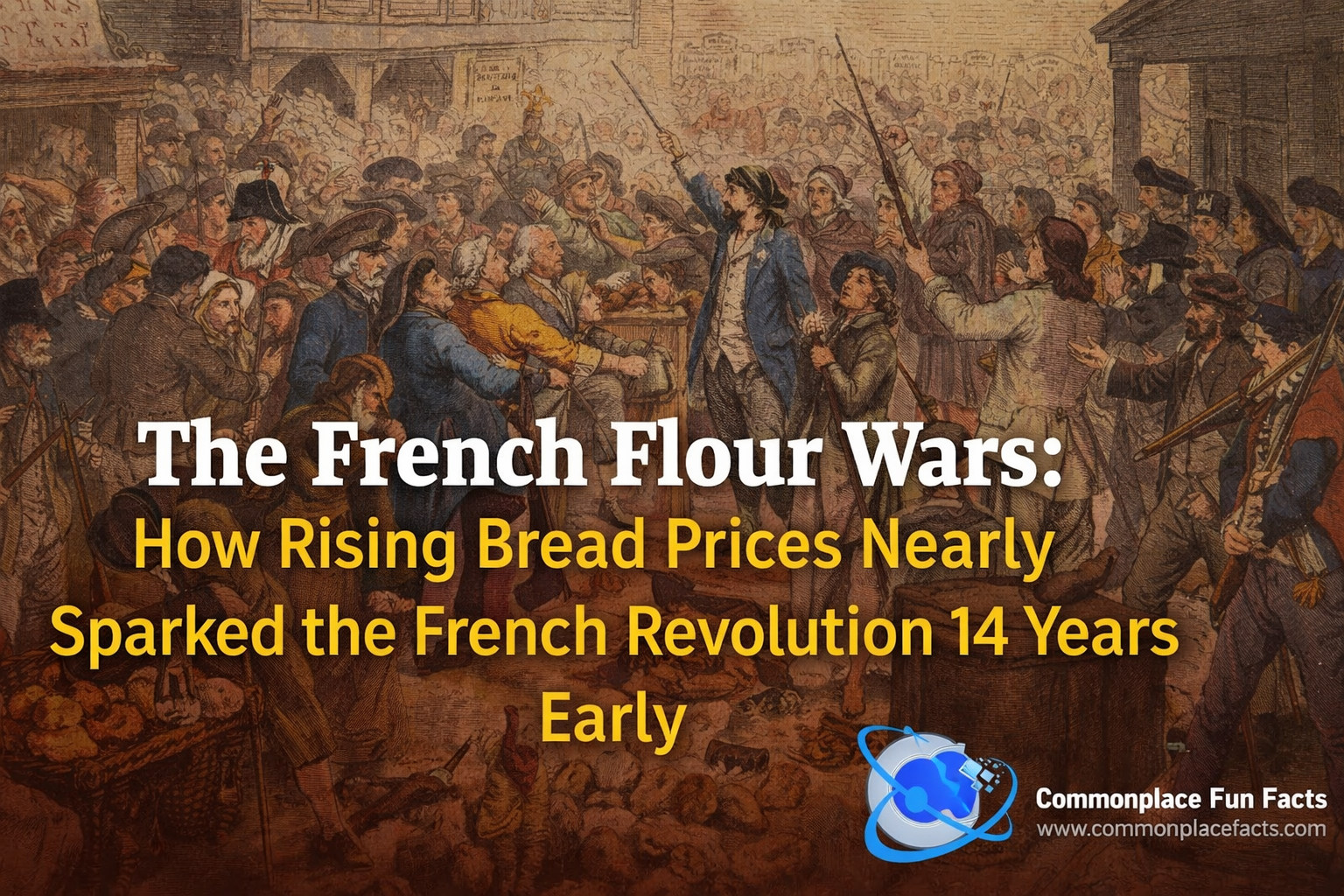
Years before the French Revolution erupted in 1789, France experienced a strange and fascinating crisis known as the Flour Wars. For a few tense weeks in the spring of 1775, large portions of the country descended into riots, wagon seizures, market confrontations, and public unrest—all over the price of flour.
This was not merely a dispute about baking ingredients. In eighteenth-century France, bread was the cornerstone of daily survival. When the price of flour spiked, it wasn’t an inconvenience. It was a national emergency that almost triggered the French Revolution a few years early.
Contents
Bread Was Life
Modern grocery stores give us a dangerous illusion that food is plentiful and interchangeable. If bread prices rise, we buy pasta. If pasta prices rise, we buy rice. If rice prices rise, we stare at the shelf for thirty seconds and then buy frozen pizza.
Life in eighteenth-century France did not offer that kind of flexibility.
Bread formed the core of the diet for the majority of the population. Laborers, craftsmen, and peasants relied on it not just as a side dish but as their primary source of calories. A working family could spend up to half of its income on bread alone.
When bread prices rose, the consequences were immediate. A spike in grain prices meant hunger, unrest, and fear.
In other words, bread was not merely food. It was social stability baked into loaf form.
A Young King and a Bold Economic Experiment
The story begins shortly after Louis XVI became king of France in 1774. The young monarch inherited a kingdom with enormous financial problems, an outdated tax system, and a government that was perpetually short of money.

To address these issues, Louis turned to a reform-minded economist named Anne Robert Jacques Turgot, who served as Controller-General of Finances.
Turgot had a bold idea.
France had long regulated the grain trade. The government controlled pricing, restricted movement of grain between regions, and intervened heavily in markets to prevent shortages and price spikes.
Turgot believed this system was inefficient. Influenced by a group of economic thinkers known as the Physiocrats, he argued that the grain market should operate freely.
In theory, removing government controls would allow grain to flow more easily to areas where it was needed. Prices would stabilize naturally through supply and demand.
On paper, it was a reasonable argument.
Unfortunately, reality had other plans.
Timing Is Everything (And This Was Terrible Timing)
Turgot’s reforms went into effect in 1774.
Almost immediately, France experienced poor harvests.
This created the perfect storm. Grain supplies tightened just as price controls disappeared. The price of flour rose sharply, and bread became increasingly expensive.
To economists, this might look like a temporary market adjustment. To hungry families, it looked like a disaster.
Worse still, many people assumed the rising prices were not the result of market forces but of deliberate manipulation. Rumors spread quickly that wealthy merchants and officials were secretly hoarding grain in order to drive up prices.
This alleged conspiracy became known as the “Famine Pact.”
Whether the theory had any basis in reality mattered less than the fact that large numbers of people believed it. Once the idea took hold that elites were profiting from hunger, public anger began to spread.
The Flour Wars Begin
By the spring of 1775, tensions had reached a breaking point.
Beginning in April, riots erupted across northern France, particularly in the grain-producing regions around Paris. Over the next several weeks, disturbances spread through dozens of towns and villages.

Crowds began intercepting wagons carrying grain or flour. In some cases they seized the cargo and forced merchants to sell it at what they considered a fair price.
Markets became scenes of confrontation. Bakeries were surrounded. Storehouses were raided.
Interestingly, many of these actions were not random acts of looting.
Participants often insisted on paying for the grain—but at a price they considered just. In their minds, they were not committing theft. They were enforcing fairness.
Historians sometimes refer to this as the “moral economy.” People believed essential goods like bread should have a reasonable price, and they felt justified in intervening if the market failed to provide one.
To the crowds, they were restoring justice.
To the government, they were rioting.
The Crown Responds
Faced with growing unrest, the royal government responded with force.
Louis XVI ordered tens of thousands of troops into the affected regions. Soldiers restored order, guarded grain shipments, and dispersed crowds.
Authorities arrested several participants and made examples of a few ringleaders through public executions.
The unrest gradually subsided, but the political damage had already been done.
The crisis exposed how fragile public trust had become. Even well-intentioned reforms could trigger widespread suspicion if they threatened people’s access to food.
The Fall of Turgot
Turgot continued to pursue reforms for a short time after the Flour Wars, but opposition was mounting.
Many nobles disliked his attempts to modernize the economy. Court factions opposed his policies. The unrest of 1775 made him even more politically vulnerable.
In 1776, less than two years after taking office, Turgot was dismissed.
His reforms largely collapsed.
France returned to a system of heavy regulation and government intervention in the grain market.
But the deeper problems facing the kingdom had not been solved.
A Warning Sign Before the Revolution
Looking back, the Flour Wars of 1775 feel like a warning tremor before a much larger earthquake.

They revealed how quickly economic stress could turn into political unrest. They exposed deep distrust between ordinary people and the ruling elite. They showed how dangerous it could be to tamper with something as fundamental as the food supply.
Fourteen years later, when bread prices surged again in 1789, the resulting unrest would help ignite the French Revolution. By that point, frustration had accumulated far beyond the price of flour.
It was during this atmosphere of desperation that one of history’s most famous quotes supposedly entered the story. According to legend, when told that the peasants had no bread, Queen Marie Antoinette responded, “Qu’ils mangent de la brioche.” (“Let them eat cake.”) The phrase—actually referring to brioche, a richer and more luxurious bread—was almost certainly never spoken by the queen. The line appears in the writings of Jean-Jacques Rousseau years before Marie Antoinette had even set foot in France. Still, the story stuck. It survived not because it was true, but because it perfectly captured what many people already believed about the royal court: that the people running the country were living in a completely different world from those who could no longer afford dinner.
Governments can survive many kinds of controversy. They can weather ideological disputes, political scandals, and policy disagreements.
What they struggle to survive is widespread hunger.
When Calories Become Politics
The Flour Wars offer a useful reminder that economics is not just about numbers. It is about survival.
When half of your income goes toward bread, the price of grain is not an abstract market signal. It is the difference between eating and going hungry.
That reality turns food into a political issue faster than almost anything else.
Across history, societies have reacted violently when staple foods become scarce or unaffordable. Ancient Rome maintained massive grain distributions to keep the population calm. Governments throughout history have regulated bread prices for the same reason.
The French monarchy discovered the consequences of ignoring that pattern.
A reform that may have been economically sound collided with a society that simply could not afford to wait for market forces to work things out.
And when dinner disappears, patience tends to disappear with it.
The Persistent Myth of the All-Powerful Leader
One of the most interesting aspects of the Flour Wars—and the bread crises that followed in 1789—is how closely the public reaction resembles something we still see today. When prices rise on everyday necessities, people naturally want someone to blame. In eighteenth-century France, that blame often landed on merchants, grain traders, or shadowy conspiracies supposedly hoarding flour. Today, the instinct often lands on whoever happens to occupy the Oval Office.

Modern voters frequently assume that the President of the United States can personally set the price of a gallon of gasoline or the cost of a dozen eggs. In reality, fuel costs are influenced by global oil markets, international production decisions, refinery capacity, transportation costs, and geopolitical events. Egg prices depend on feed costs, disease outbreaks in poultry flocks, supply chain disruptions, and consumer demand. These systems involve thousands of producers and millions of transactions moving through complex global markets. No president has a dial on the Resolute Desk labeled “Gas Prices.”
That does not stop voters from acting as if such a dial exists. Fairly or not, economic conditions—especially the cost of everyday necessities—often become a referendum on whoever is in charge. If gasoline prices spike or groceries suddenly cost more, the political consequences can be swift and dramatic. Elections are frequently shaped less by the intricacies of economic policy and more by the simple question voters ask themselves in the checkout line: “Am I paying more than I used to?”
Frequently, it is government interference with the free market that drives down the supply and forces the increase in prices. Political response to the expectation of voters often creates the very problem that voters think the government should be able to solve.
In that sense, the angry crowds seizing grain wagons in 1775 were responding to the same instinct that drives modern political frustration. When dinner becomes more expensive, people assume someone must be responsible. Whether the culprit is a grain merchant in eighteenth-century France or an elected official in Washington, the human impulse to connect rising prices with leadership remains remarkably consistent.
A Loaf of Bread and the Fate of a Kingdom
The Flour Wars of 1775 did not topple the French monarchy. The riots subsided, the troops restored order, and life moved on—at least for a while. But the episode revealed something that would become painfully clear fourteen years later: France was far more fragile than its rulers realized.
The crisis showed how quickly public trust could evaporate when basic necessities became scarce. It exposed how easily rumors and conspiracy theories could flourish when people were hungry. Most importantly, it demonstrated that economic policies that make perfect sense in theory can ignite fury if they collide with everyday survival.
In hindsight, the Flour Wars look less like an isolated disturbance and more like an early rehearsal for the upheaval that would come in 1789. The crowds, the anger over bread prices, the suspicion toward elites, and the desperate demand for food would all return—this time on a much larger stage.
France began its long, proud tradition of protesting whenever anything gets under people’s skin, including such landmark moments in civil rights as the time waiters went on strike over the right to wear mustaches and civil disobedience over the Paris law that required women to get permission from the police before wearing pants.
History often treats revolutions as the result of grand ideas and philosophical debates. Those things certainly mattered in France. But as the Flour Wars remind us, revolutions are just as often fueled by something much simpler.
Sometimes the fate of a government can hinge on nothing more complicated than the price of a loaf of bread.
You may also enjoy…

When Waiters Went on Strike Over the Right to Wear a Mustache
Protests. What a great way to express disapproval and raise public awareness about society’s most significant evils. For that matter, it’s a great way to waste a lot of time making a fuss about stuff that is rather silly, and if that interests you, then you’ll want to read this article about some of history’s…

The 213-Year-Old Paris Law That Made Women’s Pants Illegal
Learn about the Paris law that existed for 213 years, requiring women to receive permission to wear pants.

France’s Brief Experiment With Decimal Time
The French Revolutionary Calendar, introduced during the Revolution, abolished traditional dates, aligning them with nature and decimal time. Emphasizing new agricultural names, it aimed to sever ties with the Church and monarchy. However, unpopularity due to confusion, labor complaints, and practicality led to its eventual abandonment by Napoleon in 1806.





Leave a Reply