
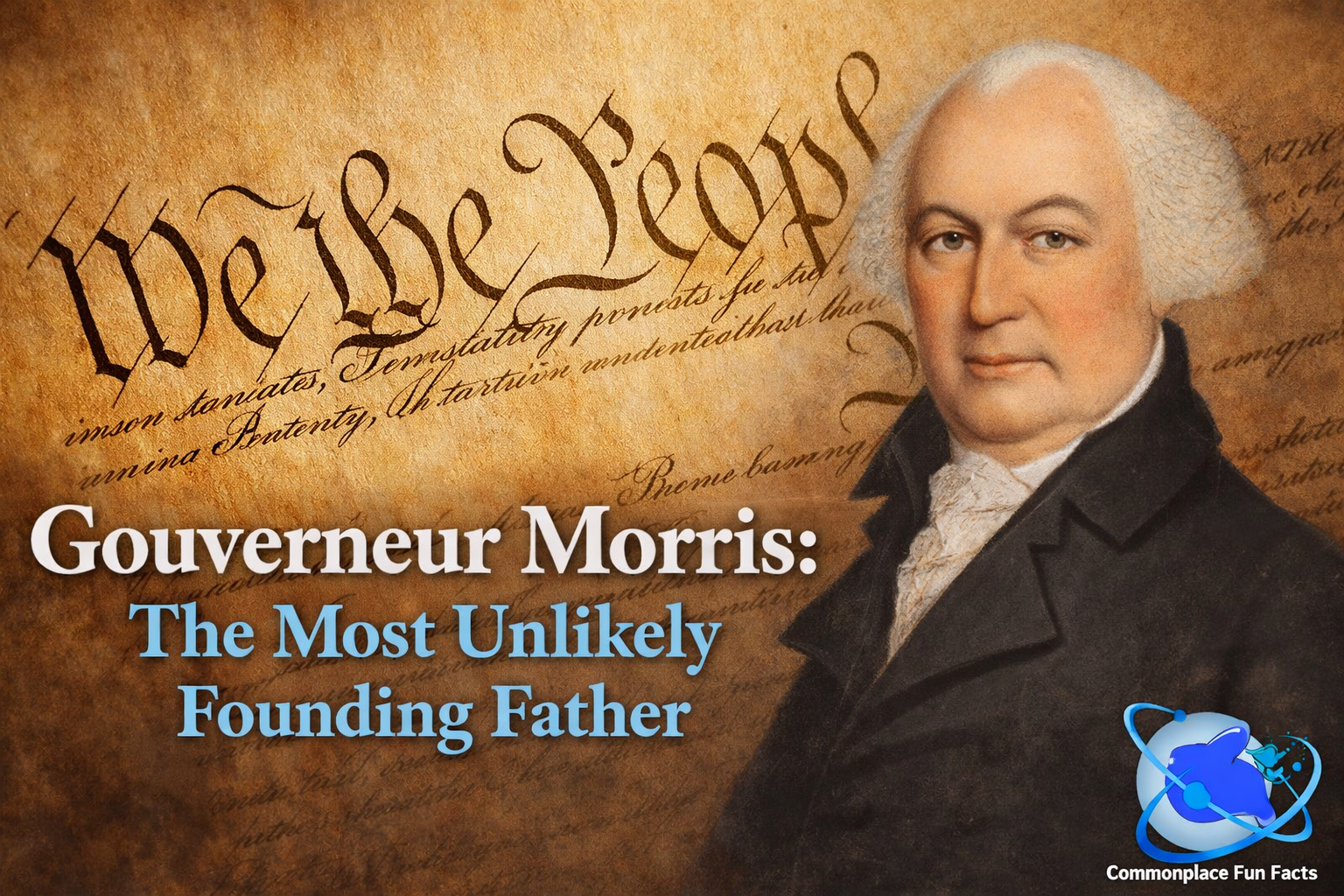

When most people think of the Founding Fathers, they picture the usual lineup: Washington looking solemn, Adams looking as though someone has just mildly inconvenienced him on principle, Jefferson gazing off as if composing a sentence he fully intends to revise later, and Franklin wearing the unmistakable expression of a man who just made a joke at your expense and is enjoying the moment you realize it.
And then we have Gouverneur Morris. He doesn’t fit neatly into that tableau. In fact, you likely didn’t include him in your mental lineup at all.
He sounds less like a Founder and more like the name of a villain in a period drama or the man who owns the railroad in a town where mustaches are legally binding. He was aristocratic, outspoken, brilliant, vain, witty, politically indispensable, socially reckless, and equipped with a wooden leg. He helped write the Constitution, probably did more than anyone else to give it its final voice, and then somehow slipped out of the public imagination while lesser personalities hogged the spotlight.
That’s a shame, because if the Founding Fathers were a movie cast, Gouverneur Morris would be the character actor who steals every scene, walks off with the best lines, and leaves the audience muttering, “Why was that guy not the star?”
Contents
A Name That Sounds Made Up by an Overconfident Novelist
Let us begin with the obvious: Gouverneur Morris had one of the most aggressively upper-crust names in American history. He was born on January 31, 1752, at Morrisania, the family estate in New York, into wealth, influence, and the sort of social standing that tends to produce men who assume they should be in charge of things. In his case, the assumption was not entirely unreasonable.

He attended King’s College, now Columbia University, and graduated when he was 16 years old—an age when most teenagers are still making catastrophic decisions involving hairstyles. He studied law, displayed a formidable intellect early, and entered public life before the Revolution had fully boiled over. Morris was no rustic man of the people. He was polished, educated, and very much a member of the colonial elite.
That background made his support for independence more notable. Plenty of well-born New Yorkers remained loyal to Britain. Morris did not. He joined the revolutionary cause and quickly established himself as a gifted writer and speaker. He helped draft New York’s first state constitution in 1777 and served in the Continental Congress. Before long, he had become one of those irritatingly capable people who seem to show up whenever a complicated document needs to be written and everyone else is too tired to do it properly.
He gained a reputation for aristocratic tendencies, which, to be fair, he absolutely had. Morris tended to believe that government worked best when filtered through people of education, property, and what he would have called character. Modern readers may find some of his opinions prickly, elitist, or capable of causing a small electrical fire in a comment section. They would not be wrong.
A Young Revolutionary with an Old Head on His Shoulders
In 1776, when the American colonies formally declared independence from Great Britain, Gouverneur Morris was just 24 years old. While most people today spend their mid-twenties figuring out how to keep houseplants alive and whether they chose the correct career path, Morris was already knee-deep in the political upheaval that would produce a new nation.
By that point, he had graduated from King’s College, studied law, and entered public life. He was already serving in New York’s revolutionary government and would soon help draft the New York State Constitution of 1777—an impressive résumé item for someone who technically still qualified for discounted theater tickets.
A Healthy Suspicion of Human Nature
Morris believed in independence, but he was not under any illusions about human nature. Where some of his contemporaries saw democracy as a kind of civic sunshine that would naturally produce good outcomes, Morris suspected it could just as easily produce chaos if left unattended.
He distrusted mob rule, worried about political instability, and believed government needed structure strong enough to survive the very passions that had fueled the Revolution. This gave him a reputation for aristocratic tendencies—which, to be fair, he absolutely had—but it also made him one of the more clear-eyed thinkers of the founding generation.
Morris was not particularly impressed by revolutionary enthusiasm when it came wrapped in instability. As he observed in his diary, “The people are generally too ill-informed to exercise authority.” This was not the sort of line that wins you popularity contests during a revolution, but it does tend to age well.
Morris did not assume people would behave well simply because they were free. He assumed they would behave like people—impulsive, self-interested, occasionally noble, and frequently not—and he thought the Constitution should be built with that in mind.
The Loudest Man in the Room, and Possibly the Smartest
At the Constitutional Convention in Philadelphia, Morris did not exactly fade into the wallpaper. He spoke more often than any other delegate. James Madison took meticulous notes, and the surviving record shows Morris rising again and again to argue, propose, object, revise, and generally make himself impossible to ignore.

This was not mere love of hearing himself talk, though one suspects he was not immune to that pleasure. Morris had substance to go with the performance. He argued forcefully for a stronger national government. He favored an energetic executive. He wanted national institutions robust enough to hold the country together. He was not there to produce a gentle pamphlet about cooperation and good vibes.
He was also one of the Convention’s sharpest critics of slavery. Morris denounced it with unusual bluntness, calling it a “nefarious institution” and attacking the hypocrisy of a republic built on liberty while allowing human bondage. That did not make him a modern egalitarian in every sense, and it would be silly to pretend otherwise. The eighteenth century was not exactly a factory for clean moral consistency. Yet on slavery, Morris was strikingly clear-eyed and far ahead of many of his peers.
He also had the useful habit of saying things in memorable ways. Some people at the Convention were architects of compromise. Morris was more like the man with the crowbar, prying ideas loose and forcing everybody to deal with them.
Samuel Adams, Thomas Paine, and Gouverneur Morris: Agitators and Architect
If the American Revolution were a construction project—and it very much was, just with more pamphlets and fewer hard hats—Samuel Adams, Thomas Paine, and Gouverneur Morris would not have been competing for the same job. Adams would have been outside rallying the crowd, handing out torches, and making sure everyone understood exactly why the old structure needed to come down. Paine would have been standing on a crate nearby, delivering a speech so persuasive that people who had arrived merely curious suddenly felt morally obligated to start swinging hammers. Morris, meanwhile, would have been inside with blueprints, insisting that whatever replaced the structure should not collapse the first time someone leaned on a wall.
Samuel Adams was, at his core, a political organizer. He understood how to move people—how to turn frustration into action and action into momentum. Thomas Paine performed a similar function, but with a pen instead of a network. His pamphlet Common Sense did not just argue for independence; it made independence feel inevitable, even obvious. Adams stirred the crowd. Paine gave the crowd its talking points. Together, they helped transform dissatisfaction into revolution.
Gouverneur Morris, on the other hand, approached politics like a man who had read the manual on human nature and found it deeply concerning. He believed in independence, but he had little patience for the idea that popular enthusiasm was a reliable governing principle. Where Adams and Paine saw the power of the people, Morris saw the volatility of the people. His focus was not on starting revolutions but on surviving them. He wanted structure, balance, and a government strong enough to endure the very passions Adams and Paine were so effective at unleashing.
The contrast is not a contradiction so much as a division of labor. Adams organized the resistance. Paine inspired it. Morris helped ensure that, once the dust settled, there would be something stable left standing. One specialized in ignition, one in persuasion, and one in containment. History, in its usual understated way, required all three.
The Man Who Gave the Constitution Its Voice
This is the part where Morris ought to be much more famous than he is.

Near the end of the Convention, once the delegates had fought their way through the big structural questions, the draft was handed over to the Committee of Style and Arrangement. That sounds like the sort of committee name designed to make everyone in the room sleepy. In practice, it mattered enormously. Someone had to organize the document, smooth the language, and turn a pile of compromises into something that sounded like a governing charter instead of the minutes from a very tense civic meeting.
Morris was the leading pen on that committee.
He did not invent the Constitution by himself. No serious person claims that. The Convention had already made the major decisions. Yet Morris appears to have done much of the final literary shaping, and in the process he gave the Constitution the voice by which the nation still knows it.
The most famous example is the preamble. Earlier drafts opened by naming the states individually. Morris helped transform that opening into the majestic and far more consequential phrase, “We the People of the United States.”
To put it differently, a great many people can quote Gouverneur Morris without having the foggiest idea they are quoting Gouverneur Morris. History is funny that way. It will let one man write the most famous words in the Constitution and then reward somebody else with the merchandise.
That change was not just cosmetic. It shifted the emphasis from a compact among states to a government grounded in the authority of the people as a whole. Three words in, Morris helped redefine the political theory of the document. Not bad for a man who most people today would mistake for the guy on the oatmeal box.
At first glance, Morris’s authorship of “We the People” seems almost contradictory. This was, after all, a man who openly warned that “the people are not to be trusted.” But Morris was not rejecting the people as the source of authority—he was rejecting the idea that authority should be exercised without structure. “We the People” was not a celebration of crowd rule; it was a statement of origin. The power of the government came from the people, but Morris was determined that it would be filtered through institutions sturdy enough to survive them. He believed in the people in the same way an engineer believes in gravity: essential, unavoidable, and best handled with careful design.
The Wooden Leg, Because of Course There Was a Wooden Leg
No profile of Gouverneur Morris is complete without mentioning the leg. It would be like writing about Napoleon and forgetting the hat.

In 1780, Morris suffered a severe carriage accident in Philadelphia. The injury crushed his leg so badly that it had to be amputated below the knee. For the rest of his life, he used a wooden prosthetic leg.
This would already be memorable enough. Morris, however, was not content to leave the matter in the safe hands of straightforward biography. Rumors circulated that the injury had happened under more scandalous circumstances, including the deliciously gossipy story that he had been escaping from a jealous husband and came to grief in the process. Historians generally treat the carriage accident as the reliable account, while the more dramatic version remains in the category of “possibly nonsense, but vintage nonsense.”
Either way, Morris did not retreat into obscurity or self-pity. He remained socially active, politically engaged, and, by most accounts, impressively undaunted. There are men who cannot recover emotionally from a disappointing appetizer. Gouverneur Morris lost part of a leg and kept attending history.
In this respect, he was not alone. Read “Santa Anna and the Lost Legs,” “The Unstoppable, Unapologetic, and Utterly Unhinged General Daniel Sickles,” and “Götz von Berlichingen of the Iron Hand: How a One-Handed Knight Became a Legend” for examples of other historical figures who capitalized on their prosthetic limbs.
An Adventurous Private Life, Because Restraint Was Never Really His Brand
Morris was not built for a quiet life of pious domestic invisibility. He was charming, flirtatious, worldly, and entirely capable of generating gossip wherever he went. His diaries and letters reveal a man who enjoyed female company with enthusiasm that could not fairly be described as moderate.
That trait followed him across the Atlantic.
In Europe, Morris moved through elite circles with ease. He had affairs, flirtations, and relationships that made his personal life a great deal livelier than the powdered portraits might suggest. Some Founding Fathers come down to us as marble busts with footnotes. Morris often reads more like a Regency character who wandered into American constitutional history by mistake.
His diary entries often read like a man keeping careful notes on both diplomacy and social engagements, sometimes in the same breath. A typical entry might record a political meeting followed by a “lively evening” with a certain lady and a departure “later than intended,” which is about as close as the eighteenth century came to a raised eyebrow in written form.
This is yet one more reason it is a shame that he is not better known today. He was not merely important. He was entertainingly important. He managed the rare feat of helping to design a republic while also maintaining a reputation that could be summarized as “brilliant, useful, and perhaps not to be left unattended at dinner parties.”
The American in Paris, Just in Time for Chaos
Morris went to Europe in 1789 and eventually became the United States minister to France, serving during some of the most dangerous years of the French Revolution. This placed him in Paris while the city was busy inventing new ways to prove that political idealism can go spectacularly off the rails.
Unlike some Americans who greeted the French Revolution with uncomplicated enthusiasm, Morris quickly became skeptical. He saw the instability, the violence, and the breakdown of restraint more clearly than many of his countrymen. His diaries from this period are extraordinarily valuable because they capture events in real time, with the observations of a man who was both politically acute and not easily fooled by rhetoric.
He watched the monarchy totter, society convulse, and the Revolution descend into bloodshed. He knew leading figures, navigated dangerous circumstances, and even assisted members of the French royal family and their allies in various ways. Being an American diplomat in revolutionary Paris was less a normal diplomatic posting and more a front-row seat to civilization having a nervous breakdown.
Morris was almost weirdly well suited for it. He had nerve, social grace, and a talent for remaining functional in a crisis. He also had the good sense to understand that slogans about liberty do not become harmless merely because they are shouted with conviction.
Why He Never Became a Household Name
Given all this, why is Gouverneur Morris not more famous?
Part of the answer is branding. Washington was the indispensable general. Jefferson wrote the Declaration of Independence. Franklin was Franklin, which is its own category. Madison became known as the Father of the Constitution. Morris, by contrast, was crucial but difficult to package. He was too elegant to be rustic, too blunt to be universally beloved, too complicated to become a schoolroom saint, and too entertainingly human to fit the tidy mythology Americans often prefer.
He also had the misfortune of being right in ways that are less cuddly than inspirational. A man who warns about popular passions, distrusts excessive democracy, condemns slavery, writes soaring prose, loses a leg, survives revolutionary Paris, and behaves like a high-functioning scandal generator is not easy to fit on a commemorative mug. The marketing department of history likes its heroes simpler.
Yet Morris deserves more notice precisely because he was not simple. He was one of the founders at their most revealing: brilliant, compromised, worldly, contradictory, indispensable, and impossible to reduce to a cartoon.
The Founding Father Who Sounds Most Like Fiction
There is something almost suspiciously overstuffed about Gouverneur Morris as a historical figure. He was a Gouverneur who never served as a governor. He was born rich, talked brilliantly, wrote beautifully, offended people freely, condemned slavery, helped shape the Constitution, gave us “We the People,” lost a leg, survived Paris during the Terror, and maintained a love life that suggests he never once mistook prudence for a virtue.
Had a novelist invented him, an editor might have advised cutting back a little.
That, however, is part of his appeal. Morris reminds us that the founding era was not populated by static marble saints but by vivid, eccentric, deeply flawed human beings. Some were wise. Some were reckless. Some were both before breakfast. Morris belonged emphatically in that last category.
He was not the most famous Founder. He may not even be the first one most people can identify in a lineup. Yet he was among the most important and certainly among the most colorful. The Constitution still carries his fingerprints. The preamble still carries his music. The history of the early republic still bears the mark of his restless intelligence.
For a man now remembered mostly by specialists, that is quite a legacy.
Then again, perhaps obscurity would have amused him. Gouverneur Morris does not seem like the sort of man who needed universal approval. He probably would have settled for knowing that when the moment came, he wrote the line everybody remembered.
You may also enjoy…

How a Little “Common Sense” Created the United States of America
Discover the pivotal role Thomas Paine’s “Common Sense” played in the formation of the United States of America.

Did George Washington’s Glasses Save American Democracy?
Learn how George Washington’s glasses played a key role in preventing the United States from becoming a monarchy.

Shakespeare’s Chair: How Adams and Jefferson Went on a Souvenir Hunt
Discover how John Adams and Thomas Jefferson found a souvenir from William Shakespeare’s chair. A story of diplomacy, history, and a bit of mischief!

Leave a Reply