
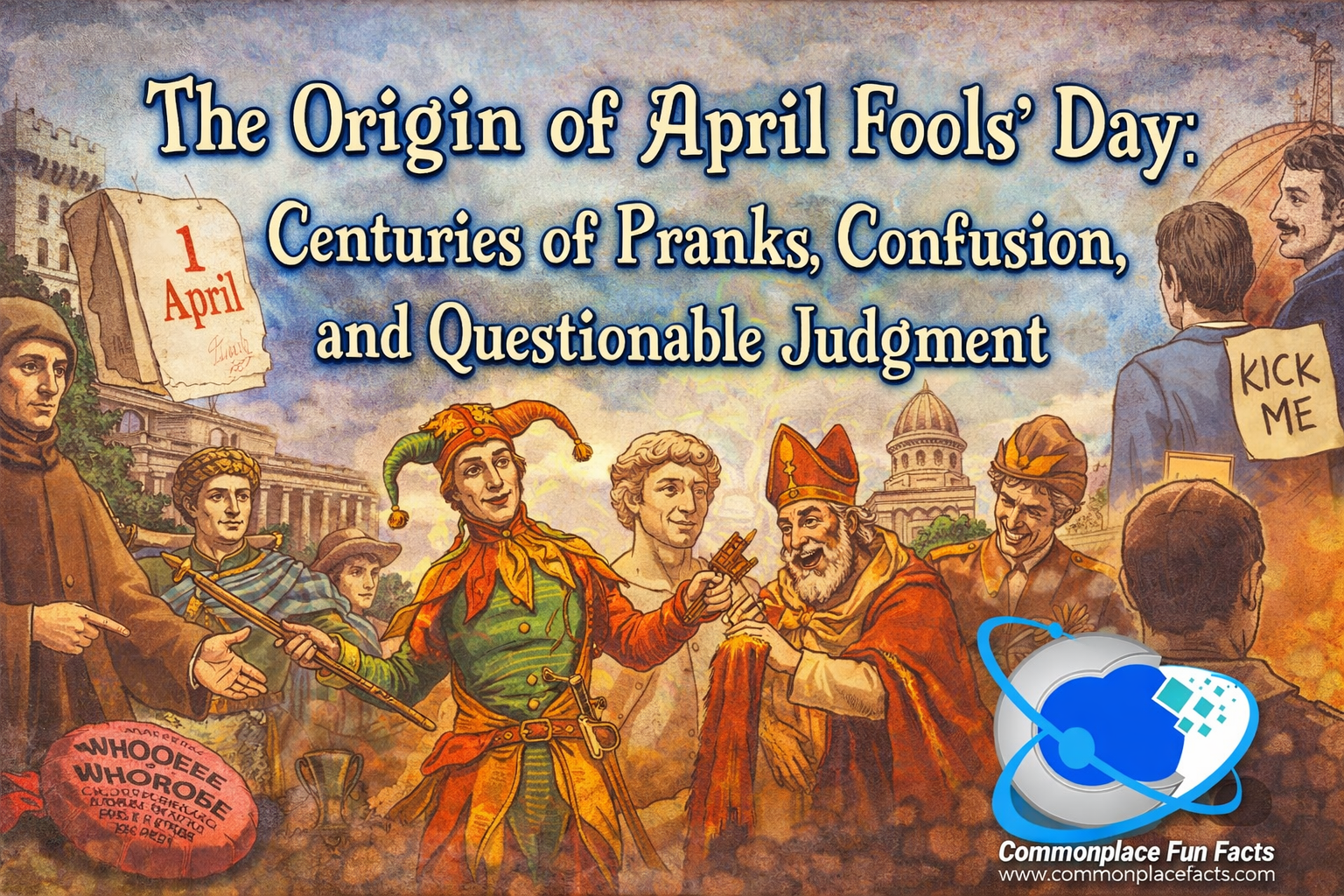

April Fools’ Day began, as all respectable traditions do, with a monarch of questionable judgment and a national policy that should have been stopped by literally anyone in the room.
In the late 14th century, King Ridiculous II of England—who was, in fact, King Ridiculous IV but insisted on renumbering himself “for comedic effect”—instituted an annual holiday known as “Fake News Day.” On this day, citizens were encouraged to spread absurd stories, mislead their neighbors, and generally behave like a room full of people who had just discovered satire and were determined to use it irresponsibly.
The king himself would participate by issuing royal decrees that were entirely fabricated. One year, he reportedly declared that all cows were to be knighted for “outstanding contributions to dairy morale.” Another year, he announced that Parliament would be replaced by a council of geese, citing their “superior honking-based communication system.”
The holiday was wildly popular until, as these things tend to do, someone took it too far. A rumor spread that taxes had been abolished permanently. Celebrations erupted. Reality returned. The king quietly discontinued the holiday, and history agreed to pretend none of this had happened.
If that sounds slightly implausible, that is because it is entirely made up.
There was no King Ridiculous II (or King Ridiculous IV, for that matter). There was no Fake News Day. The cows, tragically, were never knighted.
Which brings us to the real question: where did April Fools’ Day actually come from?
Contents
The Calendar That Confused Everyone
The most widely accepted explanation begins in 1582, when Europe adopted the Gregorian calendar. Prior to this reform, many regions celebrated the New Year around late March, with festivities often culminating on April 1.

When the calendar shifted the official New Year to January 1, not everyone got the message. Some people continued celebrating the old date, either out of habit or because communication in the 16th century was less “instant notification” and more “word of mouth and hope for the best.”
According to tradition, these individuals became the targets of jokes and were labeled “April fools.” They might be sent on pointless errands, given false information, or otherwise subjected to the kind of mild social humiliation that humanity has always found strangely entertaining.
It’s sort of like the people who make a point of arriving early at church on the days when Daylight Saving Time begins and ends, just so they can mock everyone who forgot to change their clocks. Some people collect stamps. Others collect moments like this.
This theory is tidy and satisfying, which is usually a sign that historians should approach it with caution. While it is widely repeated, direct evidence linking the calendar change to April Fools’ Day is somewhat limited.
Springtime: When Common Sense Takes a Brief Vacation
Even if the calendar theory is not the whole story, April Fools’ Day fits comfortably into a much older tradition of springtime mischief.

For centuries, cultures have marked the arrival of spring with festivals that involve role reversals, disguises, and general absurdity. It is as if humanity collectively decided that after surviving winter, we had earned the right to behave like unsupervised children for a few days.
In ancient Rome, the festival of Hilaria featured costumes, impersonations, and playful deception. Participants mocked authority figures and embraced the kind of chaos that would normally result in immediate consequences on any other day.
Medieval Europe contributed its own version with the Feast of Fools (which, until we researched it for this article, we assumed was just another name for the annual Congressional brunch), a festival during which social hierarchies were temporarily turned upside down. Lower-ranking clergy mocked their superiors, and normal rules were set aside in favor of celebration, satire, and a brief, socially sanctioned lapse in judgment.
These traditions suggest that April Fools’ Day did not appear out of nowhere. It likely evolved from a long-standing human instinct to use the changing of seasons as an excuse for controlled chaos.
Literary Clues and Historical Breadcrumbs
One of the earliest possible references to April fooling appears in Geoffrey Chaucer’s The Canterbury Tales, written in the late 14th century. A passage in “The Nun’s Priest’s Tale” mentions a date that some interpret as April 1.
Scholars have spent considerable time debating whether this was an intentional reference, a scribal error, or simply an example of medieval ambiguity doing what it does best. Regardless, by the 16th and 17th centuries, April Fools’ Day is clearly documented across Europe.
In France, victims of pranks were called “poisson d’avril,” or “April fish,” a term that persists today. In Scotland (where there are more than 20 words for “idiot”), the celebration expanded into a two-day event that included elaborate practical jokes. In England, a custom developed that pranks should only be played before noon, presumably to allow for leisurely recovery over a nice cuppa.
Why April 1?
The choice of April 1 is not definitively explained, but several factors make it a fitting candidate.
It falls near the spring equinox, a time traditionally associated with unpredictability and change. The weather alone seems to participate in the spirit of the day, offering sunshine one moment and something far less cooperative the next.
More broadly, early April represents a transitional period, when the world is shifting from winter to spring. It is a time when expectations are already slightly off-balance, making it an ideal setting for a holiday devoted to trickery.
The Left-Handed Wrench and Other Time-Honored Wild Goose Chases
No discussion of April Fools’ Day would be complete without acknowledging one of humanity’s most enduring contributions to civilization: sending someone to find something that does not exist.
Among the most famous examples is the legendary “left-handed wrench.” The setup is beautifully simple. A new employee, apprentice, or otherwise unsuspecting individual is told—usually with great urgency—to retrieve this highly specific tool. The request sounds plausible enough to avoid immediate suspicion, which is precisely what makes it effective.

What follows is less a task and more a pilgrimage.
The victim goes from one person to another, each offering just enough encouragement to keep the search alive. Someone suggests checking with another department. Another insists they “just had one earlier.” A third looks concerned and recommends trying the supply room, which of course has never heard of such a thing but is happy to send the seeker elsewhere.
This can continue for an impressively long time, depending on how committed everyone is to the bit and how optimistic the victim remains about the existence of specialized left-handed hardware.
The joke, of course, is that standard wrenches are not handed. They do not come in left or right versions, despite what an entire room of very convincing people may suggest.
Anyone who has ever been invited to go on a snipe hunt will sympathize.
The left-handed wrench is only one member of a surprisingly large family. Variations include requests for buckets of steam, striped paint, sky hooks, or other items that sound just plausible enough to pass an initial sniff test but collapse under the slightest scrutiny.
These “fool’s errands” long predate April Fools’ Day as an organized holiday. They have traditionally served as informal initiation rituals, a way of welcoming newcomers into a group by first demonstrating that the group cannot be trusted at face value.
April 1 simply takes this concept and scales it up. Instead of one apprentice being sent on a pointless quest, the entire population is invited to participate. Newspapers publish stories that are almost believable. Companies announce products that should not exist. Friends and coworkers briefly become unreliable narrators.
In that sense, the left-handed wrench is not just a prank. It is a philosophy. It is the distilled essence of April Fools’ Day: confidence, plausibility, and the quiet understanding that, sooner or later, someone is going to realize what is happening.
If you find yourself wondering just how far people are willing to go in the name of April Fools’ Day, the answer is: much, much farther than seems reasonable. Over the years, we’ve catalogued some of the most memorable hoaxes ever pulled, ranging from the delightfully absurd to the impressively elaborate. There was the time the BBC convinced an entire nation that spaghetti grows on trees, prompting viewers to call in for gardening advice. There have been fake volcanic eruptions, fictional island nations like San Serriffe, and even carefully staged scientific announcements about the link between global warming and the return of dragons.
If that sort of thing sounds like your idea of quality entertainment—and history suggests it should be—you can explore a full collection of these stories in our article, The Greatest April Fools’ Day Tricks Ever Played. It is a reminder that, given the right combination of confidence, timing, and just enough plausibility, people will believe almost anything… at least until someone says, “April Fools.”
So Where Did April Fools’ Day Come From?
The honest answer is that it wandered into existence the way many traditions do—through a combination of misunderstanding, cultural habits, and humanity’s ongoing commitment to seeing what happens when we tell people something that is almost believable.
It may have roots in calendar confusion. It may borrow from older spring festivals where normal rules took a brief and well-deserved vacation. It may even owe a debt to generations of people who looked at their fellow humans and thought, “I bet I can convince them of something ridiculous if I say it confidently enough.”
What matters is that it stuck.
Every year on April 1, we collectively agree to participate in a small, harmless breakdown of reality. We trust things we probably shouldn’t. We question things we normally wouldn’t. We discover, often within a matter of minutes, that we have once again placed our faith in someone who absolutely did not deserve it.
And then we laugh, because deep down we all know the truth.
Given the opportunity, we would have fallen for the spaghetti trees, gone looking for the left-handed wrench, and seriously considered the possibility that cows were about to be knighted for services to dairy morale.
Which may not say much for our collective judgment.
But it does explain why April Fools’ Day isn’t going anywhere anytime soon.
You may also enjoy…

The Greatest April Fools Day Tricks Ever Played: Revisiting Our Favorit Hoaxes
Take a look back at the best April Fools Day hoaxes of all time.

The Volcano Eruption That Was an April Fools’ Day Joke
It had been 400 years since Alaska’s Mount Edgecumbe last erupted. The long-dormant volcano towers at the southern end of Kruzof Island. The 8,000-plus residents of Sitka delight in the mountain’s majestic snow peak, while simultaneously taking for granted that there is no imminent danger from the volcano that is a mere 15 miles (24…

The Epic Prank that Became History’s Greatest Practical Joke
Filippo Brunelleschi (1377-1446) was an accomplished architect, designer, sculptor, and mathematician. He is considered to be one of the founding fathers of Renaissance architecture and holds the distinction of being the first person to receive a patent in the Western world. He achieved immortality in the history books by designing the dome of the Florence…

Leave a Reply