
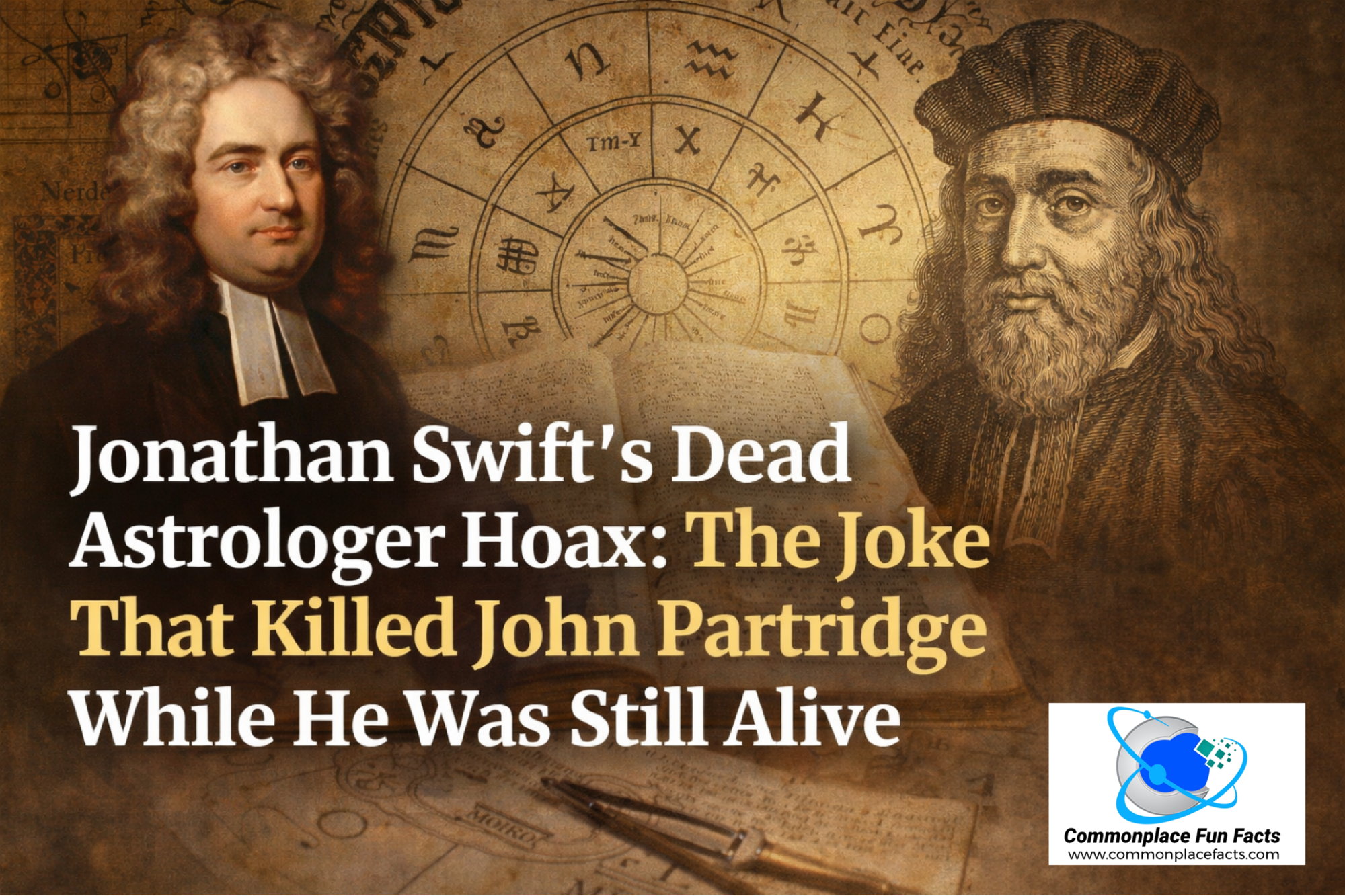

Jonathan Swift and the Art of Practical Joke Escalation
We have a certain fondness for elaborate practical jokes—the kind that require planning, commitment, and just enough questionable judgment to make authority figures slightly uncomfortable.
For example, there was the time Filippo Brunelleschi pulled off what was possibly history’s greatest practical joke by convincing a man he had become an entirely different person. That was far more than a quick prank involving a whoopee cushion and a hasty exit. It was a full-scale psychological production involving multiple actors, careful staging, and a victim who thought he had entered the Twilight Zone centuries before anyone even heard of such a thing.
In terms of pranks, this set a very high bar.
As it turns out, Brunelleschi was not the only historical figure willing to commit fully—perhaps a bit too fully—to the art of messing with someone’s sense of reality.
A few centuries later, one of history’s greatest writers and satirists looked at that general idea and thought, “This is good, but what if instead of convincing a man he was someone else… we convinced everyone else he was dead?”
Contents
A World That Took Predictions Seriously
To understand how Jonathan Swift’s prank worked, it helps to remember that early 18th-century England was a place where astrology was not relegated to the back pages of magazines between crossword puzzles and questionable advice columns.

Astrologers were, for many people, legitimate authorities. They published almanacs filled with predictions about weather, politics, health, and general life events. These publications sold well, and their authors were treated with a surprising degree of respect for people whose professional methodology involved staring at planets and making confident guesses.
One of the more prominent figures in this field was John Partridge, an astrologer who produced annual predictions and enjoyed a reasonably successful career doing so.
This, unfortunately for Partridge, placed him directly in the sights of a man who had both a sharp pen and a low tolerance for nonsense.
Enter Isaac Bickerstaff (Who Absolutely Was Not Real)
Jonathan Swift, who had already demonstrated a talent for satire sharp enough to leave paper cuts on entire institutions, decided to take on astrology in a way that would be difficult to ignore.

Rather than simply writing an essay explaining why astrology was unreliable, Swift created an entirely fictional persona: Isaac Bickerstaff.
Bickerstaff was presented as a learned astrologer—serious, authoritative, and entirely made up. This allowed Swift to enter the conversation not as a critic, but as a supposed insider.
It was an early demonstration of a principle that remains very much alive today: people are more likely to believe something if it comes from someone who sounds like they belong.
The Prediction That Started It All
In 1708, under the name Isaac Bickerstaff, Swift published a set of predictions for the upcoming year.
Among the usual assortment of forecasts, one stood out for its remarkable specificity. Bickerstaff confidently announced that John Partridge would die on March 29 of that year, struck down by a raging fever:
My first prediction is but a trifle, yet I will mention it, to show how ignorant those sottish pretenders to astrology are in their own concerns: It relates to Partridge the almanack-maker; I have consulted the stars of his nativity by my own rules, and find he will infallibly die upon the 29th of March next, about eleven at night, of a raging fever; therefore I advise him to consider of it, and settle his affairs in time.
This was not a vague or hedged prediction. There were no disclaimers, no “subject to change based on planetary alignment,” and no wiggle room.
It was a clear, testable claim. Either Partridge would die on March 29, or he would not.
Swift had set a trap, and it hinged on what would happen next.
The Death That Refused to Happen (And Then Somehow Did)
March 29 arrived, and John Partridge did what most people prefer to do on the day they are allegedly scheduled to die—he remained stubbornly alive.
In fact, he seems to have taken a certain satisfaction in this outcome. After all, a rival astrologer had just made a very public, very specific prediction about his demise, and Partridge had successfully defied it simply by continuing to exist.
At this point, one might reasonably assume the story would end. Prediction made, prediction failed, astrology looks slightly worse for wear, everyone moves on.
This was not, however, how Jonathan Swift handled things.

Instead, almost immediately after the appointed date had passed, a new pamphlet appeared with a title that suggested the matter was no longer up for debate: The Accomplishment of the First of Mr. Bickerstaff’s Predictions.
According to this account—written by a conveniently anonymous “witness” who bore a suspicious resemblance to Swift himself—the prediction had been fulfilled perfectly. The author claimed to have visited Partridge on the evening of March 29 and found him in the precise condition forecast: dying of a fever, right on schedule.
Details were supplied. Observations were made. The scene was described with just enough specificity to feel convincing and just enough confidence to discourage doubt.
And because Swift understood that nothing says “this is definitely true” quite like overcommitting to the bit, he followed this report with an elegy mourning Partridge’s passing—complete with poetic flair and the firm assumption that the matter was settled.
The only problem, of course, was that Partridge was still alive.
Which, as it turned out, was no longer the most important detail.
The Minor Complication of a Living Victim
John Partridge, who continued to exist in a very literal sense, found himself in the awkward position of having to argue that he was alive.
This is, on the surface, a fairly easy claim to support. One simply points to oneself and says, “Here I am.”
Unfortunately, Swift had anticipated this.
When Partridge protested, Swift responded with the rhetorical equivalent of a shrug and a raised eyebrow. According to Bickerstaff, Partridge might appear to be alive, but he was, in fact, quite dead. Any claims to the contrary were dismissed as either confusion or poor judgment.
The argument was not intended to be reasonable. It was intended to be relentless.
And it worked.
When the Public Decides You Are Dead
Much like the 1967 rumor that Paul McCartney was dead, the John Partridge hoax took on a life of its own. Pamphlets circulated. Readers discussed the supposed death. Some accepted it outright, while others found themselves unsure what to believe.

After all, one astrologer had made a very specific prediction, and then confidently declared it fulfilled. The other astrologer was insisting he was alive. That is an argument that would ordinarily be compelling, but astrologers have been known to be wrong, after all.
In the battle between observable reality and confidently delivered nonsense, the outcome was surprisingly competitive.
Partridge’s reputation suffered. It is difficult to maintain credibility as a predictor of future events when you cannot accurately forecast your own continued existence.
His almanac sales declined, and his professional standing weakened considerably.
Swift, meanwhile, had effectively demonstrated his point.
The Real Target: Not a Man, but a Method
This was never really about John Partridge as an individual. He was, for lack of a better term, a convenient example.
Swift’s real target was astrology itself.
By making a bold, precise prediction and then insisting on its accuracy regardless of reality, Swift exposed a weakness in the entire system. If people were willing to accept a claim simply because it was presented with confidence and authority, then the problem was not just the astrologers—it was the audience.
The hoax worked because it followed the same structure as the thing it was mocking.
It sounded authoritative. It appeared confident. It repeated itself.
And that was enough.
The Joke That Wouldn’t Go Away
The Isaac Bickerstaff persona did not disappear immediately after the initial prank. Swift continued to use the character, extending the joke and reinforcing the illusion.
Partridge, meanwhile, was left in a peculiar state of professional limbo—alive in body, but publicly declared otherwise.
Eventually, Swift stepped back and allowed the hoax to settle into history, but not before ensuring that it had made a lasting impression.
It did.
Why This Feels Uncomfortably Modern
There is something about this story that feels less like a quaint historical anecdote and more like a preview of things to come.
The ingredients are all there: a fabricated authority, a confident claim, widespread circulation, and a public willing to entertain the possibility that something patently untrue might, in fact, be true.
The only real difference is the speed at which the information traveled. What took pamphlets and word of mouth in 1708 can now be accomplished in seconds.
The underlying mechanics, however, remain remarkably consistent.
The Man Who Was Dead (Professionally, If Not Literally)
John Partridge did eventually continue his life, but his career never fully recovered from the episode.
It turns out that being declared dead by a skilled satirist is not easily undone, even with the advantage of continued breathing.
Jonathan Swift, on the other hand, added another memorable entry to his portfolio of satirical accomplishments, demonstrating once again that a well-executed joke can do more damage than a serious argument.
There are many lessons to take from this story, but one stands out above the rest. Don’t put your faith in astrology. We Sagittarians have always been skeptical.
You may also enjoy…

Filippo Brunelleschi’s Fat Woodworker Prank: History’s Greatest Practical Joke Explained
Discover the bizarre true story of Filippo Brunelleschi’s prank of The Fat Woodworker—one of the strangest and cruelest practical jokes in history.

Space Cadets: TV’s Most Expensive Hoax
Discover the jaw-dropping story behind ‘Space Cadets,’ the most expensive TV hoax ever, where contestants believed they were trained for space travel. Learn how a reality TV show fooled its participants with Hollywood magic.

The Staten Island Ferry Disaster Memorial: the Monument to the Giant Octopus Attack — That Never Happened
Discover the surprising story of the Staten Island Ferry Disaster and the attack by a giant octopus — that never happened.


Leave a Reply