

There are some national symbols that feel so fixed in the American imagination that it is hard to picture them ever having looked any other way. The bald eagle is one. The Liberty Bell is another. The flag falls squarely into that category. It is so familiar that most of us look at it with the visual confidence of people who assume it arrived fully formed from the founding fathers, glowing faintly in the morning sun while a fife played somewhere in the background.
That is not what happened.
The American flag, like many things in early American history, was less the product of a clean master plan and more the result of improvisation, disagreement, and a surprising willingness to leave important details unresolved. Congress created the basic idea in 1777, then more or less shrugged at the visual specifics and let generations of flag makers, politicians, and patriotic amateurs work out the rest. The result was a long parade of designs that ranged from elegant to eccentric to “surely someone should have stopped this.”
In other words, the Stars and Stripes had a long audition process, and some of the rejected acts were memorable for reasons that were not entirely flattering. Join us for an eyebrow-raising exploration of U.S. flag history.
Contents
Before the Stars Showed Up, There Was… a Different Kind of Flag
When we picture the earliest American flag, we tend to imagine stars bravely announcing independence. Thirteen of them, neatly arranged, signaling to the world that a new nation had arrived and was ready to be taken seriously.

That image is about a year too early.
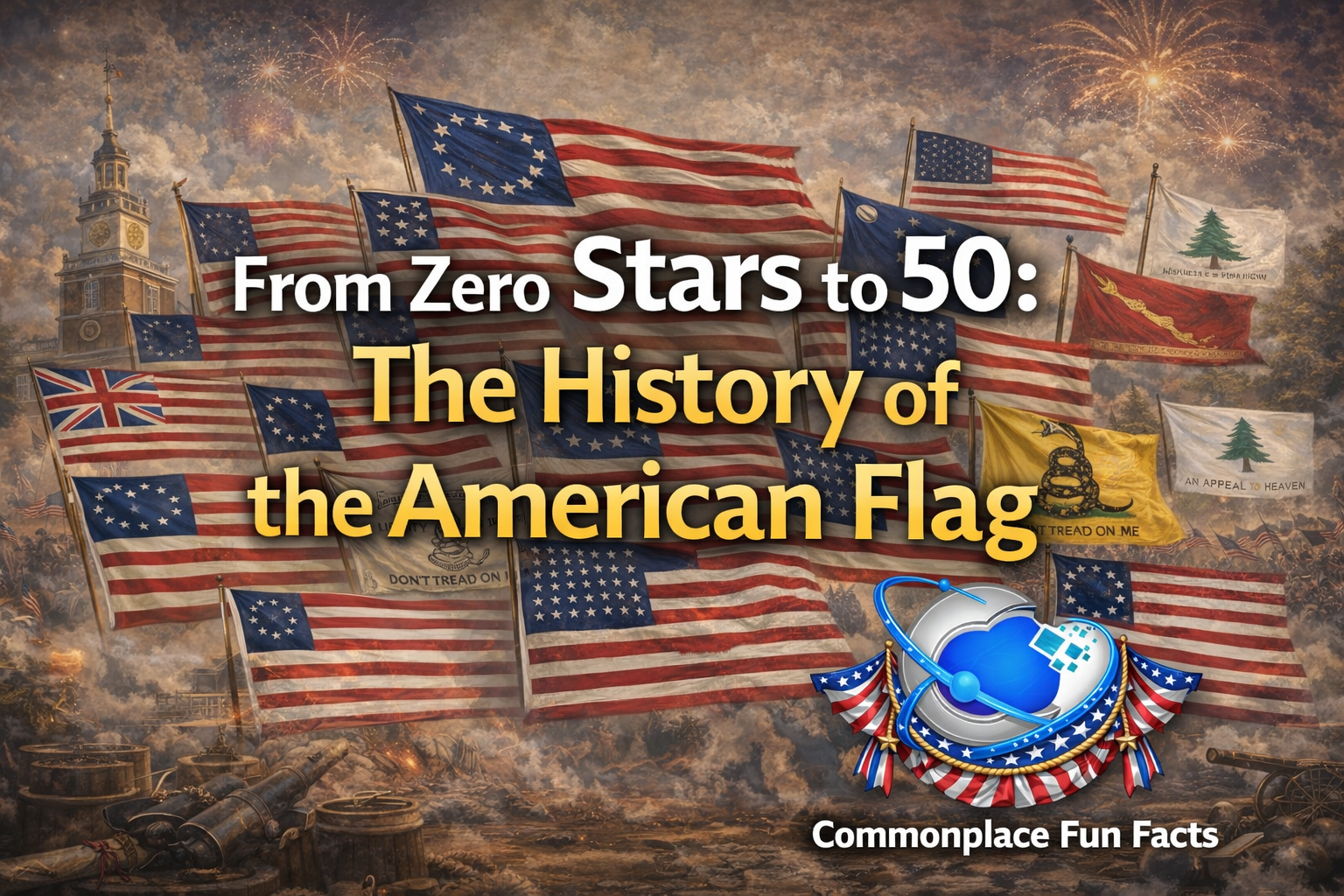
The first flag that actually resembled what we now think of as the Stars and Stripes did not have a single star on it. Instead, it featured thirteen red-and-white stripes—so far, so familiar—and, in the canton, the unmistakable presence of the British Union Flag. Yes, the earliest American “national” flag prominently displayed the symbol of the very empire the colonies were in the process of separating from.
This banner, known to history by several names (including the Continental Union Flag, the Continental Colours, the Cambridge Flag, and, somewhat retroactively, the Grand Union Flag), was first flown on December 3, 1775. Continental Navy Lieutenant John Paul Jones raised it aboard the Alfred, the flagship of Commodore Esek Hopkins, on the Delaware River.
If you are looking for a moment when the American flag made its grand debut, that is a strong candidate. It is also a moment that perfectly captures the colonies’ complicated relationship with Great Britain. This was not yet a clean break. It was more like your first awkward breakup when you’re not sure if you’re supposed to return the class ring.
George Washington Raises a Flag—and Possibly an Eyebrow
The Continental Union Flag made one of its most famous appearances on January 1, 1776, during the Siege of Boston. At Prospect Hill, George Washington ordered a flag-raising ceremony intended to boost morale among the Continental Army.
Not everyone agrees on exactly what was flying over Prospect Hill. In 2006, historian Peter Ansoff suggested that the flag may have actually been a plain British Union Flag instead. Other historians, including Byron DeLear, have defended the traditional interpretation. This means that one of the earliest symbolic moments of American unity may involve a mild historical disagreement about what, exactly, everyone was looking at.
Either way, the moment had impact. Contemporary observers reportedly mistook the display as a sign that the colonists were backing down, which must have been a confusing message to send during a revolution. It is not every day that your declaration of unity is interpreted as surrender.
“Don’t Tread on Me”: The Flag That Skipped Subtlety and Went Straight to a Warning
The Gadsden flag is one of the most recognizable—and least subtle—symbols to emerge from the American Revolution. Designed in 1775 by Christopher Gadsden, the flag features a coiled rattlesnake poised to strike above the unmistakable warning: “Don’t Tread on Me.” It was originally presented to the Continental Congress and used by the early American navy, making it less of a decorative slogan and more of a very direct message to anyone considering unwanted interference. In an era not known for understatement, the colonies chose a symbol that managed to combine menace, clarity, and just enough artistic flair to make the point impossible to miss.

The choice of a rattlesnake was not random. Earlier, Benjamin Franklin had famously used the segmented snake in his “Join, or Die” cartoon, linking the animal to colonial unity. The rattlesnake itself carried symbolic weight. It does not strike without warning, but when it does, it is decisive. It was native to North America, immediately recognizable, and—perhaps most importantly—deeply uninterested in being stepped on. In other words, it was the perfect mascot for a collection of colonies that had spent years politely asking for better treatment and had now decided that politeness had its limits.
What makes the Gadsden flag especially interesting is its longevity. Unlike many early flags that faded into obscurity or were replaced by more standardized designs, this one never quite left the stage. It has been revived repeatedly across different periods of American history, sometimes as a symbol of liberty, sometimes as a statement of defiance, and occasionally as a reminder that Americans have always had a talent for expressing complex political ideas in the form of a very clear warning printed in large letters.
The Original Instructions Were Not Exactly Detailed
On June 14, 1777, the Continental Congress passed the first Flag Resolution. It declared that the flag of the United States would have thirteen stripes, alternating red and white, and that the union would contain thirteen white stars on a blue field, representing a new constellation.
That sounds straightforward until you notice the important omission. Congress said there should be stars. Congress did not say how those stars should be arranged.

This was a little like telling a room full of musicians, “Please make a patriotic song,” and then leaving before anyone could ask a follow-up question. The stripes were set. The number of stars was set. Everything else was apparently left to the imagination of whoever had access to blue cloth and a reasonable tolerance for geometry.
That ambiguity is the reason there was no single original Stars and Stripes in the neat, modern sense. There were early flags, plural. There were multiple interpretations. There were competing layouts. There were designs made for military use, designs made for ships, designs made for ceremonies, and designs that seem to have been assembled by people who believed symmetry was for weaker nations.

One such variation was the Bennington flag. It is one of those designs that looks like it has a story to tell, and then, upon closer inspection, appears to have several stories—some of which may have been added later for dramatic effect. Most recognizable for the large “76” emblazoned in its canton, the flag is traditionally associated with the Battle of Bennington, a pivotal American victory fought on August 16, 1777. According to popular lore, this was the banner carried by colonial forces during that engagement, which has helped cement its place in Revolutionary iconography. The problem, as is so often the case in early American history, is that the evidence is less cooperative than the legend. Many historians believe the flag was actually produced decades later, likely in the early 19th century, which would make it less of a battlefield veteran and more of a commemorative enthusiast with excellent timing.
One of the more persistent stories surrounding the Bennington flag involves the Fillmore family, who managed to connect the banner not only to Revolutionary War lore but also to the White House. According to legend, the original flag was carried off the battlefield by Nathaniel Fillmore and preserved as a family heirloom. It was later said to have passed into the possession of his grandson, President Millard Fillmore, which is a convenient way of giving a historical artifact both patriotic credibility and presidential endorsement. The family continued to embrace the tradition, with Philetus P. Fillmore reportedly flying a Bennington flag in 1877 to commemorate the battle, and Mrs. Maude Fillmore Wilson eventually donating the heirloom to the Bennington Museum. Thanks to this lineage, the flag is sometimes referred to as the “Fillmore flag,” proving once again that in American history, a good story paired with a recognizable last name can go a very long way.
Even setting aside the debate over its origins, the Bennington flag stands out because it seems determined to do things its own way. The stars are arranged in a circular pattern surrounding the “76,” but they alternate between seven-pointed and eight-pointed forms, as though the designer wanted variety or simply refused to be constrained by the tyranny of uniform geometry. The number itself, of course, refers to 1776, the year of independence, ensuring that even if the design raises questions, the message does not. The result is a flag that is bold, slightly unconventional, and just eccentric enough to feel right at home among the many variations that characterized early American flag design—an era when symbolism was clear, but consistency was still very much a work in progress.
The Betsy Ross Circle and the Power of a Good Story
No discussion of early American flag designs can avoid Betsy Ross, largely because America loves a tidy origin story even when history responds by coughing politely and looking away.

The familiar version of the tale says that George Washington and company visited Betsy Ross, asked her to sew the first flag, and approved her suggestion of five-pointed stars arranged in a circle. It is an irresistibly good story. It has a patriotic craftsperson, a founding father cameo, and a design neat enough to look wonderful in elementary school textbooks.
The problem is that the documentary evidence for the story is thin. The Betsy Ross account did not surface until many years later, when her grandson related the family tradition. That does not automatically make it false, but historians have been understandably cautious about treating it as settled fact. The circular arrangement became iconic less because it was clearly the first official design and more because it was visually striking, symbolically appealing, and attached to a story Americans very much wanted to believe.
To be fair, the circle is a terrific design. It suggests unity. It suggests equality. It suggests thirteen states standing together without one lording it over the others. It also has the great advantage of looking intentional, which cannot be said for every flag arrangement that followed.
The Early Republic Was Basically Freelancing
Because Congress had never specified a precise arrangement, early flag makers had enormous freedom. Some placed the stars in circles. Some arranged them in rows. Some staggered them. Some clustered them into patterns that looked thoughtful. Others produced layouts that looked like they had begun with thoughtful intentions and then wandered off.
This variety was not a sign that anyone had failed to read the rules. It was the rules. Or rather, it was what happened when the rules were mostly vibes.
That is one of the most interesting things about the early American flag. We tend to think of national symbols as rigid and centrally controlled, but the flag spent much of its youth behaving like a decentralized art project. Americans agreed on the broad symbolism. They were less unified on the question of what, exactly, the thing should look like once the stars were sewn on.
Many surviving examples from the 18th and 19th centuries show just how flexible the idea remained. Medallion patterns became popular, with stars arranged in circular wreaths around a center star or cluster. Great Star patterns arranged smaller stars into the shape of one giant star, which is either inspired visual symbolism or an act of patriotic overachievement, depending on your mood. Some flags used orderly rows. Others used offset rows. Some seem determined to keep the viewer guessing.
The Great Star: Magnificent, Symbolic, and Slightly Extra
Among the more famous alternatives was the so-called Great Star pattern, in which smaller stars were arranged to form one large star. This design is often associated with Captain Samuel C. Reid, who played an important role in the push for a new flag law in 1818.

The Great Star concept was undeniably clever. America would not merely have stars. America would have a star made out of stars. It was symbolism with the subtle restraint of a Fourth of July cannon salute.
There is something admirable about that. The Great Star design turned the canton into a kind of patriotic visual thesis statement. It said unity while also saying ambition, and perhaps also saying, “We would like you to notice how hard we worked on this.”
Yet the design was also a bit much from a practical standpoint. It required careful arrangement and a flag maker with patience, skill, and perhaps strong opinions about trigonometry. That made it less convenient than simply lining stars up in rows like civilized people trying to finish a project before lunch.
Still, Great Star patterns persisted in various forms throughout the 19th century because Americans have always had a soft spot for taking a perfectly functional concept and making it just a little more dramatic.
Then Came the Era of More Stripes, Which Was a Terrible Idea
Early on, the country faced a problem that would only grow larger with time: what happens to the flag when more states join the Union?

In 1794, Congress decided that the answer was to add both stars and stripes. This is how the nation arrived at the 15-star, 15-stripe flag associated with the Star-Spangled Banner. Vermont and Kentucky joined the Union, and the flag responded by expanding in all directions like a republic that had not yet learned the value of restraint.
For a short while, that worked. Then people realized the obvious problem. If the country kept adding states and also kept adding stripes, the flag would eventually begin to look like a barber pole having an existential crisis.
By 1818, cooler heads prevailed. Congress returned the number of stripes to thirteen, honoring the original states, and decided that only the stars would increase with new admissions to the Union. That was one of the wisest design decisions in American history, ranking somewhere between “let’s not wear powdered wigs forever” and “maybe indoor plumbing has potential.”
The 1818 Debate Produced Some Truly Interesting Possibilities
The flag legislation of 1818 is where this story gets especially fun, because it came during a moment when Americans understood that the banner needed a more durable system but had not yet agreed on what visual form that system should take.
Captain Samuel C. Reid helped shape the discussion. He argued successfully for returning the stripes to thirteen and adding stars as new states joined. He also proposed possible layouts, including the Great Star arrangement. Other ideas floated around as well. There were concepts involving eagles. There were more elaborate quartered designs. There were suggestions that seem to have approached the national flag as though it were auditioning to become a very patriotic coat of arms.
Congress ultimately passed the law without locking in a precise star arrangement. The government had another opportunity to settle the matter and, in classic fashion, chose not to settle it completely. That left room for official guidance in some contexts and continued variation in others.
So the nation moved forward with a design system that was, once again, partly defined and partly improvised. This is a recurring theme in American institutional history. We establish the broad principle, then spend a century arguing over how rectangular it should be.
Some Flags Looked Majestic. Some Looked Like a Puzzle in Progress
Not every proposed or produced arrangement was beautiful. Many were. Some medallion flags are gorgeous. Some Great Star versions are genuinely dazzling. Some row patterns are clean and dignified. Then there are the others.

There are historic examples in which the stars seem to drift across the blue field with only a loose acquaintance with order. There are layouts that feel as though symmetry was considered, briefly, then vetoed. There are arrangements that manage to look both crowded and underplanned, which is a hard trick to pull off.
A few of them truly do give the impression that someone spilled a box of stars onto the canton and then, rather than admit defeat, announced that the result represented liberty.
To be fair, many of these oddities were not incompetence. They reflected the practical realities of hand-sewn work, changing state counts, varying traditions, and the absence of strict federal standardization. People were not necessarily doing it wrong. They were working in a system where “wrong” had not yet been fully defined.
That said, history does not become less entertaining merely because it has context.
Eventually the Government Decided Enough Was Enough
For much of the 19th century, variety remained part of the flag’s story. Then modern bureaucracy entered like the designated adult at a rowdy picnic.

In 1912, President William Howard Taft issued an executive order that, for the first time, standardized the proportions of the U.S. flag and arranged the 48 stars in orderly horizontal rows. At long last, the national government looked at the accumulated history of circles, medallions, Great Stars, offsets, experiments, and star-based improvisational theater and said, in effect, “No. We are drawing lines now.”
That decision did not erase earlier designs, but it did end the era in which the flag could appear in officially recognizable yet wildly different star arrangements. The modern flag became less a family of related concepts and more a single regulated design.
That trend continued when Alaska and Hawaii joined the Union. Officials reviewed thousands of suggestions for 49-star and 50-star layouts before the federal government settled on the arrangements we now recognize. If you would like a delightful footnote from that part of the story, we have previously written about the teenager whose school project helped shape the 50-star flag in our article on the designer of the 50-star American flag and the B-minus that almost became one of history’s strangest grading disasters.
What the Almost-Flags Tell Us About America
The designs that almost were are more than historical curiosities. They reveal something important about the United States itself.
America did not begin as a country obsessed with clean standardization. It began as a loose, argumentative, improvisational experiment staffed by people who were trying to invent both a nation and the symbols that would represent it. The flag’s many near-misses and side paths are evidence of that process.
The circle flags tell us Americans liked symbolism. The Great Star flags tell us Americans liked symbolism with flair. The medallion flags tell us Americans liked beauty. The oddball layouts tell us Americans also liked freedom, even when freedom occasionally produced a result that looked as though it needed one more draft and perhaps a nap.
That is part of what makes the history of the flag so enjoyable. The final design feels inevitable only in retrospect. It was not inevitable at all. It emerged through trial, preference, habit, politics, practicality, and the long, slow creep of official regulation. The flag we salute today was not the first idea. It was the survivor.
Conclusion: Long May It Wave, but Thank Goodness It Settled Down
There is something oddly comforting in realizing that even one of America’s most sacred symbols had a messy developmental phase. Before the stars lined up in neat, respectable rows, they wandered. They circled. They clustered. They formed larger stars. They appeared in patterns that were noble, inventive, and occasionally the visual equivalent of overcaffeinated patriotism.

The American flag could have looked very different. It almost did, many times.
Instead, after decades of experimentation, the nation gradually arrived at a design that was bold, recognizable, and simple enough that it did not require a seminar to explain the canton. This was probably for the best. A republic can ask only so much of its citizens, and “please memorize which commemorative medallion variant is currently official” would have been a bit much.
So the next time you see the Stars and Stripes, take a moment to appreciate not only what it became, but what it narrowly avoided becoming. Somewhere in the archives of American design history are the ghosts of flags that were more complicated, more chaotic, and more than a little questionable.
Which, now that we think about it, is a very American story.
You may also enjoy…

How a High Schooler’s B- Project Became the Official 50-Star American Flag
Learn how a high school student designed the 50-star American flag — and earned a B- for his efforts.

Strange Flags: A Tour of the World’s Most Unusual Flags
Take a tour of some of the world’s strange flags.

George M. Cohan: The Original Amazing Yankee Doodle Dandy Who Sang America Into a Flag-Waving Frenzy
Discover how George M. Cohan—Broadway legend and self-proclaimed Yankee Doodle Dandy—shaped American patriotism with showstopping songs, theatrical flair, and a Congressional Gold Medal to prove it.


Leave a Reply