
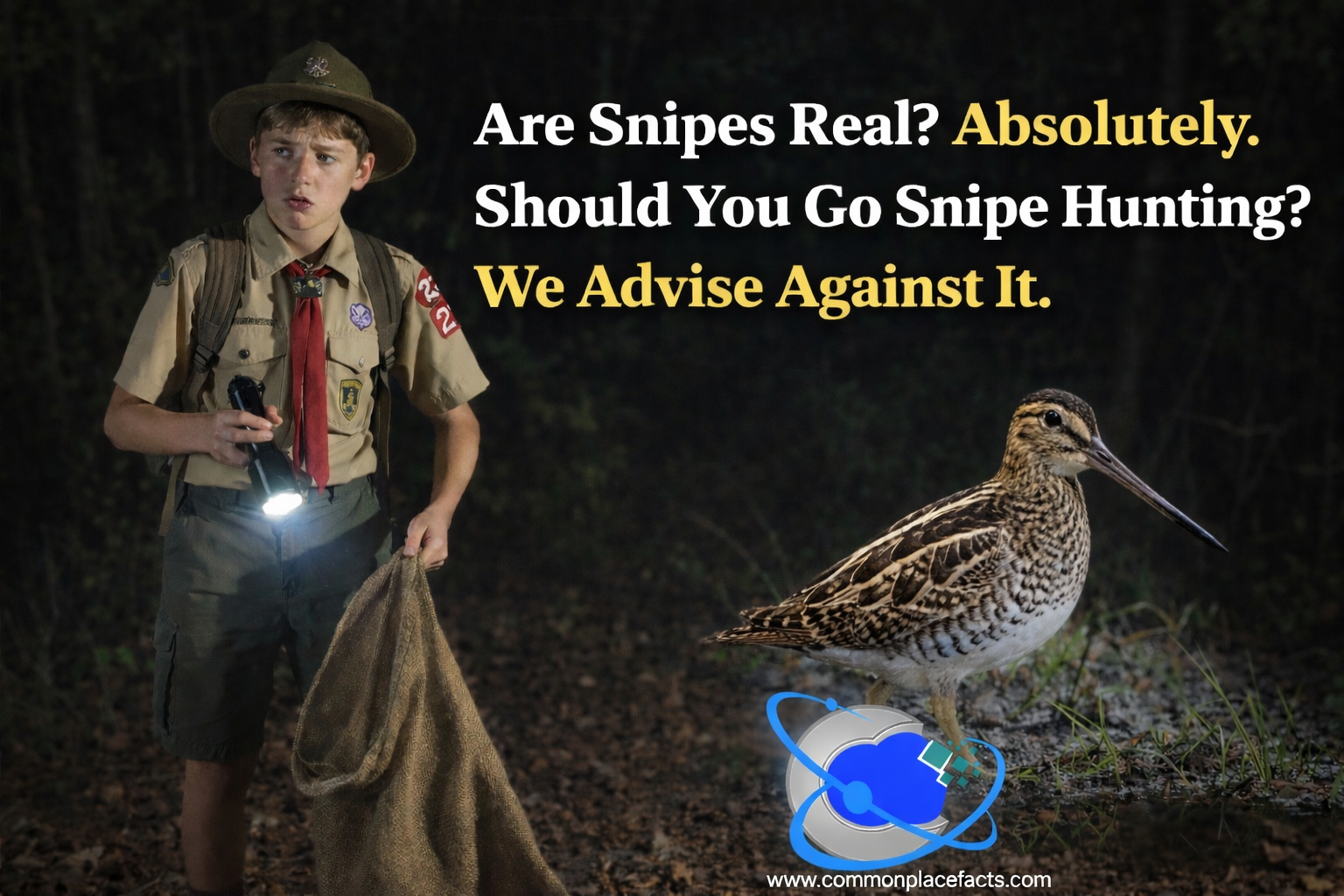

You are standing alone in the woods.
The flashlight in your hand is doing that helpful thing where it flickers just enough to suggest that it might have commitment issues. In your other hand is a burlap sack, which you have been assured will soon contain a creature known as a “snipe.” Somewhere out in the darkness, unseen but confidently described, this animal is apparently being driven toward you by people who sounded very convincing about ten minutes ago.
You wait.
At first, you are alert. Focused. Ready. This is, after all, a real hunt for a real animal. That is what you were told. Then, slowly, inevitably, doubt begins to creep in. The woods are quiet. Too quiet. The instructions you were given begin to feel less like expert guidance and more like something that should have come with a disclaimer. Somewhere between the fifth and fifteenth minute, a realization dawns: the only thing you are hunting is the exact moment your trust was misplaced.
There are certain traditions that survive because they are noble, uplifting, and culturally meaningful. There are others that survive because somewhere, at some point, a group of people discovered that it is extremely funny to send an unsuspecting person into the dark holding a bag and waiting for an animal that is not going to arrive.
Snipe hunting falls firmly into that second category.
Contents
What Is Snipe Hunting?
If you grew up around scouts, camps, hunting circles, or relatives whose idea of “character building” was indistinguishable from “mild hazing rituals,” you have probably heard of snipe hunting. Perhaps you were told to stand quietly in the woods with a flashlight. Perhaps you were instructed to smack sticks together. Perhaps you were assured, by people looking just a little too earnest, that the elusive creature in question would run directly into your sack if you just stayed put. What happened next was usually less a successful hunt than a life lesson about trust.

Depending on your trust, gullibility, patience, and tolerance for peer pressure, you might spend hours on this fruitless endeavor before someone is kind enough to clue you in on the fact that no snipe are going to come your way.
The classic snipe hunt is a masterpiece of low-stakes deception. The setup is simple and has been refined over generations: a newcomer is told that the group is about to hunt a strange, elusive creature known as a “snipe.” The victim is taken deep into the woods, handed a sack, a flashlight, and a set of instructions that sound just plausible enough to pass casual inspection. He is then told to wait quietly while the others circle around and “drive” the snipes toward him. Variations may include clapping, calling, or making odd noises to attract the animal. At this point, the organizers quietly retreat, leaving the would-be hunter alone to contemplate both the wilderness and his choice of friends or family.
What makes the prank so effective is its careful balance between truth and nonsense. Snipes are, in fact, real birds—small, well-camouflaged shorebirds known for their erratic flight. That sliver of reality gives the entire story just enough credibility to hook the unsuspecting participant. Layered on top of that is a dose of social pressure. The instructions come from people who seem to know what they’re doing, and no one wants to be the person who asks whether this entire operation might be a long-standing joke. By the time doubt creeps in, the victim is already alone in the dark holding a burlap sack—silently cursing the conspirators and, in a remarkable display of human adaptability, beginning to consider who he might trick into doing this next.
The origins of the snipe hunt as a prank are difficult to pin down precisely, which is often the case with traditions that rely on equal parts boredom and creativity. References to the joke appear in North America as early as the nineteenth century, particularly in rural communities and later in organized settings like summer camps and scouting groups. It belongs to a broader family of “fool’s errands”—sending someone to fetch a left-handed wrench or a board stretcher—where the task is just believable enough to send someone on a pointless mission. Over time, the snipe hunt became something of a rite of passage: a gentle initiation into the group and a memorable introduction to the idea that not every confident instruction deserves immediate compliance.
Are Snipes Real? Yes. The Campfire Version, Less So.
This is where the confusion begins. There is such a thing as hunting real snipe. Hunters have pursued them as game birds for a very long time, and doing so requires actual skill. They are small, well-camouflaged, alert, and prone to sudden, erratic flight. In other words, they are not the sort of creature you casually collect by standing in the woods at night with a burlap sack and the optimism of a gullible teenager.

A real snipe is not some shaggy, moonlit beast with glowing eyes and an appetite for campers. It is a wading bird in the sandpiper family. Wilson’s snipe, the species most relevant in North America, lives around marshes, muddy edges, wet meadows, and similar habitats where it can vanish into vegetation with an almost insulting efficiency. It has mottled brown plumage, a compact body, short legs, and a bill so long that it looks like the bird was designed by someone who started with “needle” and worked backward. The bird’s coloration and preferred habitat make it difficult to spot, which is part of why many people are surprised to learn it exists at all.
The fact that snipe are real creatures matters, because “snipe hunting” can mean two very different things depending on whether the speaker is an ornithologist, a bird hunter, or a summer camp counselor with too much free time.
In the legitimate sense, a snipe hunt is a real hunt for a real bird. In the folkloric, prank-laden, emotionally formative sense, a snipe hunt is a fool’s errand in which the “snipe” is no longer a bird at all, but an imaginary creature whose habits become more ridiculous the longer the setup goes on — much like the fearsome and elusive Australian Drop Bear.
Why the Joke Works
The brilliance of the snipe hunt is that it uses just enough truth to make the lie sound plausible. “We’re going hunting for snipes” sounds a lot more convincing when snipes are, in fact, real birds. That is the genius of the whole operation. Nobody says, “Tonight we are going to catch a completely fictional goblin pheasant from the Republic of Nonsense.” The prank depends on taking something genuine and wrapping it in just enough nonsense to keep the victim compliant.
Human beings are surprisingly vulnerable to this formula. Add darkness, a group of older or more confident people, a few pseudo-expert instructions, and the universal fear of being the one person who asks, “Wait, are you all making fun of me?” and suddenly the whole thing works beautifully. It is a social confidence trick with flashlights.
This is also why snipe hunting belongs in the same general family as cow tipping, which we have discussed before. Both occupy that magical borderland where rural mythology, bad ideas, and overconfident storytelling meet. Both sound plausible to people who have never tried them. Both fall apart under a moment’s scrutiny. And both have survived because they are simply too entertaining to kill with facts.
Snipe hunting does not hold a monopoly on sending unsuspecting people into the wilderness in pursuit of quasi-imaginary wildlife. Variations of the same joke appear across cultures with impressive consistency, suggesting that while languages, cuisines, and forms of government may differ, humanity remains united in its commitment to mildly haze newcomers. In France, the victim may be dispatched in search of the dahut, a supposedly lopsided mountain creature that can only run in one direction around a slope, which sounds plausible right up until you think about it for more than eight seconds. In Spain and parts of Latin America, the target becomes the gamusino, an elusive animal that can only be caught using elaborate and entirely fabricated techniques. The details change, but the formula remains the same: a confident explanation, a cooperative victim, and a task that becomes increasingly questionable the longer it continues. Apparently, independent civilizations across the globe all reached the same conclusion—that if you cannot invent a universal language, you can at least invent a universal prank.
The Bird That Named the Sniper
The difficulty in spotting and shooting the elusive snipe is also connected to one of the more unexpected bits of trivia attached to the species: the word sniper. Before it became associated with military precision and long-range marksmanship, the term had far humbler—and considerably muddier—origins. In the late eighteenth century, to “snipe” meant exactly what it sounds like: to hunt snipe. This was not a casual pastime for the easily discouraged. These birds are small, exceptionally well-camouflaged, and prone to taking off in sudden, zigzagging bursts that seem designed to mock anyone attempting to aim at them.

Because of that, successfully hitting a snipe in flight required a level of skill that went beyond ordinary hunting. It demanded quick reflexes, sharp eyesight, and a tolerance for repeated failure that would make most people reconsider their hobbies. Over time, those who proved particularly adept at this task earned a reputation for precision shooting. From there, the language evolved in a way that feels almost inevitable in hindsight: a person who could reliably hit such a difficult target became known as a sniper. What began as a term of respect among hunters gradually migrated into military vocabulary, where it took on a far more serious and somber meaning.
By the nineteenth century, the word had firmly embedded itself in military usage, shedding its marshland origins while retaining its association with accuracy and patience. Today, it is difficult to hear the word without thinking of warfare, strategy, and high-stakes precision. Yet buried beneath that modern meaning is the ghost of its original context: a small, jittery bird darting unpredictably through wetlands while someone attempts, with questionable optimism, to hit it. So yes, one of the grimmest terms in military vocabulary ultimately traces part of its ancestry to a nervous marsh bird that flies like it just remembered an unpaid bill.
The Real Hunt Versus the Fake One
Because there is a real bird and a real sporting tradition, actual snipe hunting is a perfectly legitimate thing. Hunters go after snipe in appropriate habitat, in season, with the proper licenses and all the other adult details that tend to ruin a perfectly good legend. None of this involves children crouching beside a trail while clutching a pillowcase and whispering into the void.
The fake snipe hunt, by contrast, is basically improv theater with bug spray. The organizers invent a set of rules on the spot. They explain that the snipe is attracted to noise, or light, or silence, or specific chanting, or being cornered against a log, or any other detail that sounds outdoorsy enough to pass. Then they place the victim somewhere inconvenient and vanish. Eventually, the victim figures out that the snipe is not coming, the hunters are not coming back right away, and his primary quarry has actually been his own dignity.
That may sound a little mean, and occasionally it probably is. Like many initiation pranks, its success depends a lot on the tone. Done lightly, it becomes one of those stories people laugh about for decades. Done badly, it becomes the opening paragraph in a future therapy invoice. Tradition, as always, is a flexible concept.
Why People Think Snipes Aren’t Real
Frankly, the bird has not helped its own case.

Snipes are not flashy. They do not stroll around demanding attention like peacocks or geese or anyone on social media with a ring light. They hide in marshy places. They blend into dead grass and mud. They flush suddenly and then zip away in an unpredictable path. A person can go years without knowingly seeing one, which gives the prank its perfect camouflage. If the average American had a backyard full of snipes the way people have robins, the joke would have died generations ago.
Instead, the bird lingers in the public imagination as half folklore, half biology. Many people first hear the word in the context of the prank, conclude that the creature must be fictional, and only later discover that ornithology has once again wandered into the room to make everything confusing. That is one of the best parts of this story: the truth is not that the prank invented the bird. The truth is that the bird was minding its own business while humanity borrowed its name for nonsense.
The Snipe Hunt as a Rite of Passage
There is also something strangely revealing about the endurance of the snipe hunt. For all its silliness, it functions as a kind of social ritual. The newcomer is teased, but also included. The victim is embarrassed, but then usually admitted into the circle of people who now know better and are fully prepared to do the same thing to the next generation. It is less a hunt than an inheritance.
That does not make it noble, exactly. “We suffered, so now it is your turn” has powered a distressing number of traditions. Still, compared to many rites of passage humans have invented, such as jumping over cattle while covered with dung or sticking your hand in a glove full of bullet ants, standing in the woods with a bag waiting for an imaginary bird rates fairly low on the scale of historical bad judgment.
The Final Verdict
So, are snipes real? Yes. Absolutely. Entirely real birds. They are long-billed, marsh-loving shorebirds, and Wilson’s snipe is a well-documented North American species recognized by major birding and wildlife authorities.
Is snipe hunting a real thing? Also yes. Hunters really have hunted snipe, and the bird’s difficulty in flight even helped give us the word sniper.
Is the version where someone hands you a sack, points toward the darkness, and assures you that the animal will come running if you clap enough? That one is not a real hunt. That is a practical joke with a wildlife theme.
In other words, the answer is gloriously complicated. The bird is real. The sport is real. The campfire version is fake. Humanity, meanwhile, remains exactly as ridiculous as ever.
Which is a long way of saying: if someone hands you a sack and points you toward the darkness, the only thing you’re going to catch is a valuable lesson in skepticism.
You may also enjoy…

Cow Tipping 101: Myth-Busting the Moo
Discover the truth behind the myth of cow tipping! This humorous and fact-filled article explores the science, folklore, and pop culture behind one of rural America’s most enduring (and impossible) legends.

Beware the Drop Bear: Australia’s Fluffiest #1 Death Machine
Have you heard about the legendary and fearsome Australian Drop Bear? Learn about this terrifying — and adorable — deadly menace.

The Grabbling Mystery: An Introduction to the Tiny Creature That Steals Your Stuff
Discover the Grabbling, the mischievous creature imagined by Rocket Cat Productions that might explain why everyday objects mysteriously disappear. A playful look at life’s missing items and the whimsical world of Rocket Cat.






Leave a Reply