
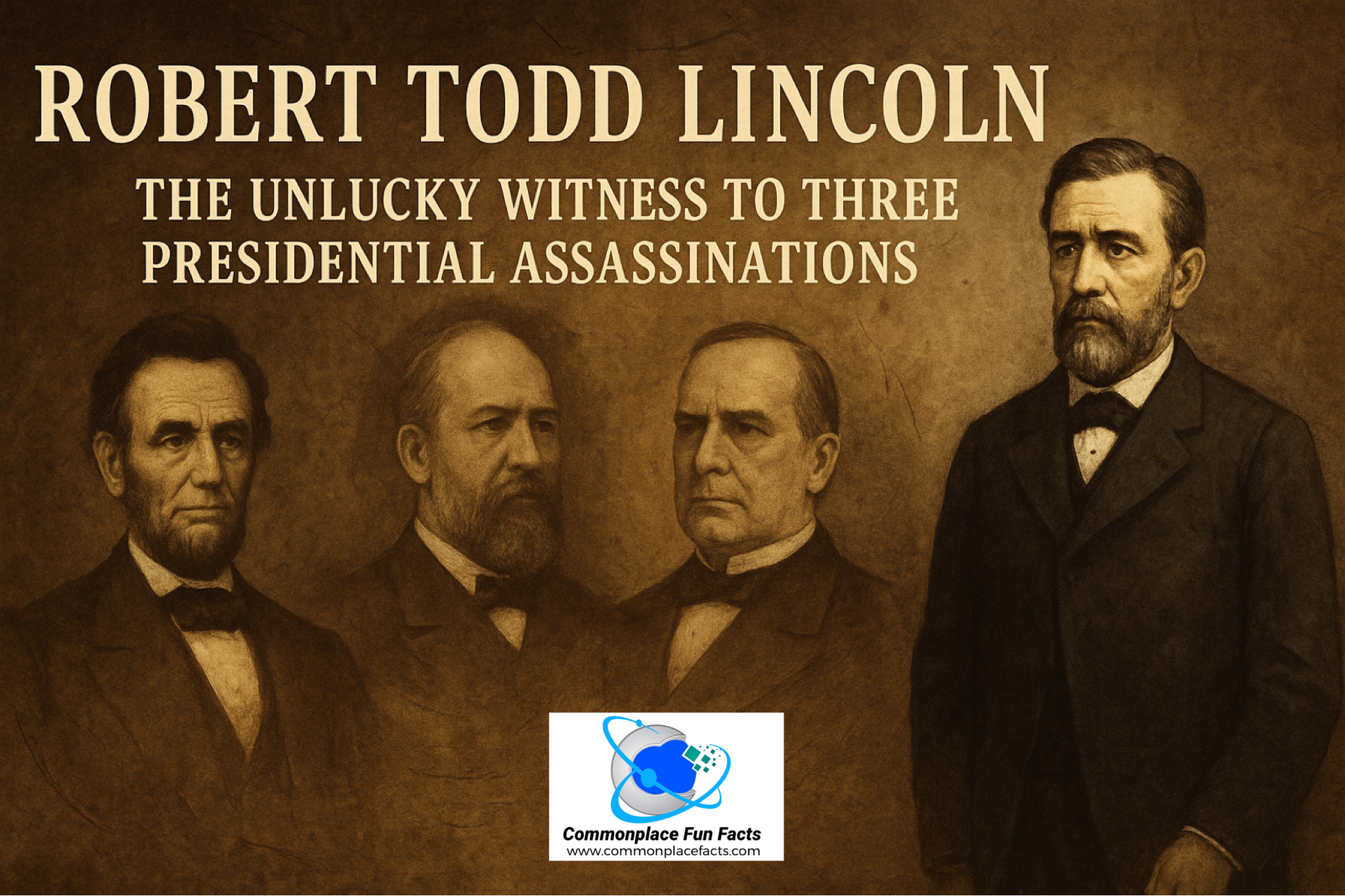

If you’ve ever had the misfortune of being that person who kills the vibe at every party, take comfort: at least you weren’t Robert Todd Lincoln. Robert had the singular misfortune of being the Forrest Gump of presidential assassinations, except with far fewer shrimp boats and more funerals.
Contents
The First Family Tragedy

Robert Todd Lincoln (1843–1926) was the eldest son of President Abraham Lincoln, which meant his childhood was already destined to be a “fun” combination of awkward family dinners, Civil War drama, and a father who was a little preoccupied with saving the Union.
On April 14, 1865, Robert wasn’t at Ford’s Theatre when John Wilkes Booth made his most infamous stage dive, but he was at the White House when news came in. He rushed to the Petersen House, where his father was carried across the street. There he stood vigil until the next morning, when Abraham Lincoln became the first U.S. president to be assassinated.
That alone would be enough trauma to make anyone avoid political events for life. History, however, was not done with Robert.
Strike Two: Garfield Goes Down
Fast-forward sixteen years. Robert, now serving as Secretary of War under President James Garfield, was doing his best to live a normal, respectable life when fate decided to test the warranty on his good luck.

On July 2, 1881, Robert accompanied Garfield to the Sixth Street Train Station in Washington, D.C. Enter Charles Guiteau, an unhinged office-seeker who believed God told him that Garfield’s death would unite the Republican Party. Spoiler for anyone keeping score at home: the plan did not work. Instead, it gave America a two-month lesson in how not to practice nineteenth-century medicine. Garfield lingered in agony until September, while Robert once again found himself standing uncomfortably close to a commander-in-chief’s demise.
Most of us would be browsing real estate listings for quiet cabins in the middle of nowhere at this point. Robert, however, still showed up when invited—at least until the third strike.
Three Presidents Down

By 1901, Robert was retired and hoping to keep his record of “presidential death bingo” capped at two. President William McKinley invited him to the Pan-American Exposition in Buffalo, New York, and social decorum being what it was, Robert accepted.
On September 6, 1901, Leon Czolgosz shot McKinley, moments after the president gave away his lucky flower. Yes, Robert Todd Lincoln was there. Again. McKinley died eight days later, and Robert realized that maybe, just maybe, he was the historical equivalent of a broken mirror, a black cat, and a ladder all rolled into one unlucky package.
The “Jinxed” Lincoln
After three presidential assassinations, Robert got the hint. He politely but firmly declined most future presidential invitations, likely with a note along the lines of: “Dear Mr. President, thank you for your kind invitation. Regretfully, I must decline, as my presence tends to dramatically shorten presidential life expectancy. Yours sincerely, Robert Todd Lincoln.”
In later years, Robert himself joked that he was cursed. Statistics were unnecessary. When you are three-for-three on assassinations, people stop inviting you to the party.
Fun Facts, Because History Can’t Resist
- Almost a Fourth: In 1922, at the dedication of the Lincoln Memorial, Robert attended with palpable reluctance. President Warren G. Harding delivered the speech, lived another year, and then died of natural causes. Washington collectively exhaled.
- The Great Irony: Robert was once saved from a train mishap by actor Edwin Booth, the brother of John Wilkes Booth. A Lincoln rescued by a Booth is precisely the kind of twist historians trot out when the plot seems too tidy.
- Longest-Lived Lincoln: Robert lived until 1926, the only Lincoln child to reach old age. His life bridged the sash-and-stovepipe-hat era to the Jazz Age, which is a sentence that should come with a soundtrack.
- Career, Not Candidacy: Robert never ran for president, which was probably wise for everyone involved. He built a substantial career as a lawyer, cabinet officer, minister to Great Britain for a time, and railroad executive with the Pullman Company.
The Legacy of the Harbinger
Robert Todd Lincoln never became president himself, and the Republic is arguably safer for it. He lived quietly, worked diligently, and tried to keep a respectful distance from the Oval Office and any public event where bullets historically tended to appear on the program. When he died at 82, the nation allowed itself a small, guilty relief: one less chance for another president to meet an untimely end in his vicinity.
The next time you think you’re cursed because your phone dies right after you charge it, remember Robert Todd Lincoln. He didn’t just kill the vibe; he practically had a VIP seat in the Presidential Assassinations Club.
You may also enjoy…

The Contagious Insanity of the Lincoln Assassination
Is insanity contagious? Consider all of the bouts of insanity that were tied to Abraham Lincoln’s assassination.

How Edwin Booth Saved Abraham Lincoln’s Son – A Forgotten Twist of Fate
Discover how Edwin Booth, brother of Lincoln’s assassin, once saved the President’s son — a shocking historical irony that defied destiny.[

William McKinley Gave Away His Lucky Flower — and Ran Out of Luck
President William McKinley loved carnations and believed them to be lucky. Learn what happened on the day he gave away his lucky flower.




Leave a Reply to edCancel reply