
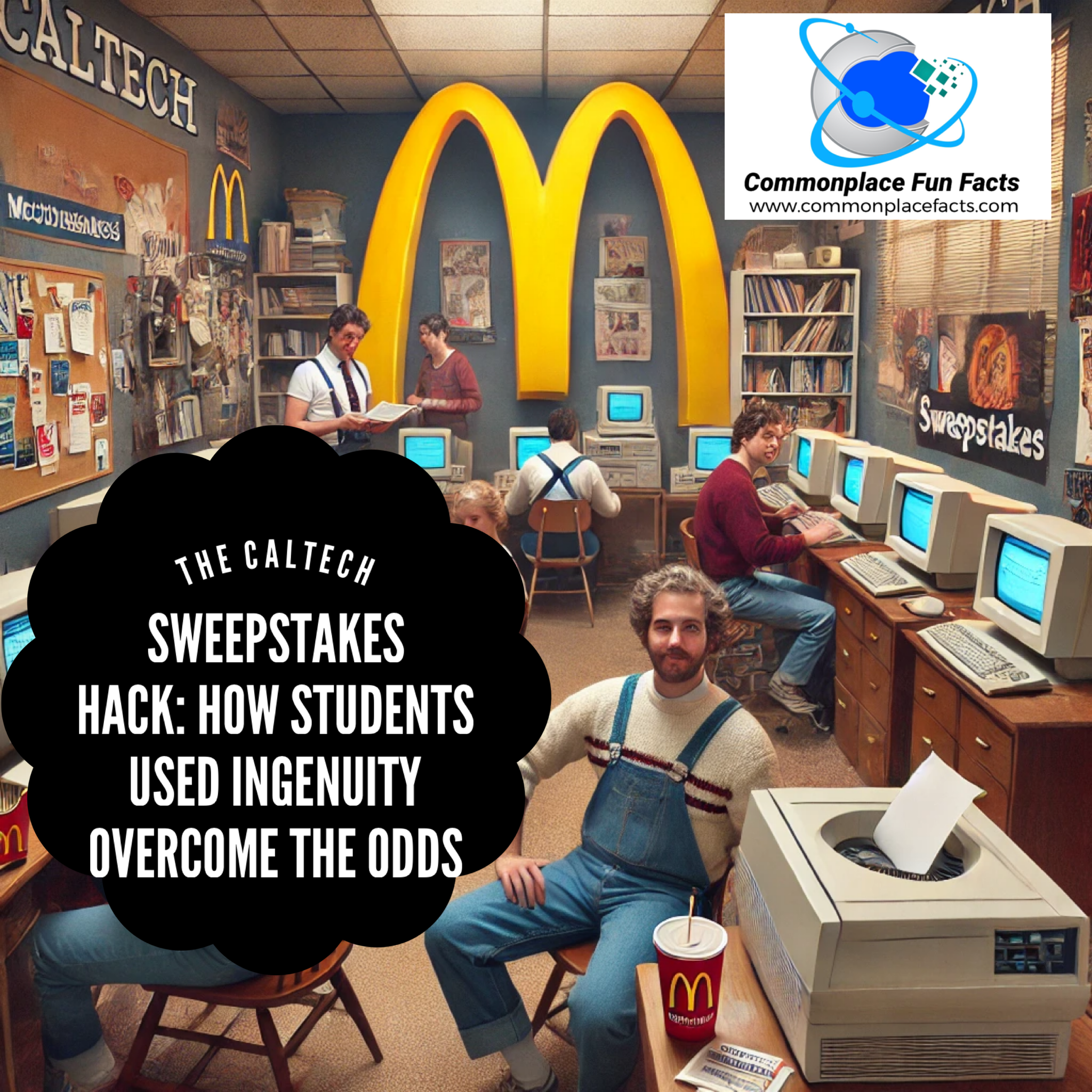

The Origins of the Caltech Sweepstakes Hack
College students have long been known to be among the most loyal customers of fast-food restaurants. In 1975 the students of Caltech combined their love of burgers with their scientific and engineering training.

The occasion was a sweepstake sponsored by 187 McDonald’s restaurants in Southern California. Participants were drawn by prizes that included one year of groceries, a new car, cash, and McDonald’s gift certificates.
Contest rules encouraged participants to “enter as often as you wish.” This caught the attention of Caltech students Steve Klein, Dave Novikoff, Glenn Hightower, and Barry Megdal. Using Caltech’s IBM system 370 mainframe computer, they created a program to generate contest entry forms. After running the program for three days, they produced 1.2 million entries in the names of 26 fellow students who agreed to participate.
After cutting the forms into the requisite 3 x 5-inch paper, the students delivered the entries to 98 different restaurants on the last day of the contest.
Responses were varied. Some in the press and public saw the endeavor as another example of students wasting their time instead of focusing on their studies. Some viewed it as a high-tech means of cheating, while others applauded the students’ ingenuity.

San Fernando residents petitioned the attorney general to investigate the legality of using “equipment at a state or federally funded college, university, or institution for the pursuit of personal interest, not to mention the cheating of American consumers.” This investigation went nowhere, once it was disclosed that Caltech is privately-funded and no government funds were involved in the acquisition or use of the computer.
Among those who saw the humor in the situation was McDonald’s primary competitor, Burger King, who offered free fries to any customer who brought in a computer punch card.
The students, for their part, maintained that they were abiding by the rules, and pledged that any prizes they won would not benefit them personally, but would be donated to charity or used to make “living improvements” in the dorm.
McDonald’s responded to the controversy by reprimanding the students for violating the spirit of the contest but said they would honor the entries as valid. They also announced they would hold a duplicate drawing for prizes, in which all Caltech drawings would be excluded.

Ultimately 3.4 million entries were submitted, with more than 35% of them coming from the Caltech students. $50,000 worth of prizes were awarded, with Caltech students claiming $10,000 of the total including the new car. One student, Becky Hartsfield, not only won the new car but also the year’s supply of groceries.
Since they submitted 35% of the entries, they were surprised to have won only 20% of the prizes. “Mathematically, it’s feasible,” said Hartsfield, “but it seems like a low figure.”
The students donated the car to the United Way and used some of the cash winnings to pay the taxes for the prizes. They kept the gift certificates for themselves.
You may also enjoy…

Revenge of the Nerds: The Epic MIT Prank on Harvard and Yale You Don’t Want to Miss
Discover how students pulled off an epic MIT prank on Harvard during the 1982 Harvard-Yale football game. Watch the video and learn why engineers are the ultimate pranksters!

This School’s Most Famous Student Never Existed
Georgia Institute of Technology is a research university based in Atlanta, Georgia. Since its establishment in 1885, Georgia Tech has awarded degrees to tens of thousands of students. None of them have come close to surpassing the fame and accomplishments of 1930 graduate George P. Burdell. Although nearly a century has passed since Burdell’s enrollment,…

The Third Wave: How A Teacher Turned Ordinary Students Into Little Fascists in Just Five Days
In 1967, a California teacher conducted a social experiment, creating a high school dictatorship in just five days. His students eagerly embraced fascist ideals, signaling the ease with which individuals are swayed to totalitarianism. This compelling tale of manipulation serves as a chilling reminder of the susceptibility of society to authoritarian influence.



Leave a Reply to sopantoothCancel reply