
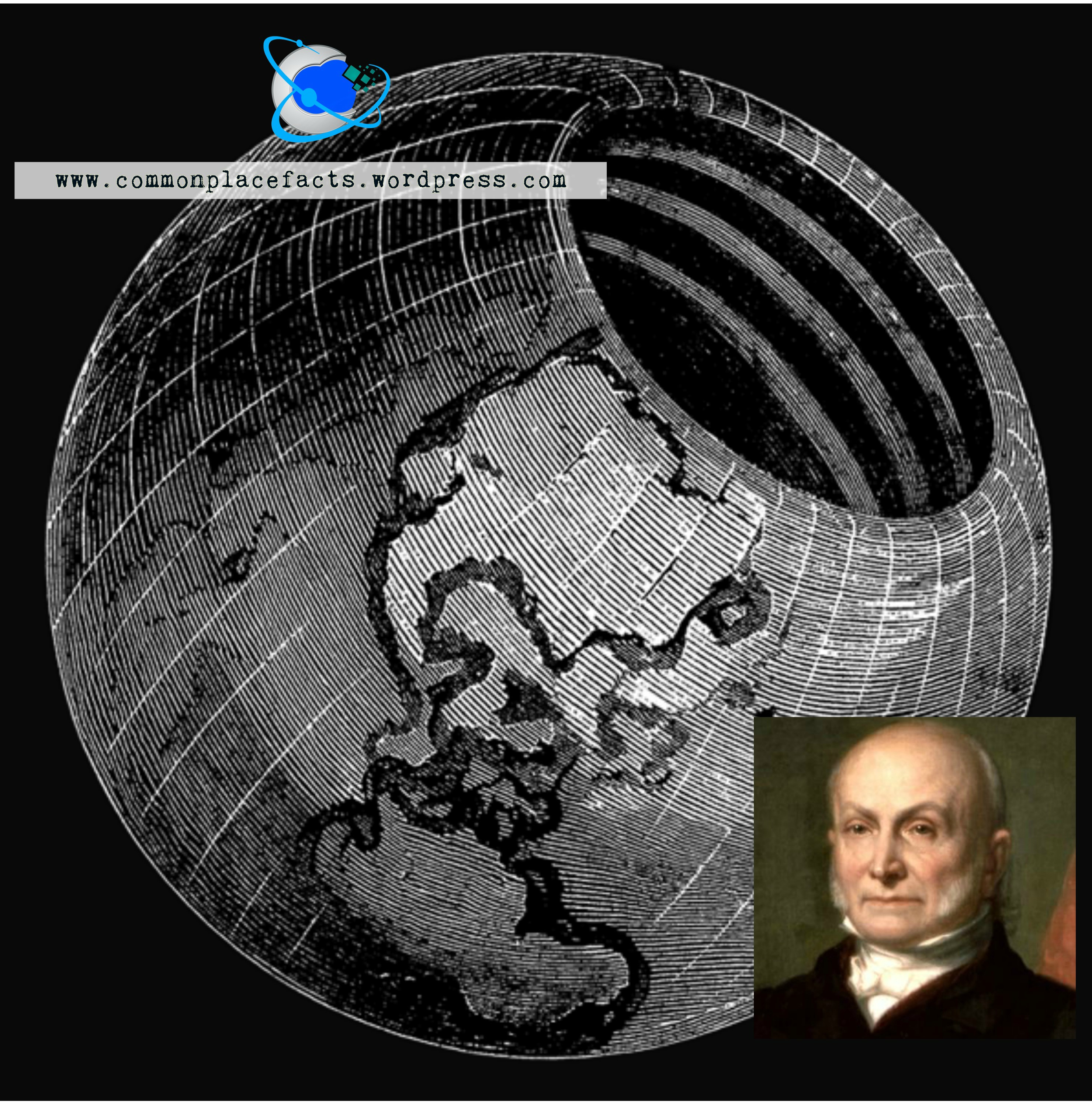

A Hollow Earth?
Who would believe that the earth is hollow and home to underground vegetation and animals? Such is the fantasy of science fiction, not of reasoned, rational minds, right? Certainly, such notions would not be embraced by the President of the United States!
Or would they?

John Cleves Symmes circulated a flyer in 1818 in which he posited that the earth is actually a hollow sphere, containing several concentric spheres. He believed these strata could be accessed through openings at the northern and southern poles. Within these hidden worlds, Symmes’ believed one could find “a warm and rich land, stocked with thrifty vegetables and animals if not men.”
Unlike the The Great Moon Hoax that would grip the world’s attention a couple of decades later, Symmes’ claims were scorned by many, but he did capture the attention of more than a few people. Among them was none other than President John Quincy Adams. Symmes met with the President in 1828 and convinced him to lobby Congress for a publicly-funded expedition to the South Pacific in pursuit of one of the elusive openings to the underworld.
The House of Representatives was convinced — somewhat. It approved the sending of one US Navy vessel, provided it could be done within the existing budget. The Senate was less convinced, despite the support of future Vice President Richard Mentor Johnson, and refused to approve the compromise measure.
Adams was not deterred and continued to push for the expedition. It was left to his successor, President Andrew Jackson, to put an end once and for all to what ended up being a hollow pursuit.

Sleep Science 101: Why Are Yawns Contagious? The Answer is More Invigorating Than You Might Expect
Why are yawns contagious? Discover the fascinating science as we explore theories on brain chemistry, social mirroring, and how yawning strengthens social bonds across humans and animals alike.

Nightmare on Left-Side Street: Is Your Sleep Position to Blame?
Does your sleep position affect whether you will have dreams or nightmares? Discover the surprising science behind sleep positions and dreams, plus tips to improve your night’s rest.

Honeybee Sting Pain Index: Exploring the Most Painful Places on the Body to Get Stung
Discover Michael L. Smith’s research on the Honeybee Sting Pain Index, ranking pain from stings on different body parts. Find out which sting hurts the most.



Leave a Reply