

Editor’s Note: This article is part of our ongoing series in which we revisit earlier Commonplace Fun Facts articles to provide expanded explanations and even more delightful absurdity. The original version of this story was published back in 2014, when our staff was younger and, frankly, didn’t know what it was doing in terms of writing a blog (that’s not to suggest that our staff is any wiser now, but the youth thing is a distant image in the rear-view mirror).
What Was the Great Moon Hoax?
Back in the hazy summer of 1835, when news traveled at the speed of a very determined pigeon and “fake news” hadn’t yet been trademarked by political campaigns, the world was gripped by an out-of-this-world scoop. The front page of the New York Sun exploded with sensational headlines proclaiming that Sir John Herschel, a very real British astronomer, had spotted life on the moon.
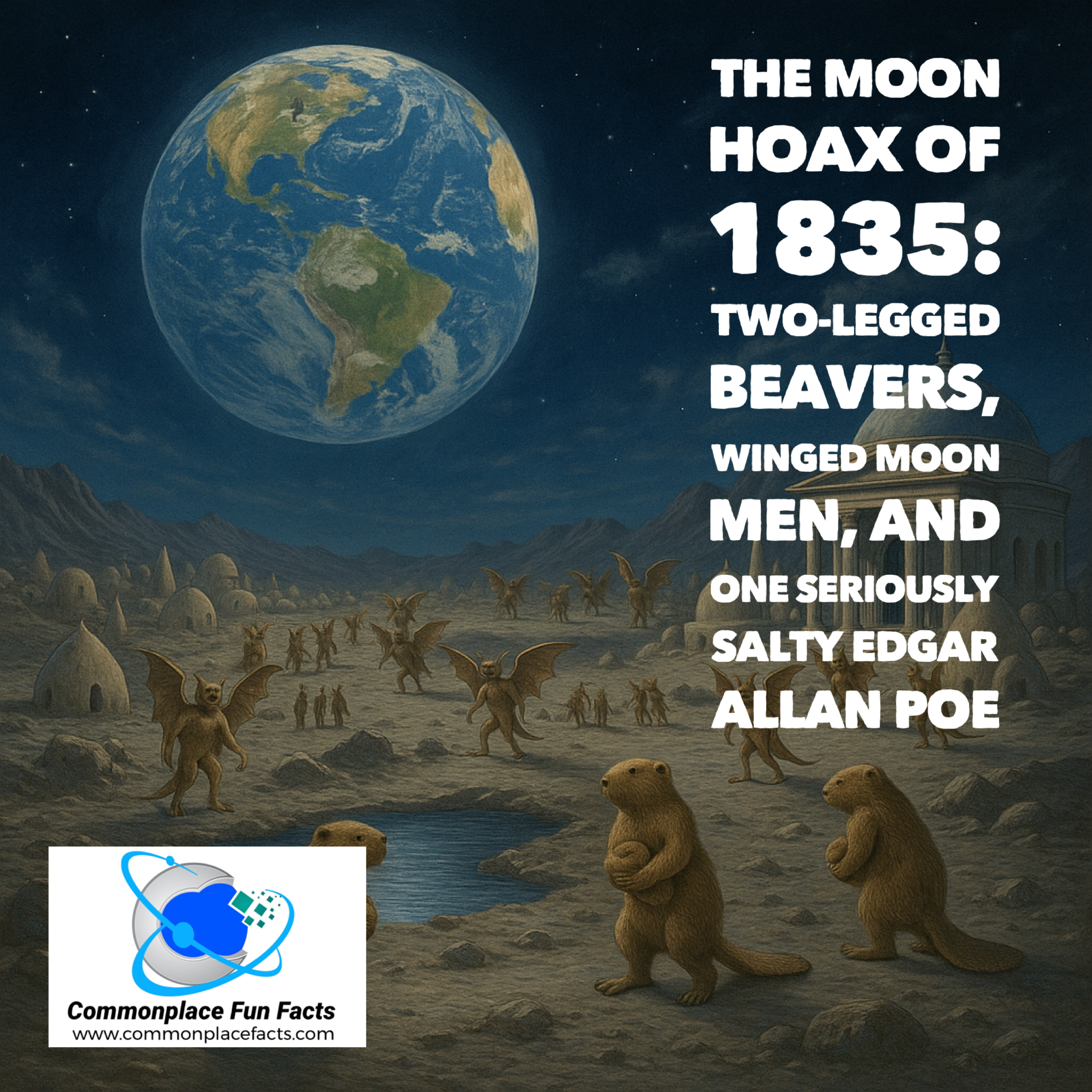
And by “life,” we’re not talking about something as bland and undeveloped as bacteria, moss, or Britney Spears—no, we’re talking unicorns, temples made of sapphire, beavers who walked on two legs (and, we assume, harbored fugitive children escaping the wrath of the White Witch), and humanoid creatures with wings who probably moonlighted as backup dancers for Cher. For a glorious six-day stretch in August 1835, the public was utterly spellbound by what ultimately became known as The Great Moon Hoax.
Contents
A Whole Lot of Lunacy
The New York Sun published the story in a series of articles starting on August 25, 1835. The reports claimed to be reprints from the Edinburgh Journal of Science—a publication that, by that point, had been as dead as disco for years. But don’t let that stop a good story, especially when it includes moon-based fauna that seem like the fever dreams of a sci-fi taxidermist.

The articles, allegedly written by Dr. Andrew Grant (assistant to Herschel), described a telescope so powerful it could make out lunar flora, fauna, and civic zoning regulations. Through this miracle of optics, Herschel and his team were said to have discovered entire ecosystems, including rivers, beaches, crystalline cities, and a species of bat-like humanoids called Vespertilio-homo—a name that rolls off the tongue like a vampire-themed pasta dish.
There were moon goats, spherical huts, and yes, bipedal beavers who not only walked upright but “carried their young in their arms and communicated with each other by barks.” That’s right—sassy, socially competent, barking lunar beavers. Who needs little green men when you have that?
All the News That’s Fit to Fabricate
The brain behind this celestial con was Richard Adams Locke, a writer and editor for the New York Sun. His motivations were part satire, part marketing stunt, and part “let’s see how far we can run with this before anyone tries some fact checking.”
Locke wasn’t some rando in a tin foil hat. He was highly educated, Oxford-trained, and reportedly grew tired of the religious and scientific hysteria surrounding extraterrestrial life. So, he did what any responsible journalist with a typewriter and a flair for dramatic fiction would do: he made up a story about lunar Batmen to poke fun at the public’s gullibility.
How gullible were our 18th century ancestors? About the same as we are today, because they bought it hook, line, and beaver.

The hoax caused the New York Sun’s circulation to skyrocket. People were practically elbowing each other to get their hands on the latest installment. Scientists debated the findings, clergymen speculated about the spiritual implications, and readers couldn’t get enough of those moon beavers. In the realm of 19th-century journalism, it was the equivalent of going viral, minus the GIFs and TikTok dances.
Quoth Edgar Allan Poe: “Nevermore”
There was at least one notable member of society who saw through the hoax, and he was not at all amused. That person was Edgar Allan Poe, America’s favorite gloomy literary genius and, apparently, one of the earliest victims of intellectual plagiarism.

Just a few months before the moon madness began, Poe had published a short story titled The Unparalleled Adventure of One Hans Pfaall in the Southern Literary Messenger. In it, Hans, a Dutchman with a balloon and a death wish, flies to the moon and describes its strange inhabitants. Poe intended the story to be the first installment in a hoax of his own, mocking sensational journalism and playing with reader expectations.
You can imagine Poe was anything other than thrilled when he discovered his idea had been hijacked—and made wildly successful—by someone else. That someone else? Richard Adams Locke, who just so happened to have edited Poe’s work at the Messenger. Talk about a plot twist worthy of a Gothic novella. Locke didn’t just steal the thunder—he built an entire lunar amusement park on it and charged admission.
Poe was furious, but also reluctantly impressed. In a letter to a friend, he grumbled, “There is no doubt in my mind that the Sun’s hoax is based on Hans Pfaall, and I do not hesitate to say so.” He later wrote an exposé titled The Great Moon Hoax, trying to reclaim his narrative, though by then the public had already moved on to newer, shinier novelties—like the invention of the telegraph and the popularity of mutton chops.
It should be noted that this would not be the only time Poe was ahead of everyone else. Just two years later, he published his only novel and creepily predicted the cannibalistic killing of a cabin boy. Follow the link for more details about that.
Backpedaling With Grace
When it finally became clear that the whole thing was a ruse, the New York Sun didn’t exactly issue a retraction. Instead, it kind of… winked. The paper never formally admitted the hoax, although Locke eventually copped to being the author. By then, the damage—or depending on your perspective, the literary fireworks—was already done. The story entered journalistic legend, and the paper’s circulation never quite returned to pre-beaver levels.
The hoax became an early cautionary tale about trusting everything you read, particularly when it involves fantastical moon dwellers and suspiciously convenient telescopes (that could see so well that they could even discern the sound of a barking beaver). But it also offered a deliciously weird case study in the power of storytelling, public gullibility, and the enduring appeal of a well-executed lie.
Legacy: The Truth Is Up There (But Mostly Made Up)
The Moon Hoax of 1835 still captures imaginations today—mainly because it’s an impressive feat of creative fiction dressed up in lab coats and scientific jargon. It paved the way for everything from War of the Worlds radio panic to Weekly World News headlines about Elvis sightings, government efficiency, and other make-believe fantasies.
It also gave us a rare, candid glimpse into the mind of a pre-internet public: hopeful, curious, and blissfully unarmed against the satirical onslaught of a clever writer with a printing press. It turns out that our species is remarkably consistent in our desire to believe in impossible things.
Oh, and in case you’re wondering—Sir John Herschel, the actual astronomer whose name was borrowed for the hoax? He was not amused. When he found out he’d supposedly discovered intelligent bat-creatures and hadn’t even been invited to the party, he was reportedly embarrassed and annoyed. But at least he got to be part of history, even if it was more pulp fiction than peer review.
The Final Frontier of Fake News
So, the next time you hear someone breathlessly sharing a wild story about alien civilizations, secret government moon bases, strange floating islands, or Bigfoot colonizing Mars, just remember: we’ve been falling for this stuff since at least 1835. And as long as there are curious minds and gullible hearts, there will be moon hoaxes, Martian chronicles, and probably a new streaming series called CSI: Lunar Beavers.
We tip our hats to Richard Adams Locke—for giving us one of the greatest newspaper hoaxes of all time—and to Edgar Allan Poe, who rightly deserved the credit but instead had to settle for inventing modern horror while fuming over literary larceny. If only he’d patented the idea. Or at least trademarked the beavers.
In the end, we can safely say that the Moon Hoax was more than just a weird blip in journalistic history. It was a celestial con, an accidental Poe parody, and a perfect reminder that truth may be stranger than fiction, but fiction often gets better reviews.
You may also enjoy…

The Great Bonsai Kitten Hoax
Bonsaikitten.com, launched in 2000 as a parody by MIT students, featured fictitious “bonsai kittens” living in glass containers, sparking public outrage over perceived animal cruelty. Despite the site’s intention as a joke, animal rights groups criticized it fiercely. The FBI investigated and found no real harm. Subsequently, the site was removed from servers.

The Great Banana Peel Smoking Hoax: Just One More Reason The 1960s Were So Weird
Say what you will about the 1960s, you have to admit it was a decade of weirdness. It was a time when rebellion, revolution, and poorly thought-through hairstyles were the norm. Musical tastes ranged from folk songs to atonal psychedelic screeches. Society was gripped with anti-war protests, race riots, political assassinations, and drugs. Return with…

The (Late) Great Paul McCartney Death Hoax of 1967
Is Paul Dead? Exploring the Great Paul McCartney Death Hoax of 1967 In 1967 a rumor began circulating that Beatles member Paul McCartney had died and was replaced by a doppelganger. This rumor picked up steam and within two years had become an international phenomenon. It started with rumors that McCartney had been killed in…






Leave a Reply