
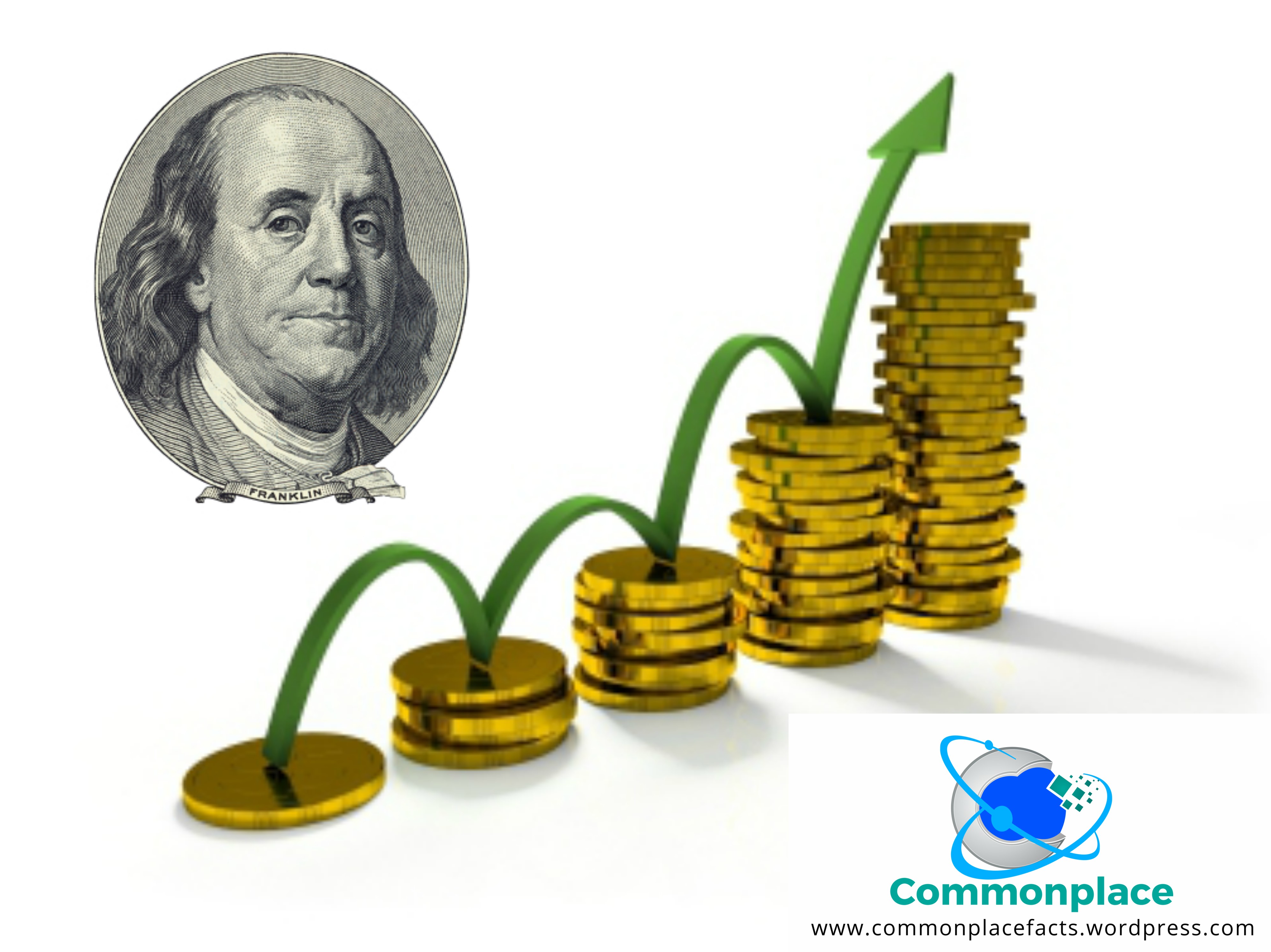

Benjamin Franklin and the Wonder of Compound Interest
Benjamin Franklin (1706-1790) has been credited with calling compound interest the eighth wonder of the world. Whether he actually said that is a matter of debate, but the fact that he believed it is undisputed.
When Charles-Joseph Mathon de la Cour wrote a parody of Franklin’s Almanac called Fortunate Richard, he attempted to make fun of Franklin’s seemingly-simplistic economic views. He wrote about a fellow leaving a small sum of money in his will to be used only after it had collected interest for 500 years. He intended it as a parody, but one reader took it seriously.
Dare Issued — Challenge Accepted
Benjamin Franklin wrote the author, telling him it was a wonderful idea, and that it had inspired him to follow suit. Franklin then prepared a provision in his will, leaving a £1,000 ($4,444 USD) bequest to the city of Boston and an equal amount to the city of Philadelphia. The funds were given on the condition that they be placed in an interest-bearing account that would gather interest over a period of 200 years.
Franklin’s will specified that the funds be used as loans for young apprentices as he had once been. Then, 100 years after his death, part of the money should be disbursed, with the remainder given out a century later. The funds evidently came from the salary he earned while serving as governor of Pennsylvania. Franklin long believed that public servants should not be paid for their service.
The Impact on Financial History
In 1907, when the first distribution came due, Philadelphia’s portion of the bequest had grown to $172,350. $133,076 was distributed to the Franklin Institute, a museum dedicated to science education. Boston’s portion was worth $405,000, and a portion of that was used to build Franklin Union on Berkeley Street, Boston.
Find out why there were 15 bodies buried in Franklin’s basement
One hundred years later, when the terms of the will required the final distribution fo the funds, Boston’s portion had grown to $4.4 million, while Philadelphia’s had, due to differing investment strategies, grown to $2 million.
Franklin famously observed, “Money makes money. And the money that money makes, makes money” All he needed to add to this was 200 years and the willingness to take a dare.
You may also enjoy…

Churchill’s Touching Bequest for a Marmalade Cat
How a Marmalade Cat Made an Impression on Winston Churchill When Winston Churchill donated his home to the United Kingdom’s National Trust, he did so with the request that there always be a marmalade cat named Jock, with a white bib and four white feet, in comfortable residence at the estate. The National Trust has…

Inside T.M. Zink’s Controversial Will: The Curious Quest to Build a Womanless Library
Explore T.M. Zink’s eccentric will to create a womanless library that sparked a legal battle over gender exclusion in the 1930s. #IowaHistory #ControversialWill #LegalDrama #WomanlessLibrary

The Very Long and Very Short of Last Wills and Testaments
When it comes to a Last Will and Testament, there are rules mandating how short or long it may be. Take a lesson from the following extremes of the shortest and longest wills on record. The record for brevity in estate planning goes to Herr Karl Tausch of Langen, Hessen, West Germany. His will, dated…




Leave a Reply