

Table of Contents
Allow us to introduce you to Townsend Murphy “T.M.” Zink, a man who made quite the name for himself as a prominent lawyer in Le Mars, Iowa. When we say “made a name,” we aren’t referring to his courtroom victories or eloquent legal arguments. No, T.M. Zink etched his place in the annals of history for something far more, shall we say, offbeat. Zink’s fame comes courtesy of his will—specifically, a will that decreed the creation of a womanless library. Yes, you read that right. T.M. Zink thought his legacy could best be established through a literary fortress of solitude where men could peruse books without the terrifying prospect of encountering a member of the fairer sex.
That’s just the tip of the eccentric iceberg. Let’s dive into the life, career, and scandalous legacy of T.M. Zink, the man who wanted to be remembered for trying to ban women from reading books.
From Ohio to Iowa: A Legal Career Begins

Born on December 28, 1858, in Hillsboro, Ohio, T.M. Zink’s story begins like many others of his era. His parents, James and Clarissa Zink, eventually decided the rolling plains of Iowa were more appealing than Ohio, and off they went to Jasper County, Iowa. While most young men of the time would have been eyeing a nice farm to settle into, Zink had other plans. He wasn’t going to spend his life milking cows and fixing fences. He was off to study law at the University of Iowa.
After graduating in 1883, Zink set his sights on Le Mars, a small but bustling town in northwestern Iowa, where he established his law practice. Over time, he built a reputation as one of the most respected attorneys in the region. We assume this means he spent his days wrangling cattle disputes and maybe the occasional attempted theft poultry, but our research was a bit skimpy in this area. Zink even dabbled in politics, although his attempt to get elected to the state congress ended about as well as a screen door on a submarine. The writing should have been on the wall when he chose to run as a Democrat in a heavily Republican county, but some people just have to learn the hard way.
Zink didn’t let his failed political aspirations deter him. He partnered with fellow legal minds, W.J. Kass and Albert Kass, forming the imaginatively named law firm Kass, Zink, and Kass. This law firm might not seem terribly relevant now, but hold on—this detail becomes important when we get into the legal debacle surrounding Zink’s controversial will.
Personal Life: A Tale of Two Marriages
Zink’s personal life, at first glance, seemed pretty ordinary. He married Emma Nix in 1885, and two years later, they welcomed their daughter, Margretta. Tragedy struck in 1910 when Emma passed away, leaving Zink a widower. He remarried in 1926, this time to Ida Bennison, a widow who had known Zink for over three decades. By all accounts, Ida and Zink’s marriage was “ideally happy.” And if this were any other story, we’d end with the happy couple living out their golden years in wedded bliss. As you may have guessed, this is not that story.
The Last Days of T.M. Zink
By 1930, Zink’s health was failing. After suffering from gallstones—those pesky little rocks that love to hang out in your gallbladder and make life unbearable—Zink underwent surgery. Unfortunately, medical procedures in 1930 were a roll of the dice, and Zink wasn’t quite lucky enough to survive. On September 11, 1930, at the age of 72, T.M. Zink shuffled off this mortal coil.
Zink’s funeral was, by all accounts, a respectable affair. The townsfolk of Le Mars gathered to pay their respects, and the local papers wrote glowing tributes to the man who had once been a pillar of the community. If only they knew what was coming next.
A Woman’s Place is in the… Well, Certainly Not the Library
That brings us to, Zink’s Last Will and Testament. Less than two months before his death, Zink drafted what can only be described as a legal grenade. While most wills leave behind money, property, and perhaps some fond words for the family, Zink’s document went in a slightly different direction. To his only daughter, Margretta, he left the princely sum of five dollars—five dollars. To his wife, Ida, he left… well, nothing. Actually, that’s not quite true. He gave her the option to rent their house for $40 a month. Who says romance can’t survive the grave?
Learn About Charles Vance Millar and the Practical Jokes Contained in His Will.
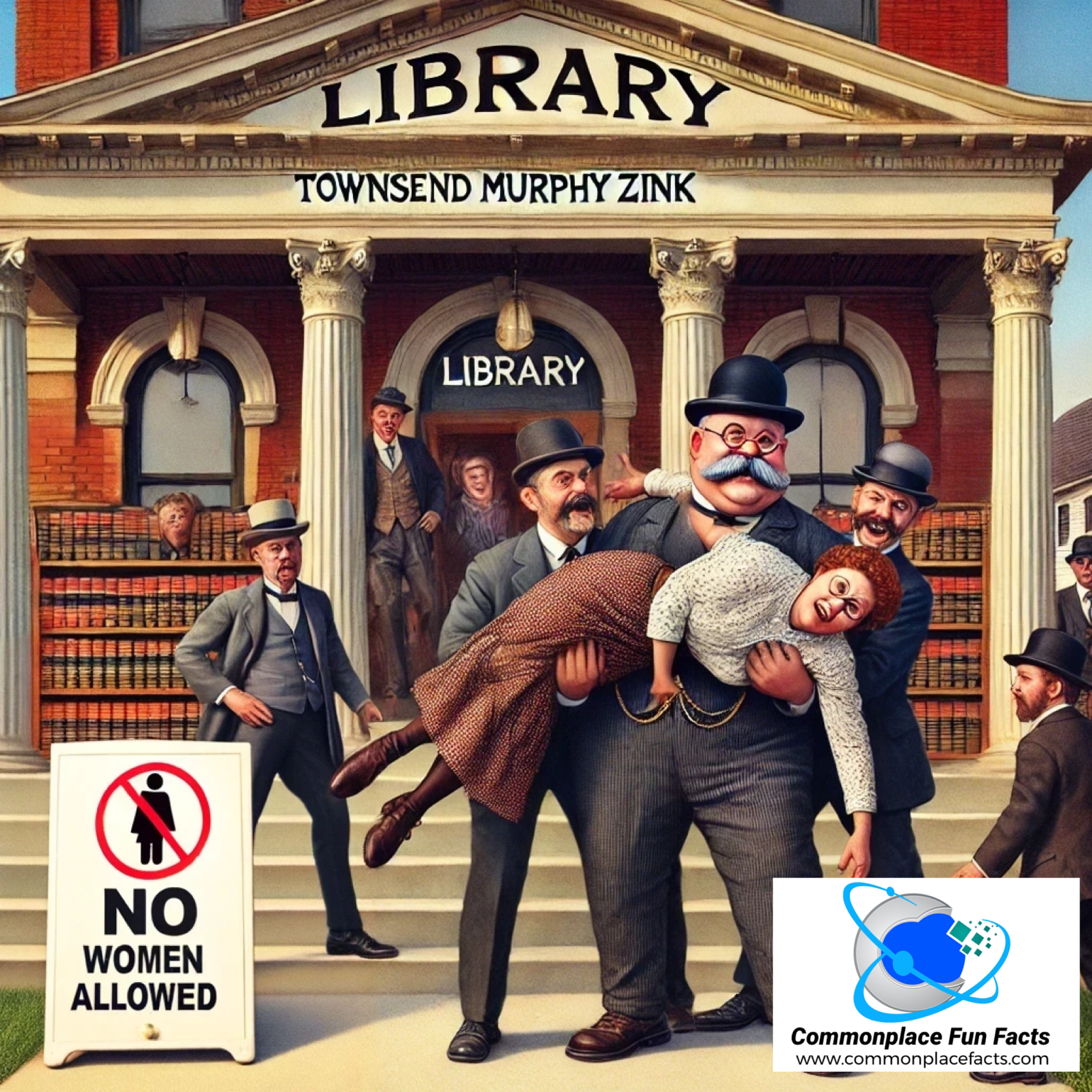
Zink’s pièce de résistance was yet to come. He allocated the bulk of his estate, valued between $40,000 and $80,000 (equivalent to anywhere between $750,000 to $1.5 million in 1924), to establish a trust. This trust had one purpose: to build a library. And not just any library. This place of learning would be forever off limits to women. Signs saying “No Women Admitted” were to be posted at each entrance, and no books, works of art or decorations by women could ever be permitted on the premises.
His will left no doubts about intentions. A sign reading “No Woman Admitted” would hang above each entrance, just in case anyone got confused about the rules. If you thought Zink’s aversion to women was some kind of personal beef with a select few, think again. He explained in his will that his hatred for women was “not of recent origin” and was based on his vast “study of all literatures and philosophical works.” (We’re guessing he skipped the chapters on gender equality.)
The Legal Battle and a Plot Twist

As you might imagine, Margretta was less than thrilled with her $5 inheritance and her father’s odd vendetta against women. She immediately contested the will, arguing that her father had been mentally unfit when he penned the document. Enter Dr. George Donahoe, a psychiatrist from the state mental hospital, who testified that Zink suffered from “sexual paranoia.”
With Dr. Donahoe’s testimony, Margretta’s case got a major boost. On March 7, 1931, the court ruled in her favor, declaring Zink’s will invalid. Margretta inherited the entire estate, and the dream of a womanless library in Le Mars evaporated faster than a snowball in July.
While Margretta won the legal battle, her victory came with a catch. The Great Depression had been busy doing what it does best—decimating the value of just about everything. By the time the court ruling came down, Zink’s once sizable estate had shriveled to around $25,000. It didn’t stop there. The estate’s value continued to nosedive, hitting a rock-bottom $10,000 by the end of 1931. As if that weren’t enough, Zink’s widow, Ida, filed a claim for $3,000 in household expenses, and a mysterious $10,000 promissory note popped up, threatening to obliterate whatever remained of the estate.
Just when you thought things couldn’t get more bizarre, it turns out Zink had signed over his entire estate to Margretta back in 1920. A notarized deed from a decade earlier meant that all of her father’s property technically belonged to Margretta anyway. The will, the court battle, the drama—it was all a bit pointless. Not that we’re complaining. It gave us something to write about for today’s Commonplace Fun Facts article.
The will may have been invalidated, but his legacy remains. The bizarre notion of a library where women were forbidden still fascinates historians and legal scholars alike. Zink’s attempt to create a monument to male intellectual superiority (or insecurity, depending on how you look at it) was foiled, but his story lives on as a cautionary tale about letting one’s eccentricities get the better of them.
Final Thoughts
Townsend Murphy Zink was, without a doubt, a complex man. He was a respected attorney, a husband (twice), and a father. But he was also a man whose deep-seated disdain for women led him to try and construct one of the most baffling legacies in legal history. His will was more than just a legal document—it was a window into the mind of a man who couldn’t quite reconcile his personal feelings with the world around him. His story reminds us that the legacies we leave behind aren’t just defined by our accomplishments but by the beliefs and eccentricities that shape us.
You might also enjoy…

Robert Louis Stevenson and the Birthday He Gave Away
Discover the whimsical story of how Robert Louis Stevenson gifted his birthday, a tale blending creativity, humor, and literary history.

Churchill’s Touching Bequest for a Marmalade Cat
How a Marmalade Cat Made an Impression on Winston Churchill When Winston Churchill donated his home to the United Kingdom’s National Trust, he did so with the request that there always be a marmalade cat named Jock, with a white bib and four white feet, in comfortable residence at the estate. The National Trust has…

Charles Vance Millar: The Man Who Laughed From Beyond the Grave
Discover the fascinating story of Charles Vance Millar, a Toronto lawyer who orchestrated one of history’s most famous pranks with his will, sparking the Stork Derby. A tale of humor and legal battles.




Leave a Reply