

Shakespeare’s Chair and Founding Father Souvenir Hunters
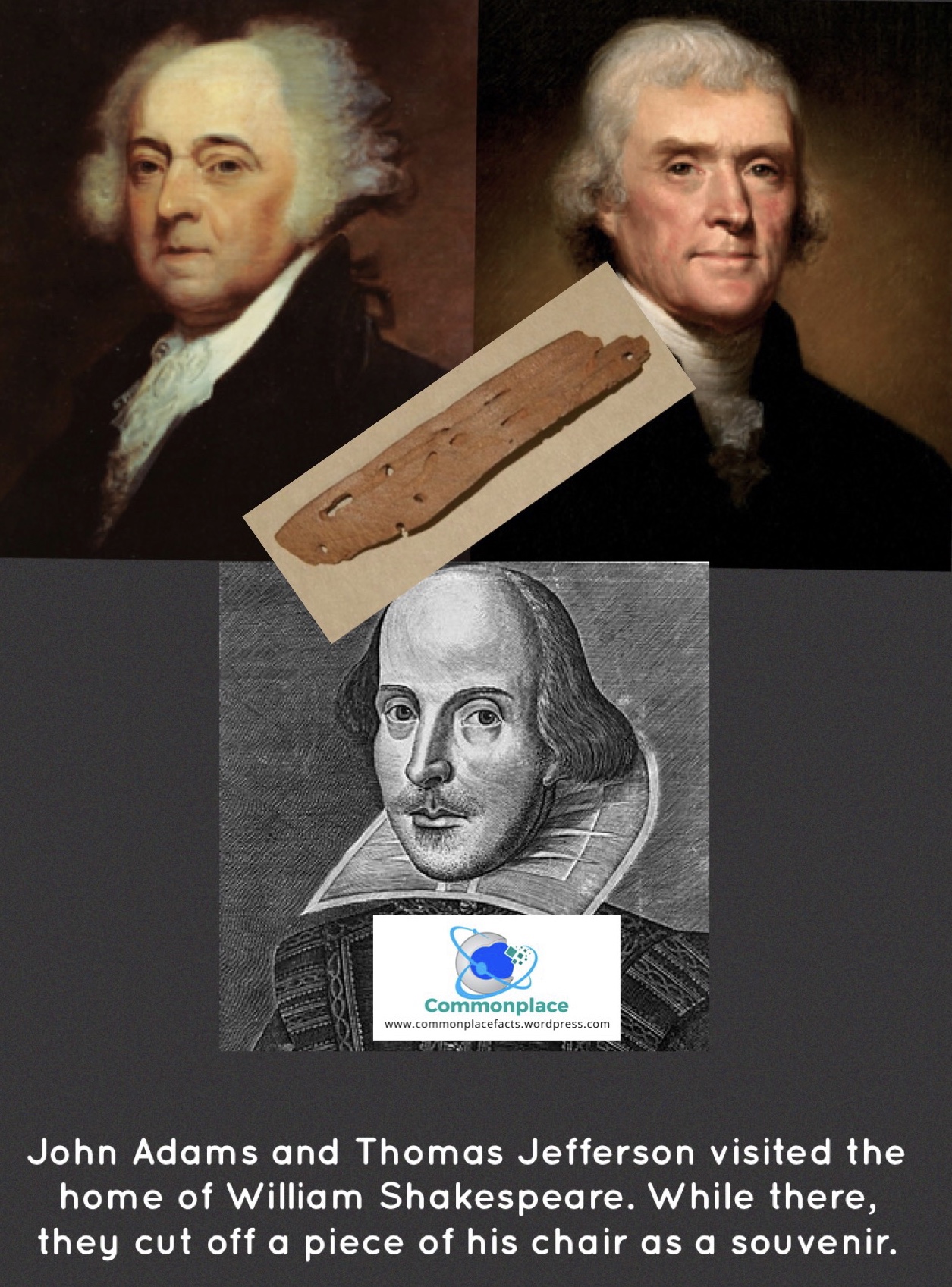
In March of 1786, John Adams and Thomas Jefferson traveled to England as diplomats of the newly-independent United States of America. While there, they engaged in a little sightseeing — and a wee bit of vandalism.
Among the places visited by the two revolutionaries was the home of William Shakespeare, Stratford upon Avon. Adams, who once counseled his son, “You will never be alone with a poet in your pocket,” apparently wanted more than just the words of this particular poet in his pocket. Together with Jefferson, he sliced off a piece of the Bard’s chair when no one was looking. Later, he wrote in his journal, “They shew Us an old Wooden Chair in the Chimney Corner, where [Shakespeare] sat. We cutt off a Chip according to the Custom.”
The chip itself was catalogued by Jefferson, along with this note: “A chip cut from an armed chair in the chimney corner in Shakespear’s house at Stratford on Avon, said to be the identical chair in which he usually wrote, if true, like the relicks of the saints, it must miraculously reproduce itself. Cut by myself in 1785.”

Curiously, Jefferson puts the date at 1785, even though John Adams’ diary and Abagail Adams’ letters all confirm that the date of the visit was 1786. Then again, Jefferson did have a tendency to overlook little details — such as the fact that he held the office of President of the United States. Also, he was not the only one who wasn’t entirely sure how to spell Shakespeare’s name. Even Shakespeare wasn’t sure how to spell his name.
You may also enjoy…

The William Shakespeare Curse: Creepy Blessings and a Missing Skull
The legend of the William Shakespeare Curse can be traced to William Shakespeare’s epitaph, inscribed with a warning against disturbing his grave. In characteristic dramatic flair, he states his intention to curse any grave robbers. Despite the potential theft of his skull in 2016, no dire consequences have been reported for the intruders. Visitors are…

Thomas Jefferson’s Moose Gift Was a Moot Point
A French naturalist argued that American animals were feeble specimens. Thomas Jefferson answered in print and then arranged to deliver a piece of evidence rather too large for an envelope.

John Adams Equates Uselessness and Congress
John Adams had definite opinions about the usefulness of the vice presidency. Serving as the first person to hold the job gave him ample opportunity to develop them.




Leave a Reply