

Hoover Vacuums: From Best to Bust
When it comes to brand identification, few companies have been more successful than The Hoover Company and its sales of vacuum cleaners. In the United Kingdom, Hoover so dominated the vacuum cleaner market that the act of vacuuming carpet is known as “hoovering.” By the mid-twentieth century, Hoover was widely accepted as one of the most trusted companies in the United Kingdom. That all changed over one horribly-misguided marketing campaign. Welcome to the Hoover Free Flight fiasco, one of the biggest marketing mistakes in history.
Department store janitor James Murray Spangler was looking for a solution to his dust allergy. This led him, in 1908, to develop and patent a motorized fan on a manual carpet sweeper, thus creating the world’s first vacuum cleaner.
Spangler soon sold the patent to his cousin’s husband, William Hoover, who developed The Hoover Company. He sold the Hoover vacuum cleaners throughout the United States and Europe. For decades Hoover was virtually the only name in vacuum cleaners in the United Kingdom. This near-monopoly served the company so well that it expanded its products to other household appliances, such as washers and dryers.

As the 1980s drew to a close, Hoover was at a crossroads. A recession in the UK suppressed sales. The rise of competitors such as Dyson threatened Hoover’s market share. No longer able to rely solely on brand identification, Hoover was forced to look for creative ways to make its products stand out. One ill-fated attempt included a “talking vacuum” that verbally advised its users when the device needed to be emptied. When this was met with skepticism from the consumers, company executives showed their willingness to consider other ideas that were well outside the box.
Hoover Free Flight Fiasco
Travel agency JSI Travel approached Hoover in 1991 with an idea. Like Hoover, JSI Travel was feeling the pinch of the recession. It had an abundance of cheap flights available but the public wasn’t all that interested in traveling at that time. Hoover had a surplus of products it was unable to sell. JSI Travel proposed an eye-catching marketing campaign that would address both of these problems.
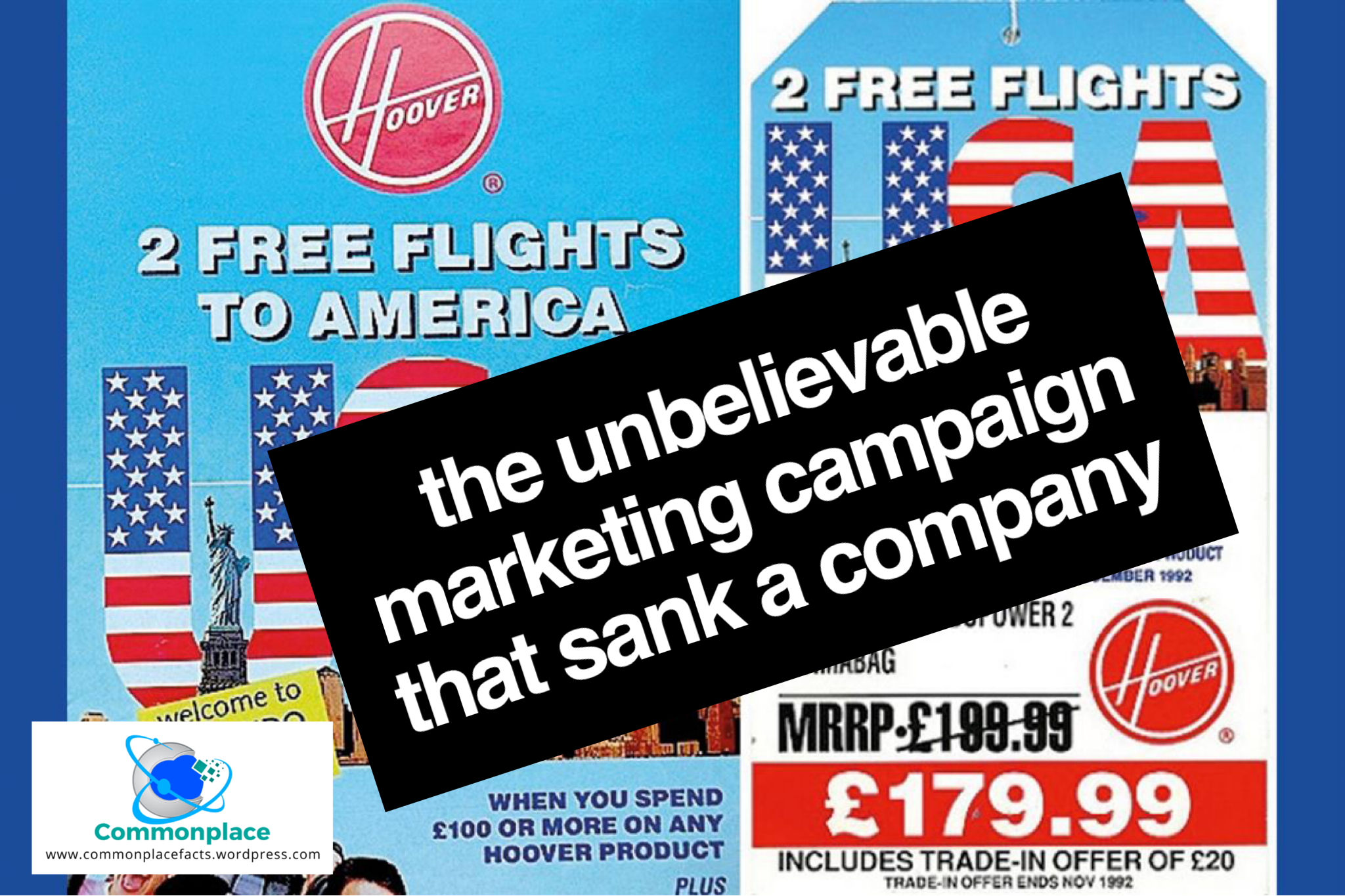
The result was the “Two Free Flights. Unbelievable.” promotional campaign. Newspapers, radio waves, and television commercials boldly proclaimed the news that if a customer bought any Hoover product worth £100, he or she would receive two free round-trip flights to any one of six European destinations. One of those television commercials can be seen here:
Anyone with a cursory knowledge of economics might be seeing some red flags at this point. The most popular Hoover product that met the £100 requirement was the Hoover Turbopower Total System vacuum. It sold for £119.99. Hoover made a profit of about £30 on each sale. Tickets from the UK to anywhere in Europe cost well in excess of £30, so how on earth did the company think this would help its bottom line?
The Strategy Behind the Free Flights Marketing Mistake
Hoover had a strategy, albeit perhaps not as well thought out as they might have wished. Those responsible for the campaign pointed out that it would have the desired effect of increasing sales. They also noted that not everyone who qualified for the free tickets would actually pursue getting them. The way they would further minimize the number of free tickets redeemed would be to make the process of redeeming the free tickets more complicated than finding an actual person to talk to at the IRS. The procedure for claiming the tickets was as follows:
- A customer buys a Hoover product for £100+ and mails in a receipt and application within 14 days of purchase. This deadline was strictly enforced. If the postmark was 15 days after the date on the receipt, you were out of luck.
- Hoover sends the customer a registration form. The customer has 14 days to send it back. Again, the deadline is strictly enforced.
- Hoover sends a travel voucher. The customer has 30 days to decide on his or her desired destination, departure date, and UK airport of origin.
- Once the travel voucher was sent back (again, with a strictly-enforced 30-day deadline), Hoover has the right to reject the customer’s choices, which it routinely did. Then the customer could then select three alternatives.
- Hoover could reject the alternatives, as well. If this happened (which it routinely did), the company reserved the right to propose its own travel plan. At this point, the customer could either take it or leave it.
The goals of the promotional campaign were successful. Hoover products flew off the shelves. A sufficiently-small number of airline tickets were successfully redeemed. The company’s profits were steadily moving in the right direction.
Free Flights or Frustrated Customers?
If an additional goal of the campaign was to aggravate and alienate its customer base, it was hugely successful in that regard as well. Discontent among those who were hopelessly tangled up in the free ticket red tape soared. In an era before social media, these unhappy customers still managed to make their discontent well known.
Hoover, however, was deaf to the complaints. Because of the success of the campaign, the company decided to go even bigger with its promises — and its obstinance. This only further escalated the Hoover free flight fiasco.
On November 1, 1992, Hoover expanded its free ticket offer to include free flights to the United States. The basic premise of the campaign was identical to the first, except the stakes were much higher now. In exchange for the £100 purchase, customers could expect to receive trans-Atlantic airline tickets. The cost of those tickets averaged £600. For that reason alone, Hoover’s interest in keeping the number of redeemed tickets to a minimum was greater than ever.

To be fair, not everyone at Hoover thought this was a good idea.
“To me, it made no logical sense,” recalled Mark Kimber, a risk management consultant. “Having looked at the details of the promotion [and] attempting to calculate how it would actually work, I declined to even offer risk management coverage.”
Less-considered opinions won the day, however, and Hoover plowed forward with its ambitious “Free Flights. Unbelievable.” campaign, version 2.0.
At first, it seemed that things were going as planned. Department stores all over the UK reported scenes of near-hysteria as customers fought with each other in a quest to snatch Hoover products from the shelves. Despite a recession, businesses were unable to keep the Hoover vacuum cleaners in stock. Hoover put its factories on 24/7 schedules, offering employees overtime in an attempt to keep up with the frenzied demand. All told, the sales generated by the campaign were ten times higher than projected.
One month into the campaign, the UK newspaper The Observer wrote, “The world has gone mad and it is all the fault of Hoover. If left uncontrolled, Britain could soon be knee-deep in Hoover Turbomaster Uprights.”
Warning Alarms
Despite the high number of sales, the warning alarms of destruction began to sound. A central premise of the campaign was that customers would spend more than the £100 minimum purchase. In reality, they continued to flock to the £119.99 Turbopower Total System vacuum. The other premise — that the number of people who would actually seek redemption of the free tickets would be comparatively low — was also flawed. The free tickets were precisely the reason for most of the sales. With only a £30 margin from each sale and a cost of £600 for each redeemed free flight voucher, Hoover stood to lose £570 off of each of these sales. Conservative estimates placed the company’s losses at more than £100 million.
With the first two premises of the campaign debunked, Hoover had no choice but to double down on the third strategy: make the redemption of the vouchers as utterly complicated as possible.
In the months to follow, the level of aggravation among consumers rose in direct proportion to the panic and desperation among Hoover executives. The company denied thousands of applications on the grounds of being improperly filled out. It sent out request forms on Christmas Eve, hoping to increase the number of customers who would fail to meet the 14-day deadline for the return. Flights that it offered departed on the other side of the country from the residence of the customer.
Despite all these obstacles, customers continued to pursue their free tickets. Many such customers, who had doggedly complied with every requirement, found that their letters had mysteriously disappeared somewhere in transit. With no way to prove otherwise, the customers received nothing for all their trouble.
At first, individual customers just assumed they were the victims of bad luck. With so many affected people, however, it did not take long for word to get around that the denied tickets were not isolated situations. Word finally got out that not a single trans-Atlantic flight had been awarded.
Harry Cichy was one such dissatisfied customer. He formed the Hoover Holiday Pressure Group. More than 4,000 unhappy Hoover customers filled its ranks, demanding that the company make good on its promises. “We don’t want blood,” Cichy said in a statement at the time. “We want tickets.”
Free Flights to Financial Ruin
Others were driven to even more extreme mean surges. In June 1993, Dave Dixon hijacked a Hoover delivery vehicle and held it in his driveway for 13 days, barricaded so it could not be moved. He finally returned the vehicle to Hoover after the company got a court order requiring him to surrender the truck.
By this point, Hoover was in crisis response mode. It fired the president of the UK division, as well as two senior marketing executives. It announced a £20 million “free flights fund.” This, however, did not even put a dent in the number of tickets it was obligated to provide.
By the end of 1993, Hoover’s sales had dropped to £390 million, but its bottom line showed a loss of £23.6 million. “Our production losses forecast for the coming years run into millions of US dollars,” Hoover’s US president, Gerard Amman, told shareholders, “[and] 80% of the total is attributable to Hoover Europe.”
After years of litigation, the company was ordered to pay about £57.5 million toward airline tickets for over 200,000 customers. This still left over 300,000 customers who received nothing.
By 1995, the company’s market share had plummeted from over 50% of all UK sales to less than 10%. It went from being one of the most trusted brands to being voted “least reliable” in several consumer reports. The British royal family even withdrew the company’s Royal Warrant — a high mark of endorsement, signaling that a company can be trusted.
Another unforeseen problem was that sales were not going to pick up any time soon. As a result of the frenzied purchase of so many vacuums, the consumers had a glut of machines that were purchased just for the free flights. A booming second-hand market emerged, as individuals unloaded their vacuums to others. As a result, there was virtually no demand for the new machines that gathered dust on the shelves.
In 1995, Hoover Europe was sold to its Italian competitor, Candy, at a loss of more than £60 million. Today, the term “hoovering” is still understood in the UK to be synonymous with vacuuming. It is highly unlikely, however, that any hoovering will be done with an actual Hoover.
At the end of the day, there was one thing that was true about the “Free flights. Unbelievable.” campaign: it was truly “unbelievable.”
You may also enjoy…

Meet Mr Delicious: The Fast-Food Mascot So Unappetizing, He Bankrupted an Entire Chain
In the golden age of fast food, Rax Roast Beef rose to fame with its simple, no-frills approach. But a misguided attempt at diversification and a bleak mascot, Mr Delicious, led to its downfall. The chain filed for bankruptcy and now only five locations remain, serving as a cautionary tale about losing sight of one’s…

How Circuit City Self-Destructed: Lessons from the Fall of a Retail Giant
Discover how Circuit City, once a consumer electronics giant, spiraled into failure through mismanagement, poor decisions, and missed opportunities. Learn the key lessons from their downfall.

The $2.5 Million Worst Super Bowl Commercial Ever
What is considered to be the worst Super Bowl commercial of all time? Learn about the Census “Snapshot of America” commercial that holds this dubious honor.




Leave a Reply to bettiecarmackCancel reply