
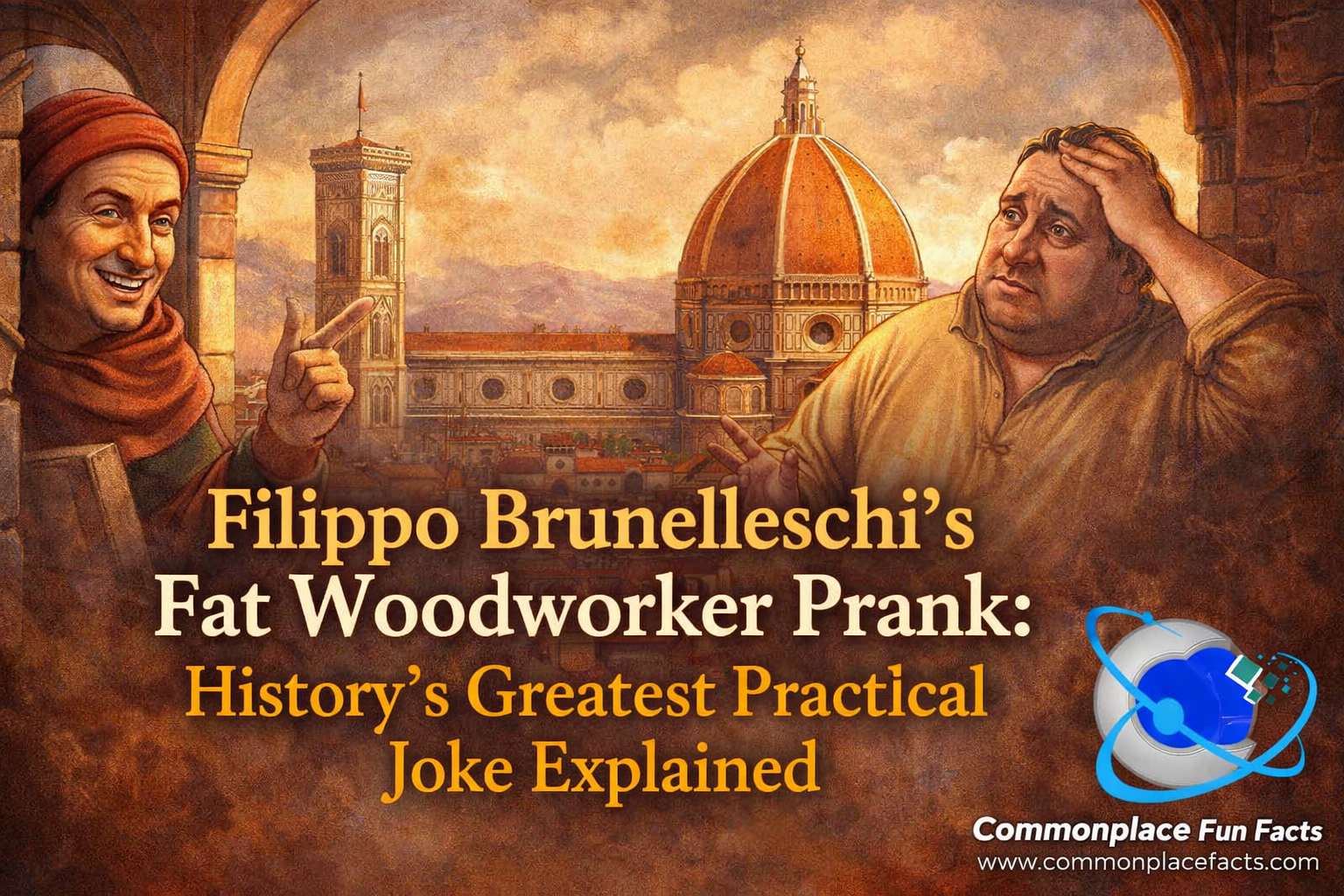

Filippo Brunelleschi’s prank is often described as the greatest practical joke in history. That is an impressive distinction in a world that has given us everything from exploding cigars to fake spaghetti harvests. This particular episode, however, raises the bar by asking a bold question: what if a practical joke did not just embarrass someone—but temporarily unraveled their entire sense of identity?
This bizarre Renaissance story centers on a woodworker named Manetto, a group of highly talented conspirators, and one deeply committed architect who apparently had too much time and just enough mischief in his soul.
Contents
Who Was Filippo Brunelleschi?
Before we examine how someone manages to gaslight a man into questioning his entire existence, it helps to know the architect behind the chaos.

Filippo Brunelleschi (1377–1446) was not just any Renaissance figure. He was the Renaissance figure. Architect, engineer, mathematician, and occasional menace to unsuspecting woodworkers, he is best known for designing the dome of the Florence Cathedral—a feat so ambitious that previous generations had essentially shrugged and said, “Well, that’s not happening.”
He also developed linear perspective in art, which allowed paintings to look like actual space instead of a collection of suspiciously flat people standing near oddly angled furniture. In short, Brunelleschi was brilliant.
He was also, as it turns out, not above orchestrating a prank that would make modern hidden-camera shows look like polite social experiments.
The Setup of the Famous Prank
The story takes place around 1409 in Florence, where Brunelleschi and his circle of artistic and intellectual friends—including the sculptor Donatello—regularly gathered for dinner.
One evening, a member of their group was missing. His name was Manetto, a woodworker described with the kind of backhanded compliment that history specializes in: not exactly foolish, but just simple enough that a sufficiently determined genius might take an interest.
The group concluded, with remarkable speed and questionable fairness, that Manetto’s absence must be a deliberate insult. Brunelleschi, who did not appear to be someone who let minor slights go unaddressed, decided that corrective action was required.
His solution was not a stern conversation or a passive-aggressive comment over dinner.
It was an elaborate, multi-day psychological operation designed to convince Manetto that he had become someone else.
How the “Fat Woodworker” Was Tricked
The plan required coordination, acting ability, and a willingness to commit fully to the bit. Brunelleschi recruited a cast of co-conspirators, each assigned a role in what can only be described as Renaissance immersive theater.

The premise was simple in theory and wildly unhinged in execution: Manetto would be led to believe that he had somehow transformed into another man named Matteo.
Execution began when Brunelleschi broke into Manetto’s house, locked him out, and proceeded to impersonate him from the inside. When Manetto protested, he was informed—by his own voice—that he was an impostor and should leave immediately.
This was the beginning of a very confusing day.
From there, things escalated quickly. Friends addressed him as Matteo. A bailiff arrested him under that name for unpaid debts. He was taken to prison, where other inmates recognized him as someone he had never met.
At this point, most people would begin to suspect a prank. Manetto, however, found himself in a situation where every piece of evidence contradicted his understanding of reality. This is what happens when a dozen people collaborate to ruin your day with unsettling enthusiasm.
The Psychological Masterpiece (or Nightmare)
If Brunelleschi had stopped at mistaken identity and wrongful imprisonment, this would already qualify as a memorable prank. Instead, he doubled down.
Two men arrived claiming to be Matteo’s brothers and secured Manetto’s release. They took him to Matteo’s home, where everything—from the furniture to the conversation—reinforced the illusion.
When Manetto insisted that he was not Matteo, the brothers responded with the universal strategy for dealing with inconvenient claims: they assumed he had lost his mind.
Eventually, they drugged him, transported him back to his own house, rearranged his belongings, and reset the stage.
The next morning, the same men returned, now treating him as Manetto again and explaining that their “brother” Matteo had been ranting about becoming a woodworker.
At this point, reality itself had filed for resignation.
Matteo even appeared in person, calmly describing a vivid “dream” in which he had lived as Manetto—complete with accurate details about his home and daily life.
Faced with overwhelming, coordinated evidence, Manetto reached the only conclusion available to a reasonable person under completely unreasonable circumstances:
He believed it.
What Happened to Manetto Afterward
Eventually, the illusion began to unravel. A visit to his mother revealed inconsistencies that could not be explained away, and suspicion turned toward Brunelleschi.
Upon realizing he had been the subject of an elaborate prank, Manetto did what many of us might consider in similar circumstances: he left town.
Specifically, he went to Hungary, where he reportedly became quite wealthy. This is one of the few known cases in history where being psychologically tormented by a Renaissance architect appears to have improved someone’s long-term financial prospects.
When he eventually returned to Florence, he and Brunelleschi shared a laugh about the whole affair. Brunelleschi even suggested that the prank had been, in some roundabout way, beneficial.
That is one way to look at it.
Was This One of History’s Cruelest Jokes?
The story of the “Fat Woodworker” comes to us from Antonio di Tuccio Manetti, a contemporary who documented the events in The Fat Woodworker. As with many historical anecdotes, there is room for embellishment, exaggeration, and the occasional creative flourish.
Even allowing for some narrative enhancement, the core of the story remains striking.
This was not a simple prank. It was a carefully orchestrated manipulation of perception, identity, and social reinforcement. Modern psychologists would likely have several thoughts about it, most of which would involve the phrase “ethically questionable.”
And yet, it has endured as one of the most famous historical pranks precisely because of its scale, creativity, and audacity.
Why This Story Still Matters
Beyond its entertainment value—and there is considerable entertainment value—this story offers a glimpse into human nature that feels surprisingly modern.
It demonstrates how easily perception can be shaped when multiple sources reinforce the same narrative. It highlights the power of social consensus over individual certainty. It also suggests that, given the opportunity, people across all centuries are perfectly capable of committing to a joke far beyond the point where it seems reasonable to stop.
Mostly, however, it serves as a reminder to always attend dinner invitations in Renaissance Florence.
Because if you do not, there is a non-zero chance that someone will convince you that you are no longer yourself.
FAQ: Brunelleschi’s Prank
What was Filippo Brunelleschi’s prank?
It was an elaborate hoax in which Brunelleschi and his friends convinced a woodworker named Manetto that he had become another person, using coordinated deception and role-playing.
Was the “fat woodworker” story real?
The story is based on an account by Antonio Manetti. While some details may be exaggerated, historians generally believe it reflects a real event.
Who was Manetto?
Manetto was a Florentine woodworker who became the target of Brunelleschi’s infamous prank and later left Florence to work in Hungary.
Why is this considered one of history’s greatest practical jokes?
Because of its scale, psychological complexity, and the number of participants involved, it goes far beyond a typical prank.
Final Thoughts
Was Brunelleschi’s prank ingenious? Absolutely. Was it cruel? Also yes. The fact that it can comfortably be both is part of what has kept the story alive for centuries.
History is filled with great minds who changed the world. Fewer of them paused long enough to convince a man he had become someone else just because he skipped dinner.
That particular contribution to human experience appears to belong exclusively to Filippo Brunelleschi.
You may also enjoy…

Virginia Woolf’s Daring Prank on the Royal Navy: The HMS Dreadnought Hoax of 1910
Discover how Virginia Woolf and her friends staged a daring hoax on the HMS Dreadnought in 1910, blending comedy and critique of British imperialism. A historical prank that still resonates!

The Hijacking Everyone Thought Was a Candid Camera Prank
A Candid Camera Prank or a Real Hijacking? For the passengers and crew of Eastern Airlines Flight 7, February 3, 1969, is a day they will never forget. That was the day they all had a serious brush with disaster, but most of them did not realize it, because they thought they were all part…

The Hitler Diaries Hoax: How Forged Journals Nearly Rewrote Nazi History
The Hitler Diaries hoax fooled journalists and historians in 1983. A look at the forged journals, the trial, and how skepticism took a day off.






Leave a Reply