
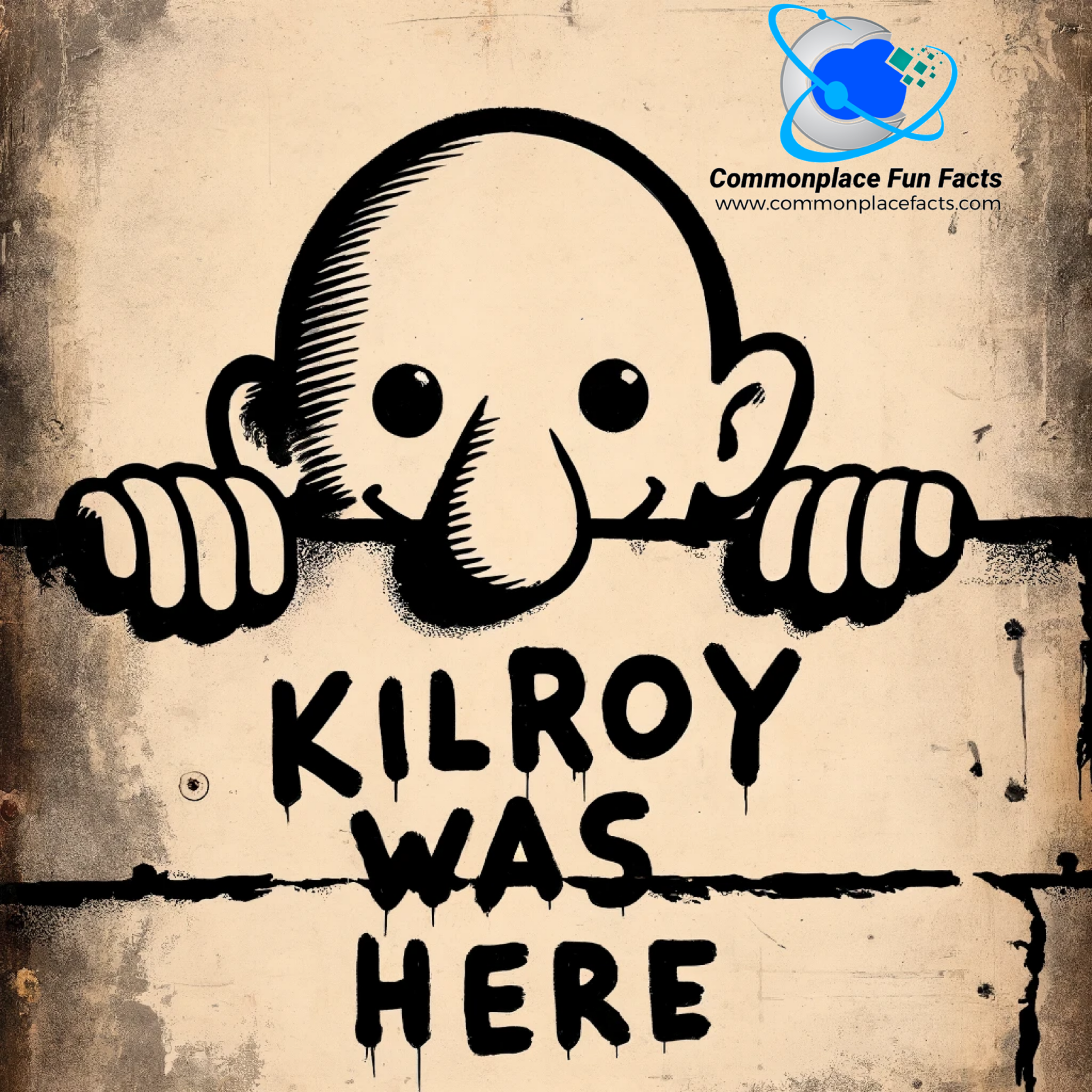

“Kilroy Was Here” — But Who Was Kilroy?
If there’s one thing World War II soldiers could count on—aside from grueling marches and questionable rations—it was finding a familiar face (or at least a familiar nose) scrawled on walls, tanks, and bathroom stalls across the world. “Kilroy Was Here” became the unofficial calling card of American troops, popping up in the most unexpected places. But who was Kilroy? And how did this doodle become an international sensation? Thanks to In the Shadow of Yesterday, we have some answers to history’s most famous graffiti:
Kilroy Was Here: The Mystery Behind WWII’s Most Famous Graffitti
originally published by Hometown Herald. Reposted with permission.
If you’ve ever seen a simple cartoon of a bald man peeking over a wall with the phrase “Kilroy Was Here” scribbled beside it, you’ve encountered one of WWII’s most enduring mysteries. This peculiar piece of graffiti spread across the world during the war, showing up in the most unexpected places—inside enemy bunkers, on the walls of the Reichstag, and even on the atomic bomb casing. But who was Kilroy, and how did his name become a worldwide phenomenon?
Origins of the Kilroy Doodle
The doodle itself—featuring a round head, a long nose hanging over a ledge, and two little hands gripping the edge—is a simple yet recognizable image. Some historians believe it may have been inspired by earlier British and Australian graffiti, such as the phrase “Foo was here.” However, its connection to the name Kilroy is uniquely American and is believed to have originated in a Massachusetts shipyard.

The Most Accepted Theory: James J. Kilroy
One of the most widely accepted explanations traces the phrase back to James J. Kilroy, a rivet inspector at the Fore River Shipyard in Quincy, Massachusetts. His job was to check and count completed rivets on warships before they were painted over. To prevent dishonest workers from erasing his chalk markings and falsely claiming extra work, he started writing “Kilroy Was Here” in large letters on inspected areas.
Since these ships were deployed before repainting, his signature phrase remained visible inside newly commissioned vessels. As American troops boarded these ships and saw the markings, they took it as a sort of running joke. Soon, they began replicating it everywhere they went—scrawling it on walls, bridges, and even enemy fortifications.
How Kilroy Spread Across the World
Once it caught on, “Kilroy Was Here” became a cultural phenomenon among U.S. soldiers. It was a way of saying, “Americans have been here,” often appearing in places where troops had no business being.
Kilroy was everywhere. Reports of “Kilroy Was Here” doodles surfaced in countless locations, including inside the Reichstag in Berlin after Allied forces captured the city. The phrase appeared on the beaches of Normandy, where U.S. troops had landed, and in the Pacific Theater, scrawled on everything from bombers to foxholes. Some accounts even claim it was written on the casing of the atomic bomb, though this remains a matter of legend.

Even enemy forces took notice. According to wartime rumors, Adolf Hitler supposedly believed Kilroy was the codename of an American super-spy because it seemed he had infiltrated every stronghold. While the truth of that story cannot be proved, it sure makes for a good story, and only adds to the legend.
The Post-War Legacy of Kilroy
Kilroy didn’t fade away when the war ended. The doodle remained a common sight well into the 1950s and beyond, showing up on Cold War-era military bases, construction sites, and even in pop culture. The symbol was embraced by various groups, from college students to rock bands, and it even appeared in Looney Tunes cartoons.

In 1977, the Smithsonian Institution attempted to track down the real Kilroy. James J. Kilroy came forward with his story and was recognized as the likely originator of the phrase. He is honored with Kilroy Square in Quincy, Massachusetts, and the doodle appears on the National WWII Memorial.

The Mystery Remains: Was It Just One Man?
Despite Kilroy’s claim to fame, some historians believe multiple sources contributed to the phrase’s spread. The war was a chaotic time, and soldiers often picked up on inside jokes, adding their own variations along the way. Whether it began as a shipyard marker or a spontaneous bit of soldierly humor, Kilroy Was Here became an enduring symbol of American wit, camaraderie, and presence.

Today, Kilroy Was Here remains one of the most famous pieces of wartime graffiti. It represents the humor and spirit of WWII soldiers, a small but powerful reminder of where they had been and what they had endured. Though the origins of the phrase may never be fully settled, one thing is certain—wherever history is made, Kilroy is never far behind.
Have you ever spotted a “Kilroy Was Here” doodle somewhere unexpected? Let us know!
You may also enjoy…

Gaius Appuleius Diocles: the Highest-Paid Athlete of All Time
Discover the incredible story of Gaius Appuleius Diocles, the highest-paid athlete of all time.

D-Day Shrapnel Makes Up 4% of the Sand on Omaha Beach
Despite all the years that have passed since the invasion, the D-Day shrapnel still composes as much as 4% of the sand on the D-Day beaches.

The Great Panjamdrum — the Hilarious and Horrible Failed Weapon of WWII
The Great Panjamdrum was an ambitious yet chaotic World War II weapon intended to clear beaches for D-Day. Despite initial design optimism, extensive trials revealed major flaws, including uncontrollable trajectories and dangerous explosions. Ultimately, the project was abandoned after its disastrous final demonstration, leading to no effective military application.



Leave a Reply