

Treading on the Sand and the D-Day Shrapnel
June 6, 1944, saw the greatest amphibious landing in the history of warfare. Over 150,000 Allied troops braved unrelenting enemy fire in order so they could regain a foothold on the continent of Europe and start the beginning of the end for Nazi Germany. Today, the beaches that were once drenched with blood appear to retain nothing but memories of that momentous day. Appearances can be deceiving. What took place on D-Day not only brought about the liberation of Europe but it sent ripples of freedom through time that we continue to enjoy. The events were so significant that visitors to those beaches, as they reflect on being the beneficiaries of that freedom, walk on sand that continues to carry physical reminders of what took place over 76 years ago.
Table of Contents
Casualties on the D-Day Beaches
Compiling an accurate account of everyone who died on D-Day is not possible. At a minimum, over 4,400 Allied troops were killed on the first day of the invasion. The greatest number of casualties occurred on Omaha beach, where 2,000 U.S. troops were killed, wounded, or went missing. The explosions of artillery shells and the impact of countless bullets ripped scars into the once-serene surroundings, turning an idyllic beachfront into a vision of hell.
By the time the war came to an end eleven months later, the visible signs of that fateful day had mostly disappeared. By the time the leaders of the Allied nations gathered for the 40th anniversary of D-Day, the only visible reminders were the monuments that had been erected after the war. President Ronald Reagan, speaking on behalf of the United States, said, “We stand on a lonely, windswept point on the northern shore of France. Today the air is soft, but 40 years ago at this moment, the air was dense with smoke and the cries of men; the air was filled with the crack of rifle fire and the roar of cannon.” Little did he or those in attendance that day realize they stood on more than memories. The sand itself had been transformed by the momentous events of that day.
Analyzing the Sand of Omaha Beach
Geologists Earle McBride and Dane Picard specialize in the study of sedimentation. In 1988 they collected a jar-size sample of sand from Omaha Beach to use as a comparison with sand from an unrelated study.
Almost 30 years passed before they got around to taking a more careful examination of their collection. They published their extraordinary findings in the September 2011 issue of the Journal The Sedimentary Record.

Ordinary beach sand is composed of minute pieces of rock, seashells, and organic particles. The sand is created by erosion, the crashing of waves, and other natural events that break up the larger items into the tiny particles that line the beach. When studied under a microscope, the sand grains tend to be rounded because of continual collisions with similarly-composed sand grains.

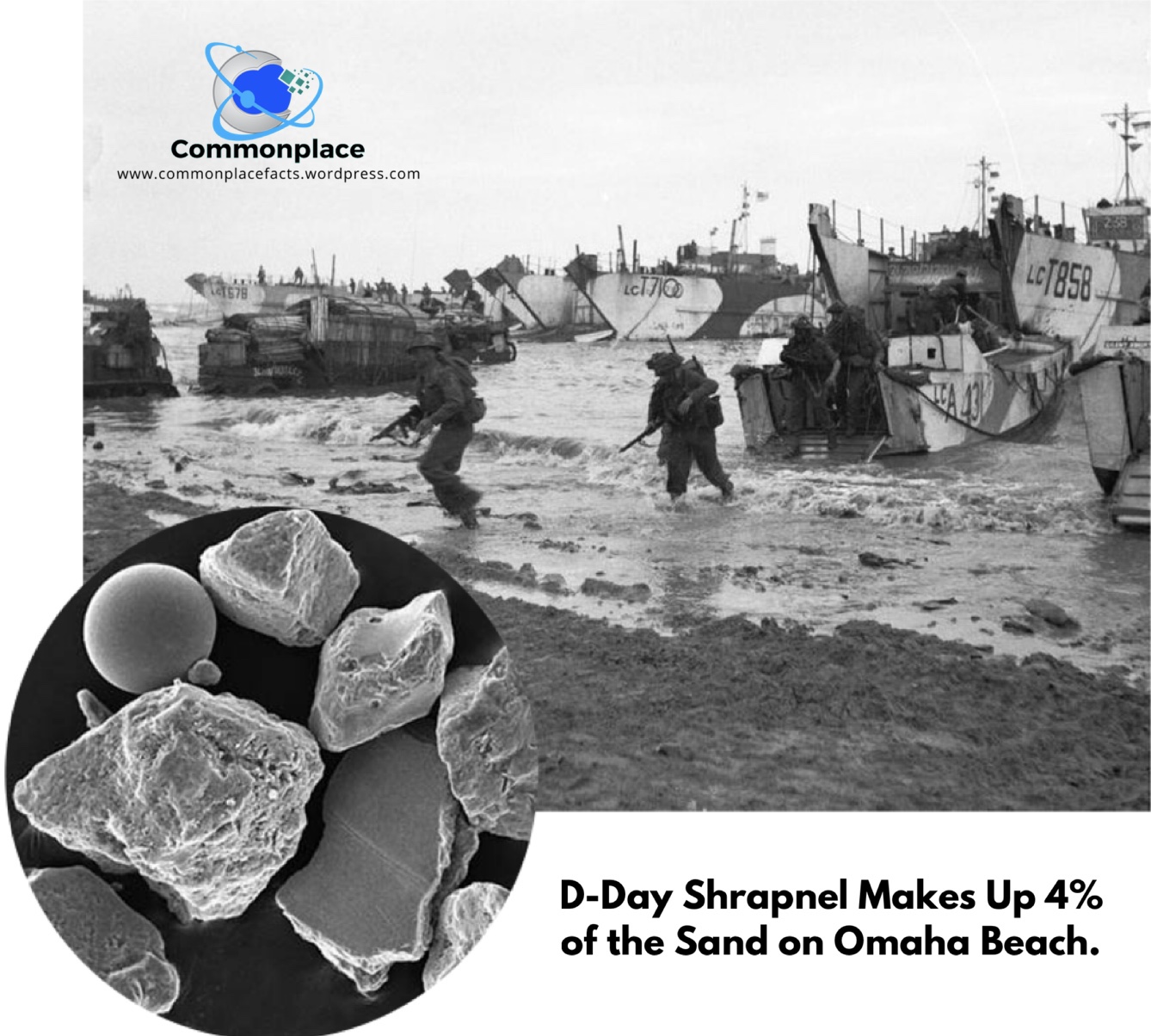
The sand the geologists collected from Omaha Beach was different. When they put that sand under a microscope, they saw angular, metallic grains. When studied further, McBride and Picard were able to identify a large quantity of iron, with red and orange rust (iron oxide) surviving on portions of the grains. What they were looking at, they realized with wonder, were pieces of shrapnel created by explosions on D-Day.
The sand contained more astonishing remnants of that fateful day. Within the relatively-small sample, the geologists found 12 glass beads and 13 intact iron beads, none more than 0.02 inches (0.5 millimeters) in diameter. These were most likely caused by the intense heat of mortar blasts, instantly melting the pieces of iron and the particles of quartz already in the sand’s composition.
All told, the particles that were generated on D-Day made up 4% of all of the sand.
As amazing as it is that these remnants of D-Day remain, the researchers warn they will not be there forever. “[T]he combination of chemical corrosion and abrasion will likely destroy the grains in a century or so,” write McBride and Picard, “leaving only the memorials and people’s memories to recall the extent of devastation suffered by those directly engaged in World War II.”
You may also enjoy…

Did A Crossword Puzzle Reveal D-Day Secrets About Invasion? The Shocking WWII Story
Did a crossword puzzle unknowingly reveal D-Day secrets? Discover the fascinating story behind this WWII mystery and how military intelligence reacted!

The Great Panjamdrum — the Hilarious and Horrible Failed Weapon of WWII
The Great Panjamdrum was an ambitious yet chaotic World War II weapon intended to clear beaches for D-Day. Despite initial design optimism, extensive trials revealed major flaws, including uncontrollable trajectories and dangerous explosions. Ultimately, the project was abandoned after its disastrous final demonstration, leading to no effective military application.

Eisenhower and His Frustration With Over-Planning
In 1952, Dwight D. Eisenhower compared a 35-page campaign plan to the planning of the Normandy invasion. Discover the humorous yet insightful story behind his reaction.




Leave a Reply