

The Dunning-Kruger Effect: The Reason the Most Ignorant Have the Loudest Voices
Gather round, dear readers, and let us regale you with the tale of a cognitive hiccup so sneaky, so tragically ironic, it might explain approximately 83% of internet comment sections, the rise of every armchair quarterback since 1845, and why your idiot co-worker thinks he could “totally land a plane” because he knows how to drive a stick-shift jalopy.
Welcome to the Dunning–Kruger Effect: a psychological phenomenon where people who know very little about a subject wildly overestimate their competence, while those who are actually skilled tend to underestimate theirs. Or, put in less academic terms: the less you know, the more you think you know; the more you know, the more you realize you don’t know squat.
Contents
A Criminal Masterclass in Citrus-Based Camouflage
Let’s rewind to January 6, 1995, when two gentlemen—and we use that term with the full weight of sarcasm—named McArthur Wheeler and Clifton Earl Johnson decided to rob two banks in the Greater Pittsburgh area. Their plan was bold. Their execution was… well, let’s just say it qualifies them for honorary PhDs in the Department of Glorious Misjudgments.
At exactly 2:47 p.m., the dynamic duo hit the Mellon Bank in Swissvale. One marched up to the teller with a semi-automatic handgun, while the other thoughtfully waited in line—as if this were a polite, turn-based felony. They waltzed out with $5,200, then headed to Fidelity Savings Bank in Brighton Heights for Act II of their ill-fated spree.

Now here’s where it gets truly citrusy.
Neither man wore a mask. No ski mask, no hoodie, not even a pair of those Groucho Marx glasses. Instead, they rubbed lemon juice on their faces, firmly believing it would render them invisible to security cameras.
Yes. Lemon juice. Like the kind you use for salad dressing or to ruin a paper cut.
According to McArthur Wheeler, it was Johnson who explained that lemon juice worked just like invisible ink—so obviously, it would work on their skin. Wheeler was reportedly skeptical at first (we’re all very reassured by that moment of critical thinking), but decided to test the theory. He slathered on the lemon juice, snapped a Polaroid of himself, and—due to either poor film, a bad camera angle, or divine intervention—didn’t appear in the photo. This was all the scientific validation he needed.
Sadly for our dynamic due, their attempt turned out no better than the guy who paid a wizard to turn him invisible so he, too, could be an unseen bank robber.
Fast forward to April 19, when Wheeler’s face—tragically not invisible—was splashed across the local news in a Pittsburgh Crime Stoppers segment. Less than an hour after the broadcast, he was arrested, thanks to a flurry of anonymous tips. When shown the surveillance footage, Wheeler was genuinely shocked. His actual words:
“But I wore the lemon juice. I wore the lemon juice.”
Meanwhile, Johnson had already been arrested back on January 12 and had decided to take the express route to plea deal town. He confessed to the Mellon Bank heist and a couple of other unrelated robberies from 1994. He testified against Wheeler and got a five-year sentence.
Wheeler? He was sentenced to 24 and a half years in prison, plus three years’ probation. The charges from the second robbery were dropped, possibly because prosecutors didn’t feel the need to continue dunking on a man who had already been undone by produce.
Two Dumb Criminals Inspire Two Smart Psychologists
And thus, a low-budget bank robbery gone awry became the unexpected spark that lit the flame of one of psychology’s most tragically hilarious theories.
In many cases, incompetence does not leave people disoriented, perplexed, or cautious. Instead, the incompetent are often blessed with an inappropriate confidence, buoyed by something that feels to them like knowledge.
— David Dunning
Psychologists David Dunning and Justin Kruger, presumably staring into the existential void after hearing about the misbegotten bankrobbery, decided to study why someone could be so wrong and so confident about it. Thus, in 1999, the Dunning–Kruger Effect was born, named after the two researchers and, sadly, not the lemon juice guy. (Just one more missed opportunity for poor ol’ Wheeler.)
The “Mount Stupid” Metaphor
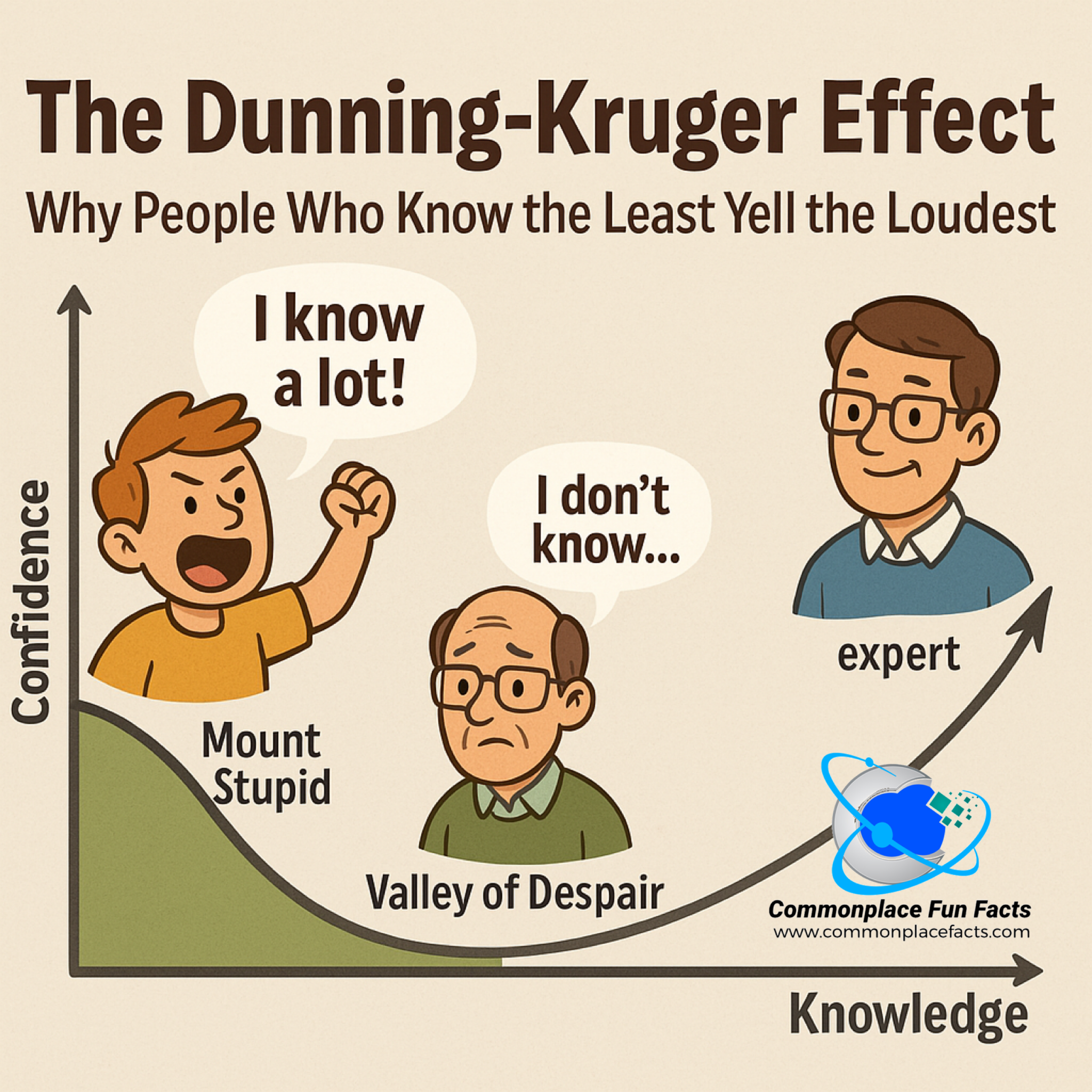
What is the Dunning-Kruger effect? Imagine you’re climbing a mountain. At the very bottom, you know you don’t know anything. As you take your first few steps—maybe read one Wikipedia article or watch half a TikTok—you suddenly feel like an expert. You’ve summited what researchers affectionately call “Mount Stupid.”
You’re on top of the world, confident, vocal, possibly starting a podcast.
But as you keep learning, you start realizing how much there is to learn, and your confidence plummets into the Valley of Despair. That’s where true experts live—in a constant state of, “Well, maybe… but I’m still learning.”
Eventually, with time, study, and more humility than TikTok allows, you climb up again—this time to a place of real competence. But you’ll never be as confident as you were back on Mount Stupid.
Why Should We Care?
Because the Dunning–Kruger Effect is everywhere.
- That coworker who has read one business book and now says things like “synergize vertical integration” in casual conversation?
- The uncle who failed high school biology but is now your go-to for pandemic-related opinions?
- The person on Facebook confidently explaining why the moon landing was faked, complete with grainy diagrams and Comic Sans?
Textbook Dunning–Kruger Effect.
And the truly qualified folks? The ones with degrees, training, experience? They’re usually too busy doing the actual work—or too aware of nuance and complexity—to post a 12-part TikTok series about it.
Can We Escape the Curse of Mount Stupid?
Good news: recognizing the Dunning–Kruger Effect is half the battle. Bad news: it’s really hard to know what you don’t know.
Not knowing the scope of your own ignorance is part of the human condition. The problem with it is we see it in other people, and we don’t see it in ourselves. The first rule of the Dunning–Kruger club is you don’t know you’re a member of the Dunning–Kruger club.
David Dunning
That’s why the smartest people tend to ask more questions than they answer. They’ve peeked into the abyss of human knowledge and gone, “Yeah… that’s a lot.” Meanwhile, the confident novices have barely cracked open the instruction manual but are already holding a TED Talk in their garage.
So next time you hear someone saying, “It’s actually really simple,” about quantum physics, geopolitics, or how to fix the economy—run. Or at least smile politely and offer them some lemon juice.
Final Thoughts
Yes, the Dunning–Kruger Effect is real. Yes, it was inspired by an actual lemon-covered not-so-invisible bank robber. And no, confidence does not equal competence—no matter how many exclamation points someone uses online.
So let’s raise a metaphorical glass to humility, curiosity, and the courage to say, “I don’t know,”—which, ironically, might be the smartest thing you can say.
Want to feel smart? Share this article. Want to feel smarter? Question everything.
You may also enjoy…

Misremembering With the Mandela Effect
Oh, how I love to remember that time I hit the game-winning home run in the big game during my senior year of high school! That was the same year that so many of the cheerleaders wanted to go out with me that I had to hire a personal assistant to manage my calendar. As…

The Cobra Effect: Beware the Unintended Consequences of Perverse Incentives
The Cobra Effect illustrates how perverse incentives can lead to unintended negative outcomes. Examples include Delhi’s cobra bounty, which increased cobra populations, and Northern Ireland’s Renewable Heat Incentive, which resulted in massive financial loss. Similar outcomes occurred in Quebec and Hanoi, highlighting the pitfalls of misaligned incentives in various programs.

The Mind Tricks the Eye With the Thatcher Effect
How does an image of Margaret Thatcher play tricks with the eyes and reveal what is happening with the mind? Find out about the Thatcher Effect optical illusion.






Leave a Reply to Herald StaffCancel reply