
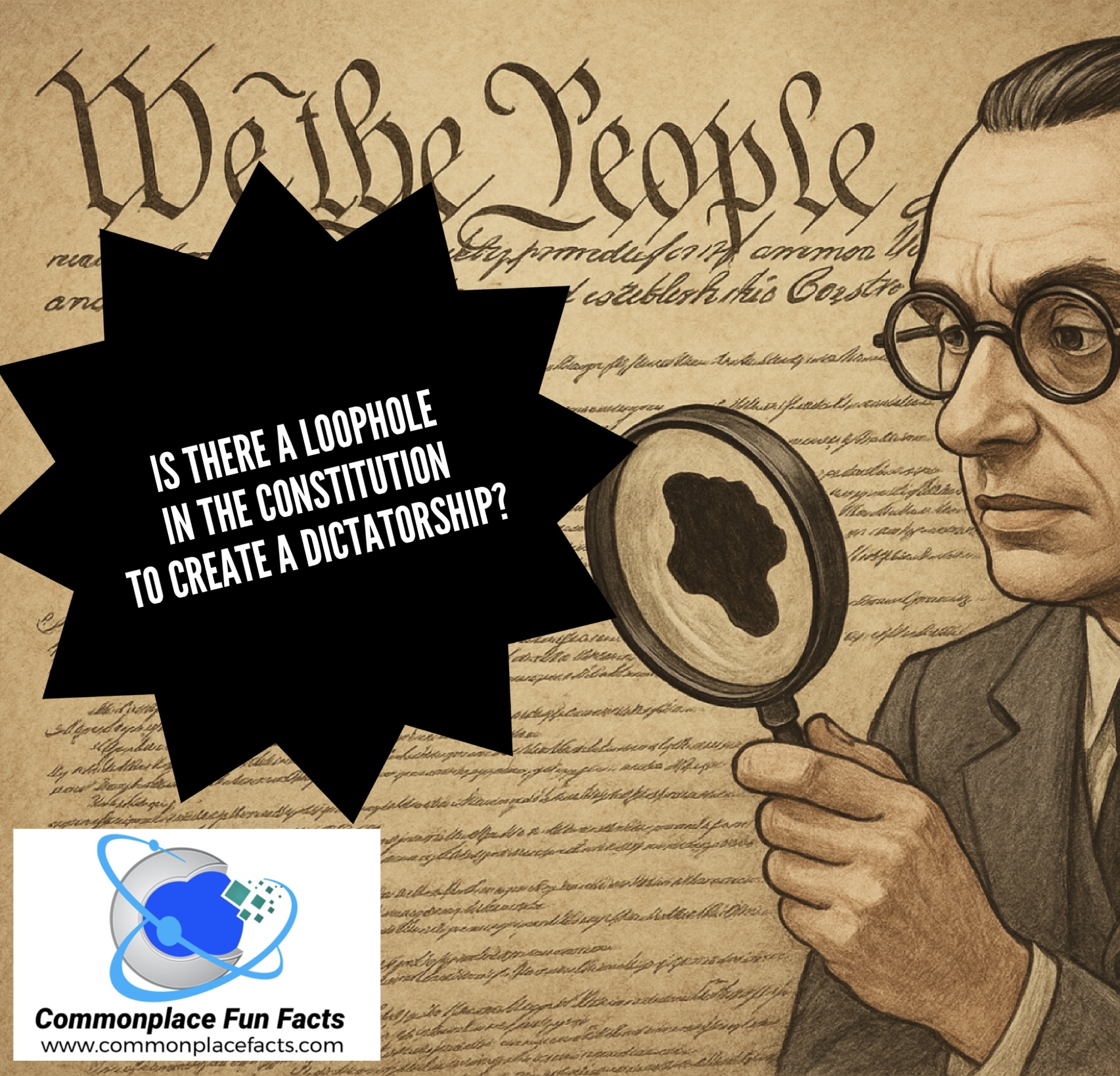

The Constitution of the United States of America. It is a timeless document and masterful work of the Founding Fathers. It created a system of delicately balanced powers, limited government, and careful preservation of the rights of the states and the people. This is how we made sure we would not have a government that repeated the offenses against the colonies that were listed in the Declaration of Independence.
But what if there was a loophole in the Constitution? Suppose we told you that despite all their caution and deliberation, the Founding Fathers missed something? It’s a loophole that would throw all of those checks and balances out the window and allow one person to assume dictatorial control of the entire country.
If you don’t believe us, then maybe you’ll believe one of the smartest guys who ever lived — a man who was best buds with none other than Albert Einstein. Yes, we’re talking about Kurt Gödel and the infamous Gödel Loophole that could turn the USA into a dictatorship.
Contents
Meet Kurt Gödel: Human Supercomputer, Socially Awkward Oracle
First, meet our hero: Kurt Gödel, the Austrian-born mathematician whose brain made your high school algebra teacher cry just by existing. Gödel is best known for his Incompleteness Theorems, which basically state that in any sufficiently complex mathematical system, there are true statements that can’t be proven within the system. (Translation: Even math has commitment issues.)

He was also a close friend of Albert Einstein, which sounds impressive until you realize Einstein mainly hung out with Gödel because nobody else could keep up with his daily walks without turning the topic into an existential crisis about socks.
Gödel was brilliant. Also, deeply paranoid. He believed people were out to poison him—so much so that he refused to eat anything that his wife hadn’t prepared. When she was hospitalized, he stopped eating entirely. Tragically, this ended exactly how you’d expect: Gödel died of malnutrition, weighing just 65 pounds.
But before that, he came this close to outing the secret tyrannical back door in America’s operating system.
Mistake #1: Telling Kurt Gödel to read the Constitution.
In the late 1940s, Gödel decided to become a U.S. citizen. Like anyone else applying for naturalization, he was required to study the Constitution and understand how American democracy worked.
Here’s where the problem started. He didn’t just read the Constitution. He analyzed it. Dissected it. X-rayed it with his laser beam brain. And in doing so, he discovered what he claimed was a logical inconsistency—a loophole—that, if exploited, could allow the U.S. to legally transform into a dictatorship.
Let that sink in. The guy who proved the limitations of logic itself just found the political equivalent of a cheat code for the United States. And unlike the Konami Code, this one didn’t involve extra lives—just the end of checks and balances.
The Naturalization Interview That Nearly Broke Reality
Gödel was understandably concerned about this. He mentioned his discovery to Einstein and another friend, economist Oskar Morgenstern. Both reportedly tried to convince him not to bring it up during his citizenship interview. This is exactly the sort of thing that could cause authorities to believe that Gödel was the sort of person who wanted to create a dictatorship, and that would submarine any hopes of getting approval for citizenship.
Spoiler: He brought it up.
At the naturalization hearing in 1948, the judge making small talk said something like, “I see you come from Austria. What kind of government do they have there?” Gödel responded that Austria’s constitution was amended and it had become a dictatorship. To this, the judge reportedly responded, “Well, it’s a good thing that can’t happen here.”
That’s when Gödel said, “Oh, yes, it can.”
You can almost hear Einstein and Morgenstern facepalming in unison.
Gödel attempted to explain that he had discovered a flaw in the Constitution that could, under specific circumstances, allow someone to legally take over the government and establish a dictatorship. The judge—either because he wanted to avoid an impromptu constitutional crisis or because he wanted lunch—quickly moved things along, and Gödel was sworn in as a U.S. citizen.
What Was Gödel’s Loophole in the Constitution?
Now we come to the juicy part: what was this so-called loophole? Gödel never wrote it down or explained it in detail. But that hasn’t stopped historians, legal scholars, and at least two people with podcast microphones and too much caffeine from speculating.
Here are the leading theories about what Gödel might have found:
1. Amendment Cascade Theory
This idea suggests that Gödel noticed the Constitution allows amendments to be made to, well, anything—including the amendment process itself. So theoretically, someone could pass an amendment that removes all restrictions on amendments, then follow it up with another amendment that declares someone Supreme Galactic Emperor for Life. All technically legal. All deeply alarming.
2. Emergency Powers Spiral
The Constitution is famously vague about the limits of emergency powers. Some speculate Gödel realized a president could declare a state of emergency and suspend normal democratic functions—then keep that emergency going indefinitely. Bonus points if they get a friendly Congress to rubber-stamp it.
3. Presidential Succession Shenanigans
Another theory is that Gödel noticed you could manipulate the line of presidential succession by controlling appointments and resignations. With the right moves, one could orchestrate a legal but highly questionable transfer of power—essentially installing a hand-picked successor without a single vote cast.
4. Article V Exploitation
Article V allows for a constitutional convention to amend the Constitution. There’s very little guidance on how such a convention should work. Gödel may have seen this as a vector for rewriting the entire system under the guise of reform—and, presumably, with Darth Vader’s theme song playing in the background.
5. Judicial Interpretation Gone Wild
Finally, there’s the theory that Gödel feared unchecked judicial interpretation. If the courts—especially the Supreme Court—choose to reinterpret key parts of the Constitution, there’s no real mechanism to override them short of amendments. If those interpretations leaned authoritarian, we might be stuck with a democracy in name only.
Whatever Gödel discovered, he was certain it was a genuine, legal path to dictatorship—and that it was embedded in the very foundations of U.S. democracy. He also seemed pretty annoyed that nobody else noticed it. Welcome to being the smartest guy in the room, forever.
Gödel’s Universe: Time Travel for Mathematicians with Trust Issues
Oh, and in case this wasn’t enough, Gödel also invented time travel. Sort of.
In 1949, he created a solution to Einstein’s equations of general relativity that described a rotating universe. In this hypothetical model, spacetime is twisted in such a way that someone could fly off in a spaceship, loop around, and arrive before they left. Cue the dramatic music and potential grandfather paradoxes.
Einstein wasn’t thrilled. He reportedly acknowledged that Gödel’s model was mathematically sound, but “not likely” to represent our actual universe. Translation: “Please stop proving the universe is a nightmare I can’t wake up from.”
What Does It All Mean?
Let’s recap:
- Gödel discovered a possible constitutional loophole to legally transform the U.S. into a dictatorship.
- He nearly derailed his own naturalization interview by bringing it up.
- He didn’t bother to explain to anyone what that loophole was or how to correct it.
- He also created a model of the universe where time travel was mathematically valid.
- He died convinced people were trying to poison him. (As far as we know, they weren’t, but in his defense, lots of people probably thought about it.)
The moral of the story? Never ask a logician to read between the lines. They will. They’ll also map out every exploit in your national operating system and accidentally create a theoretical time machine while waiting for someone to pass the salt.
Suggested Reading (If Your Brain Hasn’t Melted Yet)
- Gödel, Escher, Bach by Douglas Hofstadter
- The Constitution of the United States (and if you happen to find that loophole, for goodness sake, let someone know about it!)
You may also enjoy…

TONA: Did a Missing Constitutional Amendment Take Away the Citizenship of All Lawyers?
“The first thing we do, let’s kill all the lawyers!” (Henry VI, Part 2, Act IV, Scene 2). When William Shakespeare wrote those infamous words about lawyers in 1591, he parodied the anti-attorney sentiment that has been part of popular culture for centuries. The Bard, of course, wrote those words in jest. No one has…

Was North Dakota Statehood Not Official Until 2012? The Quirky Constitutional Mystery Explained
Dive into the fascinating story of North Dakota statehood and how it spent over 100 years in a constitutional gray area. Discover how this quirky oversight was resolved in 2012.

Fermats Theorem: World’s Most Difficult Math Problem Took 357 Years to Solve
Fermats Theorem, presented by Pierre de Fermat in the 17th century, left behind an unfinished proof next to the equation xn + yn = zn. It remained unproven for 357 years until Andrew Wiles provided a proof in 1994, earning recognition as “The Most Difficult Mathematical Problem” by Guinness World Records.






Leave a Reply to Commonplace Fun FactsCancel reply