
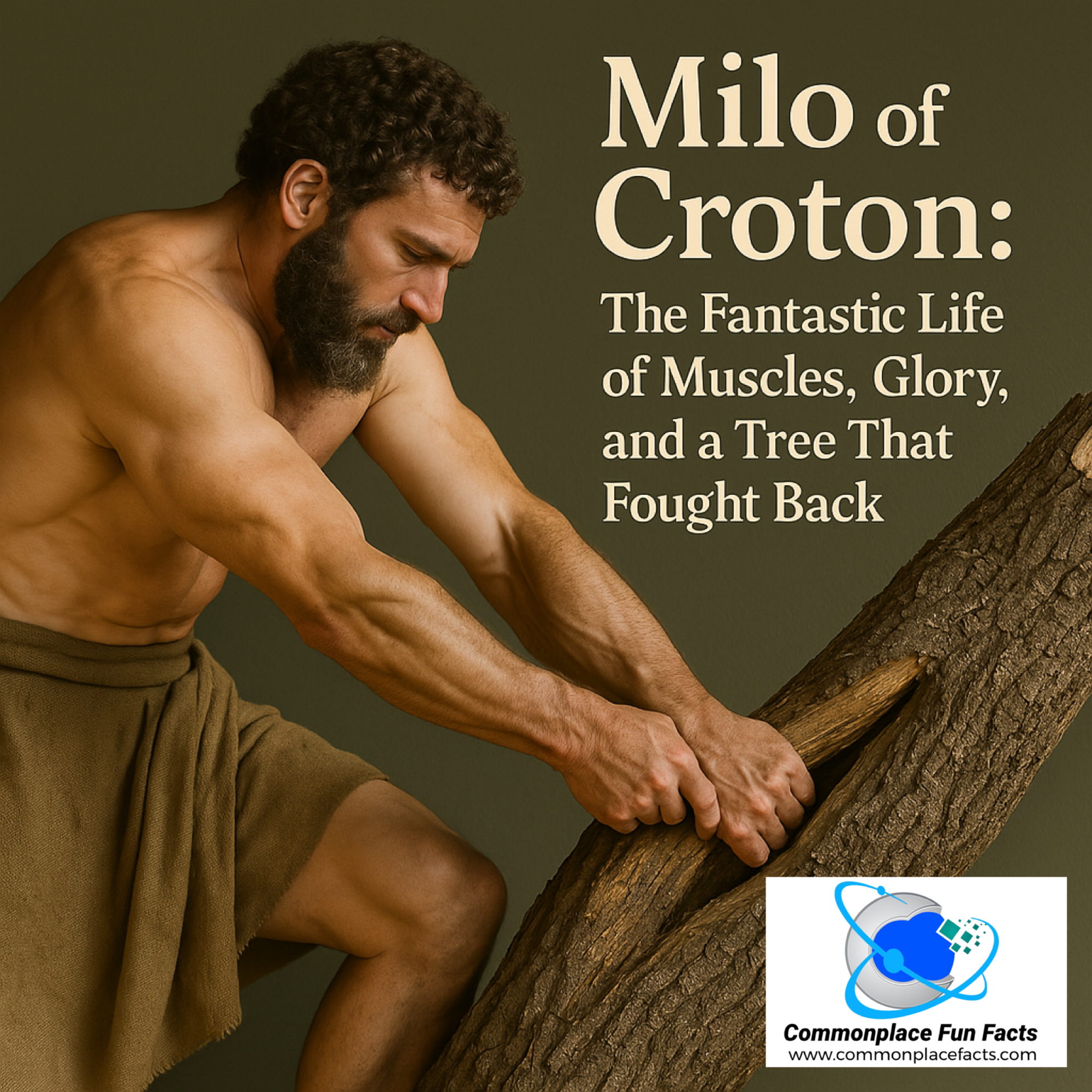

If you’re looking for a role model who embodies raw power, athletic greatness, and the tragic lesson that maybe it’s okay to ask for help once in a while, then allow us to introduce you to Milo of Croton. This 6th-century BC Greek wrestler was the original gym bro, national hero, and living embodiment of the phrase “lift heavy, die weird.”
Milo didn’t just compete in athletic contests—he dominated them. If ancient Greece had a Wheaties box, Milo’s face would’ve been on it. Possibly multiple times. Let’s flex our historical muscles and explore the beefy brilliance (and eventual bark-based downfall) of one of history’s strongest men.
Contents
Milo of Croton: He Came, He Saw, He Body-Slammed
Milo hailed from Croton, a city in Magna Graecia, which is the classical way of saying “Greek colony in Southern Italy.” Croton was known for producing philosophers, physicians, and apparently, at least one guy who could bench press a chariot.
He was a contemporary of Arrhichion of Phigalia, another Olympic champion whose legendary strength was matched only by the fact that he was the only Olympian to win his competition after dying. The full, spectacularly ridiculous details appear in “Arrhichion of Phigalia: The Olympic Champion Who Won After Death.”
Milo’s résumé reads like a steroid-enhanced fever dream of Olympic greatness. He won:
- Six victories in the Olympic Games (wrestling, naturally)
- Seven victories in the Pythian Games
- Nine in the Nemean Games
- Ten at the Isthmian Games
Basically, if there was a toga, a laurel wreath, and some guy trying to grapple you to the ground, Milo was winning it. This wasn’t just a short burst of fame, either. His Olympic victories spanned over two decades, making him the Tom Brady of throwing grown men around for sport.
Despite his accomplishments, he wasn’t even close to being the highest-earning athlete of all time. That honor goes to a charioteer who would come along about 400 years later. You can read about him here.
The Calf-Lifting Origin Story

Legend has it that Milo developed his strength using the OG progressive overload method: he carried a newborn calf on his shoulders every day. As the calf grew, so did his strength, until eventually, he was casually hauling a full-grown bull around like it was a gym duffel bag. Then, just to prove a point, he supposedly slaughtered the bull with his bare hands and ate the whole thing in one sitting.
Because that’s what heroes and Olympic champions do: lift cattle, then consume them like protein-packed victory snacks.
In all fairness, we have to observe that if the story is true, that bull must have been pretty docile to start with. We don’t know a lot of full-grown bulls who would obediently submit to being hauled around by some guy every day, so perhaps it was the Pee Wee Herman of Ancient Greek bulls. Even so, it’s a fair bit more than this writer has ever attempted.
A Fashion Icon in Leather and Olive Oil
Milo didn’t just win—he made sure you knew he was winning. He often entered the arena wearing a lion’s skin and carrying a club, channeling Heracles vibes for extra intimidation points. He also enjoyed feats of strength as party tricks, like standing on a greased-up disk and daring anyone to push him off. It will be no surprise to you to learn that no one could.
Oh, and he once held out his arm with his fingers extended and challenged people to bend even one of them. Many tried. None succeeded. It’s possible Milo invented the ancient Greek version of “Do you even lift, bro?”
Brains? Enh, Not So Much
For all his Herculean strength, Milo came from the shallow end of the gene pool when it came to decision-making. His downfall came not in the ring, but in a forest, which is either poetic justice or nature reclaiming its vengeance.

The story goes that Milo was wandering through the woods, when he came across a tree trunk partially split by some locals who had wedged it open with stakes. Now, most people would have looked at this and said, “Huh. Tree maintenance is wild these days,” and moved on. Not Milo. He saw the partially-split tree and thought, “I bet I can rip this bad boy in half with my bare hands.”
He failed to ask the obvious question: “If an Olympic champion tears apart a tree when no one is around to appreciate it, should he even try?”
Milo inserted his hands into the gap and started pulling. Unfortunately, the stakes slipped out, the tree snapped shut, and—surprise!—he got stuck. Like, really stuck. He couldn’t free himself.
That brings up the second question he should have asked himself: “If an Olympic champion gets stuck in a tree when there’s no one around, who is going to call for help?”
As it turns out, he wasn’t completely alone. Unfortunately, those who gathered to take in the seriousness of his situation were of the four-legged nature (but probably sporting more IQ points, if we’re honest).
As he stood there, helplessly pinned by an uncooperative piece of lumber, he was attacked and killed by wolves. Or possibly lions. Or maybe just a very angry woodland squirrel. As we mentioned, there weren’t any witnesses around who could record the details. Ancient sources vary, but the result is the same: death by hubris, the laws of nature, and bad decisions. Those are, coincidentally, the primary reasons that women tend to live longer than men.
The Legend Lives On
Milo’s life reads like a cautionary tale with a protein shake chaser. He was worshiped as a symbol of physical perfection. Even Aristotle mentioned him as an example of how sheer strength could overcome virtually anything—except a tree, of course, but that’s just one day in an otherwise remarkable life.
Artists throughout history have portrayed him as the ultimate tragic jock: muscles for days, intelligence on a part-time basis, and a death that seems tailor-made for a Greek version of “America’s Funniest Home Videos.” (Except instead of a $10,000 prize, you get eaten by wolves.)
And yet, Milo’s legacy endures. His training method inspired generations of athletes. His victories made him a household name (in ancient Greek households, at least). And his tree-sandwich misadventure stands as a timeless reminder: just because you can try to wrestle nature into submission doesn’t mean you should.
Final Thoughts
Is it possible that some of the stories about Milo are, shall we say, more myth than fact? Absolutely. But if our Fact Check Department had to start filtering out implausible tales of ancient superhumans, we’d have to fire half the Greek pantheon. So, for now, we’ll let Milo keep his calf-lifting, bull-eating, tree-losing glory.
Let us remember him not just as a man of exceptional strength, but as a cautionary tale for gym bros everywhere: always lift with your legs, not your pride. And maybe, just maybe, don’t stick your hands into mysterious tree crevices. Unless your name is Paul Bunyan, it’s best to leave forestry to the experts.
You may also enjoy…

Gaius Appuleius Diocles: the Highest-Paid Athlete of All Time
Discover the incredible story of Gaius Appuleius Diocles, the highest-paid athlete of all time.

Aeschylus and the Falling Tortoise: The Most Unusual Death in Ancient Greece
Discover the unbelievable true story of Aeschylus, the father of Greek tragedy, who was famously killed when an eagle dropped a tortoise on his head. Explore the prophecy he tried to escape, the ancient sources behind the tale, and the fascinating history surrounding his remarkably strange death.

The Tragic Tale of Pythagoras and the Deadly Beans
How Did Beans Cause the Death of Pythagoras Pythagoras (c. 570 – c. 495 B.C.) is most-commonly remembered for the geometric formula that bears his name. What is less-well remembered about him is the way beans contributed to his untimely death. During his life, Pathagoras developed a cult following. Known more for being a philospher…






Leave a Reply to cat9984Cancel reply