
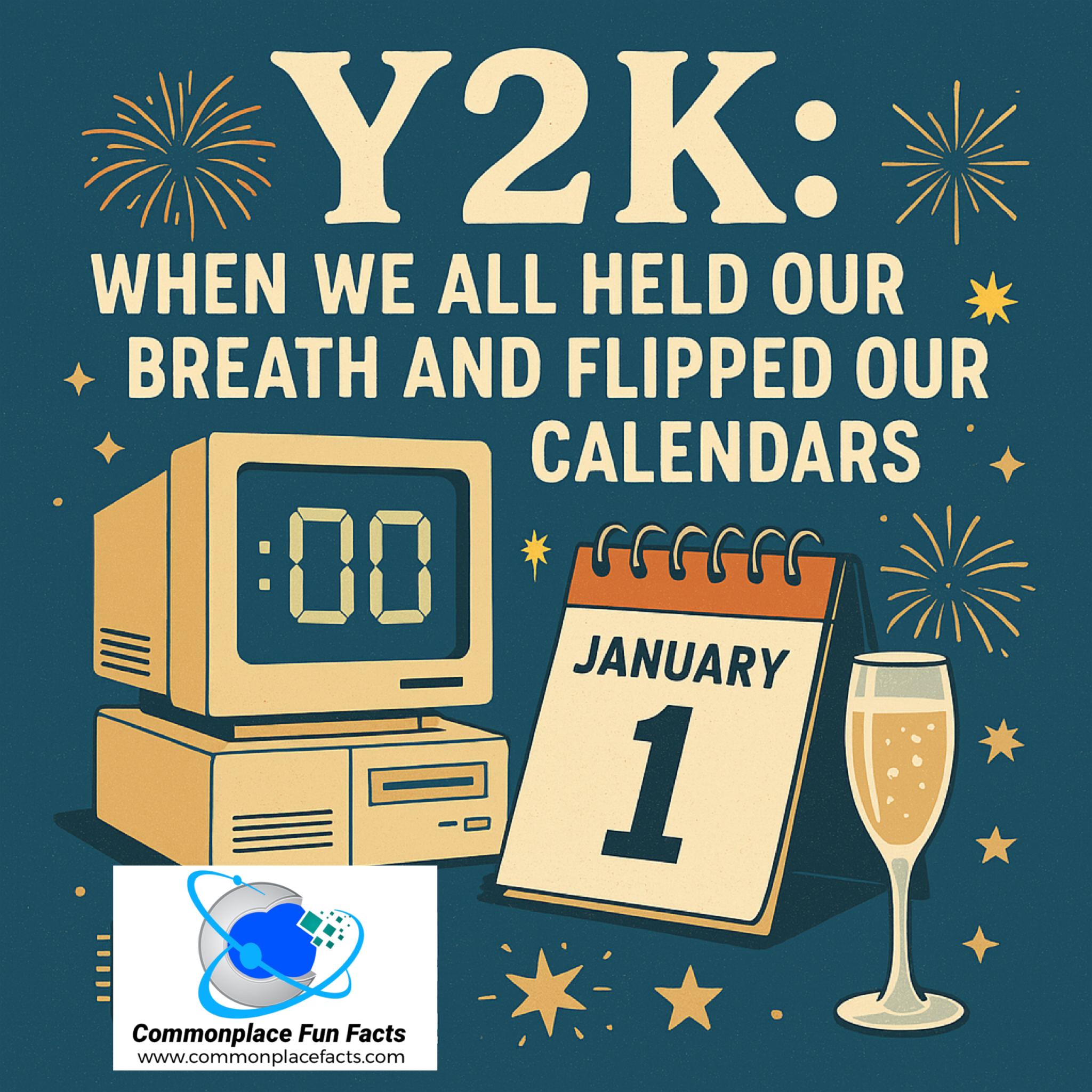

Once upon a time—not in a galaxy far, far away, but right here on good ol’ planet Earth—we collectively braced ourselves for the possibility that civilization might collapse because computers couldn’t handle a calendar. That moment in history was called Y2K. Or, as it was known in more ominous tones: The Millennium Bug. It was the technological equivalent of discovering your toaster might turn into a Terminator because the date changed.
For those of you too young to remember (and we’re trying not to be bitter about that), Y2K was a global panic attack that crescendoed in the waning days of the 20th century. The central premise? That when the clock struck midnight on January 1, 2000, computers everywhere might implode, planes could fall from the sky, banks might lose track of all your money, and your microwave might rise up and demand tribute in Doritos. Okay, maybe not that last one. But as paranoid as everyone was at the time, we wouldn’t be surprised if that was on someone’s list.
Contents
How Did This All Start?
The root of the Y2K problem was, at its core, a design shortcut. Back in the 1960s and 1970s, computer memory was expensive. Like “I could buy a car or I could store a few thousand lines of code” expensive. So programmers, trying to be frugal with those precious bytes, stored years as two digits instead of four. “1979” became “79,” “1985” became “85,” and so on. A sensible, economical choice at the time—kind of like reusing wrapping paper or pretending you can get one more squeeze out of an empty toothpaste tube.
Unfortunately, that shortcut came with a built-in expiration date: December 31, 1999. When the year flipped to “00,” computers might think it was 1900. And computers are not known for their nuanced understanding of historical context.
This seemingly small issue ballooned into a global concern because those two little digits were everywhere: banking systems, airline schedules, hospital equipment, government records, power grids, nuclear arsenals (you know, the small stuff). What would happen if computers couldn’t tell the difference between 2000 and 1900? Chaos, that’s what. Or so we were told.
The Great Y2K Countdown
As the 1990s wore on and the new millennium loomed, a quiet panic turned into a very loud one. Governments formed task forces. Corporations threw millions of dollars at consultants who mostly showed up with worried expressions and very long checklists. IT departments stockpiled caffeine and became society’s new action heroes—think Bruce Willis, but with less broken glass and muscles and more spreadsheets and social awkwardness.
Books, documentaries, and end-of-the-world specials flooded the media. News anchors discussed Y2K like it was a sentient being preparing to crash your birthday party and delete your cake. Some survivalists cashed out their savings and retreated to bunkers with 55-gallon drums of freeze-dried lasagna and enough batteries to power Cleveland. Meanwhile, the rest of us stared suspiciously at our computers, wondering if they knew what year it was.
By 1998, surveys suggested that more than half of Americans expected serious problems due to Y2K. Even the U.S. government got in on the action: President Bill Clinton signed legislation to protect companies from Y2K-related lawsuits. Because if there’s anything more American than panic, it’s litigation.
Doomsday… or Tuesday?
Then came the big night. December 31, 1999. The champagne was chilled. Dick Clark was counting down. And somewhere in the world, a programmer was clutching a flashlight and muttering, “Here we go.”
And then… almost nothing happened. The lights stayed on. Planes didn’t fall out of the sky. The banking system didn’t collapse. Your Aunt Susan’s computer didn’t even blink (although, to be fair, she was still using Windows 95). It was—let’s be honest here—a bit of a letdown. Like buying front-row tickets to a monster truck rally and finding out they replaced the trucks with sensible hybrids.
There were some minor hiccups. A few parking meters issued fines with the date 1900. A U.S. spy satellite briefly malfunctioned. Some nuclear power plants switched to backup systems as a precaution. But these were blips, not cataclysms. The end of the world had the courtesy to hit the snooze button.
So… What Happened?
There are two camps when it comes to explaining the non-apocalypse of Y2K. Camp One says it was all overblown hysteria—a tech-panic that fueled an entire industry of snake oil and doomsday merch. Camp Two says the reason nothing bad happened is because we did spend those years preparing. Billions of dollars and countless work hours were poured into rewriting code, testing systems, and ensuring that, come January 1, computers wouldn’t think we were in the middle of the Spanish-American War.
The truth, like the best debugging processes, lies somewhere in the middle. Yes, the danger was real. And yes, the massive effort to fix it probably did prevent some serious problems. But the frenzy leading up to it? That may have been a bit much. There were entire cable specials with ominous music, for goodness’ sake.
Y2K’s Legacy
In the end, Y2K left us with a few important lessons:
- Never underestimate the power of a two-digit year to mess up your day.
- When in doubt, upgrade your software.
- Never trust a doomsday prediction unless it comes with a money-back guarantee.
- And perhaps most importantly: give your IT folks a raise. But that doesn’t mean they should be encouraged to interact with polite society.
It also proved that global coordination and proactive problem-solving were possible—even if spurred by fear of impending digital doom. In some ways, it was a success story. Not because disaster struck, but because it didn’t. It was the dog that didn’t bark, to borrow from Sherlock Holmes.
Final Thoughts From the Bunker
So here we are, decades later, wiser (debatably), and still marking our calendars with four digits, thank you very much. Y2K didn’t bring about the end times, but it did give us a glimpse into what mass digital uncertainty looks like—and how humans tend to react with a delightful blend of caution, innovation, and a dash of melodrama.
And as for those 55-gallon drums of lasagna? We’re sure someone, somewhere, is still working through them. And if you want something to worry about, you might check out this article that gives helpful insight as to whether the Large Hadron Collider has destroyed the world yet.
You may also enjoy…

It’s the End of the World As We Know It…. And We’re Still Waiting
Throughout history, numerous prophets have predicted the end of the world, with notable claims spanning over 2,000 years. Despite these predictions, none have occurred. The text highlights significant dates and figures associated with various apocalyptic forecasts, illustrating humanity’s persistent fascination with doomsday scenarios, extending even millions of years into the future.

For 50 Years, America’s Nuclear Defense Relied on Floppy Disks – The Shocking Truth!
For 50 Years, America’s Nuclear Defense Relied on Floppy Disks – The Shocking Truth!

Did the USA Really Use ‘00000000’ as a Nuclear Launch Code? The Scary and Shocking Truth!
Did the USA truly use ‘00000000’ as a nuclear launch code? Discover the real history, security concerns, and expert insights into this alarming Cold War-era security lapse.





Leave a Reply to Commonplace Fun FactsCancel reply