
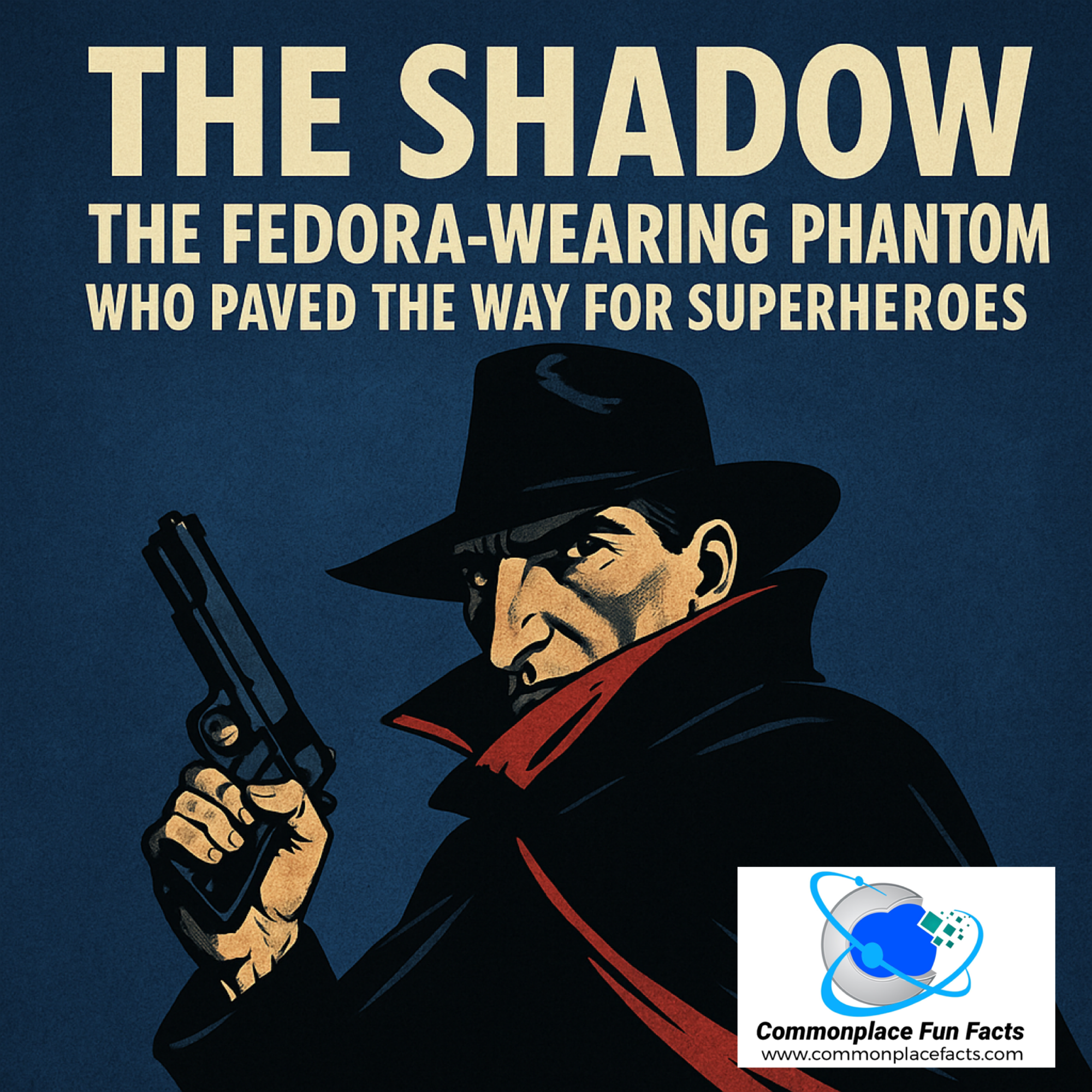

Before Batman darkened a single rooftop and long before Marvel was nearly destroyed by the Hindenburg disaster, there was The Shadow. Clad in a swirling black cloak, wielding twin pistols and a laugh that could curdle milk, The Shadow was already lurking in the hearts of men—mostly the criminal ones—by the time Superman was still trying to figure out how to get dressed in a phone booth.
He was mysterious. He was ruthless. He could cloud men’s minds and make himself invisible—which, incidentally, is the same skill set we use to dodge our responsibilities at family reunions. He was, quite simply, the prototype for every brooding, trench coat-wearing hero that came after him. And we owe him more than just a tip of the fedora.
Contents
The Shadow’s Origins: Brought to You by Marketing

As with all great mythologies, The Shadow began not with a bolt of lightning or a radioactive spider bite, but with a marketing gimmick. In 1930, Street & Smith Publications launched The Detective Story Hour, a radio program meant to drive sales of their existing pulp magazines. They added a creepy narrator—just a voice, no backstory—to read tales of crime and punishment. That voice, of course, was The Shadow.
Audiences, as it turns out, were a lot like us: easily confused and ready to throw money at something spooky. Listeners kept demanding “The Shadow magazine,” assuming he was the star of all the stories. Sensing an opportunity (and possibly haunted by the ghost of future brand synergy), Street & Smith pivoted. They hired magician-turned-writer Walter B. Gibson to turn this floating radio voice into a flesh-and-blood pulp hero. Gibson was prolific—like “typewriter catching fire” prolific—writing over 280 Shadow novels under the house name Maxwell Grant.
It was on the radio that The Shadow skyrocketed into the public consciousness. The first show aired on September 26, 1937.
Kent Allard? Lamont Cranston? Pick a Persona, Man
One of the delightful things about The Shadow is that he’s kind of like your cousin at Thanksgiving who can’t decide whether to go by his real name or his SoundCloud alias. In Gibson’s original stories, The Shadow was Kent Allard, a World War I aviator who faked his own death and returned to the U.S. to clean up crime. But to maintain a public-facing identity, he sometimes impersonated Lamont Cranston, a millionaire playboy. At other times, he just was Cranston. And sometimes, the real Cranston was off vacationing in Fiji while The Shadow borrowed his face like a really sketchy Airbnb.
Confused? So were readers, but not enough to stop buying the books. The important takeaway is this: The Shadow was a master of disguise, a man of mystery, and fully committed to the idea that one identity simply wasn’t enough.
His Powers: Smoke, Mirrors, and Just Enough Magic
Depending on which version you’re reading or listening to, The Shadow’s powers ranged from “terrifying stage magician” to “actual wizard.” In the original pulp novels, he didn’t have supernatural abilities—just supreme sleight of hand, a talent for disguise, and a psychological toolkit that would make Freud do a double take.
But the radio version—voiced first by Orson Welles (because James Earl Jones’ voice wasn’t yet available)—spiced things up a bit. Radio Shadow could “cloud men’s minds,” rendering himself invisible through what can best be described as aggressive mental gaslighting. It’s never fully explained how this works, other than vague references to hypnotic abilities learned in the Orient, but no one complains when a bad guy screams in terror because he’s being strangled by a ghost in a fedora.
That Laugh, Though
You cannot discuss The Shadow without mentioning the laugh. That maniacal cackle has been haunting airwaves since the early 1930s. It’s the vocal equivalent of a jump scare—and somehow both elegant and deeply unsettling. Even today, it sounds like the Joker’s Ivy League-educated older brother.
Every radio episode started with creepy organ music, leading up to the ominous words: “Who knows what evil lurks in the hearts of men? The Shadow knows!”
And then: BWAHAHAHAHAHAHA. That was his intro. Every week. Honestly, if that doesn’t give you goosebumps—or at least a sudden urge to turn on a nightlight—you may already be one of the villains.
As if that weren’t enough, each episode ended with that same creepy voice intoning, “The weed of crime bears bitter fruit. Crime does not pay! The Shadow knows.” Occasionally, just for variety, we would hear his other closing line: “As you sow evil, so shall you reap evil. Crime does not pay! The Shadow knows.” Of course, the last sound before station identification would be that laugh.
Curiously, for all his many talents, Orson Welles was never able to mimic The Shadow’s laugh. Those episodes in which he starred had to rely on the pre-recorded laughter of one of the earlier Shadow actors, Frank Readick Jr. It’s nice to know that even geniuses have their limitations.
Incidentally, Readick achieved the eerie sensation of The Shadow’s voice and laughter by holding a glass of water next to his mouth as he spoke. Who says you need expensive audio technology to achieve greatness?
The Agents: Because Even Mysterious Vigilantes Need Admin Support
The Shadow didn’t work alone. He had a full team of operatives scattered across New York City like morally-upstanding sleeper cells. Cab drivers, socialites, doctors, you name it—they were all on the Shadow payroll, reporting in with intel and occasionally busting heads.
The most famous of these was Margo Lane, who debuted in the radio series as the obligatory female character to give the voice actor someone to talk to. Unlike many damsels of the era, Margo was savvy, resourceful, and not shy about calling out The Shadow when he got too dramatic. She was, in short, the Lois Lane to his Batman-Sherlock hybrid persona.
Every episode began by introducing Lamont Cranston as a “wealthy young man about town,” which was a classy way of saying that he was a spoiled rich kid without any redeeming social value. Margo Lane, in turn, was described as his “friend and companion, the lovely Margo Lane,” which was a classy way of saying, “Their relationship sure looks suspicious, but we’re too well-mannered to point that out.
The Shadow’s Villains: A Rogue’s Gallery of Absurd Evil

Every great hero needs a great villain—or thirty. The Shadow faced a dizzying array of criminals, mad scientists, and weirdos with names like Shiwan Khan (an evil telepath with dreams of world domination), The Red Envoy, and—because it was the 1930s—characters who were definitely not run through the modern-day cultural sensitivity filter.
Plots ranged from “robbing a bank” to “creating a death ray in an abandoned lighthouse.” It was pulp fiction, after all, where no scheme was too outlandish and no lair too impractically located.
The Cultural Impact: The Proto-Superhero
If you squint just a little, you can see Batman peeking out from behind The Shadow’s cape. And that’s not an accident. Bob Kane and Bill Finger, the guys who created Batman, were openly inspired by The Shadow. In fact, Batman’s early adventures were so similar to The Shadow’s that they bordered on fan fiction with a budget.
Dark avenger of the night? Check. Rich guy with a double life? Check. Mysterious persona that uses fear as a weapon? Check and check. The main difference? Batman didn’t kill. The Shadow, on the other hand, had a body count that could rival a Bond villain’s Christmas party.
The Fall, the Film, and the Fanbase
As the Golden Age of Comics took off, The Shadow faded from prominence. But like any good noir figure, he never really died—just slipped back into the fog. The final radio show aired on December 26, 1954. He made periodic comebacks in comics, novels, and the occasional ill-fated movie. Speaking of which, let’s talk about that 1994 Alec Baldwin film for a second.
It tried. It really did. The costume looked good. The tone was appropriately over-the-top. But somehow, it never quite landed. Maybe audiences weren’t ready for a hero who was both grim and giggly. Or maybe they were still recovering from Batman Forever. Either way, it flopped—but it wasn’t the end.
Today, The Shadow lives on in graphic novels, retro collectibles, and the memories of anyone who once cackled along with a villain being outwitted on AM radio. He’s not as famous as he once was, but like any good shadow, he’s always there. Just out of sight. Waiting.
And perhaps the wait will not be for much longer. James Patterson released a series of novels featuring The Shadow with some options for potential screen adaptations. We’ll see.
The Final Laugh
The next time you are in the mood for a cerebral journey to a battlefield against the bad guys, remember The Shadow. He may not have the box office numbers or toy deals, but he’s the one who lit the path into darkness for every hero who followed.
The Shadow knows.
You may also enjoy…

Unveiling The Golden Bat: The First Superhero?
So, there’s a debate about who holds the title of “World’s First Superhero.” While the Phantom is officially recognized, some argue that the Golden Bat, a Japanese character from 1931, deserves it too. He had powers and a cool backstory, influencing later heroes. Ultimately, it’s up to the readers to decide!

Meet the Phantom: the World’s First Superhero
Editor’s Note: Subsequent to the publication of this article, we were made aware of The Golden Bat, who possibly has a better claim on the distinction of being the world’s first superhero. Be sure to read Unveiling the Golden Bat: The First Superhero? While many people assume Superman was the first superhero, fandom actually owes…



Leave a Reply to Commonplace Fun FactsCancel reply