
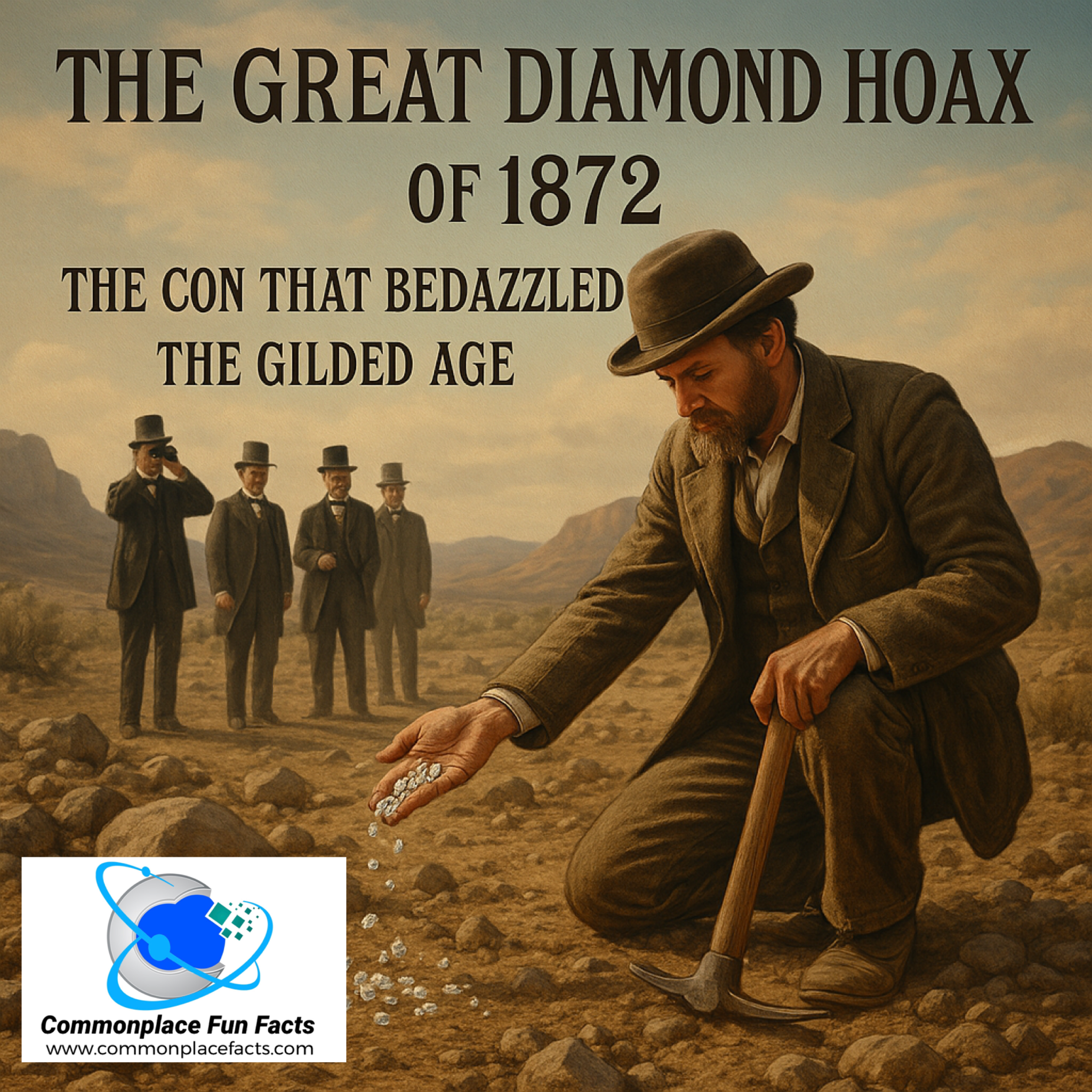

Diamonds are forever—unless, of course, they’re actually quartz, garnets, and a few broken bits of bottle glass artfully sprinkled over a pile of rocks in the middle of nowhere. Then they’re only forever embarrassing. Such was the case with one of the greatest get-rich-quick schemes of the 19th century: the Great Diamond Hoax of 1872. It’s a tale involving delusions of grandeur, pickaxes full of greed, and at least one very disappointed banker with dreams of becoming the next gem czar of the American West.
Contents
The Setup: Two Guys, a Map, and a Shovel
It all started in the fashion of a Western adventure novel, with a dusty sack, a pair of suspiciously scruffy prospectors, and a whole lot of side-eye from a San Francisco bank vault manager.
In the summer of 1871, two grizzled men—clothes caked in trail dust and faces sporting the rugged complexion of men unfamiliar with soap—strode into the Bank of California. The Kentuckians claimed to be cousins, fresh from a prospecting trip to what they vaguely called “Indian country,” and introduced themselves as Philip Arnold and John Slack. They had with them a canvas sack and a firm insistence: lock this up in the bank vault, and don’t ask questions.
Naturally, the more they insisted on secrecy, the more curious the bankers became. Eventually, bank president William Ralston was summoned—the man responsible for making the Bank of California the crown jewel of Far Western finance. After some old-fashioned pleading and high-society coaxing, Arnold and Slack finally agreed to open the sack—but only after swearing everyone present to strict secrecy.
The contents? A dazzling pile of uncut diamonds, rubies, and what may have been sapphires or emeralds. Or possibly shiny marbles. But the shine was convincing enough to hold the room spellbound.
Arnold, doing most of the talking while Slack brooded like a man who’d lost a poker hand to a goat, claimed the gems were part of a massive hoard they’d found just lying on the ground—or buried inches below the surface. He refused to say more. Naturally.
The Glitter of Greed
Ralston, no fool and definitely no amateur in the art of not-being-duped (he thought), had the stones sent to San Francisco’s top jeweler, who quickly declared them genuine. And just like that, the prospecting fever set in faster than you could say “stock options.”
With visions of another Sutter’s Mill or South Africa’s Kimberly diamond fields dancing in their heads, Ralston and his elite investor friends leaned in hard. The prospect of getting in on the “ground floor” of a diamond bonanza was too tempting to resist.
Arnold and Slack, playing the part of bashful simpletons from central casting, finally agreed to take two representatives—handpicked by Ralston—to the secret location. The catch? The men had to be blindfolded. Also, the cousins asked for a tidy $100,000 as a “good faith” gesture.
Feeling suspicious yet?
The Wild West Diamond Tour (Blindfolds Included)
The journey began with a train ride out of San Francisco, followed by a four-day horseback trek into the wilderness. Just before reaching the fabled diamond field, the investors were blindfolded like contestants on a deeply irresponsible reality show. Finally, the blindfolds were removed, and they were told to “go nuts.”
And nuts they went. Scattered across the ground were diamonds, rubies, and—somehow—pearls. One of the men even mused later, “Why a few pearls weren’t thrown in for good luck, I have never yet been able to tell. Probably it was an oversight.”
They returned to San Francisco in a frenzy of excitement. A corporation was swiftly proposed: half the stock for Arnold and Slack, the other half for the investors. Gems were displayed in a local jewelry store window, and whispers of “diamond fever” spread like wildfire. Charles Tiffany of Tiffany & Co. examined the stones in New York, valued them at $150,000, and called them fit for a rajah. The fever spiked.
From Dream to Delusion
You might think, “This really sounds suspicious. Surely no one would fall for this.” Oh, sweet summer child. The investor list looked like the Forbes 500: banker William Ralston (of Wells Fargo fame), General George McClellan (yes, the Civil War general and guy who almost became president), Asbury Harpending (whose name is only slightly less ridiculous than his financial decisions), and even Charles Tiffany (yes, that Tiffany, of Tiffany & Co.).
Stock sales were replaced by closed-circle investing. The company was christened the San Francisco and New York Mining and Commercial Company, with $10 million in capital.
To ensure this glittering unicorn of an enterprise was sound, engineer Henry Janin was hired to inspect the site, known as the Burro Mines. He returned breathless: 25 men could wash out a million dollars in diamonds a month, he said. Then he bought stock—1,000 shares at $10 each—and later sold them at $40 apiece. Janin made $30,000. Because why shouldn’t the expert also invest in his own inspection?
The Great Western Diamond Rush (Sponsored by Gullibility)

Word got out. Prospectors flooded the western frontier—Arizona, New Mexico, Colorado, Utah, and Wyoming saw a surge in people suddenly convinced they could spot a diamond with their bare hands. At least 25 new companies formed, with a combined capitalization of $200 million. People hired by the original investors were even paid to lead diamond-hungry hopefuls away from the real site. Spoiler alert #1: it didn’t matter.
“We have found it! The greatest treasures ever discovered on the continent, and doubtless the greatest mineral treasure ever witnessed by the eyes of man,” declared the April 9, 1870, edition of Tucson Weekly Arizonian. Spoiler alert #2: It wasn’t.
The investor group, now drunk on their own brilliance, bought out Arnold and Slack’s share for an undisclosed sum—possibly up to $660,000, equivalent to roughly a bajillion dollars in today’s money (OK, maybe closer to $16 million).
Enter the Rock Whisperer
Enter Clarence King. He was a government geologist who actually knew a diamond from a driveway pebble. King had been surveying the 40th parallel when he got word of the great gem discovery. He was intrigued and began putting pieces together. He tracked down the mysterious field and noticed a few things right off the bat that made him suspicious.
It was pretty evident that the ground had been “salted.” Gems were found just under the surface and oddly in clusters that looked suspiciously like someone had just tossed a handful and called it a day. Some stones clearly jammed into anthills, which, while imaginative, is not exactly how nature distributes its mineral wealth.

King noted multiple examples of certain types gems that simply do not appear next to each other in nature. Pearls, for example, come from oysters, which do not tend to thrive in the extreme geological conditions that create rubies. It would be just as suspicious as finding a fossil of a T-Rex holding a Big Mac.
Although it is understandable if your typical banker wasn’t familiar with the geological process that creates precious stones, there was another curious feature that should have caused a little bit of head scratching. Scattered among the stones were some that had been cut, polished, and finished.
The Aftermath: Riches, Ruin, and a Mildly Ironic Drowning
Further investigation revealed Arnold and Slack had used $50,000 to buy industrial diamonds from London and Amsterdam. The gems had been scattered like trail mix for gullible investors. King exposed the hoax in a New York Times exposé, and suddenly the mood shifted from “diamond jubilee” to “awkward shareholders’ meeting.” Arnold and Slack were called to testify but managed to dodge prison through a mix of legal technicalities and the inexplicable 19th-century ability to get away with just about anything if you wore a vest and a serious mustache.
Read about the con artist who sold the Eiffel Tower (Twice!)
Arnold fled to Kentucky, where extradition was refused because—well—Yankees. He returned $150,000 in exchange for immunity, opened his own bank, and was shot in a business dispute in 1878. Pneumonia finished the job. Slack vanished into New Mexico, where he became an undertaker and died with an estate worth $1,600. Somewhere, irony shed a tear.
Mining engineer Janin cashed out. Clarence King became a celebrity and the first head of the U.S. Geological Survey.
Ralston? He hung a worthless stock certificate in his office as a daily reminder. Then he overextended himself again. In 1875, the Bank of California collapsed. After resigning, he went for a swim in San Francisco Bay and never came back. Accident or suicide? History can’t decide.
And thus the Great Diamond Hoax of 1872 took its place in history as “the most gigantic and barefaced swindle of the age,” according to the San Francisco Chronicle.
The Moral of the Story
If someone offers you a stake in a secret diamond mine but refuses to give you the location, ask questions. Specifically, ask if they’ve been spending a lot of time near the souvenir jewelry section of a London pawn shop. And maybe keep a geologist on speed dial. Just in case.
Because in the Wild West, the line between a gold rush and a facepalm was as thin as a sliver of quartz—and just about as valuable.
You may also enjoy…

Scams, Shag Carpets, and Sci-Fi: The Shady Secrets Behind “The Creeping Terror”
The Creeping Terror, a 1964 sci-fi horror film, defied traditional cinema standards with its comically atrocious alien monster made from shaggy rugs, created by inexperienced director and actor Vic Savage. Despite financial troubles and lack of editing, the film gained a cult following for its “so-bad-it’s-good” charm, solidifying its place in cinematic history.

The Scam to Search for a Country that Didn’t Exist — And What Was Discovered Instead
Bob was a con man. That’s not how he would have described himself. He would have told you that he was a visionary and hero — someone who sought out new frontiers to make life better for everyone. But that’s what you would expect a con man to say, isn’t it. The fact is that…

The Great Hotel Heist: How Mickey Barreto Stole the New Yorker Hotel
Discover the wild story of how Mickey Barreto used legal loopholes to ‘steal’ the New Yorker Hotel, involving rent laws, fraud, and North Korea.






Leave a Reply