
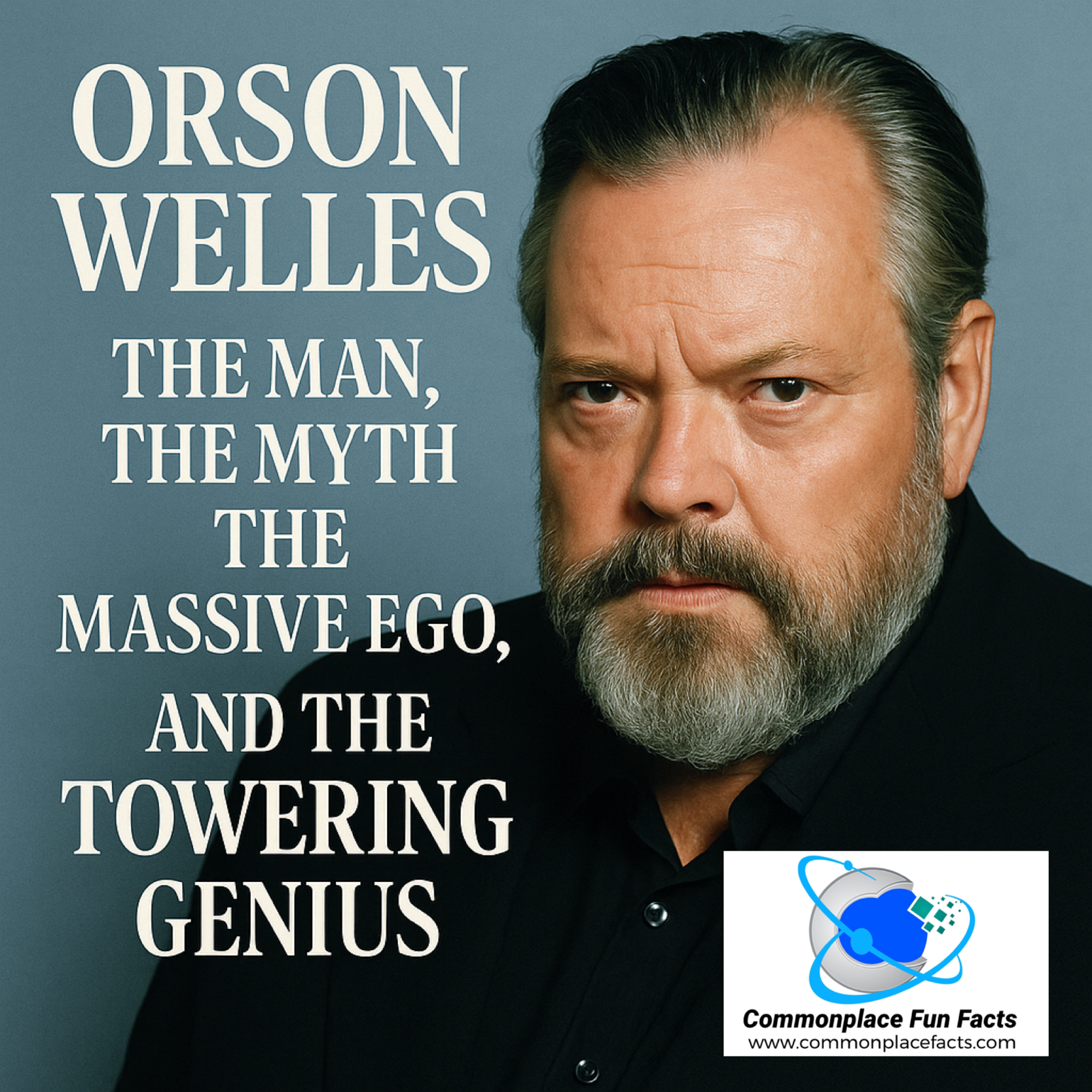

Before he was hawking frozen peas and scaring the living daylights out of Middle America with Martians, Orson Welles had already conquered the worlds of theater, Before he was hawking frozen peas and scaring the living daylights out of Middle America with Martians, Orson Welles had already conquered the worlds of theater, radio, and film—all before his 26th birthday. At an age when most of us were still figuring out how to microwave mac and cheese without setting off the smoke alarm, Welles was making Citizen Kane. Showoff.
Fresh from our writers at the Commonplace Fun Facts Department of Overachievers and Unattainable Standards bring you the story of a man whose baritone could melt butter and whose ego could crush it into submission. Let’s dive into the legend of Orson Welles—boy genius, cinematic revolutionary, and patron saint of dramatic exits.
Editor’s Note: This article was borne in collaboration with our friends at The Hometown Herald. Be sure to read their article for a fuller and richer examination of the life of this extraordinary artist.
Contents
Boy Genius With a Flair for the Dramatic
Some people are born great. Some achieve greatness. Orson Welles kicked down the doors of greatness at age 16, told it to move over, and took its chair.
In 1931, teenage Orson decided he’d had enough of Wisconsin and convinced the Gate Theatre in Dublin to let him act by claiming to be a seasoned Broadway star. Minor detail: he had never actually been on Broadway. But Welles, armed with nothing but confidence and that already-baritone voice, got the part. Lesson One about Orson Welles: when reality gets in his way, it apologizes and moves over.
By age 18, he’d co-authored a book on Shakespeare. At 20, he was performing live radio plays, doing all the voices, sound effects, and probably brewing the coffee during commercial breaks. And by 23, he was co-founder of the Mercury Theatre, casually revolutionizing stage performance while we were over here still trying to remember how to parallel park.
The Night America Forgot to Check the Radio Listing

Let’s talk about the 1938 “War of the Worlds” broadcast, otherwise known as The Night Orson Welles Accidentally Invented Fake News.
Welles and his Mercury Theatre gang decided to adapt H.G. Wells’ alien invasion novel for radio. Only they didn’t lead with “Hey everyone, this is pretend.” They went full “breaking news” mode, complete with frantic updates, on-the-ground reporting, and people screaming. It was the 1930s version of a Twitter panic, except with fewer memes and more people trying to flee New Jersey.
The panic wasn’t quite as apocalyptic as later stories made it out to be, but it was enough to earn Welles yet one more spot among the immortals and a golden ticket to Hollywood. The lesson? If you want to land a movie deal, convince the country it’s being vaporized by Martians. Works every time.
Citizen Kane and the Art of Starting Fights With Powerful People
In 1941, Welles gave the world Citizen Kane, a film so ahead of its time that people didn’t know whether to applaud it or sue it. Which brings us to William Randolph Hearst—the real-life newspaper tycoon who very much recognized himself in Kane’s character and reacted accordingly.
Hearst launched a personal vendetta against the film. He used his media empire to suppress its release, threatened theaters, and tried to buy up every copy to destroy it. You know—typical “I’m totally not the villain here” behavior.
Despite this, Citizen Kane is now widely considered the greatest film ever made. Welles was 25 when he made it. The rest of us were just proud to remember to put the laundry in the dryer before it got that weird mildew smell.
Brains, Bombast, and Brandy
Welles was more than just an overachiever with an affection for dramatic lighting. The man was smart. We’re talking “IQ reportedly around 185” smart. Our Fact Check Department hasn’t been able to confirm that number, but it’s one of those rumors that deserves to be true, even if it isn’t. He spoke several languages, quoted philosophers off the cuff, and debated literature for fun. And probably for dominance.
He once said, “The enemy of art is the absence of limitations,” which is ironic coming from a man who treated studio restrictions like personal insults and would rather set fire to his own script than let someone else rewrite it.
And then there was the voice. That deep, velvety, baritone voice that sounded like it should be delivering Shakespearean soliloquies even when ordering takeout. Which, for the record, he probably did.
From Genius to Giant Talking Robot
Welles’ career was a constant tug-of-war between creative brilliance and studio interference. He directed masterpieces like The Magnificent Ambersons—which the studio famously butchered in editing—and then spent decades trying to fund passion projects that rarely saw the light of day.
So, like any respectable auteur, he started voicing commercials. For wine. For fish sticks. And most memorably, for frozen peas, which he delivered with such gravitas you’d think the future of Western civilization depended on vegetable preservation. The wine commercials, in particular, produced some memorable outtakes, suggesting that Welles was endorsing wine with which he had much more than a casual relationship.
But his final role? Alas, it was Unicron, a planet-eating transformer in Transformers: The Movie (1986). Because if you’re going to go out, you might as well do it by voicing a cosmic death machine with existential issues. Shakespeare would’ve approved.
Fun Facts About the World’s Oldest Boy Wonder
- He was considered for the voice of Darth Vader, but George Lucas felt he was too recognizable and gave the role to James Earl Jones.
- He starred in magic shows, performed sleight-of-hand on live TV, and was a lifelong lover of illusion—both theatrical and personal.
- He referred to himself as “the world’s oldest boy wonder,” which, let’s be honest, is kind of perfect.
- He famously hated acting in other people’s movies unless they let him direct, which he treated less like a preference and more like a sacred decree.
- He married actress Rita Hayworth, proving that even geniuses occasionally make decisions based purely on looks.
Exit Stage Everywhere
Orson Welles didn’t just live a big life—he lived several simultaneously. He was the wunderkind who became an icon, the artist who battled the system, and the voice that could sell anything from Shakespeare to vegetables.
In the end, Welles was a man who defied definition. He was brilliance wrapped in chaos, wrapped in a dinner jacket. A legend in his own time and a myth in everyone else’s. And if there’s one thing we can learn from him, it’s this:
If you’re going to tell a story, tell it so well the world has no choice but to listen—even if it thinks the Martians are coming.
You may also enjoy…

Philo T. Farnsworth: The Teenage Genius Inventor of the Television
Philo T. Farnsworth, a brilliant young inventor of the television, changed the world with his inventions. Find out more about him here.

“Air Raid” — The Radio Drama That Inspired “The War of the Worlds”
Learn about “Air Raid” — the Old Time Radio drama that inspired “The War of the Worlds.”

The Great Tokyo Sea Monster Hoax of 1947: The Big Spoof that May Have Inspired Godzilla
Discover the bizarre 1947 Tokya Sea Monster Hoax where U.S. Armed Forces broadcasters in Tokyo reported a fake sea monster attack, sparking mass panic. Could this prank have inspired Godzilla?




Leave a Reply to John’s Urban Legends and TriviaCancel reply