
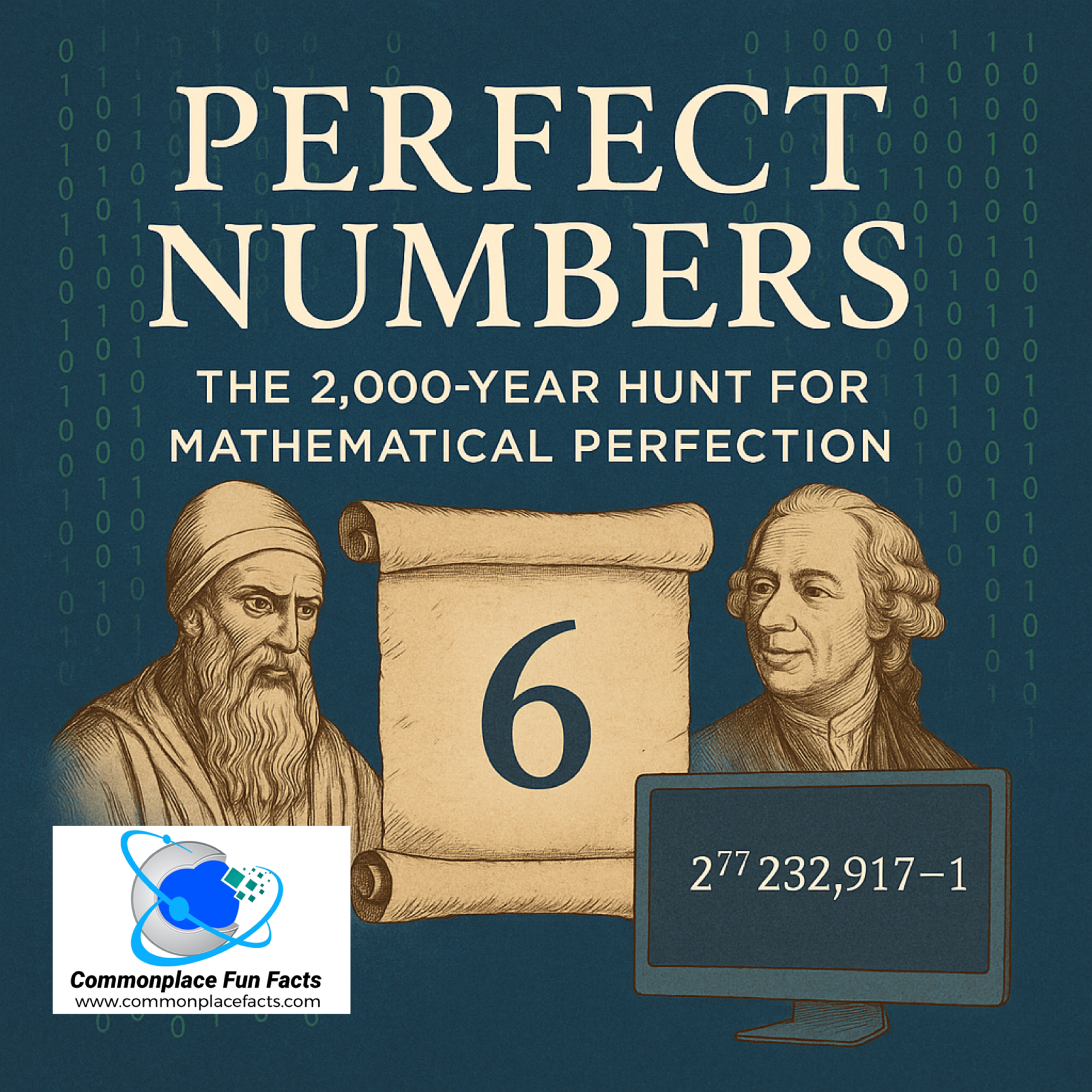

Here at Commonplace Fun Facts, there are certain things that keep us awake at night: where did Amelia Earhart go, what is the actual flavor of blue raspberry, and—perhaps most importantly—do odd perfect numbers exist?
Admittedly, that last one robbed us of sleep less out of any metaphysical pondering and more because we stayed up way too late just trying to understand the concept well enough to write about it.
Even those who are more mathematically inclined than we are have been losing sleep over this question for the past two millennia, chasing a number that may not even exist. Grab your slide rule and make sure your calculator batteries are fresh, put your high school math teacher’s phone number on speed dial, and join us on a tale of obsession, logic, primes, and one stubbornly unanswered question.
Contents
So, What Is a Perfect Number?
Before we dig into the drama, let’s make sure we all agree on what makes a number “perfect.” And no, it’s not about whether it can pull off skinny jeans or quote Lord of the Rings at dinner parties.

A perfect number is an integer that is equal to the sum of its proper divisors. “Proper” here means all the divisors of the number except itself. For example, take the number 6. The divisors of 6 (excluding itself) are 1, 2, and 3. Add them together: 1 + 2 + 3 = 6. Boom. Perfect.
Try it with 10. Its proper divisors are 1, 2, and 5. Add those up, and you get 8. That’s not 10. That number is imperfect, like most of us before our second cup of coffee.
The Ancient Origins of the Perfection Obsession
The obsession with perfect numbers goes all the way back to the ancient Greeks. Euclid was the first to propose a method for generating perfect numbers using what we now call Mersenne primes.
A Mersenne prime is basically a show-off prime number that can be written as one less than a power of two. In fancy notation, that’s Mₙ = 2ⁿ − 1. These numerical divas are named after Marin Mersenne, a 17th-century French friar who apparently had a thing for numbers and silence (he was a Minim, after all).
Now, here’s the catch: if n isn’t a prime number, then 2ⁿ − 1 won’t be prime either—it’ll just sit there being all composite and disappointing. That’s why we only bother with values of n that are prime to begin with. So, when you hear someone say “Mersenne prime,” think: “2 to the power of a prime, minus 1, and somehow still prime.” Pretty slick.
Still with us? Congratulations. Truthfully, we nodded off twice during the last paragraph alone.
Perfect Numbers Through History: A Parade of Primes
By the time of Nicomachus of Gerasa (circa AD 100), four perfect numbers were known: 6, 28, 496, and 8,128. And those were all the perfect numbers humanity would get for over 1,000 years. That’s a millennium-long mathematical dry spell, but it raises a legitimate question: just how many perfect primes are there? And, to be honest, it raises a second question: just how many perfect primes does humanity need, anyway?
Patterns, Powers, and Perfection: How to Make a Perfect Number
If only there were a recipe for perfect numbers—something like “take two primes, mix vigorously, and bake at 2ⁿ degrees.” Well, as it turns out, mathematicians have noticed a few suspicious patterns. And by suspicious, we mean suspiciously beautiful.
Let’s look at our first contestant: 6. Its proper divisors are 1, 2, and 3, and wouldn’t you know it—1 + 2 + 3 = 6. That’s what we call a textbook perfect number. Then we meet 28: 1 + 2 + 4 + 7 + 14 = 28. The math checks out, and suddenly we’re hooked. Is there a pattern here?
Each known perfect number seems to be one digit longer than the one before it, as if they’re quietly auditioning for the numerical equivalent of a growth spurt. Even more curiously, their final digits alternate—6, then 8, then 6, then 8—which not only sounds like the world’s least catchy phone number but also confirms they’re all even. Every. Single. One. (At least thus far.)
Now we tumble headfirst down the rabbit hole. These perfect numbers can also be written as the sum of consecutive natural numbers. For example, 6 = 1 + 2 + 3, and 28 = 1 + 2 + 3 + 4 + 5 + 6 + 7. If you stack these numbers in layers, you get a tidy triangle—hence, they’re called triangular numbers. Geometry and arithmetic holding hands? We love to see it.
And just when you think things can’t get nerdier: 28, 496, and 8128 can all be written as the sum of consecutive odd cubes. As in:
- 28 = 1³ + 3³
- 496 = 1³ + 3³ + 5³ + 7³
- 8128 = 1³ + 3³ + 5³ + 7³ + 9³ + 11³ + 13³ + 15³
Not weird enough? Let’s talk binary. When you convert these perfect numbers into base-2, you get an eye-catching pattern:
- 6 = 110
- 28 = 11100
- 496 = 111110000
- 8128 = 1111111000000
Each one is just a run of 1’s followed by a run of 0’s. It’s like the numbers are waving a little binary flag saying, “I’m perfect and I know it.”
Euclid’s Formula: Ancient Wisdom, Modern Wow
Back in 300 BC, Euclid noticed something curious. He began doubling 1: 2, 4, 8, 16, 32, and so on. Then he started adding up those powers of two, like 1 + 2 = 3, which is prime. Multiply that prime (3) by the last number in the sum (2), and you get… 6. A perfect number!
Let’s keep going:
- 1 + 2 + 4 = 7 (prime) → 7 × 4 = 28
- 1 + 2 + 4 + 8 = 15 (not prime, skip it)
- 1 + 2 + 4 + 8 + 16 = 31 (prime) → 31 × 16 = 496
This “prime-sum-times-the-last-term” formula was how Euclid built his perfect numbers. A millennium later, Euler would prove that this wasn’t just a neat trick—it was the only way to create even perfect numbers.
Now Let’s Get Even Fancier
There’s an even slicker way to express Euclid’s formula using some algebraic flair. Take a sum of powers of 2:
1 + 2 + 4 + … + 2n−1
If you multiply that whole equation by 2, and then subtract the original sum from the doubled one, all the terms cancel out except the last one. Voilà, you get:
T = 2ⁿ − 1
This is a classic geometric series trick. So when you multiply T (which is 2ⁿ − 1) by the last power of 2 (which is 2n−1), you get:
(2ⁿ − 1) × 2n−1
Or, more elegantly:
2p−1 × (2p − 1), where p is prime and (2p − 1) is also prime.
This is the secret sauce behind all known even perfect numbers. And because 2p−1 is always even, the whole product is always even, too—no oddballs here. But hey, we’ll save that odd perfect number conversation for another section.
Mersenne, Fermat, Descartes, and the Battle of the Primes
In the 17th century, French polymath Marin Mersenne took a crack at it. He listed a series of exponents p for which 2p − 1 is prime—these are now called Mersenne primes. Get one of those, plug it into Euclid’s formula, and voilà: a perfect number.
But Mersenne didn’t exactly fact-check his list. Some of his supposed primes turned out to be very much not prime. One example: 267 − 1. Mersenne thought it was a prime. He was off by… a lot.
Two centuries later, mathematician Frank Nelson Cole stunned an audience by silently writing the massive number 267 − 1 on a chalkboard, then multiplying two 10-digit numbers on another board to show the product matched. The man didn’t say a word. He just dropped the numerical mic and sat down. Took him three years of Sundays to do it.
Enter Euler: The Man Who Made Euclid Look Like a Slacker
Leonhard Euler, the mathematical juggernaut of the 18th century, discovered the eighth perfect number and, more importantly, proved that every even perfect number must follow Euclid’s formula. This wasn’t just a neat trick—it was a full-on proof that Nicomachus’s fourth conjecture was spot-on. Euler even added a flourish by using a new tool: the sigma function, which sums all the divisors of a number (including the number itself).
He also took a stab at the holy grail: odd perfect numbers. Euler managed to narrow down what must be true if such a number existed. Spoiler: it would have to be the product of a prime number raised to an odd power, times a square. Which is helpful, except we still haven’t found any. They’re the Bigfoot of math—rumored, elusive, and stubbornly resistant to selfies.
Odd Perfect Numbers: The Unicorns of Arithmetic

Despite all the effort, no one has ever found an odd perfect number. Not one. Nada. We’re not even sure they exist. As of now, mathematicians have proven that if they do exist, they have to be absurdly huge—like, greater than 102,200. That’s a number so big it makes supercomputers servers wince.
To make things more interesting, researchers have discovered “spoofs”—numbers that are almost odd perfect numbers. Descartes found one in the 1600s, and more have been discovered recently. Spoofs behave like odd perfect numbers in nearly every way… except for being, you know, perfect.
GIMPS and the Rise of the Machines
By the 20th century, we started letting computers do the hard stuff. In 1996, George Woltman launched the Great Internet Mersenne Prime Search (GIMPS), a distributed computing project where volunteers use their home computers to help find Mersenne primes. It’s like SETI@home, except instead of aliens, you’re hunting for perfect numbers. Way nerdier. Way cooler.
In 2017, GIMPS found the 50th known Mersenne prime: 277,232,917 − 1, a number with more than 23 million digits. To commemorate this moment, a Japanese publisher printed the number across 719 pages. No plot, no characters, just digits. It still sold out in four days. Somewhere, Euclid is laughing in binary. If you’re interested in downloading the file with the number, you can find it here.
Are We There Yet? The Future of the Perfect Number Hunt
Despite hundreds of years of progress, the biggest question remains: do odd perfect numbers exist? Most mathematicians suspect they don’t. Heuristic arguments (basically, math’s version of an educated hunch) suggest that the odds of such a number existing are astronomically low. But it hasn’t been proven. And in math, suspicion doesn’t count for much.
So we’re left with a tantalizing mystery. On one hand, the odds say we’re wasting our time. On the other, every failed attempt tightens the net around this elusive creature. Maybe someday, a high school student or a bored CPA with a fast laptop will stumble across a counterexample. Until then, we keep looking.
Why Bother?
You might be wondering, “Is this just math for math’s sake?” Yes. And that’s the point. Pure math often seems useless—until it isn’t. Number theory was long considered impractical, right up until we built modern encryption on its back. Non-Euclidean geometry was once a quirky intellectual game. Then Einstein showed up and used it to bend spacetime.
So while perfect numbers might never secure your Wi-Fi or calculate your tax refund, they push the boundaries of what we understand. They inspire us to ask better questions, build better tools, and occasionally, publish 700-page books that no one will ever read cover to cover. And that, in its own way, is pretty perfect.
So go ahead—crunch some numbers. Who knows? Maybe you’ll be the one who finally solves the oldest unsolved problem in mathematics. Or at the very least, you’ll have a great icebreaker for your next awkward dinner party.
You may also enjoy…

Why Does It Take 300 Pages to Prove 1+1=2? The Story Behind Principia Mathematica
Discover the fascinating story behind how Principia Mathematica took 300 pages to prove that 1 + 1 = 2, a mind-boggling proof by Bertrand Russell and Alfred Whitehead.

The Indiana Pi Bill and the Attempt to Redefine Mathematics Through Legislative Fiat
Do you remember when you first learned of the concept of π? Have mathematics always been at least a little bit difficult for you? Haven’t you wished you could just pass a law to make it all a lot easier to understand? When some elected legislators attempted to use their political power to change some…

The Standard Model: The Mathematical Formula for Life, the Universe, and (Almost) Everything
Want a mathematical formula that explains everything in the universe? Welcome to the Standard Model.





Leave a Reply to Herald StaffCancel reply