
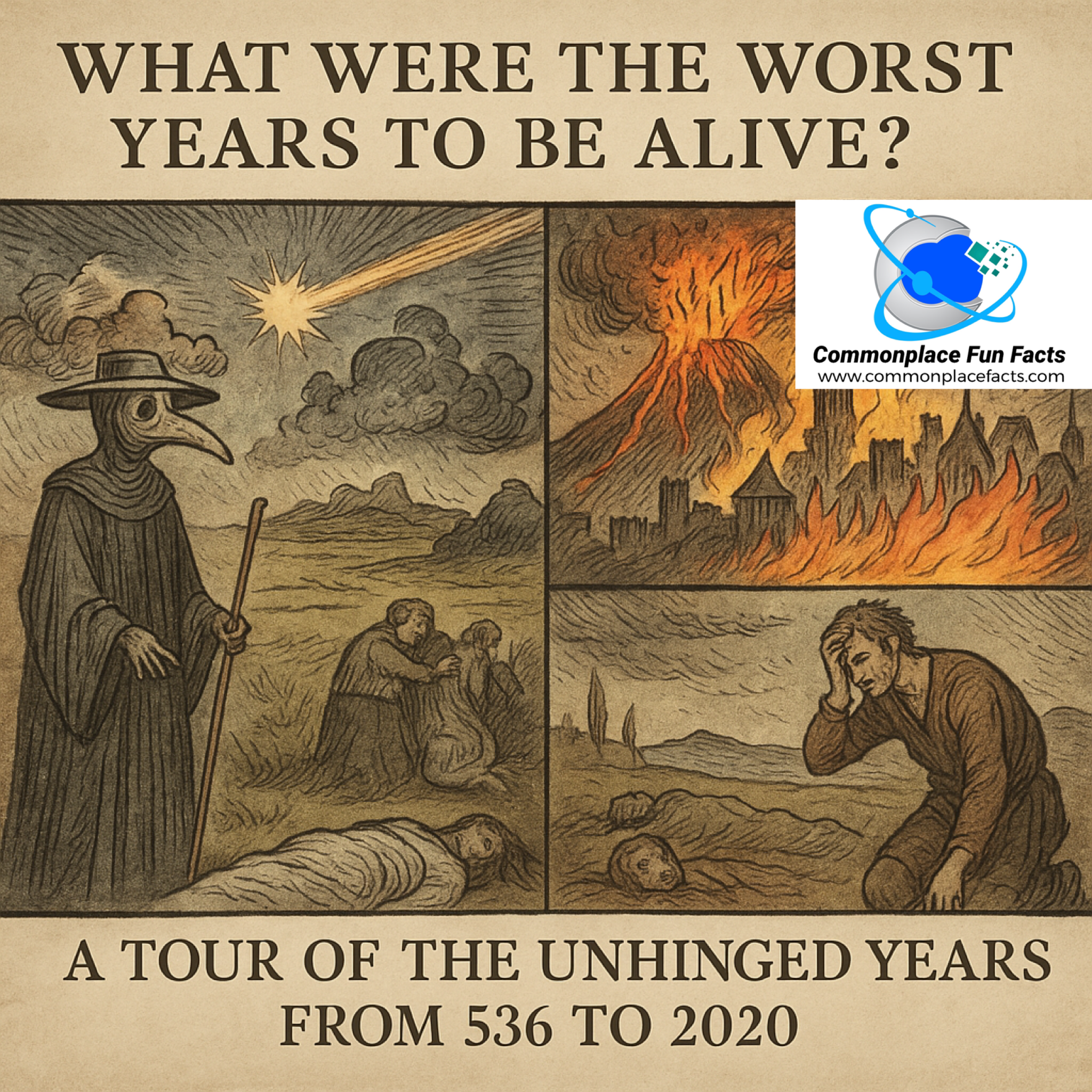

What Were the Worst Years to Be Alive?
It’s a question every history nerd, armchair philosopher, and time traveler has probably pondered while doomscrolling or dodging modern inconveniences like Wi-Fi outages: What were the actual worst years to be alive?
Sure, your flight got delayed and your coffee order was wrong. But did your village get flattened by an earthquake, your crops fail for three straight years, or your entire continent descend into plague-induced panic while comets loomed ominously overhead? Probably not.
Some years in human history truly went above and beyond in the chaos department. Whether it was famine, disease, volcanic eruptions, economic collapse, or just the general feeling that the universe had wandered off and left Earth on autopilot, these were the years that made people ask, “If we’re living in a big simulation, is this still the tutorial level, or are we already in expert mode?”
Join us on a tour through the calendar’s greatest hits of misery—from ancient eruptions and medieval meltdowns to modern messes that made the whole globe wish it could hit the reset button.
Contents
536 AD – The Year the Sun Gave Up

If you were alive in 536 AD, first: congratulations on your skincare routine, because you look absolutely fabulous for someone who is nearly 1,500 years old. Second: you had a front-row seat to what historians and climatologists agree was one of the worst years to be alive. A mysterious fog or dust cloud rolled over much of the Northern Hemisphere, blocking out the sun for up to 18 months. That’s not hyperbole. Byzantine historian Procopius wrote that the sun gave no light “like the moon,” which is ancient Greek for, “We wish someone would hurry up and invent electric lighting so we can pay the utility bill and be able to see again.”
Temperatures plummeted. Crops failed. Snow fell in summer. Famines spread across Europe, the Middle East, and Asia. And just when people were thinking, “At least it can’t get worse,” the bubonic plague showed up in 541. This was the historical equivalent of falling down the stairs and landing in a hornet’s nest.
1315–1317 – The Great Famine That Ate Europe
Before the Black Death decided to level the continent, Mother Nature warmed up with a little culinary horror show known as the Great Famine of 1315–1317. Think of it as Europe’s three-year elimination diet—only no one volunteered.
It began with relentless rainfall. Not gentle, Disney-style rain. This was swamp-everything-and-murder-the-crops rain. Harvests failed. Livestock drowned or starved. Salt, used to preserve meat, became scarce, so the little bit of food you might stumble across was likely rotten.
Things got so bad that some people reportedly ate tree bark, dogs, and in the darkest rumors, each other. Yes, this was the period where “family dinner” had a dangerously literal tone. In some areas, 10–25% of the population died, not from plague or war, but from sheer, relentless hunger.
If anyone was looking for signs of divine disfavor, they weren’t hard to find.
1347 – The Plague Rolls In, and Europe Checks Out

Imagine a pandemic that sweeps across the known world and completely disrupts civilization. If you’re thinking about 2020, that’s adorable. Having to wear masks and stand six feet away from the next person in line for the cash register was nothing compared to what happened in 1347. That was the year the Black Death visited every town in Europe and kept the Grim Reaper so busy that he had to Chuck Norris to take up the slack. It started in Crimea, hitched a ride on Genoese ships, and by the time anyone figured out that “quarantine” wasn’t just the latest Italian dessert, it was too late.
This wasn’t just a bad flu season. This was a globe-altering catastrophe. Between 75 and 200 million people died—roughly one out of every three Europeans, give or take a peasant. Whole towns were abandoned. Priests ran out of last rites. People buried their own families in backyard trenches. And doctors, bless their beaked little hearts, prescribed bloodletting and herbs, which was about as useful as a screen door on a plague ship.
The result? An existential crisis for medieval Europe that lasted decades. Also: a lot more job openings.
1666 – Fire, Plague, and End-of-the-World Vibes
If you were superstitious in 1666—and let’s be honest, most people were—you probably didn’t love the numerical aesthetic of the year. Triple sixes don’t exactly scream “good things ahead.” But even by the standards of prophetic dread, 1666 overachieved.
The year began in the smoking ruins of the Great Plague of 1665, which had just killed roughly 100,000 people in London. As if trying to upstage itself, the city then erupted into the Great Fire of London, which burned for four days and gutted the medieval core of the capital. The fact that this all happened the same year Isaac Newton started pondering gravity feels… weighty.
1811 – The Year of Wonders
If you’ve already read our breakdown of the horrific murder debacle committed by Thomas Jefferson’s nephews, you know 1811 punched above its weight class. Historians still refer to it as an Annus Mirabilis—a “Year of Wonders.” And by “wonders,” we mean “what kind of Faustian nightmare have we wandered into?”

Across much of the United States, droughts turned farmland into kindling. A total solar eclipse rolled across the Midwest, giving folks a nice dramatic light cue for their growing sense of existential dread. And then came the squirrels. Millions of them. Migrating south in such overwhelming numbers that thousands of the bushy-tailed rodents drowned trying to cross the Ohio River. It was like a Hitchcock film starring woodland creatures and poor planning.
Not to be outdone, the skies darkened with billions of passenger pigeons—America’s now-extinct, then-overachieving bird species that apparently decided 1811 was the year to go full avian apocalypse. They blacked out the sun, stripped entire forests, and gave everyone from farmers to philosophers a legitimate reason to scream “What now?!” into the void.
The answer to the “What now?!” question appeared overhead. Blazing above all of this chaos was a twin-tailed comet known as Tecumseh’s Comet. It hovered in the sky for nearly 17 months, glowing ominously while people debated whether it was a sign of divine judgment, impending war, or just really solid cosmic special effects. Native leaders like the Shawnee Prophet Tenskwatawa took it as a sign to rise against American expansion. Settlers took it as a sign to panic. Historians took notes.
The comet finally disappeared in April 1812 and won’t be back until the year 3775. If you plan on being around for its return, get ready for another squirrel migration, and don’t say we didn’t warn you.
And just to make sure no one could sleep through the chaos, the New Madrid Earthquakes started rolling in that December. We’re talking multiple quakes, some estimated above magnitude 7.5, shaking the Mississippi River Valley so hard it ran backward for a while. Church bells rang in Boston. Chimneys collapsed in Cincinnati. Entire forests sank into the ground like a bad magic trick. Missouri and nearby states, in short, had a very bad time.
1815 – The Volcano That Changed Everything
If 1811 was nature’s experimental mixtape, 1815 was the full symphony—with a volcanic crescendo. Mount Tambora, located in what is now Indonesia, erupted with such force that it remains the most powerful volcanic event in recorded human history. The blast was heard 1,600 miles away. That’s not an exaggeration; that’s a noise complaint even beyond that of that dorky neighbor kid whose bad taste in music is exceeded only by the power of the speakers in his car.
The eruption hurled enough ash and sulfur dioxide into the atmosphere to mess with global temperatures, triggering what became known as “The Year Without a Summer” in 1816. Snow fell in New England—in June. Crops failed in Europe. Prices skyrocketed. And somewhere in a gloomy villa by Lake Geneva, Mary Shelley wrote Frankenstein, because when the sun refuses to show up, all that’s left is literary horror.
1945 – When Modernity Lost Its Innocence
Let’s just call 1945 what it was: the year the 20th century grew fangs. After six years of world war, humanity closed the curtain with an atomic finale. The bombings of Hiroshima and Nagasaki didn’t just end World War II—they introduced an entirely new era of “We can now end civilization before lunch.”
Once the war was over, humanity took a collective deep breath and absorbed the true horror of the past few years. Millions of dead on the battlefields. The horrors of the Holocaust. The realization that the bloodiest war in human history was just a skirmish compared to what the next one could be.
Also, UFO sightings began to spike. Coincidence? Depends on how tinfoil your hat is.
1969 – Peace, Violence, and a Moonwalk
At first glance, 1969 looks like the feel-good year of the century. The Apollo 11 mission put humans on the Moon, fulfilling every ten-year-old’s dream and kicking off decades of conspiracy theories. Woodstock brought together half a million people in a field with only three working bathrooms. And Sesame Street premiered, teaching kids how to count and share using puppets with neuroses.
But 1969 also had a dark side. The Manson Family murders horrified the country and effectively killed off the hippie utopia narrative. The Vietnam War raged on. It was a year of contradictions—moon landings and murder trials, hope and horror, folk songs and felony charges.
2020 – The Year That Shall Not Be Named

You were there. We were there. The internet was there, recording all of it in real time. A global pandemic. Economic freefall. Lockdowns. Toilet paper black markets. Zoom birthdays. If future historians don’t dedicate entire museums to 2020, we’ll know they’re in denial.
The only upside? Introverts were free to live their days without the living horror of being around people who insist upon talking and — we shudder at the thought — hugging.
Oh yeah… we also learned that we could attend classes and business meetings while wearing pajama bottoms.
BONUS ROUND: ~73,000 BC – The Day the Sky Turned to Fire

Now, we realize this one’s a bit of a stretch, seeing as the only eyewitnesses were probably clutching stone tools and wondering why the sky was angry. But around 73,000 BC, Mount Toba in present-day Indonesia decided to audition for the role of “Extinction-Level Event” and unleashed a supervolcano eruption so massive that it may have reduced the human population to just a few thousand survivors.
We’re talking a volcanic winter, with ash blocking out the sun, global temperatures dropping, and survivors possibly huddling in caves wondering if the world had been unplugged. While historians are still arguing over the exact death toll, the Toba event remains a top-tier contender for the worst prehistoric vacation ever.
Do we include it in a list of “worst years in history”? Sure, as long as we admit it’s mostly a fossil-fueled guess.
When Years Go Rogue
Every now and then, the calendar hits a year that seems less like history and more like a particularly ambitious plotline. These aren’t just Annus Mirabilis—they’re Annus “Get Me Off This Ride.” From medieval sun blackouts to interstellar landings to a river that ran backward, these years serve as a reminder that history isn’t boring. It’s just waiting for the next plot twist.
You may also enjoy…

Mount Tambora: The Volcano That Triggered a Year Without Summer, Defeated an Empire, and Gave Birth to a Monster
Discover how the 1815 eruption of Mount Tambora caused a ‘Year Without a Summer,’ defeated Napoleon, and inspired Mary Shelley’s Frankenstein.

Y2K: When We All Held Our Breath and Flipped Our Calendars
Discover the fascinating story of Y2K—how a two-digit date nearly caused global panic, what actually happened when the clocks rolled over to the year 2000, and why your microwave didn’t start a revolution.

How Gutenberg Invented the Printing Press Because of Bad Scheduling and a Con Scheme
How did Gutenberg come up with the printing press? Read this article to find out how it was influenced by a bad schedule and a con scheme.




Leave a Reply