
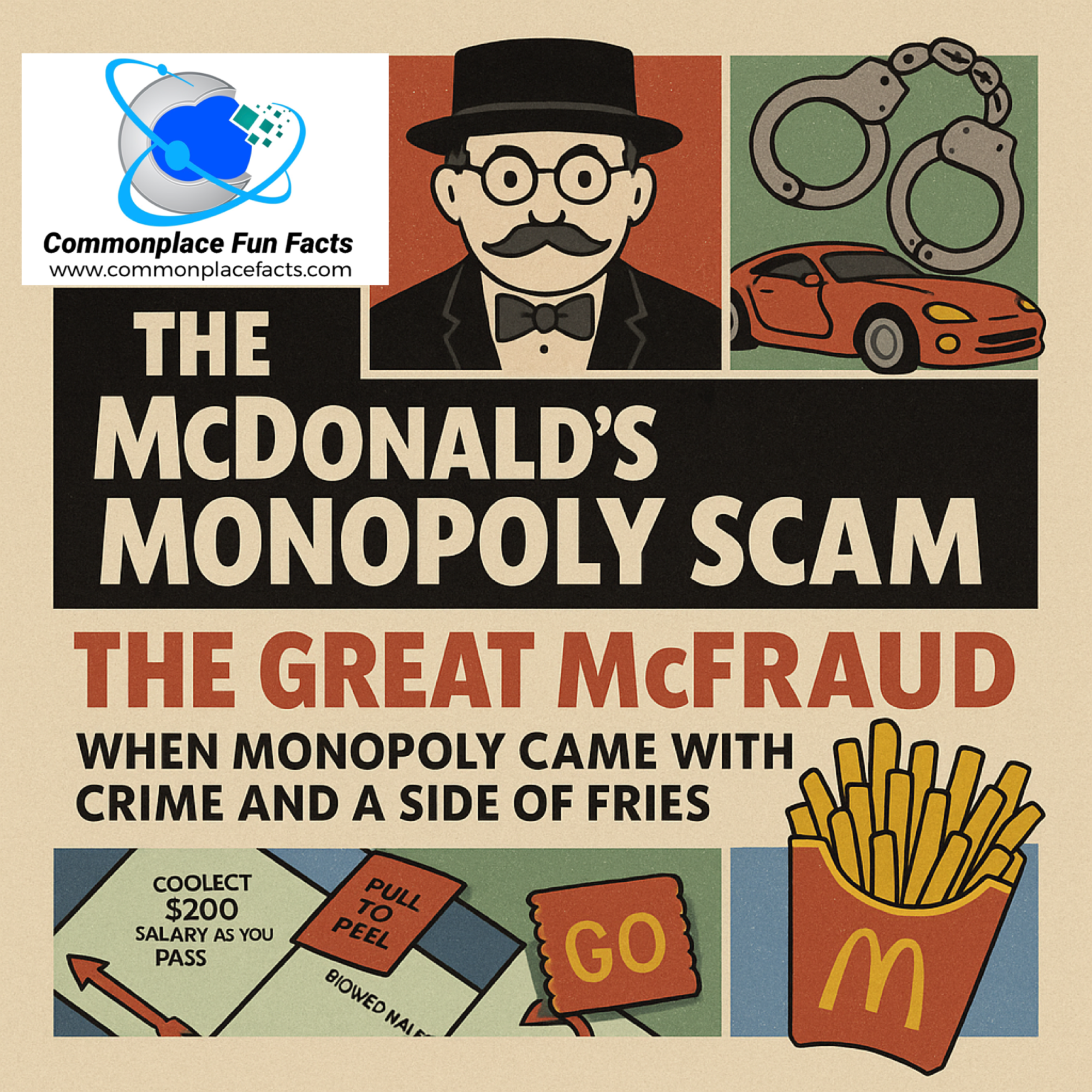

The McDonald’s Monopoly Scam: Setting the Stage
Before we dive into this tale of fast food, faster scams, and the kind of white-collar crime that somehow involves both a strip club “church” and a Mormon real estate developer, let’s play a little game. Picture yourself in 1997, peeling the corner off your large fries, dreaming of Boardwalk riches. A Dodge Viper. A Sega Game Gear. A lifetime supply of Quarter Pounders. The stakes were greasy, the odds astronomical… and the entire game was rigged.
For over a decade, McDonald’s Monopoly promotion—a glorified peel-and-win game started in 1987 by Simon Marketing—boosted sales by up to 40% each year it ran. It was a marketing behemoth. It was also, unbeknownst to the public, a $24 million fraud operation that reads like Ocean’s Eleven dipped in fryer oil and set in Jacksonville, Florida.
This isn’t your average crime caper. This one had all the ingredients of a true-crime buffet: inept Florida men, real housewives, Italian mobsters, Mormon businessmen, drug traffickers, psychics, strip clubs, and a very enthusiastic FBI agent who wanted nothing more than to wear a wire and stage a sting operation with giant novelty checks. All of it now immortalized in HBO’s McMillions, a six-part docuseries directed by James Lee Hernandez and Brian Lazarte, and currently being adapted into a Hollywood movie starring Ben Affleck and Matt Damon. Apparently because Ronald McDonald was unavailable to play the lead.
This is the story of the biggest fraud you never knew you played a part in. Pull to peel. Rage to reveal.
Contents
How to Rig a Happy Meal
Jerome “Uncle Jerry” Jacobson was a former Florida cop who pivoted from enforcing the law to outmaneuvering it. His gig as head of security at Simon Marketing—a firm responsible for printing and distributing those valuable Monopoly game pieces—gave him access to every winning ticket. He watched over the vault of million-dollar game pieces like a hawk… until he realized how easy it was to pocket one himself. There’s nothing quite so “fast food” as losing all sense of personal discipline, after all. If it peeled, he pocketed it.
He started small—$25,000 to his stepbrother, then $10,000 to his butcher. But once a set of anti-tamper seals arrived from Hong Kong, Jerry realized he could steal tickets, reseal the envelopes, and hand out million-dollar prizes like Oprah with a tray of McNuggets. All while looking like the most fastidious ex-cop in the breakroom.
Say Hello to Colombo (No, Not the Detective)
While waiting at an airport one day, Jerry met a man named Gennaro “Jerry” Colombo—a flamboyant Brooklyn-raised mobster with alleged ties to the Colombo crime family, who also had a thing for The Godfather and owning strip clubs registered as houses of worship (officially making the Church of the Flying Spaghetti Monster sound somewhat reverent in comparison). You know, normal resume stuff.
Colombo became Jacobson’s middleman, distributing winning pieces to “random” relatives and associates. At one point, Colombo even starred in a McDonald’s commercial, holding up keys to his brand-new Dodge Viper and looking as innocent as a mob-backed ad man can look on national television. Which is to say: not very.
Meet the Cast of McConspirators
As the scam snowballed, Jacobson brought in a colorful mix of co-conspirators. Mormon real estate developer Dwight Baker, deep in debt but high on hope. Drug trafficker Andrew Glomb, who handed out prize pieces like party favors to his coke-dealing friends (not the type of Coke that you would expect at a McDonald’s restaurant, in case you were curious). A few other guys—Don Hart, Richard Couturier—jumped in with their own spin on the operation.
Jacobson even consulted psychics to reassure himself the scam was “meant to be.” Fun fact: if you need supernatural validation to make yourself feel good about fraud, you probably need to reconsider more than a few life choices. Meanwhile, the FBI was quietly building its own board game—this one called “Who’s Gonna Crack First?”
Peel Here to Start a Federal Investigation
In 2000, the FBI office in Jacksonville, Florida—normally about as action-packed as a DMV—got a call from an anonymous tipster. “Uncle Jerry is rigging the Monopoly game,” the voice said. And suddenly, agents who were probably used to fraud-by-check-kiting found themselves deep in a tangled web of mobsters, Mormons, and McNuggets.
Special Agent Doug Mathews, the Energizer Bunny of the bureau, launched a sprawling investigation. 25 agents. 20,000 tapped phone numbers. FBI personnel pretending to be McDonald’s PR staff. Hidden cameras. Wiretaps. They even filmed fake commercials and handed out novelty checks just to lure in suspects. And, believe it or not, it worked.
McDonald’s cooperated—with one catch: they needed another rigged game to catch him in the act. Cue “Operation Final Answer.” FBI operatives posed as McDonald’s film crew and staging studio to snag winners on tape. They made fake commercials and invited sketchy million-dollar winners to claim prizes on camera. Michael Hoover, a bankrupt pit boss, got the check—and the cuffs.
Jail Time and Giant Checks
After delaying payouts, the FBI monitored suspects calling in, growing impatient. One winner’s story about a soggy magazine with a game piece was so preposterous that even the undercover McDonald’s “crew” could barely keep a straight face. By August 2001, more than 50 people had been arrested, including Jacobson.
As it turned out, not a single high-value Monopoly prize between 1989 and 2001 was legitimately won. If you gained obesity, high cholesterol, or Type 2 diabetes in your quest to find a winning game piece, however, you get to keep that.
Jacobson admitted to stealing at least 60 winning game pieces. His sentence? 37 months in prison and a $12.5 million restitution tab—being paid off at a leisurely $370 a month. Meanwhile, his former employer Simon Marketing was gutted, hundreds lost their jobs, and McDonald’s faced a slew of lawsuits. Burger King even tried to sue over unfair advertising competition. Truly, there is no honor among burger flippers.
Where Are They Now?
McDonald’s eventually retired the Monopoly game in the U.S. in 2016, though it continues in other countries. Many of the conspirators pled guilty. Dwight Baker was excommunicated from his church. Gennaro Colombo died in a car crash before the arrests. Jerry Jacobson now lives in Georgia, in a nice house with his seventh wife, and probably a few million reasons to keep his mouth shut buried in the backyard.
As for the FBI? They got their sting, their headlines, and even a starring role in an HBO docuseries. Agent Doug Mathews probably still hasn’t stopped smiling.
Go Directly to Jail, Do Not Collect Anything But Headlines
The McDonald’s Monopoly scam remains one of the most bizarre frauds in American history—not because of the money stolen, but because of how many people were involved, how long it lasted, and how it took a sleepy Jacksonville FBI office to bring it all down.
And let’s be honest: if you ever played the game hoping for a million-dollar win, you weren’t wrong to dream—you were just playing someone else’s rigged board. In the end, Uncle Jerry was the real-life Monopoly Man. Only this one didn’t wear a top hat—he wore a vest full of stolen tickets and a grin that said, “Catch me if you can.”
In Monopoly, you pass “Go,” collect $200… and sometimes end up in a cell. But in real life, Go means pay $370 a month and hope your remaining millions don’t get repossessed.
In retrospect, the most surprising thing is that any fast food scheme this scandalous didn’t involve Rax’s creepy Mr. Delicious.
You may also enjoy…

Howard Johnson’s: The Rise, Fall, and Fried Clams of America’s Forgotten Restaurant Empire
Discover the rise and fall of Howard Johnson’s, the original restaurant franchise empire that shaped American roadside dining—then vanished. Fried clams, orange roofs, and nostalgia await.

Meet Mr Delicious: The Fast-Food Mascot So Unappetizing, He Bankrupted an Entire Chain
In the golden age of fast food, Rax Roast Beef rose to fame with its simple, no-frills approach. But a misguided attempt at diversification and a bleak mascot, Mr Delicious, led to its downfall. The chain filed for bankruptcy and now only five locations remain, serving as a cautionary tale about losing sight of one’s…

Final Answer… or Final Scam? The Wildest Game Show Cheating Scandals in History
Explore the bizarre and brilliant history of game show cheating—from Charles Ingram’s infamous coughing scandal to an underground syndicate that gamed the system. A trivia-rich, laugh-out-loud look at TV’s most audacious frauds.




Leave a Reply to cat9984Cancel reply