
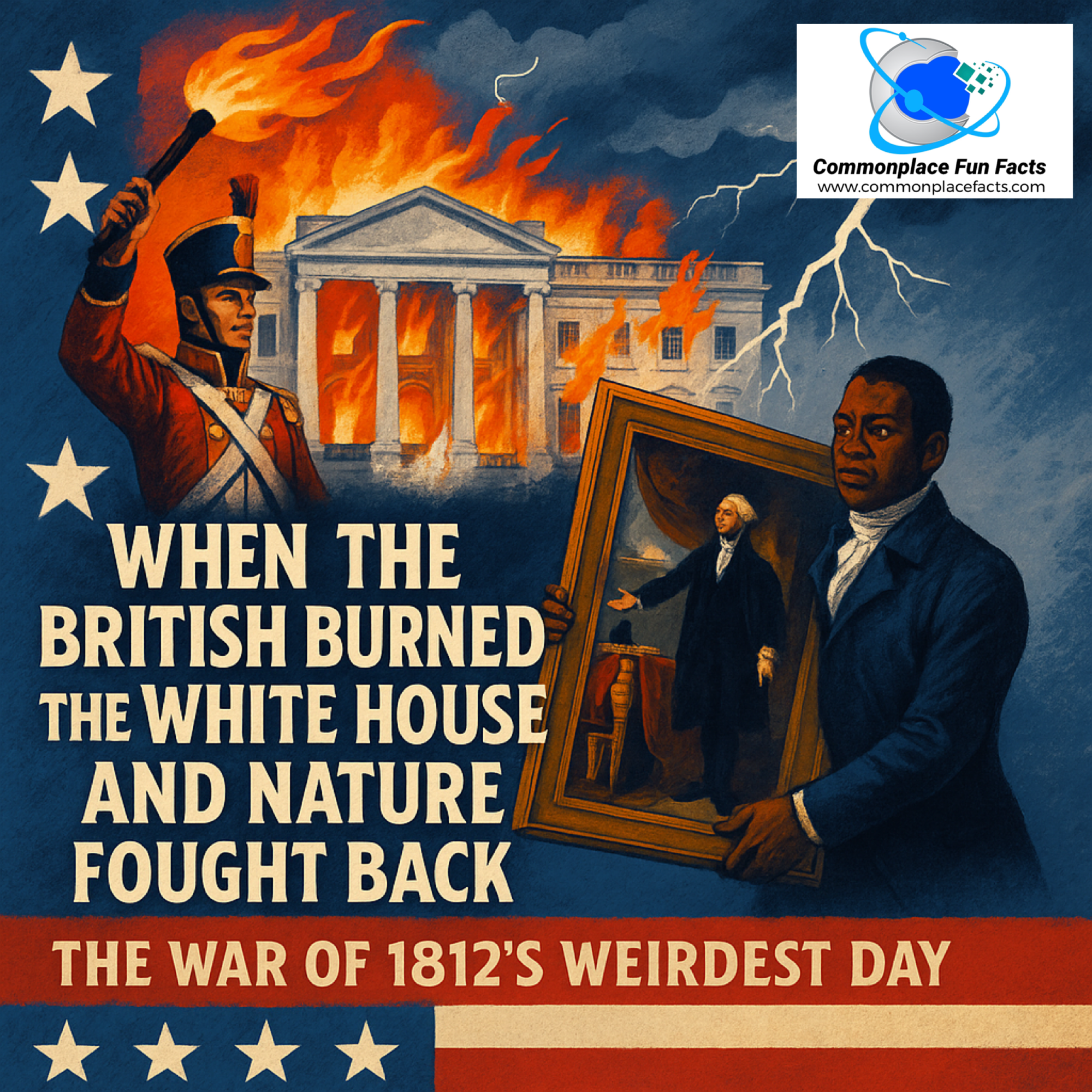

Most people remember the War of 1812 for exactly two things: the Star-Spangled Banner and Andrew Jackson’s solo career in New Orleans — which, fun fact, happened after the war officially ended. But nestled between all that patriotic cannon fire and historical confusion is one of the most fiery chapters in American history: the day the Redcoats came to Washington, D.C., held a mock session of Congress, the British burned the White House, and then got slapped by Mother Nature herself.
Grab your historical marshmallows — because things are about to get toasty — and join us on a journey that has rainstorms, stolen portraits, a White House name-origin myth that refuses to die, and even a dry one-liner allegedly from Calvin Coolidge that may or may not have happened.
Contents
The British Are Coming — And They’ve Got Matches
The War of 1812 was the sequel no one asked for — a messy follow-up to the American Revolution that featured trade disputes, impressment of American sailors, and Britain treating U.S. sovereignty like an optional suggestion. Fed up with British ships kidnapping their sailors and Parliament acting like the bossy ex who just won’t leave, the United States declared war in June 1812. What followed was two years of military blunders, naval showdowns, and awkward attempts at conquering Canada. By late 1814, things weren’t exactly going well for the Americans — especially after British forces decided to stop by Washington, D.C., and leave their calling card in flames.
It was August 1814, and President James Madison was busy not being in Washington — reportedly somewhere in the Virginia wilderness, possibly consulting a career coach. Meanwhile, British troops marched into the capital with the casual confidence of party crashers who not only drink all your punch but also light your curtains on fire for funsies.

Before breaking out the matches, Rear Admiral George Cockburn — the British Navy’s answer to a drama major with a grudge — looked around the U.S. Capitol and allegedly asked, “What say we set fire to the citadel of Yankee democracy?”
No, that’s not a deleted scene from Hamilton sung by the villain chorus. That’s a real quote (probably). Cockburn and his men then held what we wish we could say was the world’s most sarcastic session of Congress, but we suspect legitimately elected congressmen have outdone them in the years since. The soldiers voted in favor of incineration, and proceeded to roast the young nation’s capital like a colonial marshmallow. We don’t know if they took a vote on whether to recess afterward, but the ayes definitely had it when it came to arson.
The Day the British Burned the White House
Think of it as the worst sightseeing tour in U.S. history — the kind where the visitors bring torches, skip the gift shop, and leave everything in smoldering ruins. Following their mock Parliament, British troops rolled into Washington, D.C., and proceeded to give the city’s architectural highlights a fiery performance review. The Capitol? Charbroiled. The Treasury? Extra crispy. And the President’s House — not yet called the White House — got flambéed with such enthusiasm that future renovations would need to come with a fire extinguisher and a prayer.
But before we let historical fiction take the wheel, let’s separate the scorched facts from the smoke-blown folklore — because this tale comes seasoned with myths, singed around the edges with legend, and glazed with a generous helping of Dolley Madison drama.
Dolley Madison: First Lady of Emergency Salvage

Before fleeing the burning capital, First Lady Dolley Madison heroically ripped Gilbert Stuart’s painting of George Washington portrait from the wall just before the Redcoats showed up. Just to clarify: by “ripped,” we mean “gave detailed instructions to her staff to break the frame and carry it out the back door.” Dolley deserves credit for prioritizing national symbols over personal belongings, but let’s not forget Paul Jennings — a 15-year-old enslaved servant who did the heavy lifting. Literally.
The painting, by Gilbert Stuart, was saved. Sadly, the rest of the President’s House interior was not so lucky. The British set it ablaze, leaving the place scorched, roofless, and about as inviting as a chimney during a thunderstorm — which is, incidentally, what came next.
The Storm That Saved the City (Sort Of)
Just when it seemed the capital was destined to be reduced to ash and regret, something extraordinary happened. As flames consumed the heart of American government, a sudden and violent storm swept through Washington — not just any storm, but a tempest of near-biblical proportions. Thunder cracked, rain poured, and what some described as a tornado tore across the city, snuffing out fires, collapsing British supply tents, and — in a twist worthy of the Old Testament — reportedly hurling enemy cannons through the air like divine javelins. Eyewitnesses said the storm did more damage to the British than the American army had managed all week. Some saw coincidence. Others saw Providence. Because if ever there were a moment when it felt like Heaven itself had weighed in on the fate of a fledgling nation, this was surely it.
From “President’s House” to “White House”: The Paint Job Myth
After the fire, the building’s blackened walls were cleaned up and whitewashed. From that fact blossomed a persistent myth: that it was this very act of covering the scorch marks that led to the name “White House.” But here’s the historical wet blanket: the place had already been painted white before the British showed up, and people had been informally calling it the “White House” for years.
It didn’t become officially known as the White House until Theodore Roosevelt slapped the name on the letterhead in 1901. So, no, the name wasn’t born out of fire and ash. But it does sound way cooler that way, so we’ll let your middle school history teacher have that one.
Calvin Coolidge and the Steel Beam Snark
There’s a persistent legend that during White House renovations in the 1920s, President Calvin Coolidge discovered fire-damaged wooden beams — presumably charred souvenirs from the British bonfire of 1814 — and quipped, “Send the bill to the King of England.” It’s a quote that perfectly matches Coolidge’s famously dry wit… which is probably why it’s almost certainly apocryphal.
In reality, Coolidge did oversee several updates to the White House, including the installation of electric lighting, modernization of heating systems, and the construction of a new presidential garage (because even “Silent Cal” needed a place to park his Pierce-Arrow). But there’s no historical evidence that he replaced fire-damaged beams or billed Buckingham Palace for the repairs.
The real structural overhaul — complete with steel beams and a near-gutting of the interior — came two decades later under Harry Truman. By that point, the White House was less “executive mansion” and more “national fire hazard held together by wishful thinking.” Coolidge may have had a talent for thrift and stoicism, but he didn’t have to deal with 19th-century timbers pretending to support 20th-century living.
So while we’d love to imagine Cal channeling his inner sass and handing Britain an invoice for their 1814 arson spree, we’ll have to settle for him being the president who kept a pet raccoon, loved having his head rubbed with Vaseline, and didn’t talk much — but still managed to host the first presidential radio broadcast.
Wrapping Up: Flames, Fiction, and Founding-Era Shenanigans
The burning of Washington in 1814 was a low point for American pride and drywall, but it gave us some enduring tales — some true, some embellished, and some as sturdy as a damp parchment in a hailstorm. From Dolley Madison’s last-minute portrait grab to Cockburn’s sarcastic mock-Parliament, this event remains one of the most memorable (and flammable) chapters in U.S. history.
And the next time someone tells you a bit of American history that sounds too good to be true, just smile knowingly. History is full of great stories. It’s our job to separate the good ones from the real ones — and then tell both anyway, because come on, they’re just too good to leave out.
You may also enjoy…

Peter Benchley: The White House Speechwriter Who Refused to be Fired
Discover how Peter Benchley, the author of ‘Jaws,’ navigated a tumultuous stint as a White House speechwriter under LBJ and turned his experiences into inspiration for his iconic novel.

The Ghosts That Haunt the White House
They say that the house is haunted. Ridiculous, you say? No educated person believes in ghosts! Before you utterly dismiss the claims, however, you would do well to consider the credentials of those who insist they have seen the spirits wandering the halls. The house is old. That seems to be one prerequisite for most…

The Beale Ciphers: Do the Secrets of a Real Buried Treasure Exist in America’s Most Sacred Documents?
Discover the real-life buried treasure mystery of the Beale Ciphers, possibly linked to the Declaration of Independence. Explore historical facts, codebreaking legends, and modern theories behind this unsolved American enigma.



Leave a Reply to Herald StaffCancel reply