
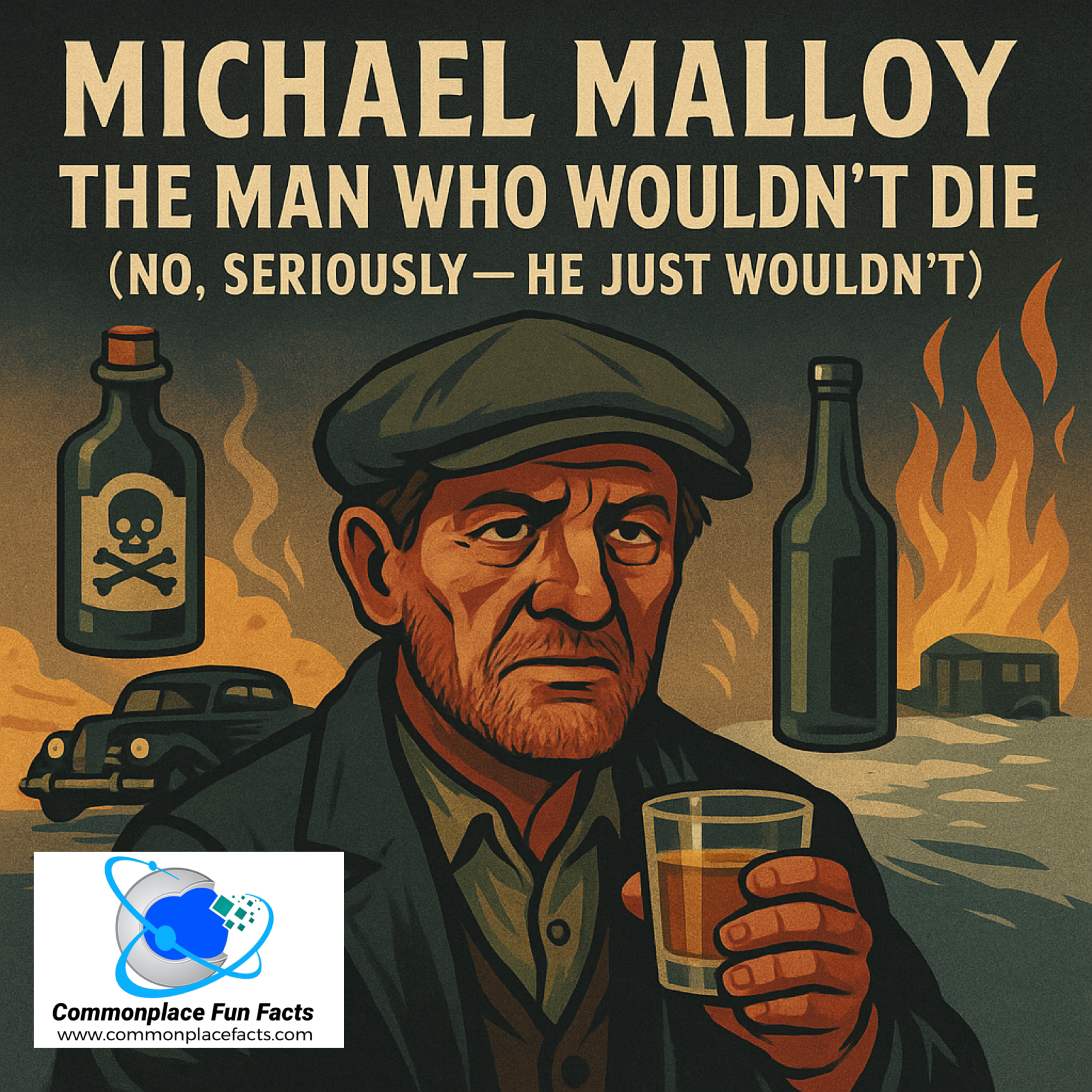

If Hollywood ever makes a biopic about Michael Malloy, it’ll have to be part comedy, part horror, and part superhero origin story. Because what started as a plan to commit insurance fraud turned into one of the most bizarre—and darkly hilarious—true crime tales in American history. Malloy, a homeless Irish immigrant in 1930s New York, did the unthinkable: he refused to die. And not in the “he battled cancer bravely” kind of way. No, Malloy straight-up tanked poison, car crashes, and arson attempts like he was auditioning to be the next X-Man.
Let’s uncork a bottle of wood alcohol, raise a toxic toast, and meet the man whose superpower was being too stubborn to die.
Contents
Enter the Murder Trust (aka the Dumbest Criminals in the Bronx)
Our story begins in 1932 in a speakeasy in the Bronx, operated by a man named Tony Marino. Like many during the Great Depression, Marino wasn’t rolling in dough—unless you count the soggy kind stuck to the bottom of a bootleg whiskey barrel. So he and a few pals—Joseph “Red” Murphy, Daniel Kriesberg, and petty criminal Hershey Green—hatched a plan that was equal parts evil and idiotic: find a down-and-out nobody, take out multiple life insurance policies on him, and then make sure he conveniently stops breathing.

Enlisting the assistance of a shady insurance agent, the group took out multiple insurance policies on Michael Malloy, a 50-something former firefighter turned hopeless alcoholic with no known family, job, or liver function.
If Malloy suffered an accidental death, the miscreants stood to gain over $3,500 (the equivalent of over $85,000 in 2025). All they had to do was make sure that accidental death took place. What they didn’t count on was a hidden superpower that would make things quite a bit harder than they had planned.
The Impossibly Long Death of Michael Malloy
Attempt #1: Let Him Drink Himself to Death
At first, Marino thought he’d come up with the perfect murder weapon: a bottomless bar tab. He figured that if Michael Malloy was allowed to drink himself into oblivion, nature—or cirrhosis—would handle the rest. But the man who would gain the nickname “Iron Mike” wasn’t just an alcoholic. He was an overachieving alcoholic with an apparently bulletproof liver. He drank from morning till unconsciousness, then woke up and asked for seconds.
Attempt #2: Antifreeze With a Twist of Lime
Growing impatient, Marino added a little something extra to the drinks. First up: antifreeze—great for automobiles but decidedly lethal for humans. That should have been more than enough to accomplish their objectives, but Malloy just belched, smiled, and carried on. Turns out ethanol can block the absorption of ethylene glycol (antifreeze) in the liver. So in a darkly ironic twist, Malloy’s constant drinking might have saved him from the poison in his drinks.
Attempt #3: Pick Your Poison

Undeterred, the Murder Trust went full poison-sommelier. They swapped antifreeze for turpentine. No effect. Horse liniment? Nothing. Rat poison? Pfft. At this point, Malloy was basically treating industrial solvents like flavor shots. Eventually, they ditched the chasers and gave him straight wood alcohol—methanol. And Malloy? He just kept showing up at the bar like it was Cheers and he was Norm.
Attempt #4: Oysters on the Death Shell
Then came the seafood course. Pasqua, drawing from his vast (and highly questionable) knowledge of toxic pairings, recalled a man who died after eating oysters and whiskey. So they soaked raw oysters in wood alcohol and served them up. Malloy slurped them down, shrugged, and reached for the bottle.
Attempt #5: Shrapnel Sandwiches and Iron Intestines
Still not dead, he was handed a sandwich—no, not of the peanut butter and jelly variety. This one featured spoiled sardines, sprinkled with poison, and garnished with crushed glass and carpet tacks. Malloy wolfed it down like it was a deli special and asked if they had any mustard.
Attempt #6: Baby, It’s Cold Outside
At this point, time was running out. Insurance premiums were due. They decided they would try to make Mother Nature a co-conspirator. On a brutally cold winter night, after Malloy passed out (again), they dragged him to a nearby park, dumped him in a snowbank, poured five gallons of water on his bare chest, and left him to become an Irish popsicle.
But Malloy, being Malloy, didn’t freeze. He was picked up by the police, taken to a local shelter, re-clothed, and sent back into the wild. Alive. Drunk. Unbothered.
Attempt #7: Road Rage
As February loomed, the Murder Trust was facing more than just moral rot—they were also up against cold, hard math. Their latest batch of life insurance policies was about to require another monthly premium, and as anyone who’s tried to commit murder on a budget can tell you, deadlines are the real killer.
Desperate to wrap things up before another payment came due, the gang brought in some new blood: 23-year-old Hershey Green, a cab driver who was promised a $150 cut to, quite literally, run over the problem. It was murder outsourcing at its most reckless.
One afternoon, the crew found Malloy in his usual state—somewhere between “pickled” and “propped up.” Pasqua and Murphy dragged the barely conscious man onto a side street and held him upright like a drunken scarecrow while Green revved the engine and accelerated toward them.

Just before impact, Pasqua and Murphy dove out of the way. But so did Malloy. Somehow, the man who couldn’t stand five minutes earlier summoned the reflexes of a Cirque du Soleil performer and jumped clear. Undeterred, the gang tried again. Same setup. Same result. Malloy, still too drunk to form a sentence, dodged a moving vehicle twice like he was auditioning for The Matrix.
The third time proved the charm—or at least seemed to. Green finally connected, hitting Malloy squarely at 45 miles per hour. Malloy went flying and landed with a sickening thud. But before they could confirm the kill or stage a crime scene worthy of their insurance claims, the noise of the impact attracted attention. The conspirators fled without making sure their not-so-dearly departed had actually departed.
For several weeks, they waited, assuming Malloy was in a morgue somewhere—anonymous, unclaimed, and finally cashable. They checked hospitals. They checked obituaries. They checked their calendars. But then, in mid-February, just when they’d all started mentally spending their blood money, the bar door creaked open…
In shuffled Michael Malloy. Bandaged from head to toe. Limping. Bruised. Grinning. He didn’t remember how he got hurt. He just knew he was really thirsty. And, as always, the cure for that was another drink.
At this point, the Murder Trust should have just started a religion around the guy. Because killing Michael Malloy wasn’t a crime—it was an exercise in futility.
Attempt #7: The Only Thing That Finally Worked
By now, it was clear that the Murder Trust had graduated from insurance fraud to full-blown financial sinkhole. Whatever payout they might eventually scrape together would be split five ways, and they’d already spent more than they stood to earn—on insurance premiums, payoffs, enough wood alcohol to fuel a Model T, and, of course, Malloy’s seemingly infinite bar tab. At this point, the gang wasn’t even trying to turn a profit. They just wanted the man dead, if only to salvage their egos.
On the night of February 22, 1933, after the usual routine of getting Malloy drunk enough to pass out (which, by now, was practically a team sport), the gang carried him to a rented room just a few doors down from the speakeasy. There, in what would finally be the end of Malloy’s morbidly impressive survival streak, they inserted a gas pipe into his mouth and turned on the coal gas. Within an hour, Iron Mike—who had dodged poison, hypothermia, vehicular manslaughter, and even a sandwich made of rusty nails—was dead.
The Payoff and the Punishment
To make the whole thing look legit, they bribed a coroner to declare the cause of death as lobar pneumonia. The first insurance company paid out $800 to Francis Pasqua, who was probably already spending it in his head. But when Pasqua approached the second insurer, things took a turn. An employee had the audacity to ask a very reasonable question: “Can we see the body?” Pasqua stammered that it had already been buried, which, shockingly, did not inspire confidence.

The insurer called the police. And wouldn’t you know it—New York’s finest had also been hearing rumors about an Irishman who could apparently survive anything short of a meteor strike. Once they connected the dots, they ordered Malloy’s body exhumed and subjected it to an actual medical exam. No surprise to anyone who wasn’t on the Murder Trust payroll: Malloy had been murdered.
The arrests came swiftly. Marino, Pasqua, Kriesberg, Murphy, and Green were all charged and dubbed “The Murder Trust” by a press corps that was equal parts horrified and riveted. During the trial, the accused men turned on each other faster than Malloy could be killed. Well, actually, a heck of a lot faster than that, obviously. Everyone pointed fingers, but it didn’t save them.

Hershey Green, the cabbie with the most inefficient hit-and-run record in history, was convicted of attempted murder and sentenced to at least 10 years in prison. The rest—Marino, Pasqua, Kriesberg, and Murphy—were convicted of first-degree murder. On June 7, 1934, Marino, Pasqua, and Kriesberg were executed in the electric chair at Sing Sing. All three were married; two had children. Joe Murphy followed them to the chair the following month.
The Man Who Wouldn’t Die—and the Industry That Wouldn’t Ignore It
And what of Michael Malloy? The man himself remains largely a mystery. We don’t know his exact age when he died. We don’t know if he had surviving family. He was, by all appearances, just another anonymous alcoholic on the margins of Depression-era New York—until a group of crooks turned him into a twisted legend.
His tragic story was certainly worth being told, and it was dramatized as three episodes of the radio show Yours Truly, Johnny Dollar in 1956.
We do know this: Malloy had once worked as a firefighter. He loved his drink with the devotion of a saint. And when it came to cheating death, he did it with such style that even the Grim Reaper had to take notes. In another reality, he might have made something of his near-indestructibility, much like Oofty Goofty, the guy who made a living getting punched in the face. “Iron Mike” wasn’t just a nickname. It was a warning to anyone who thought they could outlast, outdrink, or outlive him.
You’d think the story of Michael Malloy—human punchline turned posthumous headline—would end with the electric chair and a collective “What just happened?” from the Bronx. But Iron Mike’s legacy didn’t just haunt speakeasies and courtrooms. It punched its way straight into law books, actuarial tables, and police manuals. Because once you’ve had a guy survive poison, shrapnel sandwiches, car crashes, and hypothermia, you start rethinking how easy it is to commit insurance fraud.
First, let’s talk law enforcement. The Malloy case embarrassed the New York Police Department. The gang had committed a string of idiotic, almost vaudevillian murder attempts in plain sight—and got away with it for months. Cops realized they’d been too quick to accept a tidy death certificate and a grieving (read: sweaty, twitchy, overly eager) next-of-kin. So they started taking a harder look at so-called “natural deaths” tied to suspicious policies. In other words, if a penniless drunk suddenly had more insurance coverage than the Empire State Building, it raised more than just eyebrows.
More importantly, insurance companies had a collective panic attack. The Malloy case made it painfully obvious how little oversight there was when someone took out multiple life insurance policies on a random person. The conspirators had layered their scam like a financial lasagna—several policies from different companies, issued to people with dubious connections to the insured, and all rubber-stamped with minimal verification.
So the industry responded. Hard. Background checks became more thorough. Beneficiaries had to prove an insurable interest in the person’s life—meaning you couldn’t just take out a $10,000 policy on your bartender or the guy who sleeps in the park and hope for the worst. Multiple policies under different aliases? That started raising red flags. Insurance fraud departments were expanded, and cases involving suspicious claims—especially sudden deaths involving alcohol, gas, or poorly made sandwiches—got a lot more scrutiny.
In a strange, boozy way, Michael Malloy helped shape modern insurance regulations. His death (or rather, his repeated refusal to die) served as a cautionary tale that’s still whispered in fraud-prevention seminars and risk assessment meetings today. He may not have been a policyholder in the traditional sense, but Malloy became the most unwilling insurance reformer in history.
The Legend Lives On
Michael Malloy never asked to be famous. He just wanted a drink. Or twelve. But he became the stuff of legend: the man who refused to die, the Irish Rasputin, the world’s most durable barfly. Today, he’s a cult hero in the true crime community, a cautionary tale for would-be murderers, and possibly the patron saint of indestructible alcoholics.
So next time you toast to good health, raise a glass to Michael Malloy. Just maybe skip the wood alcohol.
You may also enjoy…

Oofty Goofty — The Man Who Made a Living Getting Beat Up
Dive into the bizarre life of Oofty Goofty—19th‑century sideshow star who charged crowds to beat him up, survived tar-and-hair tarades, and defied real pain.

Does This Look Like the Face of a Guy Who Paid a Wizard $500 to Make Him Invisible So He Could Rob Banks Undetected?
(FF.com) Never trust strangers. That is something most of us were taught by our parents or guardians at an early stage of our life, especially if the stranger says he is a sorcerer who can turn you invisible whilst you rob a bank! Unfortunately, for one man in Iran, he made the mistake of trusting…

The Original “Murderers’ Row”: The Wyoming State Penitentiary Baseball Team Death Row Inmates Who Played for Their Lives
In the early 20th century, the Wyoming State Penitentiary baseball team consisted of death row inmates, the All-Stars, to rehabilitate them and attract betting. Led by Joseph Seng, they became popular until gambling scandals led to their disbandment. Seng was executed, while player George Saban escaped.




Leave a Reply to Herald StaffCancel reply