
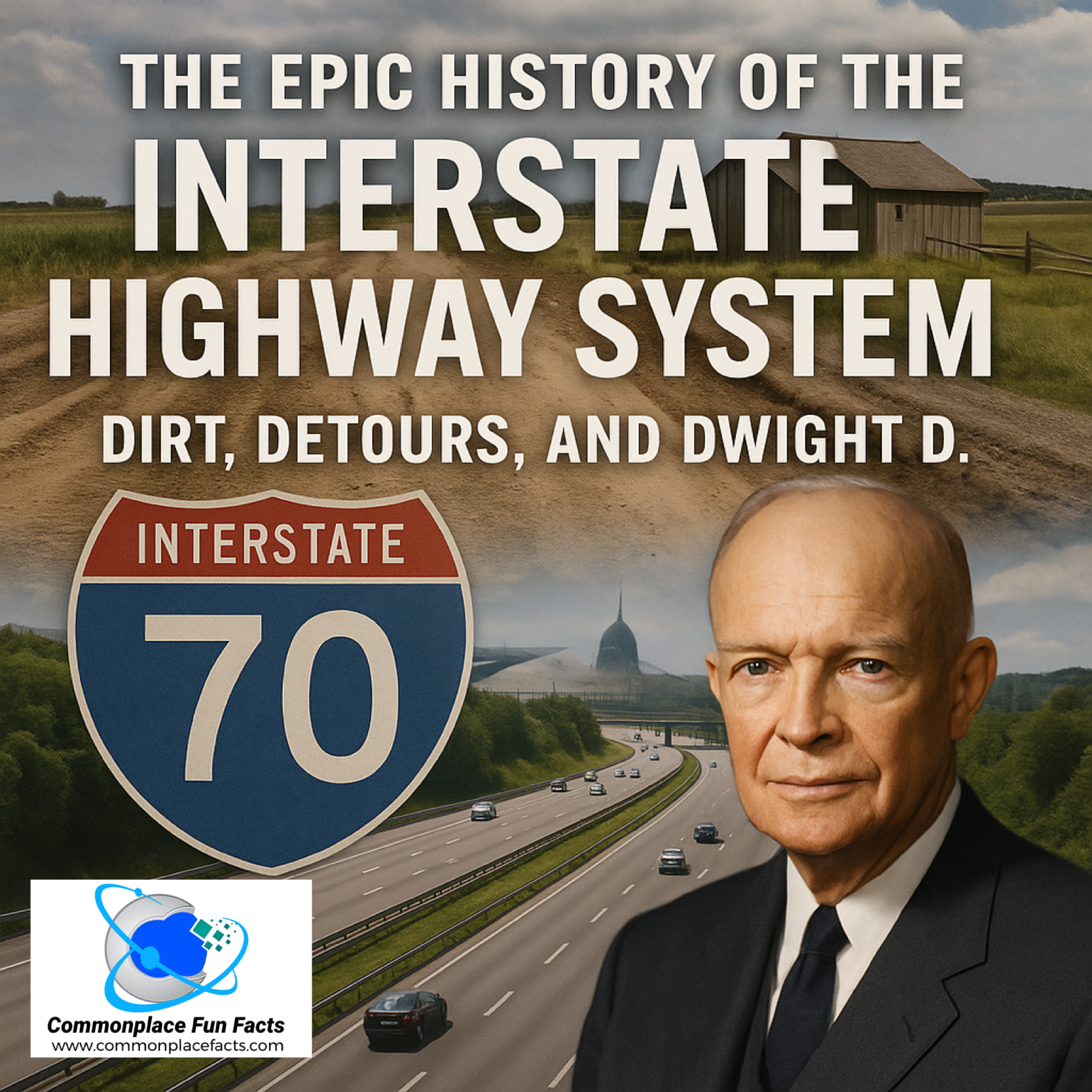

Before the Interstate Highway System: A Nation of Ruts and Regret
Dirt roads. Wooden wagon wheels. Mud holes that could swallow a whole horse and still be hungry for dessert. Welcome to rural America in the early 1900s, where transportation was less “cross-country express” and more “Lewis and Clark fan fiction.”
One young Iowan, however, took a long look at the treacherous terrain and thought, “You know what this nation needs? A whole lot of pavement.” That Iowan was Thomas MacDonald, a kid with dusty boots, callused hands, and a burning ambition to bring roads into the 20th century, even if he had to drag them there himself.
MacDonald grew up watching the consequences of America’s sad excuse for a transportation system firsthand. Working at his father’s grain and lumber store, he saw crops rot in wagons before they ever reached the market and lumber deliveries disappear into the great mud abyss. If you’ve ever lost a UPS package, imagine that—but with a wagon, six oxen, and a cargo of soggy shingles.

Fueled by equal parts frustration and a strange fondness for civil engineering, MacDonald made it his life’s mission to give rural America roads that didn’t double as mudslides. By 1913, he was the newly minted chief engineer of the Iowa State Highway Commission, and soon found himself teaming up with Logan Page and the American Association of State Highway Officials (AASHO)—a group that sounds like it sells high-visibility vests but actually helped push through major policy changes.
Their big win came in 1916 with the passage of the Federal Aid Road Act, a historic moment in transportation history. Congress allocated $75 million (or roughly the budget of one Marvel movie) to get America out of the mud and onto solid ground. It wasn’t nearly enough for the highways MacDonald envisioned, but it was something.
Then, just as the ink dried on the bill, World War I happened, and priorities shifted from roads to trenches. Resources, labor, and even the attention spans of lawmakers were redirected toward the war effort. And just like that, America’s road-building dreams were put on indefinite hold—pothole in progress.
Contents
Ford, Freedoms, and Flat Tires: The Post-WWI Car Boom
War over, economy humming, and Henry Ford churning out cars like they were hotcakes at a church fundraiser. The 1920s rolled in with all the swagger of a Model T, and America had something it never had before: car fever.
In 1913, Ford produced a respectable 202,667 vehicles. By 1919, that number had ballooned to 820,445. Not impressed? Consider that in 1913, the U.S. had 1.2 million registered passenger cars. By the end of WWI, there were nearly 6.7 million. It was like Oprah showed up yelling, “You get a car! And YOU get a car!”
Unfortunately, while Americans were getting the cars, the country was not getting the roads. A full 90% of the nation’s roadways were still dirt. That’s not just “country charm” dirt. That’s “lose-your-suspension-in-a-single-pothole” dirt. Americans now had the freedom of the open road… assuming they could get more than a few miles before their axle cracked like a wishbone.
The stage was set for something to change. Or break. Possibly both.
The 1919 Convoy That Nearly Died Trying
That brings us to the most painful cross-country road trip in American history.
On July 7, 1919, the U.S. Army launched the Transcontinental Motor Transport Corps convoy, a ragtag parade of 81 military vehicles, 260 personnel, and an idea that long-distance motor travel could be viable. Their mission: Drive from Washington, D.C. to San Francisco. Their reality: a 62-day slog through America’s Worst Road Show.
Leading the suffering was then–Lieutenant Colonel Dwight D. Eisenhower, assigned as an observer. He had plenty to observe—like what happens when 25 trucks skid off into muddy Nebraska ditches or when salt marshes in Utah turn vehicles into sunken relics of despair.
By the end of the trip, 9 vehicles had to be retired, 21 soldiers were injured, and there were 230 reported road incidents. To put that into perspective, the convoy’s average speed was a blistering 5.65 miles per hour. That’s slower than most joggers. Heck, a determined tortoise with a Fitbit might have beat them to California. Maybe it isn’t such a strange fact that the first speeding ticket was for driving 8 mph.
The experience wasn’t just miserable—it was revelatory. Eisenhower and his team returned to D.C. with a report that basically screamed, “We need better roads.” It would still take decades, two world wars, and an atomic bomb scare to get the nation moving in the right direction.
From Depression to Dream Maps
“When FDR Took a Pen to the U.S. and Said, ‘Build That.’”
In the 1930s, America was in rough shape—economically, spiritually, and in terms of paved surfaces. The Great Depression had turned much of the country into a living Monopoly board where nobody passed “Go” and everyone went directly to soup lines. But President Franklin D. Roosevelt had a knack for looking at national crises and seeing… an opportunity to doodle.
One day in 1938, FDR took out a map of the United States, grabbed a pen, and casually sketched eight bold lines across it—superhighway corridors, connecting cities like arteries on a concrete circulatory system. Somewhere between “New Deal” and “new doodle,” this map planted the seeds of the future Interstate Highway System.
In 1939, that napkin-level sketch got the grown-up treatment in a landmark document called Toll Roads and Free Roads, written by Herbert S. Fairbank, the right-hand man of our friend Thomas MacDonald (yes, he’s still at it). This report became the de facto blueprint for the highways of tomorrow. The vision? A nationwide network of toll-free, government-funded highways, with enough lane space for America’s booming car culture—and its growing appetite for drive-in everything.
But just as the country was revving up its engines and dreaming of coast-to-coast cruising, World War II crashed the party. Once again, road plans were shelved in favor of tanks, troop transports, and all things Axis-defeating. The good news? WWII wouldn’t just delay America’s highway dreams—it would give them an unexpected new role model.
Autobahns, A-Bombs, and an Ambitious Army Man
“How Germany’s Roads (and Nukes) Paved America’s Future”
As Supreme Commander of Allied Forces in Europe, Dwight D. Eisenhower had plenty on his mind— defeating Hitler being foremost on the list. But one thing stuck with him: Germany’s autobahn network. These roads weren’t just efficient—they were downright superlative, as Ike himself would later call them. Wide, fast, and militarily brilliant, they allowed the rapid transport of troops and supplies with a speed America’s mud roads could only dream of.
Eisenhower made a mental note: If he ever became president (purely hypothetical at the time), he was going to build one of these back home—only bigger, better, and with more roadside diners. And wouldn’t you know it, in 1952, he was elected to that very office.
Now, as commander-in-chief, Eisenhower was ready to finally pave the way forward—literally. But it wasn’t just memories of German engineering that got things moving. In 1953, the Soviet Union detonated a hydrogen bomb, producing a yield of 400 kilotons and a whole lot of existential dread. Suddenly, the U.S. wasn’t just thinking about cross-country road trips—it was thinking about emergency evacuations.
When your enemy has nukes, and 79% of your citizens think the end is nigh, your infrastructure starts to matter a whole lot more. America needed highways—not just to sell more Buicks, but to save civilization if the Cold War turned hot.
Enter the Clay Committee
“$100 Billion, Four Reasons, One Big Idea”
So Eisenhower called in the big guns—specifically, Lieutenant General Lucius Clay, a logistics mastermind who’d made D-Day less disastrous than it could have been. Clay was appointed head of the newly formed President’s Advisory Committee on the National Highway System, which quickly became known as the Clay Committee (because “P.A.C.N.H.S.” is not a thing anyone wants to pronounce).
The committee didn’t just ask for a few roads—they asked for a $100 billion. Their proposal boiled down to four powerful reasons for building a vast system of connected highways:
- Safety – In 1955, around 36,000 people were dying annually on U.S. roads. Better roads, they argued, meant fewer fatalities and fewer cars playing demolition derby on two-lane blacktops.
- Cost of Vehicle Ownership – Bad roads meant more repairs, more breakdowns, and more cursing at mechanics named Lou.
- National Security – In case of nuclear attack (which, again, everyone thought was definitely happening), the system would enable rapid evacuation from urban centers.
- Economic Growth – A nationwide highway network would boost commerce, reduce shipping times, and turn sleepy towns into booming metropolises.
Eisenhower loved it. Congress? Less so. Until he did what presidents do best: he sweetened the deal with taxes. By raising the federal gasoline tax and promising that the federal government would cover 90% of construction costs, Eisenhower finally turned vision into legislation. The Federal-Aid Highway Act of 1956 was signed, the machinery was oiled, and America was officially ready to pave its future.
Who Built It First? A 3-State Brag-Off
“Missouri, Kansas, Pennsylvania… Fight!”
Ah, nothing says American unity quite like a petty turf war over who paved what first. While the federal government was dreaming big and signing bills, a few states were already revving their engines, literally. Enter: Missouri, Kansas, and Pennsylvania—three contenders in what can only be described as the asphalt version of a high school debate club brawl.
Missouri claims the title of “first to start construction” under the 1956 Federal-Aid Highway Act. The state’s highway commission awarded the first official contract to build part of what would become Interstate 44, near the legendary Route 66 in Laclede County. But, in a twist, actual construction started slightly earlier on U.S. Route 40 in St. Charles County. Missouri’s stance? “Look, we had the contract—don’t ruin this for us.”

Kansas, not to be outdone, insists it was the first to finish a section—completing a stretch of Interstate 70 that could actually be driven on. And if you’re thinking “finishing a job sounds more impressive than starting one,” well, Kansas agrees with you.
Then there’s Pennsylvania, who stepped into the ring wearing an old-school leather helmet, proudly proclaiming, “We were paving highways before it was cool.” The Pennsylvania Turnpike, opened in 1940, ran for 162 glorious miles between Irwin and Carlisle and is now part of both I-70 and I-76. They called it “The World’s Greatest Highway.” A bit of a stretch? Maybe. But hey, they were early.
In the end, the bragging rights don’t really matter. Whether you paved the first mile, the first hundred, or the first drivable loop around Scranton, the real victory was in finally having a coordinated national system. Still, don’t bring this up at a Missouri-Kansas-Pennsylvania cookout unless you’re ready for some very pointed potato salad-based arguments.
Honoring Ike: The Name Behind the Network
If you’ve ever driven past one of those official-looking signs declaring your presence on the “Dwight D. Eisenhower National System of Interstate and Defense Highways” and thought, “Wow, that’s a name that could use a rest stop halfway through,” you’re not alone. But there’s a reason for every syllable.

The Interstate Highway System is named for the man who arguably made it possible: President Dwight D. Eisenhower. Sure, he didn’t personally pour the concrete or paint the lane lines, but without his relentless push—and, you know, his traumatic road trip across America in 1919—this network of nearly 47,000 miles might still be a patchwork of state squabbles and gravel dreams.
In 1990, as the system neared the tail end of its multi-decade construction marathon, Congress passed legislation to officially name the entire network in Eisenhower’s honor. It was a bipartisan gesture of gratitude that managed to get through Congress without a single detour—a feat almost as impressive as building I-70 through the Rockies.
And honestly, it’s fitting. This was a president who saw firsthand the abysmal state of U.S. roads, twice: once as a lieutenant colonel bouncing through potholes in 1919, and later as Supreme Commander marveling at the German autobahn during WWII. When he got the keys to the Oval Office, he didn’t just fix the roads—he revolutionized them.
So next time you see that mile marker or pass an “Interstate Shield” sign, take a moment to thank Ike. Or at least don’t curse too loudly when you hit construction traffic. After all, it’s the Dwight D. Eisenhower system. If anyone earned the right to slow you down just a bit, it’s him.
Decades of Detours and Dollars
“Budget? What Budget?”
When Eisenhower signed the Federal-Aid Highway Act in 1956, the plan was straightforward: 12 years, $25 billion, and 41,000 miles of beautiful, federally funded freedom. It was bold. It was ambitious. It was… adorably optimistic.
By the time the dust settled (in the early 1990s), the project had ballooned to $114 billion—the equivalent of about $618 billion today—and took a grand total of 39 years to “complete.” We’ll get to those quotation marks in a bit.
One of the main culprits behind the ever-ballooning budget? Mountains. Turns out, building highways through America’s majestic terrain is expensive when nature refuses to cooperate. Case in point: Interstate 70, which decided to go full diva and demand a string of engineering miracles:
- Glenwood Canyon – A stunning 12.5-mile stretch of road carved through dramatic cliffs and gorges. Also one of the most expensive rural highways ever built—because engineers had to work around nature, not through it.
- San Rafael Swell – A gnarly tangle of eroded rock formations and deep canyons in Utah that engineers somehow navigated without a single “Are we sure this is worth it?” on record.
- Eisenhower Tunnel – The highest point on the entire Interstate system at a breath-sucking 11,158 feet. Located in the Rocky Mountains, this vehicular wormhole connects Summit County to Clear Creek County in Colorado. If the altitude doesn’t make you gasp, the construction costs will.
In short, the budget went boom, but the payoff? A marvel of civil engineering. And an excuse to write this article. Win-win.
Highway Stats to Impress Your Inner Nerd
“It’s a Long Road, Baby—Literally”
Let’s talk numbers—because nothing gets the adrenaline pumping like stats about infrastructure.

The Interstate Highway System spans a grand total of 46,876 miles. To compare, the German autobahn—the very system that inspired Eisenhower—is just over 8,000 miles. That’s not a highway; that’s a casual warm-up lap.
Need more bragging rights? Consider:
- Longest east-west Interstate: I-90, stretching over 3,000 miles from Boston, Massachusetts to Seattle, Washington. Basically, if you’ve got snacks and a podcast playlist that runs for four days, you’re good.
- Longest north-south Interstate: I-95, covering 1,908 miles from the Canadian border in Maine to Miami, Florida. It also holds the record for the most states served—15, plus D.C.
And now for some bonus trivia to drop at your next awkward dinner party:
- Texas has the most Interstate mileage: 3,233 miles across 17 different routes. Because everything is bigger there, even the exits.
- New York wins for most total routes: 32 separate Interstates crisscross the Empire State.
- Illinois holds the title for most primary Interstates: 13 major highways and 11 auxiliary routes, covering over 2,200 miles. Basically, if you’re lost in Illinois, it’s by choice.
We know what you’re thinking—“Is this the most exciting transportation-related trivia I’ve ever read?” Yes. Yes, it is.
The Standardized Secret Sauce
“Consistency: America’s Most Unexpected Superpower”
For a country famous for its love of individuality—mismatched state laws, quirky accents, and the occasional drive-thru wedding—America pulled off a minor miracle with the Interstate Highway System: everything feels the same. And that, friends, is the real magic.
From Florida to Oregon, from Maine to California, the Interstate is a marvel of engineering uniformity, thanks to a little gem called A Policy on Design Standards—Interstate System. This eight-page document (yes, just eight!) laid out the rules that made American road travel feel delightfully predictable.
- Controlled access only: No wandering tractors or rogue mailboxes. If you’re on an Interstate, you’re entering and exiting through proper interchanges like a civilized commuter.
- Medians or barriers: Because surprise head-on collisions aren’t part of the American dream.
- Minimum lanes: Two in each direction to avoid traffic tantrums.
- Clear signage: The iconic red, white, and blue shield is as comforting as a bowl of roadside chili.
- Design speeds: At least 50 mph in cities and 70 mph in rural areas—unless you’re in Texas, where the signs just say “Drive like you mean it.”
This standardized setup meant that you could travel thousands of miles and still recognize exactly where you are by looking at the exit signs, ramp curves, and medians. In a chaotic country, the Interstate became a calm, asphalt-scented constant.
Economic Engine of America
“From Roadside Motels to Megacities”
America’s economy didn’t just ride the Interstate. It merged onto it at high speed with zero blinker.
The IHS practically created a new economic ecosystem. Suddenly, every cloverleaf interchange was an opportunity. Hotels, motels, diners, gas stations, and drive-thrus popped up like mushrooms after a rainy day in Tulsa. Travelers needed places to sleep, eat, fuel up, and ask strangers for directions before GPS made us antisocial.
Major cities like Phoenix transformed from desert outposts into sprawling metropolises. In 1940, Phoenix had about 65,000 residents. By the 1970s, it was pushing 874,000—and the Interstates were the express lane to urban explosion.
Retailers and manufacturers capitalized, optimizing supply chains, distribution routes, and delivery times. Suddenly, a warehouse in Peoria could efficiently serve customers in Portland. The phrase “just in time” became a shipping strategy rather than a sarcastic remark about your in-laws arriving for dinner.
Military Might and Emergency Measures
“Exit Here for a Tactical Airfield”
Remember that whole Cold War panic thing? The Interstate was designed to handle that, too. Some stretches were built to double as emergency landing strips for military aircraft. Because when you’re bracing for nuclear fallout, you might as well make your highways dual-purpose.

Many Army bases were built near Interstates, ensuring rapid deployment and logistical support in a crisis. The 1st Infantry Division near I-70 in Kansas. The 3rd Infantry Division near I-95 in Georgia. It wasn’t just a highway system—it was a strategic defense grid wearing a friendly speed limit sign.
Still Not Technically Finished
“Mind the Gap (We’re Looking at You, I-70)”
Despite its 1992 “completion,” the IHS has a few asterisks. Most famously: Interstate 70, which contains the most notorious break in the entire system at Breezewood, Pennsylvania. Thanks to local business interests and political resistance, the highway awkwardly merges into city streets like a teenager learning to parallel park.
While most of the system works as intended, I-70 remains a rare glitch in the Matrix—a reminder that even with 46,000 miles of pavement, America will always make room for weird exceptions.
The Interstate Highway System is under the oversight of the Federal Highway Administration, a division of the Department of Transportation. It had a budget of $62.8 billion in 2025.
Why the IHS Is America’s Greatest Unsung Hero
“It’s Not Just a Road. It’s the Road.”
The IHS makes up less than 1% of America’s total road network, yet it carries over a quarter of all vehicle miles driven every year. It’s the aorta of American mobility, the infrastructure equivalent of an overachiever with no need for attention.
And while it’s often taken for granted, it has saved countless lives. In 1956, the fatality rate was 6.05 deaths per 100 million vehicle miles. By 2023, that figure had plummeted to just 1.26. That’s not just progress—that’s pavement-based heroism.
It shaped where we live, how we work, and what we eat (It’s mostly fast food at Exit 243). It connected small towns to major markets, allowed coast-to-coast travel in days instead of months, and quite literally built modern America from the ground up.
The Genius Beneath Your Tires
From a grueling 62-day convoy in 1919 to a sleek, synchronized system of 46,876 miles, the story of the Interstate Highway System is one of vision, determination, and a whole lot of concrete. It’s an unsung hero in our daily lives—quietly working, rarely praised, and only noticed when it’s under construction (so… always).
So next time you’re sitting in traffic on I-95, wondering if your exit actually exists or if it’s just a mirage of brake lights and desperation, remember this: you’re sitting on the most successful infrastructure project in American history. Congrats!
You may also enjoy…

The Worst Traffic Jam Lasted 12 Days
No one likes to be tied up in traffic. It doesn’t matter whether the slowdown is caused by construction, a patch of ice, or an accident; when sitting in tangled traffic, every lost minute feels like an hour. Although we can’t do anything to save you from future traffic jams, we might be able to…

No Speeding Under the Radar for the Inventor of Radar
If Robert Watson-Watt’s name doesn’t immediately ring a bell with you, you aren’t alone. It didn’t mean anything to the Canadian police officer who was running radar one day in 1956 and pulled Robert Watson-Watt over for speeding. If he had been a little sharper with his history, he might have thought twice about issuing…

Take a Journey on the Road that Disappears Twice a Day
If you want to drive from Beauvoir-sur-Mer to Barbâtre on the western coast of France, you have a couple of options. You can go southwest on Route D22 to La Barre-de-Monts and catch Route D38, taking it north to your destination for a total distance of 18 km (11 mi). The alternative is to take…





Leave a Reply to Herald StaffCancel reply