
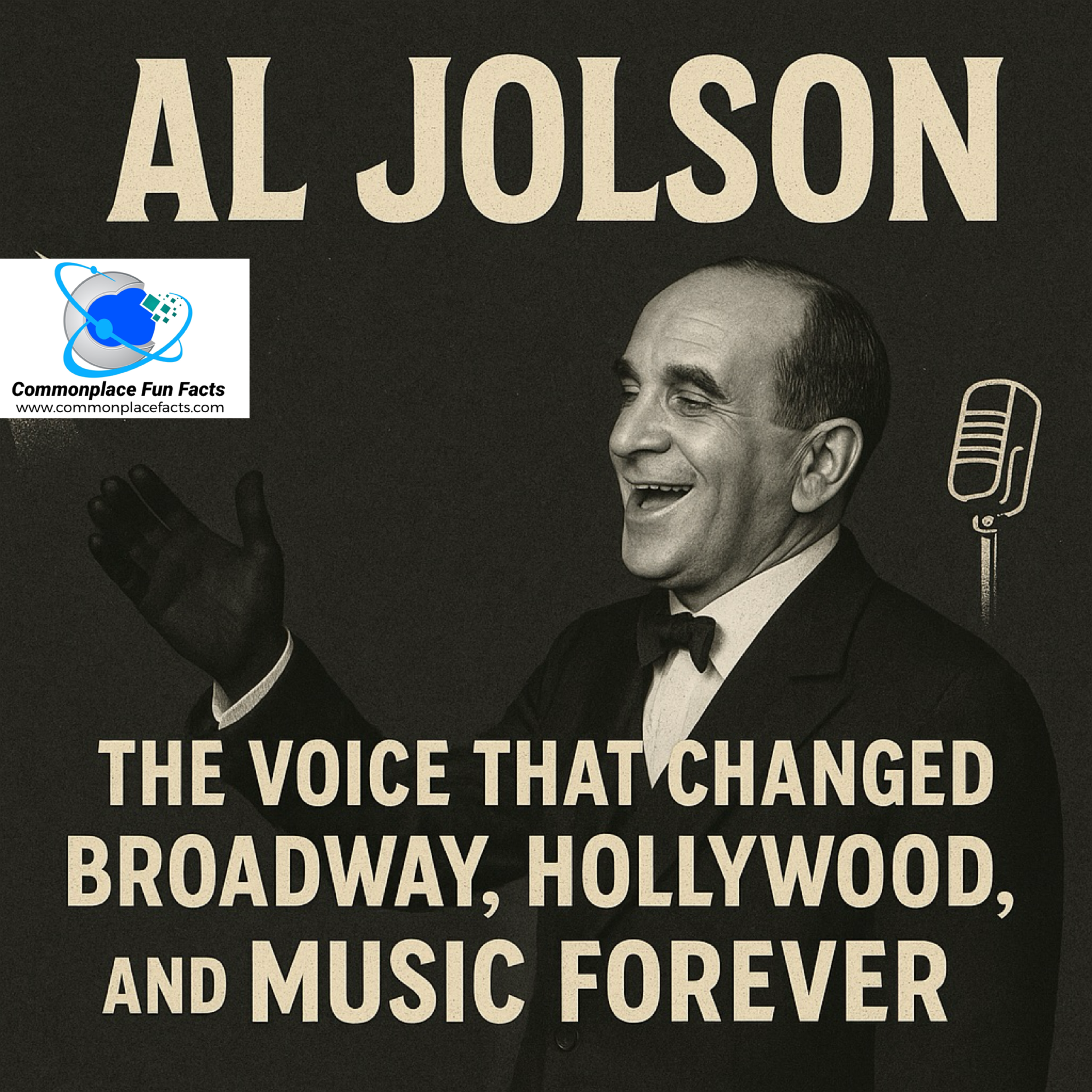

In an era before TikTok, YouTube, or even television, there was still such a thing as “going viral.” Only instead of a cat video or a dancing teenager, the unstoppable cultural phenomenon of the early 20th century came in the form of one man: Al Jolson. He called himself “The World’s Greatest Entertainer,” and for once in showbiz history, it wasn’t just an overinflated marketing tagline. This was a man who could stop a Broadway show mid-number, walk into the audience, serenade a random patron, and still have the crowd begging for an encore.
It is almost impossible to overstate the talent and success of Al Jolson. His career was a masterclass in spectacle. He wasn’t just a performer; he was an event. From his thunderous voice to his unapologetically grand gestures, he defined entertainment in a way few ever have—and he did it across vaudeville, Broadway, radio, movies, and even wartime stages thousands of miles from home. And yes, he also left behind one of the most complicated legacies in entertainment history, but let’s start with the sheer, unstoppable force of showbiz nature that was Al Jolson.
Contents
From Lithuania to Limelight
Al Jolson didn’t even start out as “Al Jolson.” He began life in 1886 (or maybe 1885—he wasn’t picky about details) in what is now Lithuania as Asa Yoelson, the son of a cantor. His family emigrated to the United States in 1894, landing in Washington, D.C., where little Asa quickly learned two things: English and how to make a crowd pay attention.
The vaudeville bug bit him early. As a kid, he’d skip school to watch street performers, memorizing their patter and mimicry. His first stage appearance? Completely accidental. A local minstrel troupe’s scheduled performer didn’t show up, so young Asa hopped on stage to fill the gap. The crowd roared. The applause was intoxicating. And from that moment, there was no turning back.
Vaudeville, Minstrel Shows, and the Birth of “Al Jolson”
Teaming up with his brother Harry, Asa became “Al Jolson,” a stage name that rolled off the tongue better than “Yoelson” and fit neatly on theater marquees. The brothers built their act in vaudeville, where audiences craved big energy, bigger voices, and performers who could make them forget about rent for 20 minutes.
Blackface was part of Jolson’s performance style—a common theatrical tradition of the era. Today it’s recognized for its racist roots and hurtful stereotypes, but at the time, it was entrenched in American entertainment. What made Jolson’s use unusual was that he also championed African American performers and music, bringing jazz, blues, and spirituals to mainstream white audiences. He even insisted on integrated casts and audiences in certain shows, a bold move in the segregated early 20th century.
Broadway Royalty
In 1911, Jolson starred in La Belle Paree, a show that should have been a modest success but turned into a sensation thanks to one number: Jolson’s. Soon he was the toast of Broadway, headlining smash hits like Sinbad (1918) and Bombo (1921).
Jolson’s trademark was breaking the fourth wall. He’d stop the orchestra mid-song, chat with the audience, and then restart. Sometimes he’d leave the stage altogether and stroll down the aisles, belting out a tune face-to-face with the audience. Who needed microphones when you had a voice that could rattle the balcony?
He also had a flair for the dramatic. If a song wasn’t getting the reaction he wanted, he’d repeat it—again and again—until the crowd was whipped into a frenzy. Once, in Sinbad, he repeated “Rock-a-Bye Your Baby with a Dixie Melody” so many times the show ended late, and nobody complained.
The Voice That Launched a Thousand Microphones
Al Jolson didn’t just sing—he sold songs like his life depended on it. His delivery was emotional, almost conversational, with crescendos that could knock the hat off a man in the back row. His signature numbers included “Swanee,” “April Showers,” and “My Mammy,” the last of which became so associated with him that the phrase “I’d walk a million miles for one of your smiles” became part of his public persona.
Fun fact: George Gershwin had written “Swanee” and couldn’t get it to take off—until Jolson sang it. Suddenly, it was everywhere. If TikTok had existed in 1920, “Swanee” would have been trending for weeks.
Hollywood, Talkies, and The Jazz Singer
It’s hard for us, living in an age where movies can be streamed to your phone in surround sound while you’re waiting for your coffee, to imagine a time when “talking pictures” were considered a passing fad. In the mid-1920s, the prevailing wisdom in Hollywood was that synchronized sound was a cute novelty at best, a technological dead end at worst. Studio executives worried it would ruin the art of cinema, alienate audiences used to the grace of silent films, and—most terrifying of all—force them to invest in expensive sound equipment. The consensus: nothing would ever come of it.
And then came Jolson.
In 1927, Warner Bros. took a gamble, casting Al Jolson in The Jazz Singer, a story about a young man torn between his family’s traditions and his love of popular music. The film was mostly silent, with title cards for dialogue—except for a handful of sequences where Jolson sang and, crucially, spoke directly to the audience. When he ad-libbed the now-legendary line, “Wait a minute, wait a minute. You ain’t heard nothin’ yet!” he wasn’t just tossing off a catchy phrase; he was announcing the birth of a new era.
Audiences were stunned. This wasn’t a distant figure on a screen anymore—it was a living, breathing voice, full of personality and warmth, talking to them. The impact was electric. Crowds gasped, cheered, and lined up around the block for repeat showings. The industry that had been politely dismissing sound as a gimmick suddenly found itself scrambling to wire theaters, retrain actors, and reimagine filmmaking from the ground up.
The Jazz Singer didn’t just make Jolson a movie star—it changed the DNA of cinema. Overnight, silent films began to fade into history, and the “talkie” became not just the best future but the only future. And at the center of that seismic shift was a man with a voice powerful enough to shatter decades of conventional wisdom in a single, ad-libbed sentence.
The Voice That Hollywood Couldn’t Ignore
Once Hollywood realized the public’s appetite for sound was insatiable, they couldn’t get enough of Jolson. He wasn’t just a singer; he was a living advertisement for what talkies could do. His follow-up films, including The Singing Fool (1928) and Sonny Boy (1929), were box-office juggernauts, each packed with tear-jerking ballads and exuberant showstoppers that played even better with the intimacy of sound.
Learn about the surprising origin of Hollywood and how it was intended to be a spiritual haven
Jolson brought something no silent actor could: the full arsenal of his Broadway charisma—booming vocals, timing honed on vaudeville stages, and an instinct for playing directly to the crowd. Even on film, he still somehow made it feel personal, as if you were sitting in the front row and he was singing just for you.
By the end of the 1920s, Jolson wasn’t just a movie star; he was the proof that sound had revolutionized Hollywood. The studios had doubted. The critics had scoffed. But after Jolson, they were all singing a different tune—sometimes literally.
Record Sales, Radio Stardom, and Comebacks
Jolson conquered radio in the 1930s with The Kraft Music Hall, delivering music, comedy, and banter in his trademark style. He sold millions of records at a time when “going platinum” meant something very different—and much harder—than it does today.

Jolson gained a following with a new generation after the 1946 biopic The Jolson Story. Starring Larry Parks lip-syncing to Jolson’s own recordings, the movie reignited interest in his music and made him a star all over again.
During World War II and the Korean War, he performed for troops overseas, sometimes in dangerous conditions. In 1950, after returning from Korea, he told reporters, “I’m going to die on stage someday.” He wasn’t far off—he passed away that same year from a heart attack, shortly after his last tour.
At his funeral, more than 20,000 people lined the streets of Los Angeles to say goodbye.
Jolson the Personality
Al Jolson was a walking paradox: equal parts generous and egotistical. He’d perform for free at hospitals, especially for veterans, and was known for his private donations to struggling artists. Yet he also once said, only half-jokingly, “You ain’t heard nothin’ yet” applied to every other entertainer compared to him.
He hated rehearsals, loved spontaneity, and believed every performance should feel like it might spin out of control at any moment. This unpredictability kept audiences hooked—and drove producers slightly insane.
Final Bow
Al Jolson lived—and performed—like every show might be his last. He sang with the kind of full-throttle commitment that made audiences feel like they were part of something once-in-a-lifetime. Whether you remember him as the star of The Jazz Singer, the Broadway powerhouse, the tireless USO performer, or the man who could make you cry in three verses flat, there’s no denying it: in the early 20th century, no one had heard anything like him.
And in some ways, we still haven’t.
You may also enjoy…

“It Ain’t What They Call You…” – W.C. Fields Drops a Sassy Truth Bomb
Discover the wit and wisdom of W.C. Fields with his iconic quote: “It ain’t what they call you, it’s what you answer to.” A timeless lesson in self-worth and selective hearing.

Mae West Went to Jail in Silk Underwear—and Came Out a Star
Discover how Mae West turned scandal into stardom—writing risqué plays, defying censors, and becoming the highest-paid woman in Hollywood. From jail time to radio bans, her legacy is anything but quiet.

How Jack Benny Nearly Became One of the Marx Brothers – A Forgotten Comedy Connection
Did you know Jack Benny nearly joined the Marx Brothers? Discover the untold story of how paused ambitions and parental intervention shaped a comedy legend.




Leave a Reply