
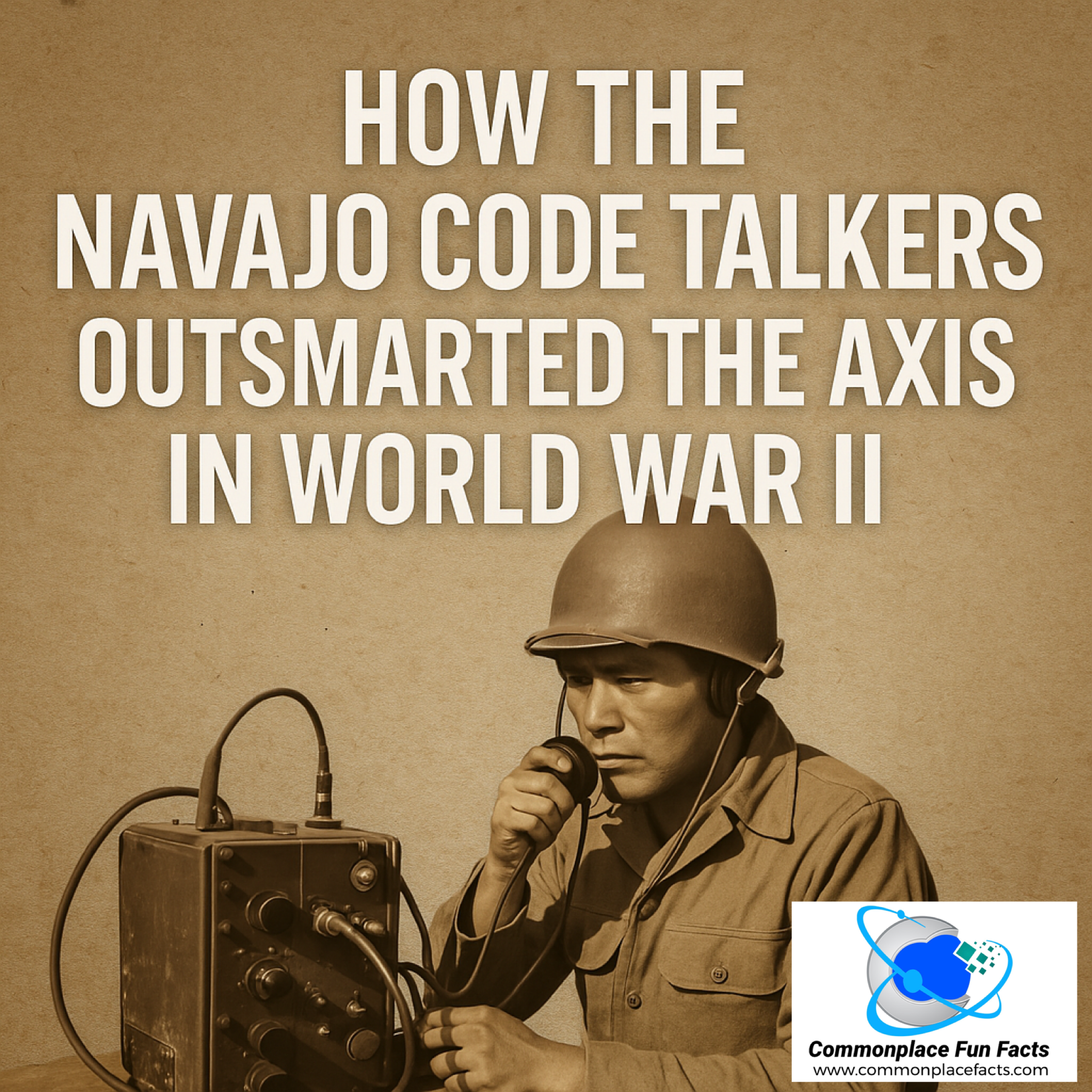

World War II was, among other things, the golden age of codemaking and codebreaking. In Europe, the Germans had their whirring, clacking Enigma machine. The Allies had Alan Turing and his codebreaking team at Bletchley Park, armed with coffee, mathematics, and probably the occasional nervous breakdown. This high-stakes chess match between cipher and decipher is fairly well known. But while machines battled machines in Europe, halfway around the globe the U.S. military had another trick up its sleeve. Forget fancy gadgets — their most unbreakable code came not from technology but from people: the Navajo Code Talkers.
Contents
Why Codes Matter (and Why Getting Them Wrong Is a Bad Idea)
In wartime, secure communication isn’t just nice to have — it’s the difference between winning a battle and walking straight into an ambush. If your enemy cracks your code, you may as well hand them your battle plans engraved on silver platters with a polite note that says, “Please defeat us at your leisure.” The Germans had Enigma, which was eventually cracked, and the Americans needed something faster, safer, and less prone to interception. Enter: the Navajo language.
Before Navajo: Choctaw, Comanche, and the “Oops, They Figured It Out” Problem
The idea of using Native American languages in warfare wasn’t brand-new. In World War I, the U.S. military had already used Choctaw speakers to transmit tactical messages. The Germans and Japanese took notes (literally) and, between the wars, started sending students to the U.S. to study Native American languages like Cherokee, Choctaw, and Comanche. They were doing their homework. Unfortunately for them, the Navajo language remained stubbornly outside their grasp. And that turned out to be very, very lucky for the Allies.
Why Navajo? Because Good Luck Learning It
Philip Johnston, the son of missionaries who grew up on a Navajo reservation, suggested using Navajo as the foundation of a military code. He had a point: this wasn’t your average “learn-it-in-Duolingo-over-a-weekend” language. Navajo is beautifully complex. A verb changes not only with its subject but with the type of object involved: long objects, granular objects, flexible objects, bundled objects. If that sounds confusing, imagine trying to conjugate “to kick” differently depending on whether you kicked a football, a pile of sand, or a snake. Oh, and the verbs also include adverbs, and can reflect whether you personally witnessed an event or just heard about it. A single Navajo verb could pack in the information of an entire English sentence. It was probably the most complicated language in the world before Ithkuil was invented and took things to a whole new level of complication.
The First 29: Building an Unbreakable Code
In May 1942, the first 29 Navajo recruits reported for duty at Camp Elliott near San Diego. Their assignment? Create a usable military code out of Navajo. The system they devised combined direct translations with clever substitutions. For example, a “turtle” meant a tank, a “chicken hawk” was a dive-bomber, and battleships were called “whales.” Over time, the vocabulary expanded to cover hundreds of military terms. By the end of the war, 420 Navajo Code Talkers had been trained and deployed with the Marines in the Pacific.
War in the Pacific: Voices on the Front Lines
When the U.S. Marines stormed across the Pacific — from Guadalcanal to Okinawa — the Navajo Code Talkers were right there with them. Their mission was deceptively simple: send and receive messages faster and more securely than anyone else. In practice, this meant hunkering down in foxholes, crouching behind sandbags, or squeezing into command posts, radios crackling while artillery shells whistled overhead. In those moments, the Code Talkers weren’t just linguists; they were lifelines.
During the invasion of Iwo Jima in February 1945, six Code Talkers worked around the clock for nearly two days. They sent over 800 messages without a single error. Think about that — 800. All flawless. Considering that ordinary coded messages could take hours to compose, transmit, and decode, the Navajo system was a revelation. One Marine commander later remarked that without the Code Talkers, “the Marines would never have taken Iwo Jima.”
Their presence wasn’t limited to Iwo Jima. Navajo Code Talkers were used in every major Marine assault in the Pacific, including Guadalcanal, Bougainville, Tarawa, Saipan, Peleliu, Guam, Leyte Gulf, and Okinawa. Wherever Marines went, the Code Talkers went too — sometimes arriving with the first wave of landings, armed with nothing more than a bulky radio, their voices, and nerves of steel. Their code could transmit coordinates for artillery strikes, relay casualty reports, or call for reinforcements — all in real time and all impossible for the Japanese to decipher.
The contrast between old-school methods and the Navajo system was staggering. Without the Code Talkers, it could take hours to encrypt and transmit a single order. With them, a message that might decide the fate of an entire battalion could be transmitted, received, and decoded in minutes. In the chaos of battle, that speed was as valuable as any weapon. It turned the tide of engagements, saved lives, and made the Marines more effective than ever.
And through it all, the Japanese — some of the most determined and resourceful codebreakers of the war — never made a dent in Navajo. Lieutenant General Seizo Arisue, Japan’s intelligence chief, admitted after the war that although his team cracked several U.S. military codes, Navajo left them completely stumped. That, more than anything, speaks to the genius of pairing an ancient language with the urgency of modern warfare.
Top Secret… Until 1968
Despite their vital contributions, the Navajo Code Talkers went unrecognized for decades. Their work remained classified until 1968. It wasn’t until 1969 that the Code Talkers held their first reunion. Gradually, their story entered the spotlight. In 2001, surviving Code Talkers were awarded the Congressional Gold Medal, a recognition that was long overdue. Their code remains one of the very few in history that was never broken.
The Legacy of Voices That Won a War
The story of the Navajo Code Talkers is more than just military trivia. It’s a reminder of how human ingenuity — and in this case, an ancient language passed down for generations — can turn the tide of modern warfare. It also shines a light on Native Americans’ immense contributions to U.S. history, too often overlooked or underappreciated. Machines like Enigma may get the headlines, but in the end, the Allies’ most secure code wasn’t punched into a machine. It was spoken, over static-filled radios, by men whose voices became weapons of victory.
As military historians like to say: the Navajo Code Talkers didn’t just speak a language. They spoke victory.
You may also enjoy…

Kryptos: the Secret Code that Still Stumps the CIA
Can You Crack Kryptos? It should not be surprising that CIA Headquarters is home to some of the world’s biggest secrets. What may raise your eyebrows is the fact that one of its biggest secrets is on public display. At an agency that employs the best codebreakers in the world is an encrypted message written…


Endangered Languages and the Frantic Race To Learn From Their Last Speakers
Thousands of languages have vanished, and many more are on the brink of extinction. Discover the world’s endangered languages and their last speakers before they disappear forever.


Leave a Reply