
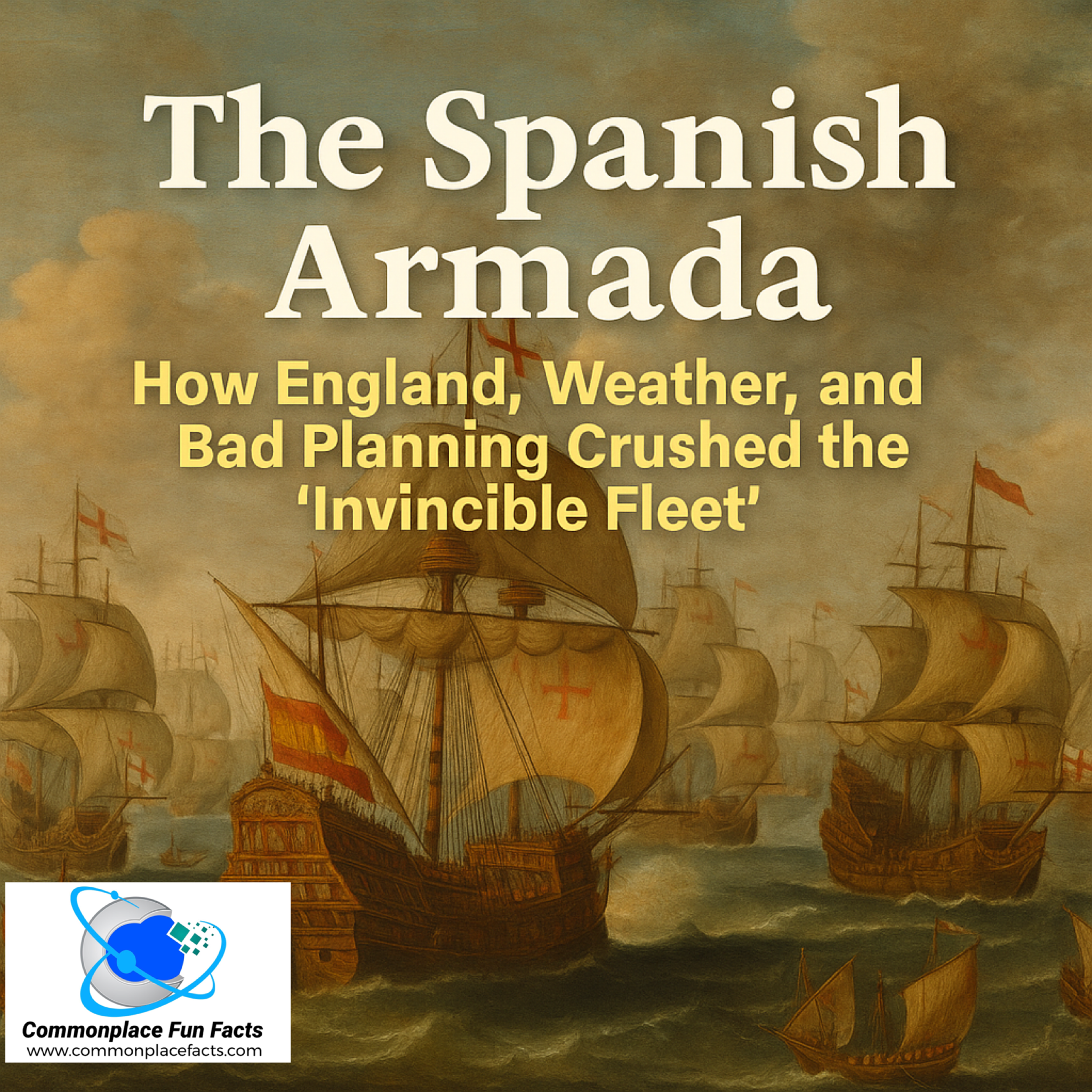

In 1588, England faced what looked like certain doom. Philip II of Spain, armed with the world’s biggest empire, deepest pockets, and a religious grudge the size of Gibraltar, sent the Spanish Armada —- a fleet of about 130 ships to squash Elizabeth I’s Protestant experiment once and for all. On paper, it was the military equivalent of bringing a flamethrower to a candlelight vigil. England had fewer ships, fewer men, and, depending on your view of Elizabeth’s wardrobe choices, maybe less intimidating leadership.
And yet, the story didn’t play out the way Spain imagined. Instead of the Armada rolling triumphantly into the English Channel like an unstoppable juggernaut, it became the punchline of one of history’s greatest naval fiascos. Fireships, nimble English vessels, and some truly catastrophic Spanish logistics turned the “Invincible Fleet” into a case study in why overconfidence and poor planning make such a charming couple.
Sail with us as we separate fact from fiction and explore the legend of the Spanish Armada. The story is colorful, full of daring English tactics, papal crowdfunding that didn’t quite pan out, and a Spanish empire that discovered the hard way that branding your fleet “Invincible” is just asking for trouble.
Contents
The Invincible Fleet (That Wasn’t)
On July 21, 1588 (by the newfangled Gregorian calendar), the Armada finally set sail from Lisbon. And when we say “set sail,” we mean it took two whole days for the entire thing to actually clear the harbor—because moving 141 ships isn’t like pulling out of the driveway. This floating armada of ambition carried about 10,000 sailors, nearly 20,000 soldiers, and a supporting cast of 1,500 non-combatants—volunteers, friars, servants, and the sort of people who would’ve been called “essential staff” if HR had existed in the 16th century. Add to that 1,500 brass cannons and 1,000 iron ones, and you’ve got yourself less of a fleet and more of a floating fortress parade.
After consultation with their PR team, the Spanish named their fleet La Armada Invencible—the Invincible Fleet. Pro tip: never give your military campaign a name that begs the universe to prove you wrong.
The Master Plan: Conquest by Rube Goldberg
The grand scheme was simple—on paper. The Armada would sail up the Channel, link up with the Duke of Parma’s army in the Spanish Netherlands, ferry them across the water, and march on London. Easy, right? One small hitch: Parma’s army was blockaded by Dutch rebels, and no one explained how he was supposed to stroll past them with 30,000 men. It was basically a military blind date where the Armada showed up, but the other party couldn’t leave the house.
Enter Elizabeth’s Rock Stars: Drake, Howard, and Hawkins
England’s response team included Sir Francis Drake, Charles Howard, and John Hawkins—men who made naval combat look like a pub brawl with cannons. The most famous anecdote? When the Armada was sighted, Drake supposedly insisted on finishing his game of lawn bowling in Plymouth before heading out to fight. True or not, it cemented his reputation as the chillest admiral in history.
England’s ships were faster and more maneuverable, built for long-range gunnery. Spain’s, meanwhile, were heavy and designed for boarding actions—fantastic for close combat, less useful when the enemy kept zipping around shouting “catch me if you can.”
The Channel Battles: Tag, You’re It

As the Armada made its way up the Channel, the English harassed them with long-range cannon fire. The Spanish formation, a neat crescent, looked great on parade but less so when English firepower and bad luck started poking holes in it. The real game-changer came at Calais, where the English sent in fireships—basically floating Molotov cocktails. The Armada scattered in panic, breaking formation and never really recovering.
And no, it wasn’t just “one Spanish ship” that went down. The English inflicted damage across the board, though the Armada’s sheer size and stubbornness kept it afloat longer than you might expect. Even so, it soon became clear that naming the Armada “The Invincible Fleet” was more than a little optimistic.
Running Out of Ammo (and Patience)
By the time the Spanish Armada turned north, the English were running low on ammunition. Elizabethan supply chains weren’t exactly speedy, and this wasn’t the kind of problem Amazon Prime could solve. The English shadowed the Armada, keeping the pressure on, but they were just about as tired as their enemy. The Armada’s retreat wasn’t a triumph of Spanish tactical genius—it was a desperate “let’s get out of here before things get worse.”
“God Blew, and They Were Scattered”
Then came the weather. Forced to sail home around Scotland and Ireland, the Armada encountered a series of brutal storms. Not one big hurricane, as the story often gets told, but wave after wave of nasty gales. Dozens of ships were wrecked on rocky coasts. By the end, only 65 ships—about half the original fleet—limped back to Spain.
The English celebrated with a commemorative medal reading, Flavit et dissipati sunt—“He blew with His winds, and they were scattered.” Which is true… if you leave out the part where English naval tactics, fireships, and Spanish logistical incompetence did most of the heavy lifting before the storms ever showed up.
The Human Cost: Disease, Wrecks, and Bad Hospitality
Naval combat and storms weren’t the only killers. Disease—especially dysentery and typhus—ravaged the Armada’s sailors. More men died of illness than of cannon fire. To make things worse, shipwrecked survivors who washed up on Irish shores often faced imprisonment or execution. The Irish are famous for their hospitality — unless, of course, you happened to be trying to attack their country. In which case, watch out for their particular brand of Celtic charm.
Meanwhile in England: Tilbury Speech Mic Drop
Back in England, Elizabeth I was having her moment. At Tilbury, she rode among her troops and delivered one of the most quotable speeches in history: “I know I have the body of a weak, feeble woman; but I have the heart and stomach of a king, and of a king of England too.” Translation: “Don’t let the corset fool you—I can take on Spain.” If social media had existed, her quote would have gone viral.
Of course, she did end up dying after being poisoned by her own makeup, so it’s possible she had misplaced priorities. You can decide for yourself by reading the details in this article.
Bonus Trivia Nuggets
- Pope Sixtus V promised Philip II money if the Armada succeeded. Spoiler: it didn’t, so no payout. Heavenly crowdfunding denied.
- A handful of battered Armada ships survived and served for decades afterward. Imagine serving on a vessel remembered as “the ship that lost spectacularly.”
- Despite the defeat, Spain didn’t collapse. It remained a superpower for decades. England just got a boost of confidence—and some really good propaganda material.
Conclusion: The Day Fortune Favored the Unprepared
When the smoke cleared (and the seas calmed), the “Invincible Armada” wasn’t looking so invincible anymore. Half the fleet lay wrecked at the bottom of the ocean or splintered along Irish and Scottish coastlines, thousands of sailors were dead, and Philip II was left with the unenviable job of explaining to God, the Pope, and his accountants why the most expensive naval expedition in history ended in a soggy fiasco. Meanwhile, Elizabeth I basked in a glow of propaganda so bright it still shines in history books today—riding the PR wave from Tilbury all the way into legend.
The Armada was vanquished, and as is the case in most military disasters, it wasn’t just one thing that caused its defeat. It was a perfect storm of English naval innovation, Spanish overconfidence, disease, logistical nightmares, and, yes, some well-timed gale-force winds. History loves a simple explanation, but the truth is always messier and usually involves a lot more dysentery.
If there are any lessons to take away, it’s these: never call your fleet “Invincible,” never assume your supply chains will magically work, and never never count on sunny weather around England. Oh… and it’s probably not a good idea to interrupt Francis Drake’s bowling game.
You may also enjoy…

The Yellow Fleet: The Micronation That Floated (and Waited) for Eight Years in the Suez Canal
Discover the true story of the Yellow Fleet—15 cargo ships trapped in the Suez Canal for 8 years after the Six-Day War. From lifeboat Olympics to DIY postage, it’s the most bizarre maritime traffic jam in history.

Remembering the Wilhelm Gustloff: the Worst Naval Disaster in History
The Titanic and the Lusitania are well-known maritime disasters, but the sinking of the Wilhelm Gustloff in 1945 overshadowed them in terms of human loss. Carrying over 7,000 civilians fleeing the Soviets, it faced tragic chaos and minimal rescue efforts. Despite being largely forgotten, its legacy serves as a poignant wartime reminder.

Vikings Beware! There Be Scots Here!
Vikings were feared throughout Northern Europe for more than 300 years. The mere mention of these fierce Norse warriors was enough to turn the most battle-hardened soldier weak at the knees. There was one place, though, where even the Vikings trembled and avoided when possible: Scotland. 800-year-old documents, written on yellowed calf vellum, have been…





Leave a Reply