
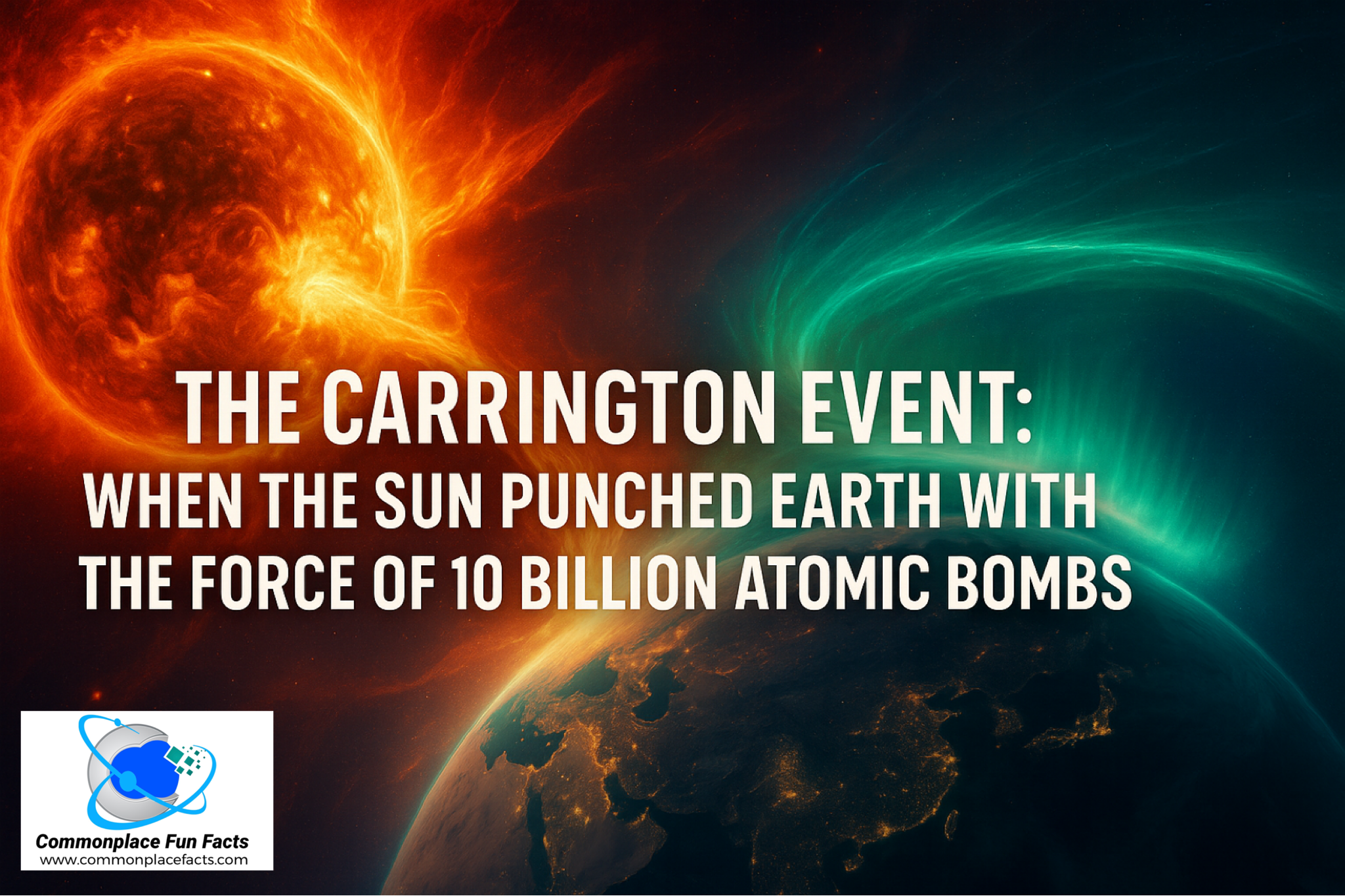

Every so often, the universe likes to remind humanity just how utterly powerless we are. One such display occurred on the morning of September 1, 1859. That’s when an unassuming English astronomer named Richard Carrington pointed his telescope at the sun and witnessed the cosmos throw a tantrum. What he saw was the opening act of the most powerful solar storm in recorded history — a cosmic haymaker that would rattle Earth’s magnetic field, set the sky ablaze, and make Victorian scientists seriously reconsider their life choices.
That outburst, now known as the Carrington Event, didn’t just put on a pretty light show. It fried telegraph systems, shocked operators, set papers ablaze, and made birds so confused they started singing in the middle of the night. It was as if the sun had decided to remind humanity that all our technological cleverness is, at best, a sandcastle in the cosmic tide.
If you are feeling particularly confident about your supremacy over nature, this article is for you. Join us as we dive into the chaotic splendor of the Carrington Event and ask the question, “What if it happened today?”
Contents
What Was the Carrington Event?
The Carrington Event was a massive solar storm caused by a coronal mass ejection (CME) that struck Earth on September 1–2, 1859. It was the most intense geomagnetic storm in recorded history, delivering energy equivalent to roughly 10 billion atomic bombs.
Here’s what happened: As Carrington observed a cluster of dark sunspots that morning, he saw “two patches of intensely bright and white light” erupt from the surface. The phenomenon lasted just five minutes. But 17 hours later, the consequences arrived — and they were spectacular.
The Night the Sky Forgot What Time It Was
Across the world, night suddenly decided it was day. Curtains of green, red, and purple aurora danced as far south as Cuba, Jamaica, and Hawaii. In the Rocky Mountains, miners leapt out of bed to make breakfast at 1:00 a.m., thinking dawn had arrived. People in Colombia wrote about “blood-red clouds” swirling overhead. And in the northeastern United States, birds — those tiny feathery know-it-alls of daylight — began chirping at midnight, convinced the sun had risen.

Victorians, who already worried about comets and spontaneous human combustion, naturally assumed the apocalypse was nigh. One newspaper described the heavens as “on fire with an awful grandeur.” It wasn’t the end of the world, but it was the end of business as usual for one crucial invention: the telegraph.
When Wires Became Lightning
In 1859, the telegraph was the closest thing the world had to the internet. It was the backbone of global communication, transmitting news, business deals, and bad poetry with blazing speed (well, compared to carrier pigeons). But telegraphs had one fatal weakness: they relied on long, unshielded wires stretched across continents — basically giant antennas just begging to pick up a solar storm’s wrath.

The first hint of trouble came a few days before Carrington’s observation, on August 28, when an earlier CME brushed past Earth. Telegraph systems across North America sputtered, sparked, and in some cases, combusted. In Pittsburgh, manager E.W. Culgan reported that the surges were so powerful they nearly melted platinum contacts, and “streams of fire” poured out of the circuits. In Washington, D.C., operator Frederick W. Royce was shocked so violently that an arc of fire jumped from his forehead to the telegraph equipment. A few decades later, that would have made an intriguing origin story for a comic book character with the superhuman ability to pummel bad guys with dots and dashes. We likely would have featured him in one of our “Worst Comic Book Characters” articles. Happening when it did, it resulted in nothing more than a severe physical and emotional shock for the poor guy.
And then came the main event. When the second, larger CME slammed into Earth on September 1, telegraph networks collapsed worldwide. Systems overloaded, messages garbled, and in some bizarre cases, machines kept working even after being unplugged from power — the induced current from the storm itself was enough to run them for several minutes. The 19th century’s hottest new energy source was “the sky is angry.”
How a Solar Storm Works (Without a Physics Degree)

How did this astrophysical marvel happen? Here’s the bite-sized science: The sun is basically a raging ball of magnetic chaos. Its magnetic field twists, tangles, and occasionally snaps like a cosmic rubber band. When that happens, it can release a coronal mass ejection — a gargantuan blob of plasma and magnetic fields hurled into space at millions of miles per hour.
If Earth is unlucky enough to be in the way, that plasma slams into our planet’s magnetic field, compressing it like a stress ball and sending charged particles racing through our atmosphere. That’s what creates auroras. But it also induces massive electrical currents in anything long and conductive — like telegraph wires, power lines, pipelines, or undersea cables. The Carrington Event was basically the sun saying, “Nice infrastructure you’ve got there. Be a shame if something… fried it.”
Other Times the Sun Lost Its Temper
While nothing has matched the ferocity of the Carrington Event, the sun has thrown smaller tantrums since then — and they’ve been enough to cause real trouble.
The 1921 “New York Railroad Storm”
On May 15, 1921, a solar storm nearly as intense as Carrington’s hit Earth, knocking out telegraph service across the United States and sparking fires in telephone exchange offices. It disabled signal systems on the New York Central Railroad and caused widespread disruptions to navigation and communications. Historians estimate that if that storm happened today, the damage could exceed $40 billion.
The Quebec Blackout of 1989
On March 13, 1989, a geomagnetic storm about one-third the strength of the Carrington Event plunged the entire Canadian province of Quebec into darkness for nine hours. The sudden surge of current tripped circuit breakers and destroyed transformers. Power grids across North America teetered on the edge of collapse, and the storm caused more than 200 grid disturbances in the United States alone.
Meanwhile, Earth’s orbit looked like a cosmic bowling alley. The atmosphere puffed up from the sudden energy input, increasing drag on satellites. About 1,500 of them slowed down, many lost communication, and some tumbled out of control. And remember: this was 1989 — pre-internet, pre-smartphone, pre-“help, my toaster is trying to connect to Wi-Fi.”
The 2012 Near Miss
On July 23, 2012, the sun hurled a massive CME almost identical in power to the Carrington Event. Fortunately, Earth was out of the line of fire. If the storm had launched nine days earlier, we would have taken a direct hit. NASA scientists later estimated that a strike could have caused $2.6 trillion in global economic damage and knocked out power and communications for months or even years.
What Would a Carrington-Level Event Do Today?
Let’s play a fun thought experiment — “fun” in the same sense as watching a train wreck in slow motion. Imagine the Carrington Event happened now, in our beautifully electrified, Wi-Fi-saturated, satellite-dependent world. Here’s what would happen:
- Power grids would collapse across continents. Transformers (not the cool ones from outer space that can switch between being robots and vehicles) would blow out in seconds, and replacing them could take months or years.
- Satellites — including those running GPS, weather forecasts, banking networks, and the internet backbone — could be fried or knocked off course.
- Internet cables, especially the long undersea ones, could experience damaging induced currents, potentially severing global connectivity.
- Aviation would be grounded as navigation and communication systems failed. Astronauts aboard the International Space Station would retreat to shielded areas to avoid radiation exposure.
- Financial markets could freeze without electronic communication, triggering global economic chaos.
A 2013 study by Lloyd’s of London estimated that a Carrington-class event today could leave 20–40 million people without power for up to two years in the United States alone. Global economic losses could surpass $2.6 trillion. And good luck ordering pizza online — your delivery app would be about as functional as a telegraph without wires.
How Often Do Solar Storms Like This Happen?
Here’s the unnerving part: scientists estimate that Carrington-scale solar storms hit Earth every 100–150 years on average. The last one was in 1859. That means… well, you can do the math. We’re living on borrowed magnetic time.
And our sun is entering the peak of its 11-year solar cycle right now. Solar Cycle 25, which began in December 2019, is expected to peak between 2024 and 2026. NOAA has already issued multiple solar storm alerts in 2024 and 2025, including one in May 2024 that produced auroras visible as far south as Arizona and Spain. That wasn’t Carrington-level — but it was a friendly reminder that the star next door hasn’t forgotten how to throw a tantrum.
So maybe it’s worth dusting off that old fountain pen and writing a letter now and then. Because if the sun decides to throw another tantrum, your Wi-Fi router will make a wonderful bookend, but it won’t be good for much else. And honestly, if the next Carrington Event wipes memes off the face of the Earth… some people might consider that a blessing.
Can We See a Solar Storm Coming?
Thankfully, we’re not flying blind anymore. Space weather forecasting is now an actual thing, thanks to a fleet of solar-watching spacecraft including NASA’s Solar Dynamics Observatory and NOAA’s Space Weather Prediction Center.
These observatories monitor the sun’s magnetic activity and track CMEs as they burst into space. If one’s heading our way, we can usually get 12 to 72 hours’ warning. That’s enough time for utilities to power down vulnerable equipment, for satellites to enter safe mode, and for astronauts to hunker down in shielded areas.
But here’s the catch: we still can’t stop it. Space weather forecasting is more like meteorology in the 1800s — we know the storm is coming, but we can’t move out of its path. All we can do is prepare and hope the sun’s in a forgiving mood.
How Humanity Is Bracing for the Next Solar Superstorm
Governments, scientists, and power companies are (thankfully) paying attention. The United States, for example, has a National Space Weather Strategy and Action Plan that coordinates monitoring and response efforts across agencies.
Some of the strategies on the table:
- Grid hardening: Installing surge protectors, grounding systems, and transformers that can handle geomagnetically induced currents.
- Satellite shielding: Designing spacecraft with better radiation protection and fail-safe modes.
- International cooperation: Space weather doesn’t respect borders, so global data-sharing is key.
- Backup infrastructure: Developing non-electric communication methods and redundant power systems.
Even with all that, though, a Carrington-class storm would still be disruptive. It’s a bit like preparing for a hurricane by nailing plywood over the windows — it helps, but the house is still going to rattle.
Could We Survive Without the Internet?
Here’s where the story gets truly terrifying: a world without Wi-Fi memes. Imagine no email, no GPS, no streaming, no TikTok dances. You’d be forced to talk to actual humans. Businesses would have to mail invoices on paper. Teenagers would rediscover a terrifying relic called “boredom.”

The entire staff of Commonplace Fun Facts would have to emerge from their coffins, even during daylight hours, and try to emulate human behavior. In short, none of us would last more than a few hours.
In the 1850s, when the telegraph went down, society grumbled and waited for it to come back. In the 2020s, a days-long outage could halt global trade, disrupt emergency services, and plunge entire countries into chaos. Modern civilization isn’t just conveniently electrified — it’s utterly dependent on the constant hum of electrons.
It’s worth remembering that even the mightiest empires have been humbled by forces beyond their control. Rome fell partly because of plagues. The Bronze Age collapsed due to drought and invasion. Our downfall could be caused by an angry ball of plasma 93 million miles away throwing a temper tantrum.
History’s Fiery Messenger — and Our Fragile Future
Richard Carrington couldn’t have known that his five-minute observation would echo across centuries. He wasn’t trying to change the world; he was just an amateur astronomer with a telescope and curiosity. Yet his discovery exposed one of humanity’s greatest vulnerabilities: our dependence on systems that the universe can casually swat aside.
The Carrington Event is more than a story about a spectacular light show in 1859. It’s a reminder that our planet lives in the blast zone of a volatile star. And while we can map the heavens, split the atom, and build machines that talk back, we’re still subject to the whims of a sunspot.
You may also enjoy…

What Were the Worst Years to Be Alive? A Tour of the Unhinged Years From 536 to 2020
What were the worst years to be alive? Discover history’s wildest years, from the comet-fueled chaos of 1811 to the volcanic winter of 1815, the blacked-out skies of 536, and the unforgettable rollercoaster of 2020. Some years just really went for it.

The Man Who Suggested Moving the Whole Solar System
When it comes to recognizing those who dare to dream grand and lofty goals, don’t forget to include the man who proposed moving our entire solar system. Fritz Zwicky (1898-1974) was a Bulgarian-born physicist who spent his entire career thinking about things that were well beyond the ken of ordinary mortals. Before delving into some…

The Wedding Ring That Was Lost — And Found — in Outer Space
Many human-made objects have been placed in space, including this comprehensive list of items that remain on the moon. None of these items retain quite the drama or personal impact as the wedding ring that was lost — and found — in the vacuum of space. It was 1972. Apollo 16 was in its second…





Leave a Reply to Herald StaffCancel reply