
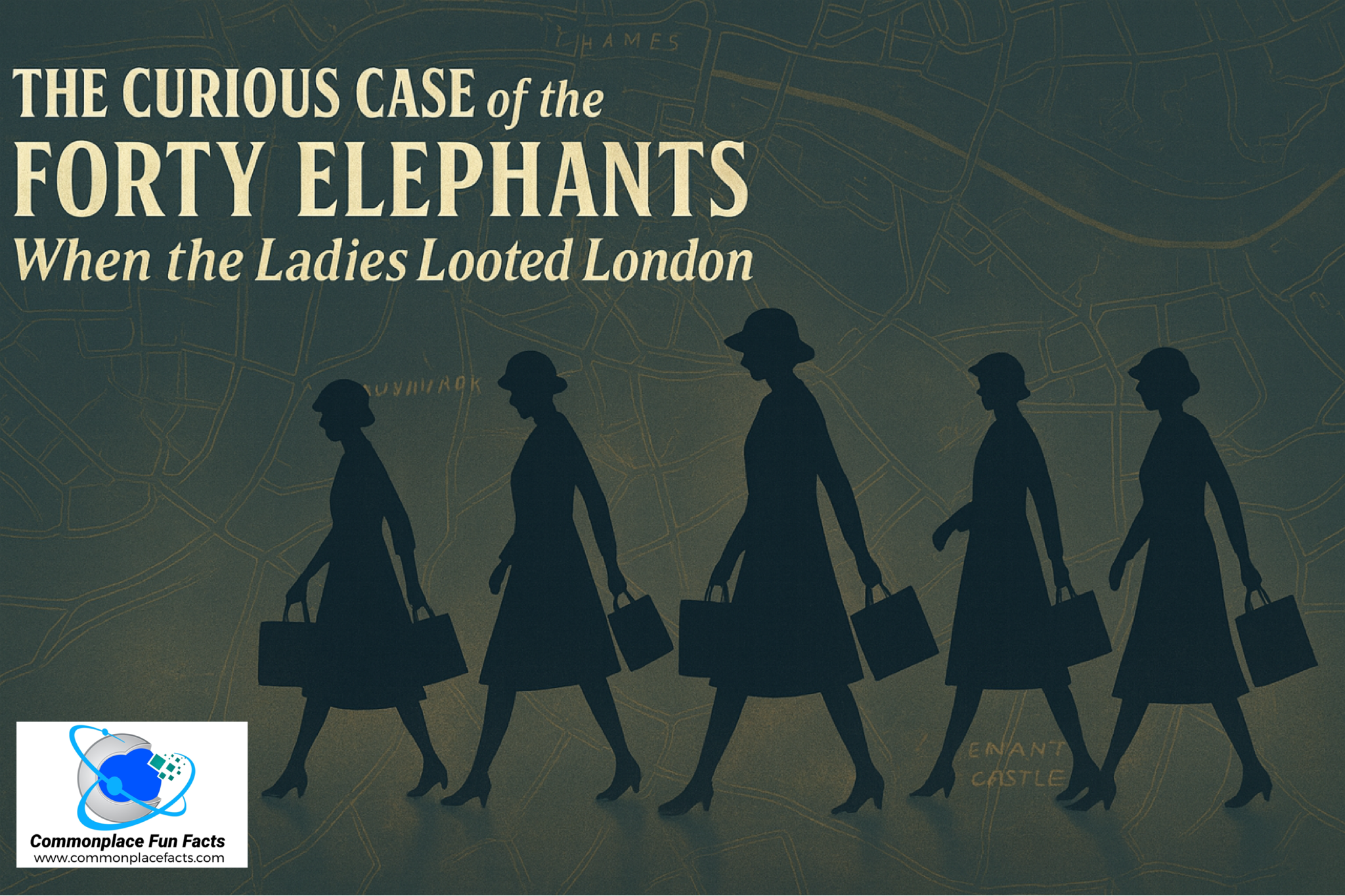

Few cities have more landmarks and legends than London. Big Ben. Guy Fawkes. Jack the Ripper. Oh, and let’s not forget a gang of impeccably dressed women who made shoplifting look like an art form. The Forty Elephants weren’t just another criminal gang — they were the Chanel of crime, the Versace of vice, and the only group of thieves who could probably lecture you about both larceny and proper corset structure. From the late 1800s into the mid-20th century, this all-female collective of “professional shoppers” terrorized London’s department stores with a mixture of charm, cunning, and the kind of teamwork most startups can only dream of.
Contents
The Birth of the Herd
Lest you think the Forty Elephants got its name from some morbidly overweight miscreants, we need to tell you about a London district known as Elephant and Castle. In the 19th century, it was grimy, bustling, and about as forgiving as a Victorian corset. Opportunities for women were thin on the ground, unless you counted becoming someone’s maid, someone’s wife, or a lady of ill repute.

Unsatisfied with these life choices, a few enterprising women decided to skip the job ads and create their own business model: stealing everything that wasn’t nailed down. Their stomping ground gave them their name — “Elephant” for their turf, “Forty” for reasons no one’s entirely sure of. Maybe there were forty of them. Maybe they just thought it sounded poetic. Either way, the branding worked.
By the late 19th century, the Forty Elephants had turned theft into a thriving, organized enterprise. This wasn’t a group of chaotic pickpockets; it was a sisterhood of strategists. They had hierarchies, codes of conduct, and — crucially — a sense of style. If you were going to rob London’s elite, you might as well look good doing it.
Meet the Leading Ladies

Like any good drama, the gang had its leading ladies. The early years were ruled by Mary Crane, a woman whose toughness could curdle milk. But the true icon of the Forty Elephants was Alice Diamond, better known as “Diamond Annie.” She stood nearly six feet tall, with fists that could flatten a sailor and taste that could bankrupt one. Diamond Annie ran her crew like a CEO — part disciplinarian, part den mother, and entirely terrifying. She expanded the operation far beyond South London, coordinating heists that reached every corner of the country. Think of her as a mob boss with a fur stole and a flawless manicure.
Under Diamond Annie’s reign, the Forty Elephants developed an almost corporate structure. Recruits were trained, territories managed, and profits shared. There was even a pension plan of sorts — older members who couldn’t “hoist” anymore were taken care of by the younger ones. It was organized crime, yes, but with HR benefits and better outfits.
The Fine Art of Stealing Elegantly
What made the Forty Elephants so effective wasn’t brute force — it was brains, audacity, and petticoats with more hidden compartments than a magician’s hat. In an era when respectable women were assumed to be delicate and harmless, the gang turned that stereotype into camouflage. They waltzed into London’s finest stores looking like society ladies, layered in voluminous skirts and coats lined with secret pockets. In went jewelry, perfume, silk, and anything else that sparkled. Shop assistants were too polite — or too terrified — to suspect a thing.

Some of their tricks were straight out of a heist movie. They’d stage distractions, bump into displays, or create a “crush” — a deliberate crowding of a counter while one or two members did the lifting. Others posed as maids to wealthy families, using their access to case homes and pinch valuables later. A few even faked pregnancies to smuggle goods under false bellies. If Ocean’s Eleven had been written in 1915, the Forty Elephants would’ve sued for plagiarism.
They didn’t stop at London, either. When stores got wise to them in the city, they took their talents on tour — hopping trains to Birmingham, Manchester, even as far as Paris. Shopkeepers across Europe learned the hard way that underestimating women in fine hats was bad for business.
Crime, but Make It Fashion
For the Forty Elephants, stealing was as much about style as survival. They didn’t just take expensive clothes; they wore them. A successful job wasn’t complete until the loot was paraded around nightclubs and cabarets. Their reputation for luxury was legendary — fur coats, diamonds, champagne, the whole Gatsby-before-Gatsby aesthetic. There’s a certain poetic symmetry in robbing the rich, dressing like them, and then stealing from them again the next week.
They weren’t exactly Robin Hood, though. The proceeds didn’t go to the poor — unless you count themselves. But they did upend social expectations. In a time when women were supposed to be meek and modest, these ladies built a criminal empire that mocked those rules. They moved through society with confidence, wit, and the kind of gall that makes you almost want to applaud. Almost.
Trouble with the Law
All good runs end eventually — even the glamorous ones. As police techniques improved and store detectives became a thing, the Forty Elephants found themselves increasingly cornered. Some were arrested in dramatic busts; others quietly faded away. The interwar years brought tighter security, rationing, and the awkward realization that you can’t exactly hide a mink coat during an air raid. Diamond Annie herself did several stints in prison but reportedly never lost her poise. One can only imagine her critiquing the drab prison uniforms: “Honestly, darling, this gray does nothing for my complexion.”
By the 1950s, the golden age of lady shoplifters was over. Postwar austerity, changing fashions, and a general sense of “please stop stealing everything” brought the operation to an end. Yet even in decline, the Forty Elephants inspired awe — and a touch of reluctant admiration — from the same society that once pretended women couldn’t tie their own shoes without supervision.
The Legacy They Left Behind

Today, the Forty Elephants live on as one of London’s strangest success stories — a gang that operated for nearly a century without ever being fully crushed. They were bold, strategic, and frankly, far more organized than most legal enterprises of their time. They showed how gender expectations could be weaponized — how “harmless women” could quietly strip a city of its finery and then toast each other in champagne after. It’s hard not to admire the audacity, even while admitting they were, you know, criminals.
There’s a certain modern irony to it all. In an age obsessed with influencers, image, and luxury brands, the Forty Elephants were the original curators of the “fake it till you make it” lifestyle. Except they didn’t fake it — they stole it, sold it, and wore it out dancing. Their story isn’t just about theft; it’s about power, performance, and refusing to stay invisible.
A Toast to the Unlikely Queens of Crime
It goes without saying — or at least it should — that no one here is suggesting a return to the art of well-dressed larceny. The Forty Elephants were, after all, criminals, and not the sort of role models you’d put on a classroom poster next to “Integrity” and “Teamwork.” But beneath the pickpocketing and polished shoes lies something unexpectedly admirable: a quiet rebellion against the narrow box society built for women. When the world told them to stay small, they went out and built an empire — one that proved power, intelligence, and defiance weren’t traits reserved for men in pinstripe suits.
So while we can (and should) condemn their methods, it’s hard not to give a nod of respect to their audacity. The Forty Elephants didn’t just steal jewels; they stole agency, visibility, and a measure of control over their lives in an era that denied them all three. They didn’t fit into society’s mold — they smashed it, reshaped it, and left behind a legacy that still gleams, faintly silver, in London’s history.
After all, even Al Capone, despite everything else, gave us milk with expiration dates.
You may also enjoy…

How Al Capone Revolutionized Food Safety With Milk Expiration Dates
Discover how Al Capone’s influence extended beyond organized crime, revolutionizing milk safety with expiration dates and reshaping the dairy industry.

The Strange Case of Mrs. Prodgers — The Terror of London Cabmen
Caroline Giacometti Prodgers, an infamous figure in 1890s London, gained notoriety as the Terror of London Cabbies for her relentless legal battles against cab drivers, filing over 50 lawsuits. Known for her dramatic courtroom antics, she became a symbol of consumer advocacy and garnered both fear and ridicule from cabbies. Her death in 1890 was…

Do You Have What it Takes to Master “The Knowledge”?
A trip to London invariably involves visits to Big Ben, Buckingham Palace, Westminster Abbey, the London Eye, and countless other iconic locations. One of the best ways to see all of these sights is by way of another London trademark: the black cab. Not only is the black cab a convenient way to travel, but…






Leave a Reply to Herald StaffCancel reply