
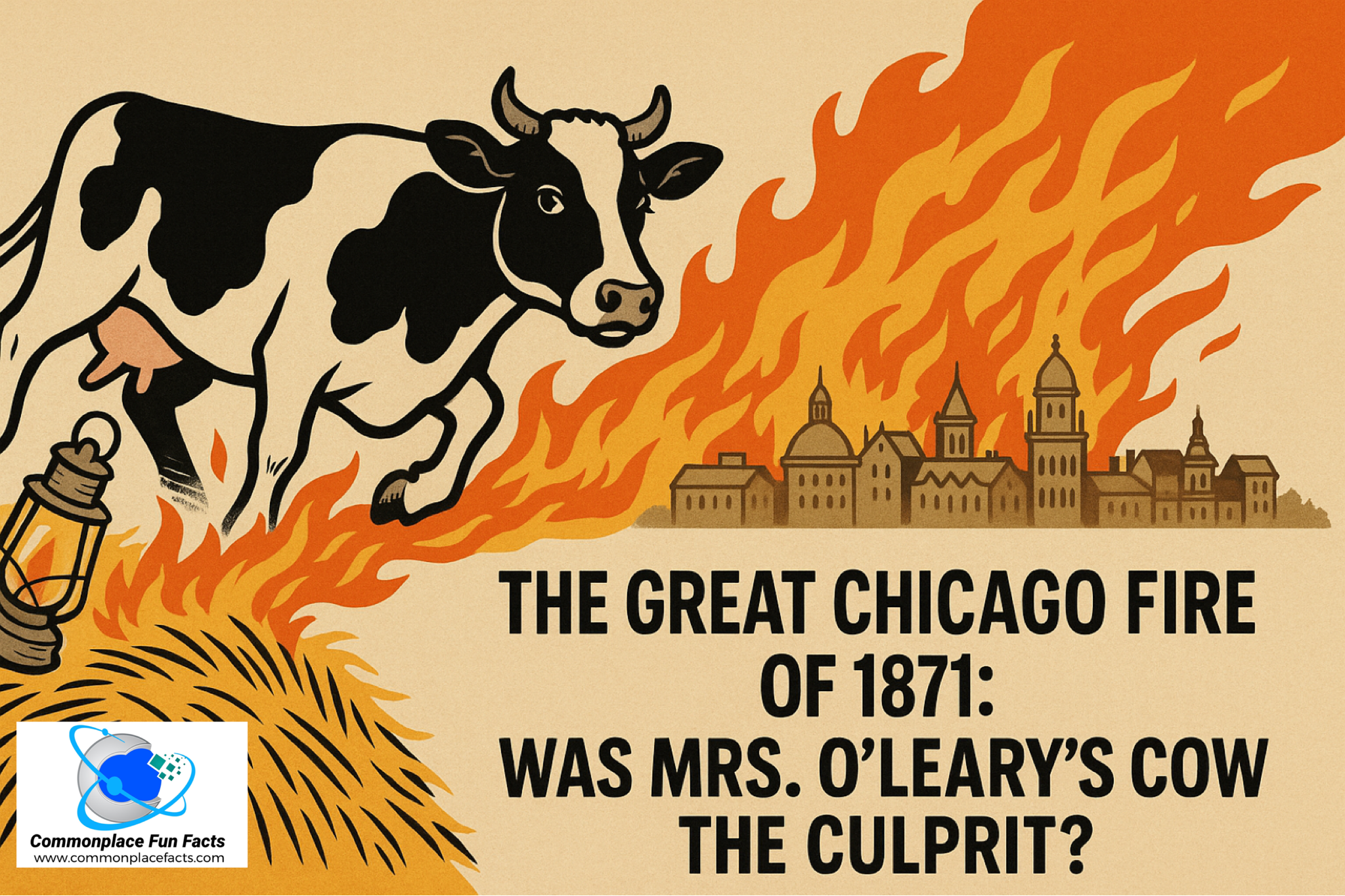

On the night of October 8, 1871, Chicago decided to test the limits of combustion. The city was dry as tinder, the wind in the Windy City was living up to its name (although that’s not really the reason for the nickname, but that’s a story for another article), and someone — or something — decided that was the perfect time to light a match. By the next day, three square miles of the city had vanished in a blaze so fierce it turned brick to dust, iron to soup, and history into mythology.
Most people have heard the story: Mrs. O’Leary’s cow kicked over a lantern in her barn, and poof — there went Chicago. It’s a great story. It’s got drama, fire, livestock, and an Irish immigrant to blame, which apparently checked every 19th-century journalism box. Is that the real reason for the disaster, or are those facts as murky as Chicago’s politics? Join us as we explore the Great Chicago Fire of 1871 and uncover some surprising (and slightly toasted) fun facts along the way.
Contents
By the Numbers: How Much, How Long, and How Many
The Great Chicago Fire didn’t politely flicker out after a few hours of civic inconvenience. It tore through the city for nearly two days, from the night of October 8 to the early morning of October 10, 1871—long enough for residents to run out of both water and hope.

By the time the flames were finally out, roughly three square miles of Chicago had vanished. More than 17,000 buildings were gone—homes, businesses, entire neighborhoods reduced to ash and regret. The fire didn’t just erase streets; it rewrote the city’s skyline.
About 300 people died, though no one knows the exact number. Tens of thousands—somewhere around 100,000—were left homeless. In a city of roughly 300,000, that meant one out of every three Chicagoans suddenly found themselves with a great view of the stars and no roof to block it.
Catherine O’Leary and the Cow Who Got Framed
While the smoke was still rising from the ashes, Chicago Republican reporter Michael Ahern published a claim that the fire had started when a cow kicked over a lantern while it was being milked. We think he was referring to the cow being milked, not the lantern, but Chicago Republican is defunct and was unable to provide clarification. He didn’t name the suspected bovine arsonist, but within days a tidy little fable trotted out of the ashes: the cow in question belonged to a woman named Mrs. O’Leary.
Catherine Donegan O’Leary did not ask to become the patron saint of scapegoats. She was an Irish immigrant, a working mother, and the owner of a modest barn at 137 DeKoven Street in Chicago. On the night of October 8, 1871, that barn caught fire. Of course, so did 17,000 other buildings in the city, but that didn’t stop the rumors from flying: it all started late at night while she was milking her cow. The creature — either out of ignorance or villainous intent — kicked over a lantern, ignited the hay, and—whoosh—there went Chicago.

It’s a cinematic story with all the narrative nutrients: a simple villain, a single moment of slapstick catastrophe, and a convenient immigrant woman (and her cow) to blame.
This writer, having grown up on a dairy farm, can attest that all cows are evil from the moment they are born — nay, spawned by the Prince of Darkness himself. Having said that, there isn’t a shred of evidence that Mrs. O’Leary’s cow was guilty of this particular crime against humanity. Catherine maintained she had gone to bed early and wasn’t in the barn. The official inquiry never identified a cause. Years later, the reporter admitted he embellished the cow tale because it “read better.” That’s journalism-speak for “facts were getting in the way of a good headline.”
In reality, Chicago in 1871 was a city built like a bonfire: months of drought, strong winds, wooden homes, wooden sidewalks, wooden everything. In that environment, almost any spark would do. The real mystery is why a disaster hadn’t occurred earlier. Even so, the legend stuck, partly because it lined up neatly with the era’s anti-Irish and anti-Catholic bias. Why wrestle with messy systemic problems when you can pin it on a cow with attitude?
To their credit—eventually—Chicago’s leaders circled back. In 1997 the City Council posthumously cleared Catherine O’Leary (and, by implication, the four-legged accomplice). It was a gracious apology delivered a brisk 126 years after the rumor did its damage. The myth, however, continues to moo along, because a tidy story tends to outrun an untidy truth.
So did Mrs. O’Leary’s cow burn down Chicago? Unlikely. Have Mrs. O’Leary and her cow been voting every year without fail in Chicago elections, despite her death in 1895? We suspect so, but the deadline for this article prevented further research on that topic.
Other Suspects, Equally Flammable
If it wasn’t Mrs. O’Leary, who was it? Theories range from a group of neighbors playing cards to a cigarette carelessly tossed in the wrong direction. Among them are a few theories that are worth noting.
Take, for example, Daniel “Pegleg” Sullivan, Chicago’s most ironically named suspect in a fire story. Amateur historian Richard Bales suggested that old Pegleg might’ve been the real spark behind the inferno. According to Bales, Sullivan wasn’t just the first to report the fire; he may have accidentally started it while trying to swipe a bit of milk from the O’Learys’ barn. In his own account, given weeks after the fire, Sullivan claimed he saw flames bursting through the barn’s side and heroically dashed across DeKoven Street to save the animals, including a cow that conveniently belonged to his own mother. It’s a story that, depending on how charitable you’re feeling, sounds either noble or suspiciously well rehearsed. Historians remain divided: the Chicago Public Library dismissed the theory as dubious, while the Chicago City Council in 1997—apparently still in the mood to assign blame somewhere—suggested Pegleg’s role deserved a second look. If true, it means Chicago burned down because someone couldn’t wait for breakfast.
In 1997, journalist Anthony DeBartolo dug up a theory that, frankly, has more cinematic potential than the famous cow story. He uncovered evidence suggesting that the Great Chicago Fire might’ve started not with a lantern-kicking cow, but with a poorly timed dice game. According to accounts tied to a man named Louis M. Cohn—who apparently couldn’t resist a little posthumous confession—he and some neighborhood boys were rolling craps in the O’Learys’ barn that night. When Mrs. O’Leary came storming out around nine o’clock to chase them off, the boys scattered in panic, and someone (possibly Cohn, possibly karma) managed to knock over a lantern. Cohn claimed he paused just long enough to grab the gambling money before making his escape. Years later, he left a tidy $35,000 bequest to Northwestern’s Medill School of Journalism, which included a written note implying he’d been there at the fire’s infamous beginning. Historians still argue about whether to take him seriously, but as alternative theories go, “dice and disaster” has a certain charm.
The fact is that Chicago was so dry that autumn that even a harsh glare could’ve started a blaze, so picking a single culprit is a bit like blaming one raindrop for a flood. Once the first flame took hold, the fire jumped from block to block faster than civic responsibility disappears during budget season.
The Meteor Theory: Biela’s Comet and the Cosmic Firestorm That Wasn’t
If blaming a cow feels too mundane, there’s always the option of blaming space. In 1882, writer and fringe theorist Ignatius L. Donnelly—best known for his book Ragnarok: The Age of Fire and Gravel (which sounds like it would have made an infinitely more enjoyable movie than Thor: Love and Thunder) proposed that the Great Chicago Fire wasn’t an accident at all, but the work of a meteor shower. His culprit of choice: fragments from Biela’s Comet, which had obligingly split apart in 1845 and then mysteriously vanished from observation.

Over a century later, engineer and physicist Robert Wood dusted off Donnelly’s theory at a 2004 aerospace conference. He argued that Biela’s Comet—or at least one of its fiery bits—had slammed into the Midwest on October 8, 1871. His reasoning was tantalizing: four massive fires erupted the same day, all around Lake Michigan—Chicago, Peshtigo, Holland, and Manistee. Eyewitnesses claimed to see “balls of fire” falling from the sky, blue flames dancing in the air, and spontaneous blazes with little or no smoke. Wood theorized that the comet’s methane content might have ignited when it hit the atmosphere, showering the region in flaming gas. In other words: the Midwest was, quite literally, hit by fire from space.
It’s an idea that sounds thrilling until you talk to an actual scientist. Meteorites tend to be stubbornly uncooperative as co-conspirators with arsonists. They simply don’t work that way. By the time they hit the ground, they’re cold to the touch. Methane, the supposed culprit, is lighter than air and disperses quickly, making it highly unlikely that it could form an explosive, Earth-scorching cloud without a script from a Michael Bay movie. And if an icy comet fragment had made it through the atmosphere intact, it wouldn’t have gently ignited some barns—it would have detonated in an airburst on the scale of the Tunguska event. Chicago would’ve been gone, not just singed.
There’s also the small matter of celestial timing. Biela’s Comet’s orbit didn’t intersect Earth’s path until 1872—one year after the Great Chicago Fire. So unless the comet had a head start or took a wrong turn, it couldn’t have been the culprit. The much less romantic but far more plausible explanation: the Midwest was bone-dry, the winds were high, and everything that could burn did. No comet required—just the perfect storm of drought, timber, and human carelessness.
Still, the idea of fire from the heavens refuses to die, probably because “meteor from outer space” sounds a lot more exciting than “a whole city forgot that wood is flammable.” History loves a good myth, and this one burns bright no matter how many scientists point out the holes.
The Peshtigo Fire: The Bigger Disaster Nobody Remembers
While Chicago was busy burning its way into history books, another fire raged in Peshtigo, Wisconsin—the same night. It was, by every metric, worse. Over 1,200 people died.
Let’s make sure you didn’t skip over those numbers. Over 1,200 people died. Keep in mind that Chicago’s fire, as bad as it was, took the lives of about 300 people.
The Peshtigo fire remains the deadliest wildfire in U.S. history. Entire towns were vaporized. The air literally caught fire. Hardly anyone heard anything about it, however, because Peshtigo didn’t have a major newspaper or a telegraph line that survived the night. Consequently, the world focused its attention on Chicago, and all but ignored an even greater disaster about 250 miles away.
The Peshtigo Fire was so hot that sand turned to glass and survivors described the river boiling. It was hell on earth, but Chicago got the headlines. The moral? Public relations has always mattered more than reality.
The Midwest Meltdown: Holland, Manistee, and Port Huron
As if the universe were running a promotional event called “Buy One Fire, Get Two Free,” Michigan also joined the inferno. Holland and Manistee burned almost entirely to the ground that same night. On the other side of the state, Port Huron did the same. If you’d drawn a map of the Great Lakes region on October 9, 1871, you’d have needed a red crayon and a fire extinguisher.
Whether by comet, carelessness, or collective bad timing, the Midwest went up in flames like a region that had skipped Fire Safety Week for several decades in a row.
Aftermath: From Ashes to Architecture
The Great Chicago Fire killed roughly 300 people and left 100,000 homeless. But within weeks, the rebuilding began. Architects saw opportunity in the ashes, experimenting with fireproof materials and new designs. The “Second City” nickname didn’t come from Chicago being smaller than New York—it came from this rebuilt version, born from the first one’s cremation.

By the time the dust (and soot) settled, Chicago had reinvented itself. The skyline grew upward. Steel replaced wood. And Mrs. O’Leary’s descendants probably avoided lanterns and a few may have become vegetarians for the rest of eternity.
Every great disaster deserves a great story, and sometimes we’re too fond of the story to let truth get in the way. Mrs. O’Leary’s cow makes for a better bedtime tale than “structural negligence and drought combined with poor urban planning.” People love blaming individuals, not institutions. Especially if the individual is a cow with a suspiciously bad attitude.
The Great Chicago Fire reminds us that legends spread faster than flames, that science and scapegoats rarely mix well, and that sometimes the biggest tragedies happen in the places no one’s looking. Peshtigo learned that the hard way. Chicago got to rise again as an architectural marvel. The rest of us got a cautionary tale—and one very undeservedly infamous cow.
So what really caused the Great Chicago Fire? Maybe it was a comet, maybe it was a careless smoker, or maybe it was just the inevitable result of a wooden city daring the universe to test its fire insurance policies. But whatever the cause, one thing’s certain: when the Midwest decided to burn, it didn’t do it halfway.
And we’re still keeping a wary eye on all the cows out there — whether or not they can actually be tipped over while they sleep.
You may also enjoy…

The Iroquois Theater Fire: When “Fireproof” Proved to Be Just a Punchline
Discover the tragic story of the 1903 Iroquois Theater fire in Chicago. Learn how design flaws, corruption, and hubris led to over 600 deaths—and how Eddie Foy became an unlikely hero.

The Wisconsin Butter Fire of 1991: Melted Madness and Dairy Disaster
Discover the shocking story of The Great Wisconsin Butter Fire of 1991, where millions of pounds of butter fueled an epic inferno. Learn how this unusual disaster unfolded, its environmental impact, and the heroic efforts to control a molten butter flood.

Origin of Chicago: How a Man Without a Country Created a Quiet Place of Refuge
Would you believe that the origin of Chicago centered around one man’s plan to create a quiet place of refuge away from all the chaos?





Leave a Reply to Herald StaffCancel reply