
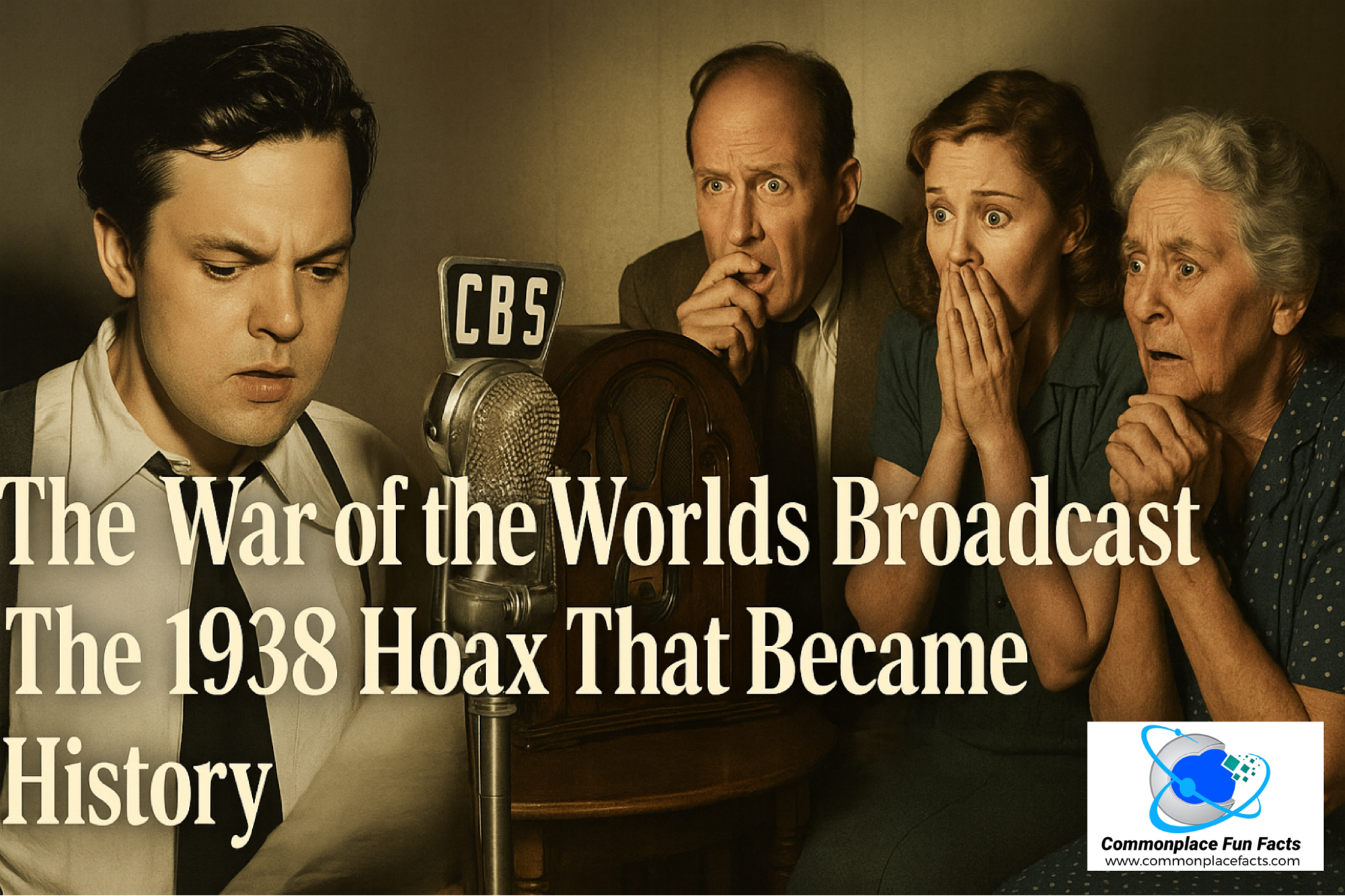

On this date eighty-seven years ago, it was a quiet Sunday night—October 30, 1938. Families gathered around the radio for a time of pleasant escapism. Then, fifteen minutes later, America collectively decided that Martians had landed in New Jersey. The War of the Worlds broadcast of 1938 remains the greatest case of a Halloween prank and of “whoops, wrong channel” in broadcast history.
If you tuned in late (and there were plenty who did), you missed the polite introduction explaining this was fiction. What you did hear sounded like an urgent news bulletin: explosions on Mars, scientists alarmed, and strange cylinders falling from the sky. By the time the “reporter” described tentacled aliens emerging with heat rays, many listeners were already packing the car, grabbing the kids, and wondering if the dog could keep up at 60 miles per hour — or possibly it was the kids who were having to keep up with the dog. Honestly, everyone was in a panic, so it’s hard to say.
Contents
The Show That Changed Everything
Behind the microphone stood a 23-year-old theatrical prodigy named Orson Welles. He’d just launched The Mercury Theatre on the Air, a classy little program devoted to dramatizing literary works. Unfortunately, “literary” wasn’t exactly lighting up the ratings. So the team decided to spice things up for their Halloween episode. Their choice: H.G. Wells’ The War of the Worlds. Their plan: make it sound like live news. Their goal: get everyone’s attention while avoiding getting into trouble. Two out of three isn’t bad.
In truth, the idea wasn’t entirely new. A few months earlier, Archibald MacLeish had written a radio play called Air Raid that mimicked news bulletins. Welles thought, “Let’s do that—only with aliens.” (You can read more about the radio play that inspired the War of the Worlds in this article). The scriptwriters, including Howard Koch (who’d later co-write Casablanca), worked feverishly to turn a Victorian sci-fi novel into modern mayhem. They transformed the narrative into a series of fake live reports, complete with “on-scene correspondents,” background music for dance halls abruptly interrupted by breaking news, and panicked announcers shouting over static.
The change resulted in a wild reassembly of all of the planning. Everything about the production screamed improvisation. The cast juggled multiple roles; sound technicians banged on metal plates and sloshed water to simulate alien movement; and the Martian death ray’s “zap” came courtesy of an electric guitar amp fed through a blender of feedback and imagination.
Somehow, it worked. The “reporters” spoke in the authoritative style that requires belief, no matter how outlandish the situation. The result was so authentic that CBS’s switchboard nearly melted. Radio drama had just invented the mockumentary—and accidentally, the first viral panic.
How a Boring Song Helped Make the Nation Panic
To be fair, the program did make it clear at the beginning that listeners were about to hear a radio dramatization. Anyone who heard that and was paying attention had no excuse for believing the Martians were coming for real. So here’s the big question: if the War of the Worlds started with a perfectly clear disclaimer saying it was all make believe, why did so many people miss that? The answer is as simple as human nature—and as relatable as missing the first five minutes of your favorite show because you were raiding the fridge.
The broadcast went live at 8 p.m. Eastern, right up against one of the most popular radio programs in America: The Chase & Sanborn Hour starring Edgar Bergen and Charlie McCarthy. Millions were tuned in elsewhere, chuckling at a ventriloquist act they couldn’t even see. Typically, its ratings left The Mercury Theatre on the Air in the dust. Tonight, however, things would be different.

A few minutes into The Chase and Sanborn Hour, many listeners turned their dials to different programming. The reason? Because it was a snooze. The usual crowd tuned in expecting the banter between Edgar Bergen and his wooden sidekick Charlie McCarthy, but instead of comedy gold, they got crooner Nelson Eddy kicking off the show with “Song of the Vagabonds.” Nothing against 15th-century French operettas, but that’s not exactly toe-tapping, laugh-out-loud radio. Eddy’s heroic baritone came roaring out of the speakers like an operatic air raid siren, and unless you were fluent in melodrama, you probably had no idea what he was singing about. Something to do with Burgundy and France—because that’s just what the average 1938 listener needed to help digest dinner.
And as if one musical misfire wasn’t enough, he followed it up with the “Canadian Logging Song,” which sounds exactly as thrilling as it isn’t. (Trust us; we listened to it for research. As much as we love Canada and Canadians, no one should have to suffer through that much cheerful lumberjacking.) By that point, radios across America were being frantically retuned by desperate ears in search of something—anything—less operatic. And that’s when they landed on CBS, right in the middle of Orson Welles’s breaking-news-style Martian invasion. One minute, it was odes to timber; the next, it was total annihilation. And that, in a nutshell, is how bad programming decisions helped aliens conquer Earth—at least for an hour.
And timing wasn’t the only culprit. The late 1930s were a tense moment in world history. Europe was teetering on the brink of war, and Americans were used to radio bulletins interrupting regular programming with grim updates from overseas. So when Welles’s actors cut into a fictional dance broadcast with “news” of a mysterious invasion, it didn’t sound like theater—it sounded like Tuesday.
The Alien Invasion of New Jersey — That Will Teach the Martians a Lesson
By the time the latecomers arrived, the Mercury Theatre’s polite introduction— “The Columbia Broadcasting System and its affiliated stations present Orson Welles and The Mercury Theatre on the Air in ‘The War of the Worlds’ by H.G. Wells” —was long gone. Instead, they heard a series of frantic bulletins: explosions on Mars, objects falling from the sky, scientists warning of strange gases, and breathless “live” reports from Grovers Mill, New Jersey. It was the radio equivalent of switching on Jaws right as the shark attacks—and then calling the Coast Guard.
Did anyone question why the Martians chose New Jersey as their initial point of conquest? Perhaps they assumed the governments of Earth wouldn’t put up much of a fight for that particular piece of real estate. Maybe they assumed an alien invasion wouldn’t even be noticed in the Garden State until it was too late to do anything. Regardless, folks were so panicked that they didn’t exactly react with calm, rational thinking. Terror and panic immediately gripped the nation.
Or did it?
The Great American Freak-Out — Or Maybe Not
Perhaps not everyone bought the idea that mass panic swept the nation, but one thing’s certain: a whole lot of people came in late, heard the middle of a fake newscast, and filled in the missing context with pure, uncut terror. That’s how a modest Halloween broadcast became one of the most famous examples in history of what happens when you miss the opening credits. Many listeners believed Grovers Mill, New Jersey was being vaporized. Poor Grovers Mill. They didn’t even have a gas station, but suddenly they were the epicenter of an interplanetary crisis.

The reaction was legendary—though not quite as apocalyptic as the newspapers claimed the next morning. Headlines screamed that “radio listeners in panic, taking war drama as fact.” There were stories of highways jammed with fleeing motorists, churches packed with weeping congregations, and one poor man who allegedly ran into the street shouting, “I’d rather die with my girl than alone!” (His girl, one imagines, was less enthused.)
But historians now say the chaos was exaggerated. Yes, thousands were confused, and police stations fielded frantic calls. But most Americans were more bemused than terrified. What really happened was a perfect storm of limited context, vivid performance, and sensationalist journalism the next day. In short, the panic over the panic was the real panic.
Still, the stories are irresistible. One New Jersey farmer reportedly shot up his own water tower, thinking it was a Martian tripod. In another town, a power outage during the broadcast sent residents sprinting to their cars. And over in Cleveland, switchboard operators logged complaints from people demanding to know whether they should “evacuate or fight.” Humanity’s first instinct, it seems, is to call customer service.
Jack Paar and the Night Cleveland Lost Its Cool
Future talk show host Jack Paar had a front-row seat to the chaos—literally, from behind a microphone in Cleveland. Back then, Paar was a young radio announcer, blissfully unaware that Orson Welles was about to hijack his Sunday evening. As he told the story years later, his ritual was simple: finish his local broadcast, grab a malted milk and a club sandwich, and bask in the modest glory of hearing his own voice on air. But that night, something new caught his attention—the Mercury Theatre. He tuned in late, just in time to hear breathless “news bulletins” about explosions and Martians landing in New Jersey. “That’s awful,” he remembered thinking. “In New Jersey!”
That’s when the phones started lighting up like Christmas. Cleveland listeners were in full meltdown mode, calling to ask what to do about the alien invasion. With no operator on duty, he answered the calls himself, assuring terrified citizens that he thought it was just a drama—though he wasn’t entirely sure. When he finally cut into the network feed to calm everyone down, his boss accused him of being “too emotional” and told him he’d never make it in radio. By the next morning, Paar was a local hero—the man who “saved Cleveland” from Martians. Three years later, on December 7, 1941, he heard another breaking bulletin—this one real. “I thought, they’re doing it again,” he said. “But this time, it was Pearl Harbor.” And for once, no one thought it was just another New Jersey thing.
Aftermath: Fame, Fallout, and Fake News Before Fake News
Orson Welles emerged the next morning bleary-eyed and apologetic—or at least pretending to be apologetic. His solemn press conference made headlines nationwide. The Mercury Theatre’s sponsor list tripled within a week. Hollywood called soon after, leading Welles to direct Citizen Kane three years later. Not bad for a night that allegedly traumatized half the country.
The Federal Communications Commission, Congress, and a few furious newspaper editors demanded answers. CBS promised not to trick the public again (apparently no one copied Dan Rather in on the memo). Psychologists leapt in to study the “mass delusion,” while sociologists coined new phrases like “media-induced panic.” In truth, it said less about gullibility and more about how powerfully realistic storytelling could be when delivered through a trusted medium.
The broadcast’s influence lingered. It inspired later hoaxes, news parodies, and even the found-footage style of horror films. It also spawned imitators abroad, some of which went horribly wrong—most infamously in 1947 with a fake report of a giant monster attacking Tokyo, and in Ecuador, where a 1949 version of the play provoked riots and several deaths. Apparently, the lesson “don’t play alien invasion jokes on live radio” didn’t travel well.
Legacy: When Martians Met Modern Media
The War of the Worlds broadcast didn’t just scare a few million Americans; it rewrote the rules of storytelling. It showed that radio wasn’t just for music and variety shows—it could terrify, enthrall, and manipulate emotion like no other medium. It also gave journalists and broadcasters a collective case of trust issues that persists to this day.

For Orson Welles, it was both blessing and burden. It made him famous, but it also convinced people he was capable of anything—up to and including staging an interplanetary hoax on short notice. For the rest of us, it became a lesson in skepticism, narrative power, and why you should always double-check whether the apocalypse is on another channel.
We like to think we’re immune to such mass confusion. But swap “radio” for “social media,” and the comparison gets uncomfortably close. The technology changes; the panic doesn’t. The real alien invasion is our willingness to believe anything that is communicated with a confident (or sufficiently loud) voice. Sometimes the scariest thing isn’t the aliens. It’s how easily we believe they’re real.
So on this and every October 30, cue up the episode. Listen to the crackling static, the earnest reporters, the glorious absurdity of it all. And when the Martians land in Grovers Mill yet again, remember Orson Welles’ concluding words to that memorable broadcast:
“This is Orson Welles, ladies and gentlemen, out of character to assure you that ‘The War of The Worlds’ has no further significance than as the holiday offering it was intended to be. The Mercury Theatre’s own radio version of dressing up in a sheet and jumping out of a bush and saying Boo! Starting now, we couldn’t soap all your windows and steal all your garden gates by tomorrow night … so we did the best next thing. We annihiliated the world before your very ears, and utterly destroyed the CBS. You will be relieved, I hope, to learn that we didn’t mean it, and that both institutions are still open for business. So goodbye everybody, and remember please for the next day or so the terrible lesson you learned tonight. That grinning, glowing, globular invader of your living room is an inhabitant of the pumpkin patch, and if your doorbell rings and nobody’s there, that was no Martian …it’s Halloween!”
Recommended listening: The original 1938 broadcast of The War of the Worlds. Just… maybe don’t turn off the lights.
You may also enjoy…

The Great Tokyo Sea Monster Hoax of 1947: The Big Spoof that May Have Inspired Godzilla
Discover the bizarre 1947 Tokya Sea Monster Hoax where U.S. Armed Forces broadcasters in Tokyo reported a fake sea monster attack, sparking mass panic. Could this prank have inspired Godzilla?

“Air Raid” — The Radio Drama That Inspired “The War of the Worlds”
Learn about “Air Raid” — the Old Time Radio drama that inspired “The War of the Worlds.”

Orson Welles: The Man, the Myth, the Massive Ego, and the Towering Genius
Discover the larger-than-life story of Orson Welles—boy genius, radio rebel, cinematic legend, and frozen pea pitchman. Explore his triumphs, controversies, and the myth behind the man in this witty and engaging deep dive.




Leave a Reply to Herald StaffCancel reply