
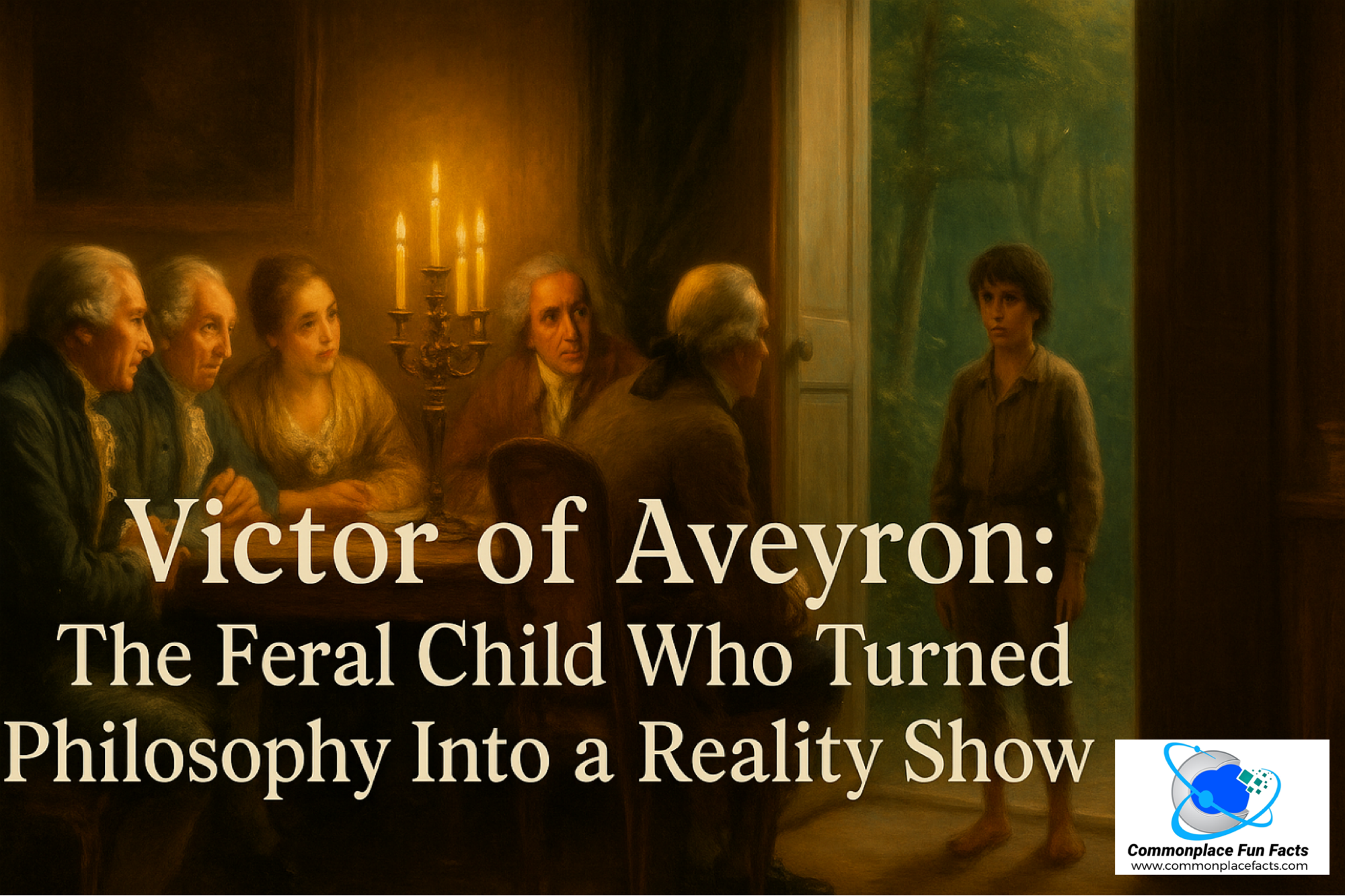

Once upon a time a boy wandered out of the woods with no clothes, no manners, and no meaningful way to communicate. No, we’re not talking about the day after the big fraternity party at your nearest university. This happened over 200 years ago and became the hottest topic in Enlightenment-era gossip circles. It wasn’t your typical “lost child” story; there were no kindly wolves, no fairy godmothers, and definitely no rumors about a pack of vampires. Just a silent, scarred, bewildered kid and an army of philosophers practically tripping over each other to declare him the key to understanding human nature. He would be known as Victor of Aveyron, though that came later — because when you’re discovered living like a woodland cryptid, people tend to focus on the “feral” part before filling out the paperwork.
To the intellectuals of the late 1700s, Victor wasn’t just a person; he was a science project with excellent timing. Europe had recently rediscovered empathy — at least as a philosophical concept — and here was a real, live test case for all their theories about the “natural man.” Was he proof that humanity was pure before society corrupted it? Or was he evidence that civilization was the only thing standing between us and eating tree bark for dinner?
Join us as we explore a strange and mysterious story that is part science experiment, part moral fable, and part social train wreck: Victor of Aveyron — the feral child who set the salons of Paris abuzz.
Contents
The Backdrop: France, Woods, and “What on Earth?”

It’s the end of the 18th century, and the French Revolution’s hangover was still throbbing through the countryside. In the region of Aveyron, villagers were reporting that they kept spotting something moving through the trees. Sometimes it looked like a child, sometimes like a cryptid with commitment issues. By the time anyone got a proper look, it was gone. For years, reports trickled in — a naked boy, stealing crops, darting through the brush, living on roots, nuts, and whatever else nature coughed up.
Philosophers like Jean-Jacques Rousseau had popularized the idea of the “noble savage” — that humans, left to nature, are pure, innocent, and uncorrupted by society. Others thought people were born blank slates, and civilization scribbled all over them until they learned to pay taxes. The boy in the woods, it seemed, could settle the argument once and for all.
The Discovery: “Oh, Look At That… Human?”
By 1797, locals had been seeing the strange boy long enough to start asking whether to feed him or call the papers. Hunters finally captured him in the winter of 1800. He was about twelve, covered in scars, naked, and completely nonverbal. After escaping twice (which, to be fair, most of us would do if civilization’s first gesture of welcome involved being examined by 18th-century physicians), he was brought to the town of Saint-Sernin-sur-Rance.
From there, the authorities shuffled him between orphanages and clinics before finally sending him to Paris. The “Wild Boy of Aveyron” became a celebrity. He was studied by scientists, pitied by priests, and stared at by anyone who could afford a carriage fare. To the scholars of the day, Victor wasn’t a person — he was an experiment. A question wrapped in dirt and trauma.
When Victor Was Found: More “Forest Child” Than “Fairy Tale Hero”
When Victor emerged from the woods of Aveyron sometime around 1800 (estimated age roughly 11), he was far from the romantic image of a wolf-raised prodigy. Instead, reports describe a boy with no speech, covered in scars, and oddly indifferent to extremes of heat or cold. He didn’t flinch from bare feet on frost or dip his hands in boiling water without apparent pain. He had apparently spent years with little to no human contact, perhaps abandoned at age two or three according to one examiner’s guess. Behaviorally, Victor moved and behaved oddly: crawling or leaping, howling in the woods, trotting instead of walking, ignoring human voices yet startling at small natural sounds. In short: he was less “wild genius” and more “human after a very messy childhood edition.” The philosophers swooped in.
The Education Attempt: One Man’s Bold Idea (and Its Limits)

Enter Jean-Marc Gaspard Itard, French physician-educator, who took on Victor as if he were both student and specimen. Unlike the fabled Green Children of Woolpit, Victor’s story would be well documented through Itard’s research. Itard’s aims were ambitious: awaken Victor’s senses; teach him to use speech; help him join human society. His plan involved sensory stimulation (hot/cold bath time rather than chalkboard lectures), linking words with objects, training routine, encouraging comfort with clothes and shoes—the full “come in from the wild” package.
Progress was real, albeit limited. Victor eventually learned to recognize a few written words and respond to gestures — a kind of homemade sign system that let him express simple needs. But despite years of patient teaching, full literacy or fluent communication never arrived. He understood the connection between objects and words, yet language itself remained just out of reach. In the end, he could gesture for milk or follow basic commands, but the miracle of reading, writing, or real conversation stayed beyond him. Still, even those small steps showed that education could reach places society had already given up on.
Who Was Victor Before the Woods?
No one knows. Some suspected he’d been abandoned as a baby because of developmental delays. Others thought he’d wandered off and survived by chance. One rumor claimed he was the illegitimate child of a local notary, ditched to preserve family honor. Whatever the truth, he clearly hadn’t been raised by wolves or a musical bear named Baloo.
Modern researchers, including historian Serge Aroles, have suggested Victor’s scars and malnutrition hint at abuse rather than wilderness survival. And later psychologists like Uta Frith proposed that Victor displayed signs consistent with autism — repetitive rocking, lack of speech, and social detachment. The more we’ve learned, the more tragic his story becomes: he may not have been a feral prodigy of nature, but a boy society failed long before it ever “rescued” him.
As the public continued to gawk, the educated elite, always eager to see suffering intellectualized, debated whether Victor represented humankind before language — or just humankind before decent childcare.
Doctors poked, priests prayed, and philosophers philosophized. The newspapers called him a “wild boy,” though, to be fair, he seems better behaved than the average child we encounter at Walmart.
Dr. Itard: Doctor, Dreamer, Possibly Delusional
Convinced he could “civilize” him, Itard continued an education campaign that would make every special-education pioneer simultaneously applaud and wince. He focused on two goals: teaching Victor language and developing his sense of empathy — because having just emerged from the Reign of Terror, where better than France could someone learn such civilized traits?

Itard and his assistant, Madame Guérin, established a daily routine designed to coax Victor out of his isolation. Their lessons mixed sensory exercises, object-word associations, and simple tasks — things like recognizing familiar objects, imitating gestures, and responding to gentle prompts. Over time, Victor grew more comfortable with human company and learned to follow basic directions. His greatest challenge, however, was speech. After years of effort, he mastered only two spoken expressions: “lait” (milk) and “Oh, Dieu!” (“Oh, God!”). He sometimes used them in the right situations, but not always with full understanding — much like a well-trained parrot. For all his progress, language — the one skill everyone most wanted him to master — remained just beyond reach.
Progress was slow. He learned to dress himself, to sit through meals without bolting for the woods, and to show occasional affection. Itard grew frustrated, alternating between paternal pride and scientific disappointment. He wrote that Victor was “as much a child of nature as one could imagine — and yet, not one that Rousseau would recognize.”
The Challenges and the (Partial) Progress
Itard’s meticulous journals show a boy who could learn routine but not abstraction. He could fetch water, recognize objects, and respond to his name, but concepts like “love,” “friendship,” or “justice” were as distant as the stars. Modern neuroscience offers an explanation: the “critical period” for language development had passed. Victor’s brain, deprived of linguistic input in early childhood, could no longer form the necessary neural connections. In plain terms, the window had closed.
“He had an obstinate habit of smelling anything that was given to him, even things which we consider void of smell; his mastication was equally astonishing, executed as it was solely by the sudden action of his incisors, . . . in certain circumstances he had devoured small dead animals.”
— Jean-Marc Gaspard Itard
By 1806, Itard reluctantly admitted defeat. Victor would never fully learn to speak, though he had become calmer and more affectionate. He remained largely dependent on others for survival. Itard’s notes oscillate between heartbreak and hubris — the tone of a man realizing he might have overpromised on humanity’s potential.
Yet out of this disappointment came progress. Itard’s experiments laid the groundwork for modern special education, especially for deaf and autistic children. His emphasis on sensory training and patient repetition influenced later educators like Édouard Séguin and, eventually, Maria Montessori. In failing to “civilize” one boy, he helped generations of others find ways to connect.
Victor’s Later Life
After Itard’s official reports, Victor faded from public fascination — because nothing kills a Parisian fad faster than compassion fatigue. He continued living with Madame Guérin, who cared for him quietly in Paris. She reportedly grew deeply fond of him, treating him less as a specimen and more as a son. Victor died sometime around 1828, possibly of pneumonia, though exact details remain unclear. For a boy who spent his early years hunted through forests, dying peacefully indoors might have been the closest thing to justice life ever gave him.
Nature vs. Nurture: Victor’s Unwanted Legacy
Victor became the poster child (quite literally) for debates about human nature. Was language innate or learned? Are empathy and morality products of environment or genetics? Philosophers dissected him as if he were a walking essay question. Rousseau’s “noble savage” ideal didn’t hold up well — Victor wasn’t noble, just neglected. And for those who believed society corrupts, he offered the uncomfortable counterpoint: civilization may bruise us, but isolation breaks us.
Modern scholars see in Victor a warning about how easy it is to romanticize tragedy. He wasn’t proof of nature’s purity. He was proof of what happens when human connection disappears. Every scar, every silence in him told a story about absence — of language, of touch, of care.
The Autism Hypothesis
Decades later, psychologists began revisiting Victor’s behavior through the lens of modern diagnoses. Uta Frith and others proposed that he exhibited many traits consistent with autism: self-stimulation behaviors like rocking, lack of eye contact, repetitive movements, and resistance to change. If true, the case of Victor was not an experiment in civilization but a historical encounter with neurodiversity — one that science lacked the empathy or vocabulary to recognize at the time.
In hindsight, Itard’s efforts look both cruel and compassionate. He genuinely wanted to help Victor, but his definition of success was assimilation — making the boy “normal.” The tragedy is that Victor’s failure to conform taught future generations to redefine what learning, connection, and humanity can mean.
The Legacy of a Failed Experiment
Though Itard never “civilized” Victor, his reports became foundational texts in educational theory and developmental psychology. They inspired new approaches to teaching children with sensory or cognitive differences, proving that patience and observation could be tools of science as well as compassion. His student Édouard Séguin later developed methods that informed early special-education systems in Europe and America.
Victor’s story also influenced how we think about “the forbidden experiment” — the moral problem of studying human isolation. You can’t ethically raise a child without language to test how humanity works. But here was one already created by tragedy, offering answers at a terrible cost.
Pop Culture and the Myth of the Wild Child
Victor’s fame didn’t die with him. The French filmmaker François Truffaut dramatized his story in L’enfant Sauvage (The Wild Child) (1970), where Truffaut himself played Itard — because apparently nothing says “respectful retelling” like casting yourself as the compassionate genius. The film, while sympathetic, still frames Victor as a creature halfway between beast and boy, rather than a person caught between cruelty and curiosity.
Since then, Victor has appeared in literature, psychology courses, and the occasional listicle of “History’s Most Famous Feral Children,” usually sandwiched between “the wolf girls of India” and “Tarzan.” It’s not the legacy anyone would wish for, but it keeps him alive in the cultural imagination — a reminder of how thin the line is between fascination and exploitation.
What Victor Really Taught Us
In the end, Victor of Aveyron didn’t prove Rousseau right or wrong. He didn’t reveal the essence of humanity or the blueprint of civilization. What he revealed — painfully, wordlessly — was how dependent we are on one another. Without others, language doesn’t develop. Without language, thought shrinks. Without connection, empathy starves. He wasn’t the mirror of nature; he was the shadow of neglect.
For all their experiments, the philosophers missed the simplest truth: Victor didn’t need to be studied; he needed to be loved. And the fact that he found at least one person who gave him that — Madame Guérin — might be the closest this story ever came to a happy ending.
The Final Word
Two centuries later, we’re still talking about the boy from the woods. We still chase the same questions — nature or nurture, science or soul. But maybe the real takeaway isn’t about philosophy at all. Maybe it’s about compassion. Civilization isn’t built on logic or language. It’s built on people showing up for each other. Victor’s story reminds us what happens when no one does.
He may never have learned to speak, but his silence said plenty.
You may also enjoy…

The Green Children of Woolpit: Medieval X-Files, But With Beans
Discover the strange tale of the Green Children of Woolpit—mysterious green-skinned siblings who appeared in medieval England speaking an unknown language and eating only beans. History, folklore, and extraterrestrial theories collide in this bizarre true story.

The Haunting Legend of Sawney Bean: Scotland’s Scary Cannibal Clan
Discover the chilling legend of Sawney Bean, the Scottish cannibal who may—or may not—have eaten over 1,000 people. Truth, myth, and dark folklore collide.

Joseph Meister: The First Boy to Survive Rabies in 1885, Thanks to Louis Pasteur
Discover the true story of Joseph Meister, the first person to survive rabies in 1885 thanks to Louis Pasteur’s groundbreaking vaccine. A pivotal moment in medical history that changed the future of infectious disease treatment.







Leave a Reply