
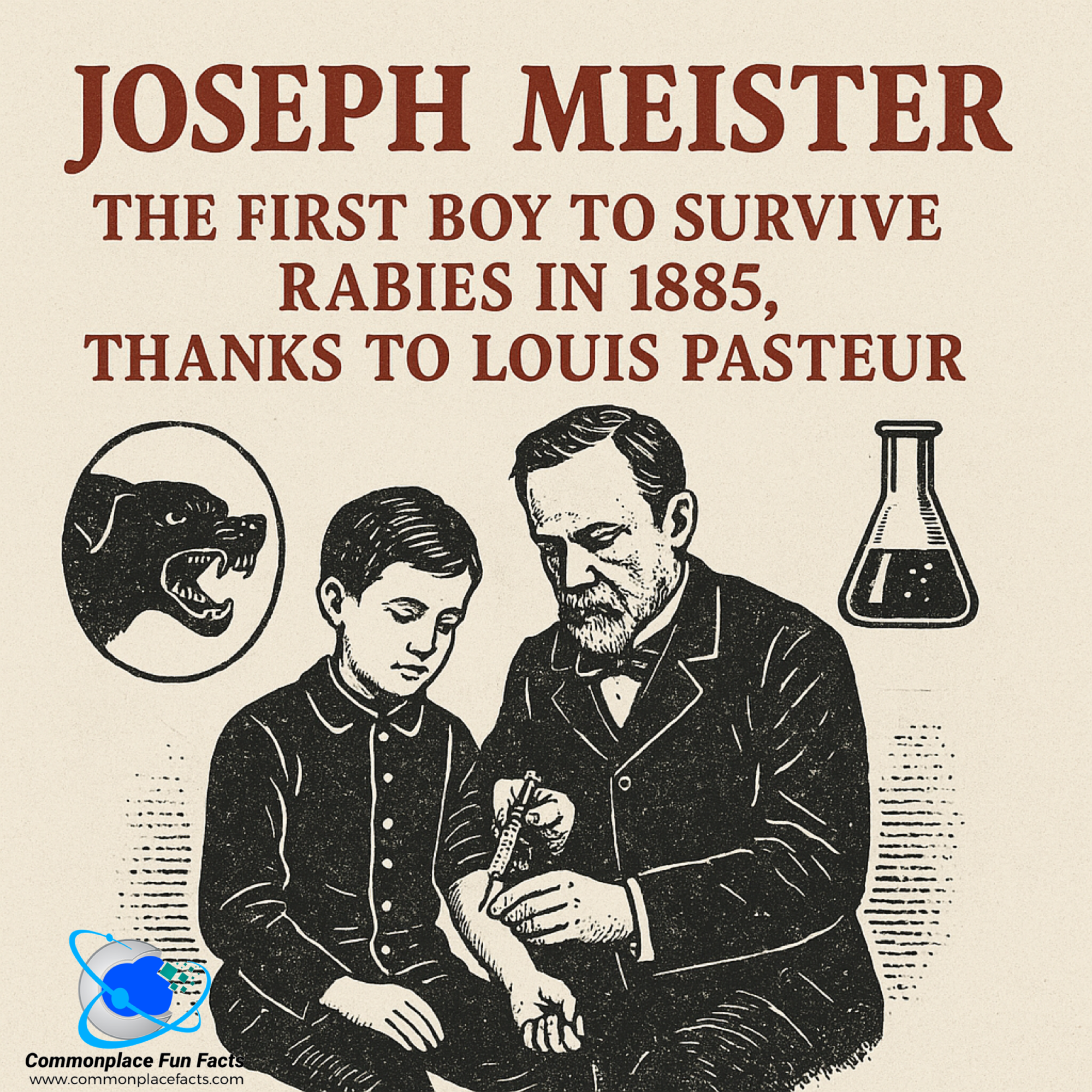

Pasteur’s Rabid Gamble: How a Mad Scientist Saved Joseph Meister From Certain Death
Louis Pasteur wasn’t a doctor. He didn’t even play one on TV. (Admittedly, this was the 1880s, so no one did—but you get the idea.) What he was, however, was a chemist who had the unnerving habit of asking awkwardly specific questions about wine, spoiled milk, and why people insisted on getting sick and dying all the time. His germ theory of disease was already turning the medical world on its listerine-scented head. But it was a moment of horrifying opportunity—a young boy foaming at the mouth on death’s doorstep—that would give Pasteur his defining “mad scientist saves the day” moment.
Contents
Meet Joseph Meister: History’s First Human Guinea Pig (and, Remarkably, Not Its Last)
On July 6, 1885, 9-year-old Joseph Meister was dragged—literally—by his frantic mother through the streets of Paris to the lab of Louis Pasteur. The boy had been bitten 14 times by a rabid dog, which, in 1885, was basically a death sentence wrapped in a growling, slobbery bow. Rabies, after all, was the Freddy Krueger of diseases: incurable, horrific, and disturbingly fond of the central nervous system. Even now, once symptoms begin, the disease has, essentially, a 100% fatality rate. In those days, getting a bite from an infected animal was an almost guaranteed death sentence, usually in a state of terror, seizures, and hydrophobic rage.

Pasteur had been working on a vaccine for rabies, but his results were limited to dogs, rabbits, and test tubes that did not scream, cry, or sue. The idea of injecting a child with an untested serum was… let’s say “controversial.” But Joseph was already beginning to show symptoms, and the Pasteur Institute (which technically didn’t exist yet, but more on that in a minute) was the only place in the world with something that might work. Pasteur was hesitant. He wasn’t a licensed physician, and giving the treatment to a human could get him arrested if it failed. (Or, knowing 19th-century France, guillotined.)
But after consulting with two actual doctors, who basically shrugged and said, “Well, he’s gonna die anyway,” Pasteur rolled up his sleeves—and Joseph’s—and started the injections.
The Vaccination Marathon
Pasteur’s rabies vaccine wasn’t a one-and-done kind of thing. It was a multi-day course of injections using progressively stronger doses of rabies virus that had been weakened (attenuated, for those playing virology bingo) by drying the spinal cords of infected rabbits. That’s right—Pasteur treated a child using aged rabbit spine juice. Science is glamorous like that.

Credit: Wellcome Library, London.
Over ten days, Joseph received 13 injections. With each dose, Pasteur and the doctors watched nervously for signs of rabies. Each day Joseph didn’t foam at the mouth was considered a small miracle. By the end of the treatment, Joseph was not only still alive—he was showing no symptoms. Pasteur’s gamble had worked.
Word spread faster than a 19th-century case of cholera. Pasteur went from “that milk guy” to international hero. Not long afterward, wealthy donors helped him establish the Pasteur Institute in Paris, where he could continue his microbial meddling full-time. The rabies vaccine became one of the first great triumphs of modern medicine. And Joseph Meister? He became the boy who lived.
So What Happened to Joseph Meister?
You’d think Joseph, having survived a headline-making brush with death, might have pursued a quiet life—maybe opened a cheese shop or become a professional poodle groomer. But no, Meister remained deeply connected to the man who saved his life. As an adult, he became the gatekeeper of the Pasteur Institute, the very place that bore his savior’s name.
For decades, Meister watched over the institute like a devoted guardian. He reportedly refused entry to anyone who showed up drunk, disorderly, or disrespectful. Pasteur had saved his life, and Meister repaid the debt with loyalty bordering on the sacred.
But here’s where the story takes a tragic—and wildly misunderstood—turn. In June 1940, as Nazi forces marched toward Paris, Joseph Meister feared the worst. Concerned for his family’s safety, he urged them to flee while he stayed behind to protect the Pasteur Institute—and the tomb of Louis Pasteur himself—from German desecration. Afterward, Meister came to believe, incorrectly, that his family had been captured by the Nazis. In a cruel twist of fate, they returned safely to the institute just hours after Meister had taken his own life. Meister’s devotion to the man who saved his life endured until the very end.
From Mad Science to Modern Medicine
Pasteur’s rabies treatment paved the way for vaccinations as we know them. It was a gamble that paid off not only for one terrified boy, but for millions who’ve received vaccines since. And it reminded the world that sometimes scientific breakthroughs come with a side of moral queasiness, rabbit spinal cords, and extraordinary courage.
It also showed that being “not a doctor” doesn’t mean you can’t save a life. You just need a prepared mind, a steady hand, and enough rabbit parts to make a medieval apothecary blush.
Today, rabies is still fatal if untreated, but if caught early, the vaccine is a routine (and slightly less medieval) process. And every time a child gets that life-saving shot after an unfriendly encounter with a raccoon, a lot thanks is due to Louis Pasteur—and to the boy who dared to be the first.
You may also enjoy…

Rabies — 100% Fatal and 100% Preventable
Learn about rabies — a disease that has a 100% fatality rate but is completely preventable.

Attacking Rabies in Europe: The Reason Europe Was Bombed With Severed Chicken Heads
How did rabies in Europe get attacked with a weapon of severed chicken heads?

Encephalitis Lethargica: The Forgotten Zombie Epidemic of the 20th Century
Although largely forgotten today, an epidemic known as Encephalitis Lethargica swept across the world in the early 20th century. Learn about the lingering effects of this still-mysterious disease.





Leave a Reply