
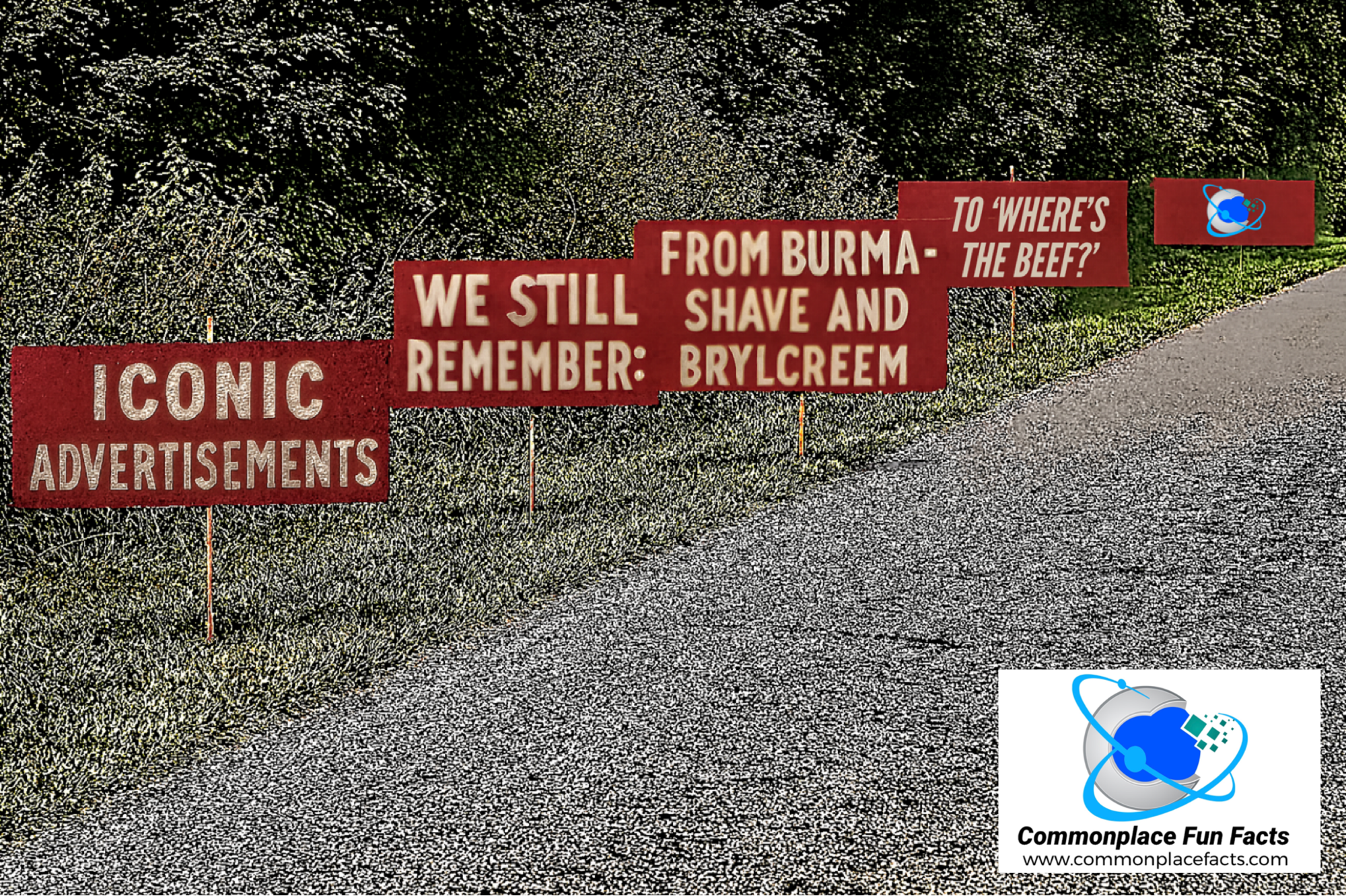

Iconic Advertisements that Tickle Our Memories
Memory is a tricky thing. You can forget the shopping list the moment you step into the cereal aisle and face 187 varieties of corn-based, sugar-fueled breakfast necessities. Your mind blanks the instant you have to punch in your debit card PIN, even though you’ve used the same four digits since they had to be written as Roman numerals. You’re still apologizing for the year you forgot to send flowers on the 11-month anniversary of the first time you let your significant other sip from your soda can without flinching. And yet the moment someone says “Brylcreem,” your brain, in its infinite and slightly judgmental wisdom, automatically supplies the rest: “A little dab’ll do ya.”
We didn’t sign up for this. We simply absorbed enough radio jingles, TV ads, and roadside signs over the years that our minds became storage lockers for stray catchphrases no one remembers choosing to keep.
In the spirit of honoring all the pop-culture clutter our brains refuse to delete, let’s take a wander through some of the most iconic advertising campaigns in American history. Along the way, we’ll run into roadside poets, jingle writers who apparently operated without sleep, and marketing teams who somehow convinced the entire country to yell “Where’s the Beef?” in situations that definitely didn’t call for it. This is memory lane, paved edge-to-edge with slogans.
Contents
The Roadside Poets: When Highways Had Better Literature Than Some Magazines
Before audiobooks, podcasts, or the questionable joy of arguing with your car’s GPS, long-distance drivers passed the time by staring at whatever words happened to be nailed to posts along the highway. And in the 1920s, 30s, and even into the 60s, no one did roadside entertainment quite like Burma-Shave.
Burma-Shave: The Original Highway Haiku
Burma-Shave signs were simple: a series of short rhymes, each placed on a different sign, spaced just far enough apart to give you a rhyme as you sped past.
If driving long
felt dull or grim,
these signs turned roads
to margin whim—
the poets of
the highway brave…
America’s trip
with Burma-Shave.
The signs were cheeky, harmless, and oddly comforting. If poetry could wave at you from the shoulder of Route 66, this is what it would look like.

The charm was undeniable. The signs warned drivers not to speed. They flirted with passengers. They poked fun at themselves. They even managed to slip in public safety messages without sounding like your auntie scolding you, with such gems as:
He’s the boy
the gals forgot
His line was smooth
His chin was not
Burma-Shave
Today the signs are gone, replaced by podcasts, traffic alerts, and the endless temptation to check your phone at red lights. But there was something wonderfully human about those red-and-white rhymes flickering past the window. They didn’t just sell shaving cream. They kept drivers company. They turned dull stretches of highway into a traveling scrapbook of humor, safety tips, and the occasional gentle roast.
Even now, long after the last jingle was taken down, the spirit of Burma-Shave lingers in the rearview mirror of American memory: a reminder that sometimes all it takes to brighten the road is a clever rhyme, a steady rhythm, and a company bold enough to put poetry on a fencepost.
You can peruse more Burma-Shave jingles and learn about the Burma-Shave company here.
Other Iconic Roadside Legends
Burma-Shave may be the undefeated champion, but it had plenty of company.

- South of the Border — The billboards stretch for hundreds of miles, counting down to a South Carolina tourist trap so enthusiastically kitschy it feels like an accidental pilgrimage.
- Wall Drug — Because nothing says “family vacation” like hearing about a pharmacy you’re still 400 miles away from. The advertising campaign for this South Dakota mega tourist trap makes any trip to Mount Rushmore feel incomplete without stopping to ride on the giant jackalope.
- See Rock City — The barn-roof advertisements that blanketed the South more completely than humidity ever could.
- Meramec Caverns — If there was an available barn, bridge, or rock face within two states, Meramec Caverns probably painted their name on it.
These campaigns turned empty stretches of road into treasure hunts. Somewhere between the state lines and the questionable roadside diners, these signs made the journey as memorable as the destination.
The Earworms: Jingles That Set Up Permanent Residence in Our Brains
Jingles aren’t just catchy; they’re the special forces of advertising. A slogan might tap politely on your memory, but a jingle kicks the door in, sets up camp, and starts reorganizing the furniture. Once it moves in, good luck getting it to leave. Years—sometimes decades—later, the melody resurfaces out of nowhere, acting like it’s been patiently waiting in the corner the whole time, just hoping you’d hum it again.
By the way, you might want to bookmark “Earworms: Why Is That Song Stuck In Your Head and What Can You Do About It?” in case any of these jingles need to be served an eviction notice from your mind.
Wildroot Cream Oil: “Wildroot Cream Oil, Charlie!”
Once upon a time, men wanted hair so shiny it could signal aircraft. Enter Wildroot Cream Oil, whose jaunty radio jingle became a mid-century staple. If you listen to enough old broadcasts, you’ll hear it approximately every nine minutes, always sung with the enthusiasm of someone who genuinely believes hair oil is the key to a fulfilling life:
“Get Wildroot Cream Oil, Charlie,
It keeps your hair in trim,
You see, it’s non-alcoholic, Charlie,
It’s made with soothing lanolin,
You better get Wildroot Cream Oil, Charlie,
Start using it today,
You’ll find that you will have a tough time, Charlie,
Keeping all those gals away!”
Wildroot threw itself into radio advertising with the enthusiasm of a golden retriever discovering a tennis ball, sponsoring everything from adventure serials to comedy hours. Before long, Wildroot wasn’t just a grooming product; it was basically an unofficial member of the household, chiming in every time someone turned the dial. And with the constant hints that poor Charlie could barely fend off all the admiring gals, every young man in America suddenly felt inspired to help Charlie out by taking a few of those admirers off his hands by keeping his own hair in trim with the magical elixir.
Other Jingles That Refuse to Leave
Prepare yourself—some of these might trigger a melody you haven’t thought about since your childhood cereal bowl days.
- Oscar Mayer Wiener Song — There was a time when parents encouraged their children to dream big: become captains of industry, brilliant scholars, pillars of society. Then 1962 arrived, and a chorus of cheerful children announced their true ambition — to grow up to be a wiener. And we’d best leave it at that.
- Meow Mix — The purest example of brand honesty ever recorded: “Meow, meow, meow, meow…”
- Nationwide is on your side — You probably sang the last word. Everyone does. It’s practically a reflex at this point.
- Band-Aid: “I am stuck on Band-Aid brand…” — And that, friends, is why half the country still uses the trademark when they mean the bandage.
- Folgers: “The best part of wakin’ up…” — A charming little lie that convinced millions they enjoy mornings more than they actually do.
- Doublemint Twins Jingle — The relentlessly cheerful tune that taught America the surest way to “double your pleasure, double your fun” was apparently to travel everywhere with an identical sibling. Advertising logic at its finest.
- Alka-Seltzer: “Plop plop, fizz fizz…” — Medical relief never sounded so jaunty.
- I’d Like to Buy the World a Coke — Advertising’s attempt at global diplomacy.
It’s remarkable, really. You can forget birthdays, phone numbers, or the very reason you walked into a room, but heaven help you if you try to forget a catchy jingle from 1978.
The Slogans: Tiny Phrases With Outsize Staying Power
If jingles are the musical invaders, slogans are their minimalist cousins—short, sharp, and devastatingly effective. Advertisers discovered long ago that humans are strangely susceptible to four-word sentences.
Brylcreem: “A Little Dab’ll Do Ya”

The Brylcreem slogan, “Just a little dab’ll do ya!” is basically a polite reminder not to slather your head in goo. And it worked. Catchy, cheerful, and just the right amount of bossy, the phrase became a pop-culture line all its own, referenced in movies, radio skits, and the occasional dad joke.
It captured postwar styling sensibilities, too—the era when men groomed themselves with military precision, and women used hairspray with the confidence of structural engineers.
Other Slogans That Have Become Permanent Residents in Our Collective Memory
- “Just Do It” – Nike: A friendly reminder that your shoes are far more confident about your life choices than you are. (Read this article to learn about this slogan’s surprising and disturbing connection to a Death Row inmate.)
- “Got Milk?” – California Milk Processor Board: A reminder that no matter how sophisticated we pretend to be, a milk mustache still counts as marketing.
- “Melts in your mouth, not in your hands” – M&M’s: Which is great, assuming your mouth is less chaotic than your glove compartment.
- “Finger-lickin’ good” – KFC: A slogan that boldly assumes it is not the lunch of choice for sewer workers.
- “Good to the Last Drop” — Maxwell House Coffee: A slogan that had its origins in an endorsement from none other than Theodore Roosevelt, it reminded you not to throw away those last few drops of caffeine goodness.
- “We Try Harder” – Avis: The world’s most polite way of saying, “Look, we know we’re in second place.”
- “How Many Licks Does it Take to Get to the Tootsie Roll Center of a Tootsie Pop?” – Tootsie Pop: The question was asked, but the answer left you strangely suspicious of the science behind the conclusion. Fortunately, the science part is answered here.
- “Don’t Leave Home Without It” – American Express: Credit-card advice delivered with the urgency of a life-saving medical directive.
- “The Quicker Picker Upper” – Bounty: An ode to the universal truth that spills happen exactly when you’re already late.
- “Snap! Crackle! Pop!” – Rice Krispies: Because nothing says breakfast like cereal that might startle you into scrambling for cover and surrendering to the microwave.
- “Breakfast of Champions” – Wheaties: Perfect for anyone who wants to feel like an athlete while eating breakfast while watching TV in their underwear.
- “Trix are for kids!” – Trix: A slogan that insists adults cannot be trusted with brightly colored sugar.
Some slogans are so culturally ingrained you can almost hear the original announcer’s voice when you read them. It’s advertising as shorthand, a kind of linguistic time capsule connecting generations who experienced the same commercials.
Campaigns That Became National Sensations
Every so often, an ad campaign gets lucky—or brilliant—and leaps beyond its intended purpose. These aren’t just commercials. They’re phenomenon-level events, the kind people quote in presidential debates or scribble onto notebook covers during math class.
Wendy’s: “Where’s the Beef?”
In 1984, Wendy’s rolled out its now-legendary “Where’s the Beef?” commercial. Clara Peller, a no-nonsense older woman with both gravitas and impeccable timing, inspected a competitor’s burger bun, found it lacking, and unleashed a question that reverberated across the nation: “Where’s the beef?”
The phrase became a cultural catchphrase, an all-purpose expression of skepticism. It appeared on T-shirts. It appeared in sitcoms. It even popped up in politics, proving that not even the presidential campaign trail is safe from fast-food commentary.
Wendy’s struck marketing gold. For a moment in the mid-80s, that three-word question was as American as baseball, apple pie, and arguing about how to hang the toilet paper roll.
Other Campaigns That Took Over Everything
- Apple’s “1984” — A Super Bowl ad so iconic it practically invented the “must-watch commercial.”
- California Raisins — Claymation fruit performing Motown. The 80s were truly wild.
- Energizer Bunny — The drumming rabbit that just kept going, much like your uncle’s favorite story.
- “I Want My MTV!” — An ad campaign that built an entire broadcasting empire through sheer force of yelling.
- Old Spice “The Man Your Man Could Smell Like” — A masterclass in bizarre confidence, causing women around the world to wonder how their guy ranks on the smell-o-meter.
- Charmin’s “Don’t Squeeze the Charmin” — A plea that, predictably, made everyone want to squeeze the Charmin and incur the wrath of Mr. Whipple.
- GEICO’s rotating cast of mascots — Cavemen, geckos, camels… basically an entire small zoo of insurance ambassadors.
Some of these campaigns succeeded because they were clever. Others succeeded because they were delightfully strange. Either way, they didn’t just advertise a product—they became part of American cultural wallpaper.
Why These Ads Stick: The Strange Magic of Marketing Psychology
Why do certain ads stay with us while others disappear faster than your motivation to assemble Ikea furniture? A few reasons:
- Repetition — If you hear something enough times, your brain adopts it like a stray cat.
- Rhythm and melody — Humans are rhythm-loving creatures. That’s why we tap our toes and why we can’t forget “Plop plop, fizz fizz.”
- Emotional triggers — Humor, nostalgia, joy… if an ad makes us feel something, it sticks.
- Simplicity — A good slogan is as short as the lifespan of a campaign promise and twice as refreshing.
- Shared experience — When everyone knows the same ad, it becomes a miniature cultural handshake.
At the end of the day, advertising is less about selling a product and more about selling a feeling. The best campaigns sell both. The legendary ones make you forget which was which.
Conclusion: Our Minds Are Basically Antique Shops of Old Ads
We live in a world absolutely drowning in information, yet the things that stick with us the longest are somehow the jingles, slogans, and roadside poetry we never actually tried to memorize. They’re the stowaways of the mind, popping up whenever conversation gives them even the faintest crack in the door.
And honestly, that’s part of the fun. These ads—whether they were charming, bizarre, heartfelt, or wonderfully ridiculous—ended up becoming tiny cultural time capsules. They remind us what America used to laugh at, hum along to, or shout at the TV during commercial breaks.
So here’s to Burma-Shave, to Brylcreem, to Wildroot, to Wendy’s, and to every marketing team bold enough to pitch an idea that sounded just strange enough to work. Somehow, their creations became the soundtrack of our road trips, the scenery of our highways, and the slogans our brains absolutely refuse to evict.
Now we’re curious: which of these classic campaigns have permanently moved into your head? Tell us your favorites—we’ll be over here humming a certain hair-product jingle and wondering how, despite all that promised charm, the gals still managed to keep a safe distance.
You may also enjoy…

The $2.5 Million Worst Super Bowl Commercial Ever
What is considered to be the worst Super Bowl commercial of all time? Learn about the Census “Snapshot of America” commercial that holds this dubious honor.

How a President’s Coffee Commentary Produced a Memorable Slogan
There’s nothing like a good cup of coffee — especially a strong, robust cup of coffee. We’re not talking about the kind that is strong enough to make you into a psychopath, but perhaps the kind that will fire you up enough to grab a gun and go hunting for bears. Does that sound intriguing…

The Brilliant Plan to Sell Wallpaper Cleaner to Children
Wallpaper cleaner and children. The only apparent connection between the two is that the more you have of the latter, the more likely you will need the former. With appropriate supervision, you might want to have children help scrub the walls. Aside from that, we generally don’t advocate unfettered access to cleaning materials by those…



Leave a Reply to ScottCancel reply