
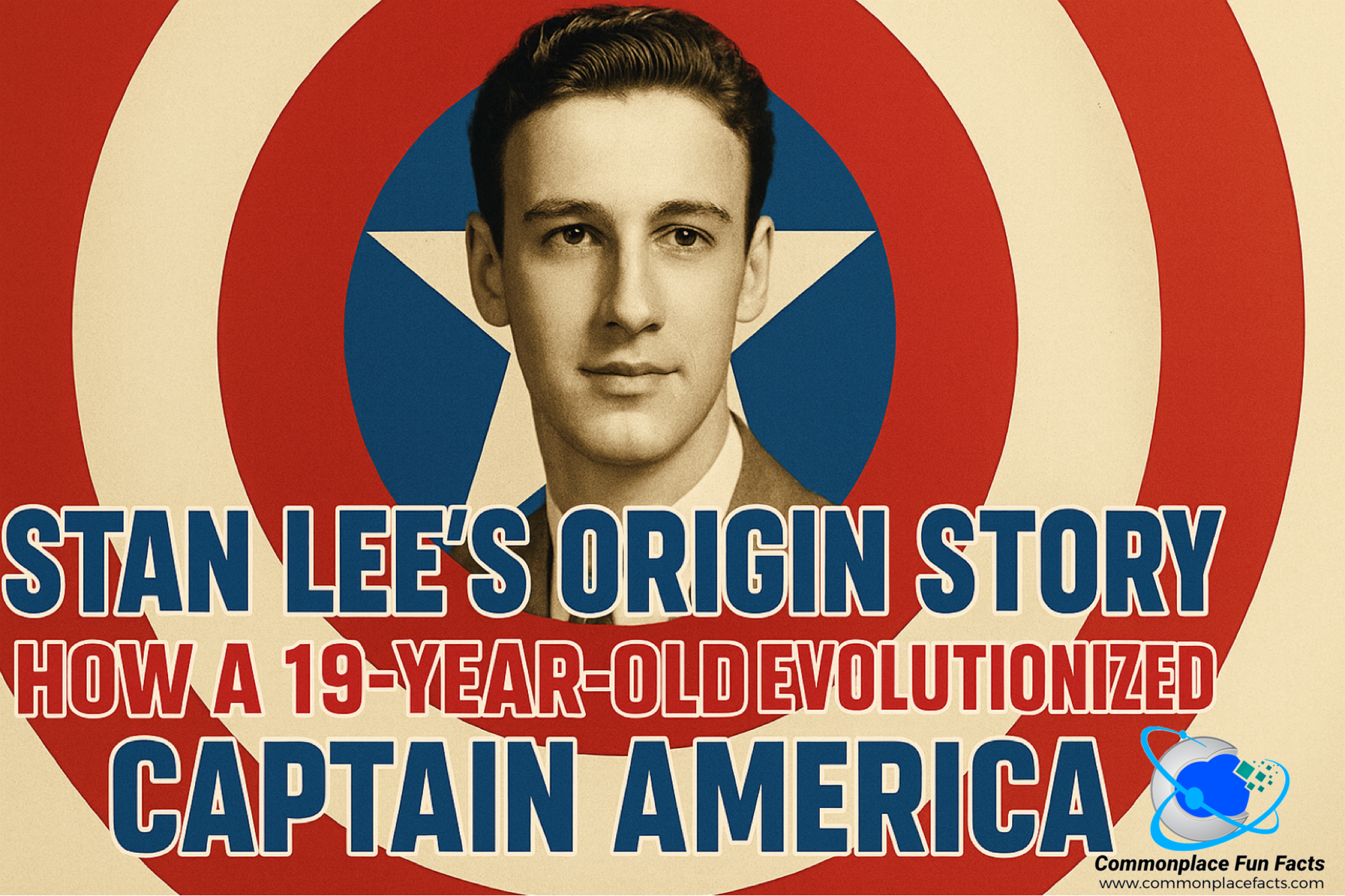

Many people spend their teenage years doing algebra they’ll never use again or discovering the structural engineering limits of a skateboard ramp. Stan Lee, naturally, decided to do something slightly different: help reinvent an entire genre of American storytelling. After all, some kids get acne, and some kids redefine pop culture. Life is unfair like that.
From the very beginning, Stan Lee’s career read like a comic book origin story—minus the radioactive spiders and plus a lot of coffee-stained scripts. He was still a teenager, still signing his work with pseudonyms so his future as a “serious novelist” wouldn’t be ruined by dabbling in comic books (which, in 1940, were considered one step above writing ransom notes). Yet there he was, poking at the machinery of an industry that didn’t expect him to do much more than sharpen pencils and keep quiet.
Naturally, he didn’t keep quiet.
Contents
The Birth of a Hero (and a Teen Writer Who Refused to Behave)

It was 1940: Europe was at war, the United States was pretending it wasn’t, and Americans desperately wanted someone in red, white, and blue to punch evil in the face. Joe Simon and Jack Kirby stepped up and delivered Captain America, a hero so patriotic he could make an eagle stand up and salute.
The first issue, released in December 1940, sold a million copies. Captain America punched Hitler in the face right on the cover, which was bold timing given it came out a full year before America entered the war. It was also a great example of comics doing what comics have always done best: wildly ignoring diplomatic nuance.
Cap’s first shield was triangular, which lasted exactly one issue before it got swapped out for the circular disc fans know today. The official reason was a conflict with a rival character’s shield design. The unofficial reason was that round shields bounce better, and someone clearly foresaw that would be important.
Enter Stan Lee, Teenager With Opinions

By issue #3, Captain America was so popular that Timely Comics (the company that would eventually become Marvel) decided to take a tiny gamble: letting a 19-year-old kid write a text filler piece in the comic. The kid was named Stanley Martin Lieber, although you wouldn’t have known it. He loved using pseudonyms, partly because comics weren’t “respectable,” and partly because Stan just liked pseudonyms. The man collected pen names the way other people collect stamps.
Armed with youthful confidence and the editorial equivalent of “Sure, kid, why not,” Stan wrote a short text piece for Captain America #3 and promptly committed an act of creative rebellion. Up to that moment, Captain America’s shield was just a defensive accessory. Stan looked at it and thought, “This is basically a giant Frisbee with better color separation.” So he wrote Cap using it as a thrown weapon.
That single idea—Cap throwing his shield and having it ricochet back—became one of the most iconic visual signatures in comic book history. This is the comic book equivalent of a summer intern deciding Nike should try a swoosh.
Oh, and the name he signed to that script? It wasn’t Stanley Martin Lieber. It was a pseudonym he’d cooked up earlier: “Stan Lee.”
Stan Lee Goes to War (Sort Of)

Stan didn’t spend the war punching Nazis like Captain America, but he did the next best thing: he joined a U.S. Army unit so exclusive its alumni list reads like Hollywood’s strangest dinner party. Officially, he was part of the Signal Corps Training Film Division. Unofficially, he spent the war writing slogans, posters, manuals, and training films to keep soldiers from doing catastrophically dumb things with military equipment.
Other members of this ultra-rare “Army creatives” unit included:
- Frank Capra – future Oscar-winning director
- Theodore Geisel – better known as Dr. Seuss
- Charles Addams – creator of The Addams Family
Imagine that writer’s room. Stan Lee creating characters with superpowers. Dr. Seuss inventing animals that defy physics. Charles Addams suggesting the training posters needed “more graveyards.” And Frank Capra probably asking whose turn it was to refill the coffee pot.
It was quite possibly the most impressive gathering of creative minds in one place since some of the world’s greatest authors decided to form a cricket team (but that’s a story for another article).
Post-War Comics: Stan Decides Every Hero Needs Problems
When Stan returned to Timely Comics after the war, superheroes were everywhere, but they were all basically the same: flawless, invincible, and deeply unrelatable. Trying to relate to the superheroes of the Golden Age was like being a pimply-faced nerd with thick eyeglasses and trying to put himself in the shoes of the captain of the football team who had all the cheerleaders swooning over him.
Stan wanted something else. He wanted heroes who had:
- Rent due
- Crippling self-doubt
- Bad relationships
- Homework
- The emotional stability of a malfunctioning vending machine
Comic books, in other words, needed some humanity. And oh, did Stan deliver.
The Comic That Was Canceled… Until Stan Made It Immortal
In 1962, Marvel had a problem called Amazing Fantasy. The comic was about to be canceled. When a title is circling the drain, editors traditionally stop taking risks. Stan, being Stan, did the opposite: he used the final issue to introduce a hero that absolutely no one thought would work.
First, the hero was a teenager. Unheard of. Teens could be sidekicks but not leads. (Something about responsibility and bedtime.)
Second, his powers came from a spider—an animal people instinctively despise with a white-hot hatred surpassed only by dinner-time visits from door-to-door timeshare salesmen. As marketing strategies go, it was bold.
Stan insisted anyway. And in Amazing Fantasy #15, the world met Peter Parker: a nerdy kid from Queens who had normal kid problems like bullies, poverty, crushes, and accidentally inventing a genre-defining superhero mythos with his alter-ego: the Amazing Spider-Man.
The issue sold like crazy. The “failed” comic became a legend. The teenager no one thought would make a second appearance became the heart of Marvel Comics’ entire lineup. And Stan Lee—finally using the pseudonym he’d invented back in 1941—became the face of the Marvel Universe.
So Who Was Stanley Martin Lieber?

Stanley Martin Lieber eventually got tired of people recognizing “Stan Lee” instead of his real name. So he did the logical thing and legally changed his name to the pseudonym he’d invented as a teenager because it “sounded punchier.”
This is the comic book equivalent of Clark Kent legally changing his name to Superman because people keep messing up the paperwork.
Today, his influence is everywhere: the Marvel Cinematic Universe, theme parks, video games, and the emotional damage inflicted on audiences every time a beloved character turns to dust.
All because a teenager looked at Captain America’s shield and thought, “What happens if he throws it?”
Excelsior.
You may also enjoy…

How Did the Hindenburg Disaster Nearly Destroy Marvel Comics?
What was the unlikely connection between the Hindenburg disaster and Marvel Comics? Find out in this amazing tale.

The Marvel Mutants Court Case: Mutants Are Not Humans, According to Court
Are Marvel Comics’ mutants human or not? Find out the answer as decided in the the famous Marvel Comics mutants court case.

Unveiling The Golden Bat: The First Superhero?
So, there’s a debate about who holds the title of “World’s First Superhero.” While the Phantom is officially recognized, some argue that the Golden Bat, a Japanese character from 1931, deserves it too. He had powers and a cool backstory, influencing later heroes. Ultimately, it’s up to the readers to decide!




Leave a Reply to Commonplace Fun FactsCancel reply