

History is full of bold ideas. Some of them changed the world. Others merely singed the eyebrows of the people standing too close. And then there are the ideas that sit somewhere between “visionary” and “I can’t believe adults with security clearances suggested this.” Project Orion sits squarely in that final category. For a few shining years during the late 1950s and early 1960s, some of the brightest minds in American engineering seriously proposed building a spaceship powered by the rapid detonation of nuclear bombs. Not metaphorical bombs. Not “bomb” as in “this idea is a bomb.” Actual, literal nuclear devices.
To be fair to those engineers, the logic was beautifully simple: chemical rockets are sluggish and fussy, while nuclear explosions are… energetic. What if we pointed all that enthusiasm in the right direction? Could a series of carefully timed nuclear detonations propel a spacecraft to the outer planets in record time? Could the same principle hurl heavy payloads into orbit, shoot probes toward neighboring stars, or launch extremely unlucky cargo at incredible speeds?
The answer, according to the people behind Project Orion, was a resounding: “Probably! Let’s try it and see what happens.” Because honestly, what’s the worst that could happen?
Contents
The Dream of a Bomb-Powered Spaceship
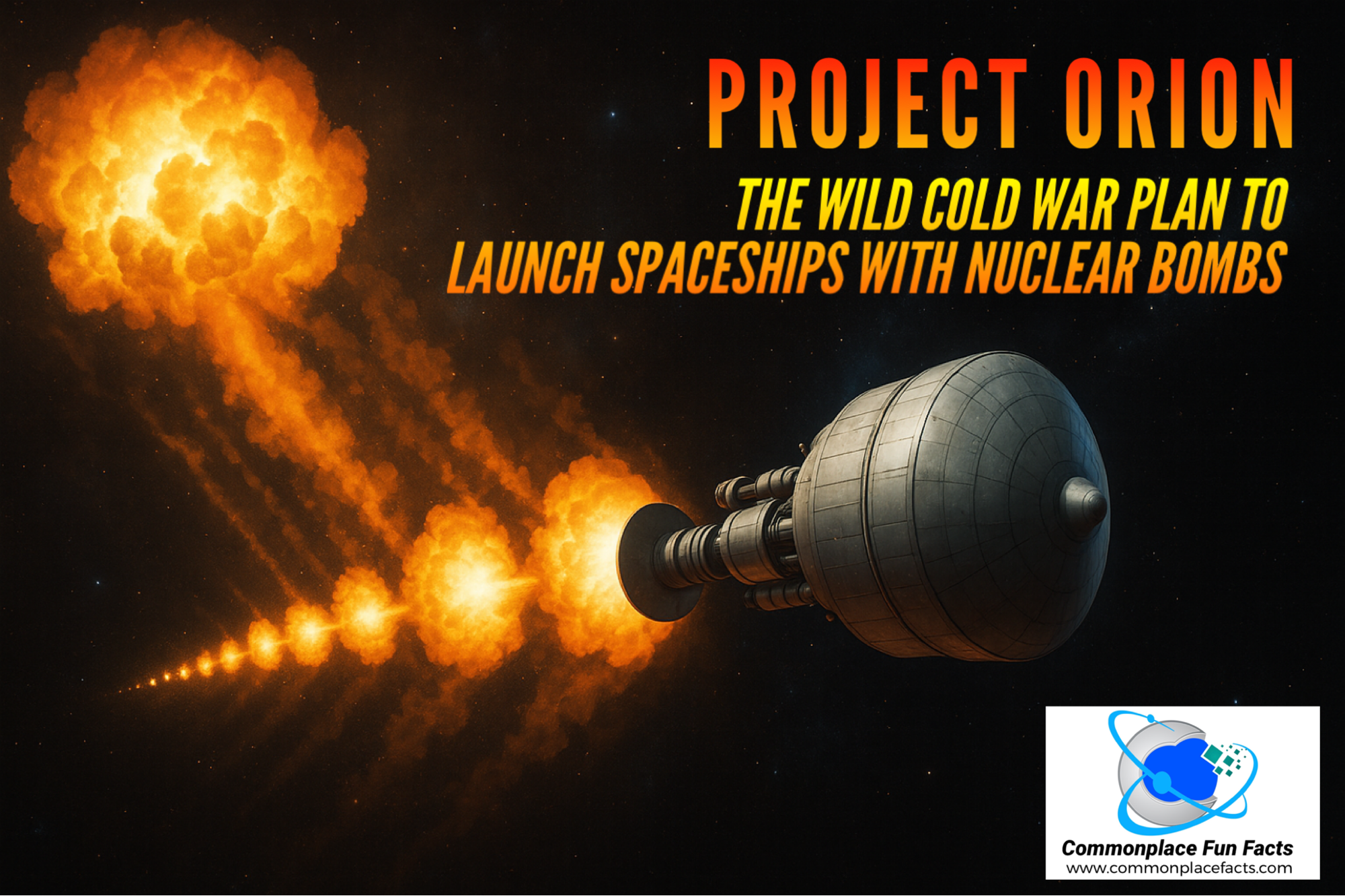
To understand Orion, imagine a spaceship the size of an office building. At one end is a massive steel plate, called the pusher plate. Behind the ship, engineers would toss out small nuclear bombs like cosmic breadcrumbs. Each bomb would detonate a short distance behind the pusher plate, blasting it with a shockwave of superheated plasma. The pusher plate, reinforced to withstand the equivalent of repeated sledgehammer impacts from the universe’s angriest blacksmith, would transfer that impulse to the ship through an intricate system of shock absorbers.

If this sounds like a child describing a rocket after misunderstanding how grenades work, that’s because the concept really does flirt with cartoon-level energy. But the physics were sound. Nuclear explosions release tremendous amounts of energy. Harnessing that energy meant a spacecraft could achieve specific impulse values far beyond the reach of chemical rockets. Instead of creeping toward Mars in seven months, an Orion vessel could theoretically sprint there in a matter of weeks.
Also, unlike most space-age visions of delicate, needle-shaped spacecraft clad in shimmering alloys, Orion vehicles were designed to be thick, rugged, and unapologetically sturdy. They resembled interplanetary battleships, complete with metal hulls thick enough to survive the repeated shock of nuclear detonations. When your propulsion system is “detonate a series of bombs beneath your feet,” you tend to err on the side of overbuilding.
After all, if you can use a nuke to put out a fire, why can’t you use it in the Space Race?
Enter the Pusher Plate: The Business End of Insanity
The heart of the system was the pusher plate, the most hardworking slab of metal ever conceived. This heroic disk needed to do several jobs simultaneously:
- Absorb the shock of thousands of nuclear blasts.
- Not vaporize in the process.
- Not transfer lethal vibrations to the crew compartment.
- Remain intact long enough to get the ship somewhere useful.
Scientists carefully studied whether the plate could survive repeated nuclear abuse. They discovered two things:
- Radiation ablation might be tolerable if you coated the plate with a sacrificial layer.
- There was still a non-zero chance the whole thing would flake apart like a cosmic pastry.
This did not seem to discourage anyone.
Mounted between the plate and the rest of the spacecraft was a system of shock absorbers so elaborate that one team member described it as “a mechanical ballet of controlled violence.” Each explosion would slam the plate backward. The absorbers would catch that motion, smooth it out, and convert it into forward thrust. The crew, ideally, would experience a series of firm but survivable pushes—sort of like riding an elevator that has very strong opinions about acceleration.
We can’t help but suspect that calling those nuclear-powered jolts “firm but survivable” is the aerospace equivalent of a dentist breezily assuring you, “You’ll feel a little pressure,” moments before lighting up every nerve ending above your shoulders like a Christmas display gone feral.
The Pulse Units: Little Bombs With Big Dreams
The nuclear devices themselves, charmingly called “pulse units,” were small, precisely engineered explosives containing fissionable material designed to detonate at predictable distances. Some versions included a tungsten propellant disk to produce a shaped plasma jet. After all, if you’re going to throw nuclear bombs out the back of your spaceship, you might as well do it stylishly.
Each pulse would add another jolt of acceleration. Thousands of pulses could build a velocity unimaginable to chemical rockets. Orion wasn’t just a way to escape Earth’s gravity. It was a way to skip across the solar system like a stone across a pond.
Project Orion Goes to the Proving Ground

Before anyone could pitch a nuclear-powered starship with a straight face, the Orion team had to prove their big idea wasn’t just Cold War daydreaming dressed in lab coats. That meant testing whether a spacecraft could actually survive being shoved repeatedly by violent blasts. In 1959, engineers built a one-meter fiberglass model—nicknamed “Hot Rod,” because “Irradiated Death Vehicle” probably wouldn’t look as good on T-shirts—and rolled it out to the U.S. Navy’s test range at Point Loma in San Diego. The plan was simple: set off a series of non-nuclear explosives behind the vehicle and see if it behaved like a spacecraft or like modern art with smoke.
The little craft was fitted with a steel pusher plate and a shock-absorber system meant to smooth out the hammering from each blast. When the engineers detonated the charges in rapid succession, Hot Rod didn’t flip, disintegrate, or burst into flames. Instead, it rose cleanly off the ground, riding each explosion like a very confused elevator. In its best-known test, the vehicle shot upward roughly 56 meters before deploying its parachute and drifting gently back to Earth, smugly intact. For a machine being smacked by explosives, it performed alarmingly well. It even did better than the Ford Pinto that someone, for reasons known only to the universe, was equipped with wings to fly.
These tests gave the Project Orion team something they desperately needed: evidence that pulsed propulsion wasn’t just theoretically possible but mechanically viable. The pusher plate survived. The shock absorbers worked. The overall flight was stable enough to make even skeptical observers mutter, “All right, fine, maybe it can work.” Today, the original test vehicle lives a peaceful, non-explosive retirement at the Smithsonian’s National Air and Space Museum as the Propulsion Test Vehicle, Project Orion, where visitors can admire the only spacecraft in history to earn its wings by surviving repeated blasts to the backside.
The Nuclear Pulse Vehicle Study: Orion’s Expanding Family
Project Orion did not exist alone. Once the basic idea was on the table—using external nuclear detonations to push things—people began thinking about which other things could be pushed this way. The Nuclear Pulse Vehicle Study (available here) examined multiple designs for nuclear-pulse-propelled craft, from interplanetary transports to heavy-lift launch systems that could loft cargo to orbit with an efficiency that makes today’s rockets look like flying antiques.
Other papers went even further. One elegant little report titled On a Method of Propulsion of Projectiles by Means of External Nuclear Explosions (available here) explored how nuclear blasts could propel objects without even using a pusher plate. These ideas ranged from the practical to the questionably sane. If you’ve ever wondered whether anyone seriously contemplated firing payloads into space using nuclear explosions like a cosmic potato gun, the answer is yes. They absolutely did. That’s the sort of technology that might have been responsible for a manhole cover becoming the first man-made object in space.
Some ideas looked suspiciously like the plot of a post-apocalyptic sci-fi movie. Others seemed surprisingly reasonable. If your goal was to launch extremely heavy payloads without using chemical fuel, a nuclear blast does have certain attractive qualities. The blast is powerful. The blast is free once you’ve purchased the warhead. And the blast does not require you to carry oxidizer or propellant on the vehicle itself. It’s hard to argue with efficiency, even when the side effects include “radioactive dust” and “global atmospheric radioactive contamination.”
The Strengths: When Nuclear Propulsion Actually Makes Sense
As hilarious as the concept may seem in retrospect, Orion had some impressive strengths. Nuclear pulse propulsion could theoretically offer:

- Specific impulse orders of magnitude higher than chemical rockets.
- Massive thrust, sufficient to move extremely heavy spacecraft.
- Interplanetary travel times dramatically shorter than current missions.
- Potential interstellar precursor missions based on known physics.
- Construction using 1960s technology, not exotic future materials.
It was one of the few propulsion concepts capable of getting humans not just to Mars, but to Saturn, Uranus, Neptune, and beyond within realistic timeframes. Imagine a world where humanity built spacecraft large enough to host entire laboratories, workshops, or even (in some designs) gardens and lounges. Orion was less a “capsule” and more a mobile habitat. A nuclear-powered Winnebago for the solar system.
The Problems: Everything Else
Unfortunately, Orion also came with a few problems. Minor things, really. Just the sort of issues that tend to end careers, ignite protests, and generally prevent nuclear-powered megaships from leaving the launchpad.
Environmental Fallout
Let’s get the obvious issue out of the way: detonating dozens of nuclear bombs per minute in the Earth’s atmosphere tends to upset the local environment. And by “local,” we mean “the entire planet.” The fallout from Orion-style launches would have been substantial. Even the most enthusiastic advocates conceded that launching from the ground was not the best idea. Early designs involved exploding the first set of nuclear devices just a few hundred feet above the surface. In the 1950s, this was considered bold. Today it would be considered a war crime.
In 1963, the Partial Test Ban Treaty prohibited atmospheric nuclear tests. While the treaty didn’t explicitly ban hurling a spaceship into orbit via synchronized nuclear kabooms, the message was clear enough. Orion was politely asked to take its glowing ambitions elsewhere.
Engineering Uncertainties
Even if environmental concerns magically resolved themselves, engineers still had unanswered questions. The pusher plate might survive the blasts… or it might gradually melt, crack, blister, flake, and disintegrate. Repeated nuclear hammering is not gentle on materials. While early tests suggested survivability was possible, no one could say with certainty that a full mission would not end with the plate shedding pieces like a nervous man with dandruff.
The shock absorber system also posed challenges. It needed to transform violent impulses into manageable acceleration. Too much force, and the crew becomes smears on the bulkhead. Too little, and the ship becomes a very expensive maraca.
Political Will (or the Lack Thereof)
NASA was never enthusiastic about Orion. The agency’s aesthetic leaned more elegant: slender rockets, clean lines, and propulsion systems that did not require atomic detonations. The U.S. military was interested for a time, but even they began to doubt the wisdom of “using nuclear bombs as a means of personal transportation.” And as environmental and public health concerns mounted, political enthusiasm evaporated faster than tritium in a vacuum.
By the mid-1960s, Orion had become the sort of idea people whispered about fondly in conference rooms but never said too loudly in front of Congress.
The Undead Future of Nuclear Pulse Propulsion
Here’s the surprising part: Orion never truly died. It merely went dormant, like a radioactive seed waiting for the right political climate to sprout again. Over the decades, various engineers and theorists have reexamined the concept. Some argue that with modern materials, better simulations, and careful attention to radiation, a sanitized version of Orion could be built in space—far away from oceans, forests, and easily startled neighbors.
Other descendants include proposals for “mini-pulse” nuclear systems using photofission triggered by high-powered lasers. These would produce smaller, cleaner pulses rather than the burger-sized nuclear devices envisioned in 1960. While still complicated (and still very nuclear), such ideas demonstrate that the fundamental physics behind Orion remain enticing.
An Alternate Timeline: The Orion Age of Space Travel
It’s hard not to wonder what might have happened if Project Orion had launched before the Test Ban Treaty. Imagine an alternate 1970s where humanity built not delicate capsules but massive steel starships. In that world, the solar system would have been dotted with giant nuclear-powered cruisers. Space tourism would involve signing liability waivers thicker than your wrist. Astronauts would wear ear protection as standard equipment. And every launch would have been the sort of event best watched from a safe distance behind a reinforced bunker.
In that timeline, movies would depict Orion ships as majestic symbols of human ambition rather than historical footnotes that make environmental regulators twitch. The phrase “nuclear propulsion” might even inspire awe rather than a collective groan.
Conclusion: The Idea Too Bold to Live, Too Interesting to Die
Project Orion remains one of the most audacious, ridiculous, visionary, and scientifically fascinating ideas ever pursued. It combined genuine engineering brilliance with a breathtaking disregard for environmental consequences. It offered a path to the stars powered by enormous optimism and even more enormous explosions.
And the wildest part? It might actually have worked. With enough steel, enough engineering ingenuity, and enough earplugs, humanity really could have built a nuclear pulse spacecraft in the early 1960s. Whether that would have been wise is another matter entirely. Orion teaches us that ambition is admirable, but sometimes it’s good to pause before throwing nuclear bombs out the back of your spaceship.
Still, there’s something irresistibly compelling about a propulsion system that treats nuclear detonations not as existential threats but as stepping-stones to the cosmos. Somewhere, in the files of forgotten Cold War dreams, Orion still hums faintly with possibility. It may never fly—but it will also never entirely disappear.
You may also enjoy…

Using a Nuke to Put Out a Fire
Since the dawn of the nuclear age, much of the diplomatic and military strategies of nations have centered around preventing the world from going up in flames in a nuclear holocaust. Some scientists have suggested that nuclear weapons could be put to better use than reducing civilization to ashes. In fact, these fearsome weapons could…

First Man-Made Object in Space: Was it a Manhole Cover?
Was a manhole cover the first man-made object in space? Find out the surprising answer here.

Project Sundial: The Doomsday Bomb That Could Have Wiped Out Humanity
Discover the chilling story of Project Sundial, a 1950s U.S. plan to build a nuclear bomb so powerful it could destroy humanity. Learn why it never happened and its lasting legacy on global security.






Leave a Reply to cat9984Cancel reply